

 Home
Home Chiang Mai(


























Rating: 2.8/5 (9 votes)
 |
|  Map
Map 
 Have Map
  No Map
Ratchaburi attractions
Attractions in Thailand
Open Days: Every day
Opening Hours: Monday–Friday 08.00–17.00 / Saturday–Sunday 08.00–18.00
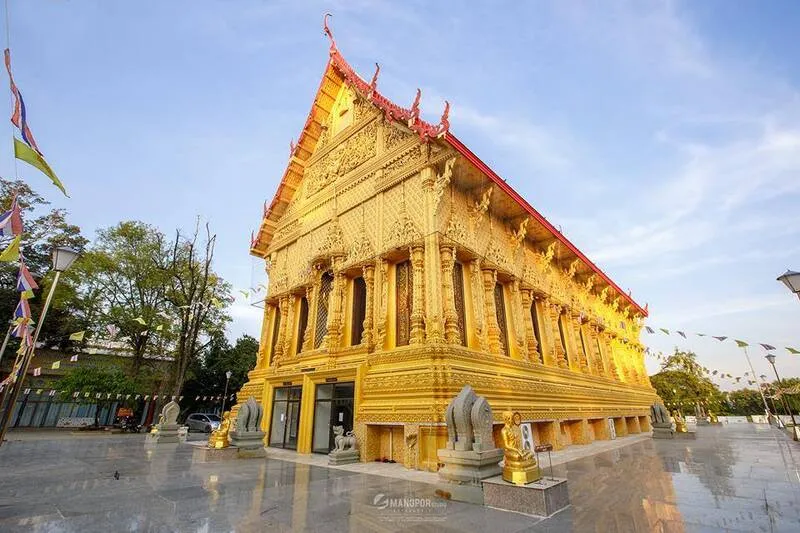
Wat Phra Si Arn, widely known among travelers as the “Hundred Million Baht Ubosot,” is an important temple in Photharam District, Ratchaburi Province. It stands out for its intricately decorated golden ordination hall, which took as long as 37 years to complete. The temple’s appeal lies not only in the beauty of its stucco craftsmanship and interior murals, but also in its history that traces back to the late Ayutthaya period, its revered principal sacred Buddha images, its old historic ordination hall, and the story of Luang Pho Khan, whose faith became a major spiritual force for the local community.
Wat Phra Si Arn (The Hundred Million Baht Ubosot) is one of the temples that has made the name of Photharam District, Ratchaburi Province, stand out clearly among pilgrims and admirers of Thai religious art. The moment visitors arrive, the first sight before them is the brilliant golden ubosot rising prominently in the middle of the temple grounds. Standing close to it brings not only admiration for the sheer scale of the structure, but also a deep sense of the faith of the local community that joined together to turn such a grand work into reality. This temple is therefore not merely a beautiful photo stop in Ratchaburi, but a place where history, religion, art, and the memories of local people come together in one complete setting.
The distinctive quality of Wat Phra Si Arn lies in its sense of magnificence. Yet the magnificence here is not superficial luxury. Rather, it reflects the refinement of traditional craftsmanship and the continuity of faith gradually built up over time. The golden hundred-million-baht ubosot is a work that took 37 years to complete, so it was never an architectural project rushed into existence. Instead, it grew alongside the community, passing through both smooth periods and difficult interruptions until it finally became a defining landmark of the temple and a memorable symbol for many visitors to Ratchaburi today.
From a historical perspective, Wat Phra Si Arn is older than many people might assume. The temple was originally called “Wat Sa-an” and is believed to have been founded during the late Ayutthaya period, around 1732. In its early phase, it was an abandoned temple without resident monks. Within the grounds stood a small old brick ordination hall, built in the Maha Utt style with only one entrance, along with an ancient pond to the north, which local people regarded as a sacred well that had long been associated with the temple. In those earlier days, the temple would have appeared as a quiet old monastery surrounded by shade and large trees, rather than the prominent tourist destination it has become today.
Later, around 1932, monks began residing at the temple continuously once again, and in 1957 the name was changed from Wat Sa-an to “Wat Phra Si Arn.” The new name reflects the temple’s close connection with Phra Si Arn, the temple’s revered Buddha image that had long been deeply respected by local people. This faith became the central force in the development of the temple in later years and is one of the key reasons why Wat Phra Si Arn possesses a distinctive spiritual identity beyond that of a typical beautiful temple. Here, visitors encounter stories of sacred Buddha images, the history of former abbots, and traces of earlier architecture that still connect the past with the present in a remarkably seamless way.
The story that brought Wat Phra Si Arn widespread recognition is the construction of its hundred-million-baht golden ubosot. This project began in 1967 under Phra Khru Siriphatthanakit, or Luang Pho Khan Kantatharo, the former abbot who played the leading role in initiating it. The primary aim was to create a proper sacred space for the performance of monastic ceremonies and at the same time leave behind a beautiful artistic legacy for the temple. The ubosot received its royal boundary marker in that same year. Structurally, it is a large reinforced-concrete building, but what makes it more valuable than an ordinary religious structure is the fact that it was designed without relying on a ready-made blueprint. It was instead a creation born from the specific vision and determination of its initiators and the local craftsmen of the community.
One of the details that makes this ubosot even more remarkable is that it was built in an era when construction technology was not as advanced as it is today. There are accounts that, in the early stage, the builders did not use driven piles as in modern construction, but instead filled the ground with stone and poured beams to support the structure. The craftsmen responsible for the work were local people, while much of the labor came from villagers giving their time outside of their regular occupations. This means the ubosot was not the work of a single contractor, but truly a project of the entire community. Although construction was interrupted at times, especially after the passing of Luang Pho Khan, later generations continued the work until it gradually reached completion in the era of Phra Khru Withit Phatthanasophon, the current abbot.
In terms of artistic value, the hundred-million-baht golden ubosot of Wat Phra Si Arn is especially charming because it preserves the spirit of Thai craftsmanship with a distinctly local character. The exterior stucco motifs were created specifically for this temple and were not made from ready-made molds, giving the building a unique identity of its own. Walking around the structure, visitors can appreciate the consistency of the golden tone that covers the walls, columns, gables, and decorative elements, allowing the ubosot to stand out even from a distance. Yet the closer one looks, the more apparent it becomes that the true beauty lies in the smallest details of the plasterwork and ornamental decoration, each executed with great care.
The interior of the ubosot is no less valuable than the exterior. Some of the doors and windows are decorated with gilded lacquer and carvings depicting Buddhist themes with remarkable delicacy. The walls are adorned with murals narrating the story of Phra Mahachanok and the Five Buddhas, adding an educational and artistic dimension to the visit. As a result, exploring the ubosot is not limited to photographing a golden building. It also becomes an experience of slowly reading artistic details through observation. For those interested in Thai temple architecture, Wat Phra Si Arn offers an excellent example of how faith, local craftsmanship, and the creation of a new iconic temple image can blend together in the modern era.
Within the temple grounds are also several important Buddha images that continue to draw devotees. One of the most significant is “Phra Si Arn,” the temple’s principal revered image, known for its distinctive appearance. It is depicted with a ceremonial fan placed before the image, while the robe falls in folds reminiscent of Gandhara-style Buddhist art. The original Phra Si Arn has long been regarded as a sacred Buddha image worshipped by the local community. Another image was later invited from Wat Thammasala in Nakhon Pathom Province. The faith and devotion associated with Phra Si Arn are precisely what give the temple its distinctive identity and make its story deeper than that of a merely picturesque temple.
Another major highlight is the principal Buddha image inside the ubosot, a Mara-Vijaya posture image in Burmese art style carved entirely from white jade. The beauty of this main image creates an atmosphere of calm and quiet dignity inside the hall, in contrast with the striking golden brilliance of the exterior. Many visitors therefore choose to spend time sitting quietly and paying respect before continuing to explore the rest of the temple. The presence of both the ancient revered temple Buddha image and the elegant white jade principal Buddha gives Wat Phra Si Arn a complete richness in both artistic and spiritual dimensions.
In addition, the temple houses the preserved body of Luang Pho Khan, enshrined in a glass coffin, which is another point where devotees often stop to pay their respects. Luang Pho Khan was not only a former abbot in title, but also the key figure who drove the construction of the golden ubosot and left behind a clear legacy of determination at the temple. A visit to Wat Phra Si Arn is therefore not simply an opportunity to admire architecture, but also a chance to encounter the life story of a monk whose role was of great importance to both the local community and the development of the temple itself.
If time allows, visitors should also stop by the old ordination hall, because this area helps reveal the temple’s transition from its earlier era to the present one in a very clear way. The old Maha Utt ordination hall serves as evidence that the story of the temple has remained unbroken. Nearby is the sacred well, long respected by the community, adding further layers of historical and spiritual meaning to the atmosphere. Anyone interested in old temples or in the transformation of Thai communities from the past into the present will easily sense that this place holds strong narrative value.
Another aspect that should not be overlooked is the role of Wat Phra Si Arn in the local community. The temple does not function only as a place for religious ceremonies, but has also played a part in youth development through its Buddhist training camp for young people. It was also once a learning site for traditional Thai kite-making with local wisdom masters. This reflects the image of a Thai temple that remains deeply connected to everyday community life. The importance of Wat Phra Si Arn therefore lies not only in its buildings, but also in its function as a place where religion, knowledge, and local relationships are continuously passed on.
For travelers who want to fully enjoy the atmosphere, the best time to visit is in the morning or late afternoon, when the light brings out the golden surface of the ubosot particularly well and the weather is not too hot for walking around comfortably. Visitors should dress modestly in keeping with temple etiquette, and anyone entering the ubosot to pay respect should remain quiet, composed, and avoid loud behavior. The temple grounds include the front courtyard of the golden ubosot, the main building area, the old ordination hall zone, and other devotional spaces, making the site ideal for an unhurried walk rather than a rushed stop.
Travelers interested in cultural tourism can easily include Wat Phra Si Arn as part of a wider trip around the Photharam area, because there are several worthwhile attractions nearby, including Wat Khongkharam, Photharam Fresh Market, Photharam Dragon, and the Siam Cultural Park Wax Museum. Planning either a half-day or full-day itinerary is therefore quite simple. One practical approach is to begin with making merit and admiring the golden ubosot in the morning, then continue on to the old market area and some of Photharam’s well-known eateries later in the day. In this way, a visit to Wat Phra Si Arn becomes more than just a short stop, but part of a travel route rich in local stories and the character of Photharam itself.
Getting There If traveling by private car, take the route toward Photharam District via Highway 3080. Near Bang Phae Intersection, continue for about 500 meters and you will see the sign for the temple entrance on the right-hand side. From there, drive another roughly 500 meters to reach the temple grounds. The temple is located at 139 Moo 9, Ban Lueak Subdistrict, Photharam District, Ratchaburi Province. Those using public transportation can take a vehicle into Photharam Market and then continue by local transport or walk toward the temple following the entrance sign. The journey is convenient and not far from the district center, making Wat Phra Si Arn suitable both for those coming specifically to make merit and for those including it as one stop on a wider Photharam trip.
Overall, Wat Phra Si Arn is one of the most complete religious and cultural attractions in Ratchaburi. It offers a long history dating back to the late Ayutthaya period, the story of the former abbot who initiated the golden ubosot project, important Buddha images and sacred objects respected by the local people, and architectural beauty that clearly distinguishes it from more ordinary temples. For anyone seeking a destination that offers serenity, beauty, and historical knowledge all at once, Wat Phra Si Arn is a highly worthwhile place to visit in Photharam District and a temple that should not be overlooked when traveling in Ratchaburi.
| Name | Wat Phra Si Arn (The Hundred Million Baht Ubosot) |
| Location | 139 Moo 9, Sukhaphiban 8 Soi, Ban Lueak Subdistrict, Photharam District, Ratchaburi 70120 |
| Address | Ban Lueak Subdistrict, Photharam District, Ratchaburi Province, near Bang Phae Intersection |
| Place Summary | A historic temple in Photharam known for its hundred-million-baht golden ubosot, serving as a place of worship, an important artistic landmark, and a cultural attraction in Ratchaburi. |
| Main Highlights | A hundred-million-baht golden ubosot built over 37 years, unique stucco motifs, murals of Phra Mahachanok, Phra Si Arn as the temple’s sacred Buddha image, a white jade principal Buddha in Burmese style, the preserved body of Luang Pho Khan in a glass coffin, the old ordination hall, and a sacred well. |
| Period / Era | Originally founded in the late Ayutthaya period, around 1732, and continuously developed throughout the Rattanakosin era. |
| History | Originally called Wat Sa-an, it was once abandoned before monks began residing there again. In 1957 it was renamed Wat Phra Si Arn. The golden ubosot project began in 1967 under Luang Pho Khan and took 37 years to complete. |
| Name Origin | The temple’s name is connected with “Phra Si Arn,” the sacred Buddha image long revered by local people. |
| Current Abbot / Temple Administration | Phra Khru Withit Phatthanasophon, Abbot of Wat Phra Si Arn Assistant Abbot: Phra Maha Sombun Jantachoto Assistant Abbot: Phra Ajarn Charoen Sumchano |
| Open Days | Every day |
| Opening Hours | Monday–Friday 08.00–17.00 Saturday–Sunday 08.00–18.00 |
| Zones | 1. Front Courtyard Of The Golden Ubosot 2. Interior Of The Ubosot And White Jade Principal Buddha 3. Phra Si Arn Sacred Buddha Image Zone 4. Glass Coffin Of Luang Pho Khan 5. Old Maha Utt Ordination Hall Zone 6. Sacred Well And Surrounding Temple Grounds |
| Getting There | By private car, take Highway 3080 toward Photharam District. About 500 meters after Bang Phae Intersection, you will see the temple entrance sign on the right. Continue for another approximately 500 meters from the sign. By public transport, travel into Photharam Market, then continue by local transport or on foot toward the temple following the entrance sign. |
| Current Status | Open to visitors and worshippers according to the opening days and times announced through the temple’s official channels. |
| Nearby Tourist Attractions With Distance | 1. Chao Mae Lim Ko Niao Shrine, Ratchaburi – Approx. 0.8 km 2. Siam Wax Museum – Approx. 1.5 km 3. Wat Khongkharam – Approx. 4.5 km 4. Wat Sai Ari Rak – Approx. 4.7 km 5. Photharam Fresh Market – Approx. 5 km 6. Photharam Dragon – Approx. 4.9 km |
| Popular Restaurants Nearby With Distance | 1. Khrua Khun Sa, Bang Phae – Approx. 0.4 km 2. Moo Satay Mae Phimpha, Photharam Branch – Approx. 0.3 km 3. Nong Yui Moo Kratha Phochana – Near Wat Phra Si Arn 4. Je Cheng Moo Satay, Photharam – Approx. 4.9 km 5. Yazashi Japanese Restaurant – Approx. 4.6 km 6. Ban Dol – Approx. 4.8 km 7. Khao Tom 200 Pi – In The Photharam Area |
| Nearby Accommodations With Distance | 1. Wicket White Villa – Approx. 4 km 2. Photharam 126 Resort – Approx. 4.5 km 3. Katom Satu Garden Cottage – Approx. 4.7 km 4. Ban Rao Eng Photharam Villa – Approx. 7.2 km 5. Ping-Pe-La Photharam – Approx. 7.6 km 6. Ingthara Camp Resort, Riverside Photharam – Approx. 7.6 km 7. The Antique Riverside Resort & Café – Approx. 7.9 km 8. The Way Hotel Banpong – Approx. 10 km |
| Contact Numbers | Wat Phra Si Arn / Phra Khru Withit Phatthanasophon: 063-221-8589 Phra Maha Sombun Jantachoto: 092-658-9364 Phra Ajarn Charoen Sumchano: 064-934-2959 Wicket White Villa: 081-428-7896 The Way Hotel Banpong: 081-385-8999 The Antique Riverside Resort & Café: 095-230-8133, 032-297-298 Nong Yui Moo Kratha Phochana: 081-852-0219 Je Cheng Moo Satay, Photharam: 089-451-5414, 080-558-6740 Khao Tom 200 Pi: 089-504-1166 |
Frequently Asked Questions (FAQ)
Q: Where is Wat Phra Si Arn located?
A: Wat Phra Si Arn is located in Ban Lueak Subdistrict, Photharam District, Ratchaburi Province, near Bang Phae Intersection. It is convenient to reach by both private car and public transportation.
Q: What time is Wat Phra Si Arn open?
A: Currently, the temple is open from 08.00 to 17.00 on Monday to Friday, and from 08.00 to 18.00 on Saturday and Sunday.
Q: Why is Wat Phra Si Arn called the Hundred Million Baht Ubosot?
A: It is called that because the temple’s golden ubosot is valued at around one hundred million baht and took as long as 37 years to complete, making the name both memorable and widely recognized.
Q: What are the highlights inside Wat Phra Si Arn?
A: The major highlights include the golden ubosot, unique stucco motifs, mural paintings, Phra Si Arn as the temple’s sacred Buddha image, the white jade principal Buddha in Burmese style, the preserved body of Luang Pho Khan in a glass coffin, the old ordination hall, and the sacred well.
Q: What is the history of Wat Phra Si Arn?
A: The temple was originally called Wat Sa-an and dates back to the late Ayutthaya period. It was later renamed Wat Phra Si Arn in 1957 and went on to become one of the important temples of Photharam.
Q: When is the best time to visit Wat Phra Si Arn?
A: If you want to enjoy the beauty of the golden ubosot and walk around comfortably, the best time is in the morning or late afternoon, when the light is beautiful and the weather is not too hot.
Q: Who is the current abbot of Wat Phra Si Arn?
A: The current abbot is Phra Khru Withit Phatthanasophon, who has continued the temple’s development after the era of Luang Pho Khan.
 Wat Phra Si Arn Map
 Category:
  Group:
  Last Update: 12 HourAgo
Comment
 Nearby Attractions
| Keyword (Advance) |
 Facebook Fanpage
 Region
 Art, Culture and Heritage
 Historical Sites and Monuments(
 Landmarks and Memorials(
 Art, Craft Centres, Tradition(
 Museums(
 Art Gallery(
 Educational Places
 Educational Gardens, Farm(
 University
 Other religious and spiritural sites(
 Research and Development
 Royal Project(
 Suburban Living
 Village, Community(
 Local Market(
 Floating Market(
 Nature and Wildlife
 National Parks and Marine Reserves(
 Mountain (Doi)(
 Dam, Reservoir, Lake(
 Waterfalls(
 Hot Springs(
 Caves(
 Flower Field(
 River, Canal(
 Other natural attractions(
 Entertainment and Agricultural
 Zoos and Aquariums(
 Animal camps and shows(
 Farm, Parks, Gardens and Ecotourism(
 Waterpark(
 Outdoor and Adventure Activities(
 Shopping
 Shopping and Night Market(
 Spas and Wellness
 Spas and Wellness(
 Travel Articles, Recipes
 Travel Review, Food Review(