

 Home
Home Chiang Mai(























Rating: 5/5 (1 votes)
 |
|  Map
Map 
 Have Map
  No Map
Ratchaburi attractions
Attractions in Thailand
Open Days: Held annually during the tenth lunar month according to local tradition
Opening Hours: Rituals take place from early morning – late morning on the merit-making day
The Bun Khao Sak tradition, known among the Thai Lao Wiang people as “Sarat Lao,” is one of the most important traditions of the Thai Lao Wiang community in Ban Sing Subdistrict, Photharam District, Ratchaburi Province. It reflects a way of life, beliefs, and faith deeply connected to Buddhism, nature, and ancestral spirits. This tradition is rooted in an agricultural society in which rice farming was the main occupation. The villagers believe that abundant harvests come from the benevolence of the sky deities, the earth, and the spirits of their ancestors who protect the land and their cultivation.
Each year, when the tenth lunar month arrives, which falls after the rice harvest season, the Thai Lao Wiang community comes together to hold the Bun Khao Sak ceremony. It is performed to express gratitude to ancestors and sacred beings believed to protect the community. The ritual also serves as an act of transferring merit to the deceased and of praying for prosperity and abundance in the next planting season.
The Thai Lao Wiang community in Ban Sing Subdistrict has a long history. Their ancestors were Lao Wiang people who migrated and settled in central Thailand during the early Rattanakosin period. They brought with them their language, culture, traditions, and beliefs, passing them down in this new settlement. As a result, the community has preserved its distinct cultural identity clearly, even after many generations.
One of the traditions that most clearly reflects the community’s identity is “Bun Khao Sak.” While it shares similarities with other Sart festivals found in different parts of Thailand, it has its own ritual details and cultural meaning unique to the Lao Wiang people. The term “Khao Sak” refers to food and rice offerings gathered together for merit-making and dedication to ancestors, while “Sarat Lao” is the traditional Lao Wiang name passed down from earlier generations.
About 2–3 days before the merit-making day, villagers begin preparing by gathering to make the sweets used in the ceremony. One of the most important activities is stirring popped rice, which is a key step in making Khanom Phaya Sart, or the Lao Wiang-style Krayasart sweet. This is usually done in large groups, using jars, earthen containers, or baskets to mix the ingredients. The atmosphere is filled with enjoyment, cooperation, and community spirit.
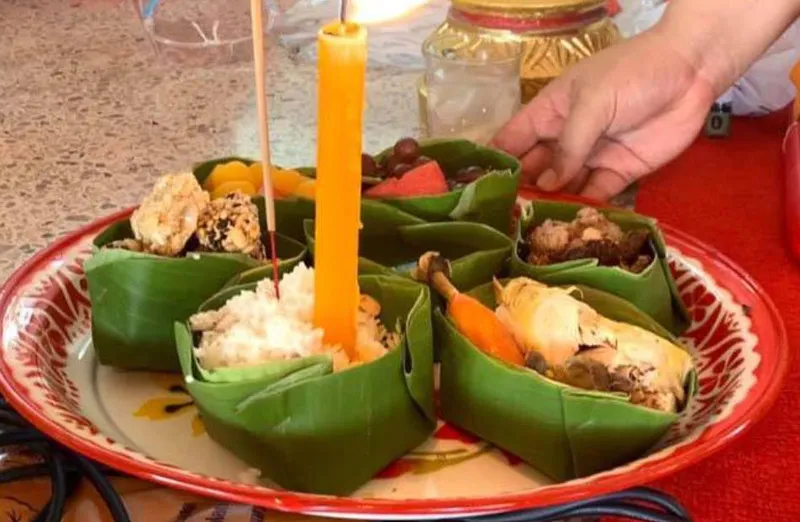
Khanom Phaya Sart is one of the most important ritual foods in Bun Khao Sak. Its main ingredients come from the villagers’ own agricultural produce, including popped rice, puffed rice, sesame seeds, peanuts, sugarcane sugar, and palm sugar. These ingredients are mixed together to create a sweet with a fragrant aroma and a chewy texture. This sweet is not only prepared for merit-making, but also symbolizes the richness and abundance of the land’s produce.
On the merit-making day, villagers prepare food, sweets, and Khao Sak offerings to bring to the temple. In the past, rice and sweets were traditionally wrapped in banana leaves, but today other containers such as tiffin carriers, trays, or baskets may also be used. Offering these foods to monks and dedicating merit to ancestors is considered a significant ritual believed to pass merit on to the departed.
Beyond its religious meaning, the Bun Khao Sak tradition is also an activity that strengthens the bonds within the community. Villagers share Khanom Phaya Sart with neighbors, relatives, and visitors, creating an atmosphere of generosity, happiness, and social unity.
Although the community’s way of life has changed over time, and many families are no longer engaged in agriculture as they once were, the Bun Khao Sak tradition continues to be passed down. It remains a symbol of cultural roots that connect people in the community to one another.
Getting There Those interested in learning about Thai Lao Wiang culture can travel to Ban Sing Subdistrict, Photharam District, Ratchaburi Province, which is about 20 kilometers from Ratchaburi city center. Visitors can drive from Bangkok via Phetkasem Road into Ratchaburi Province, then continue toward Photharam District and Ban Sing Subdistrict. Another option is to take the Southern railway line to Photharam Station and continue into the community from there.
Today, the Bun Khao Sak tradition of the Thai Lao Wiang people in Ban Sing Subdistrict continues to be preserved from generation to generation. It is not only a religious ceremony, but also a cultural heritage that reflects the deep relationship between human beings, nature, and ancestral spirits.
| Name of the Tradition | Bun Khao Sak Tradition (Sarat Lao) |
| Location | Ban Sing Subdistrict, Photharam District, Ratchaburi Province |
| Highlights | Bun Khao Sak merit-making rituals, stirring popped rice, making Khanom Phaya Sart, and dedicating merit to ancestors |
| Festival Period | The tenth lunar month |
| Current Status | Still actively observed within the Thai Lao Wiang community |
| Nearby Tourist Attractions | 1 Damnoen Saduak Floating Market – 30 km 2 Wat Khanon Nang Yai Museum – 15 km 3 Photharam Market – 10 km 4 Wat Khongkharam – 12 km 5 Khao Ngu Stone Park – 25 km |
| Nearby Restaurants | 1 Ratchaburi Jar Noodle Shop – 18 km – 032-337-111 2 Lung Rong Kitchen – 20 km – 032-321-444 3 Ban Mai Riverside Restaurant – 15 km – 032-324-555 4 Photharam Kitchen Restaurant – 9 km – 032-389-222 5 Photharam Boat Noodle Shop – 10 km – 032-388-666 |
| Nearby Accommodations | 1 Na Wela Ratchaburi Resort – 20 km – 032-206-888 2 Ban Ing Nam Resort – 18 km – 032-211-555 3 Western Grand Hotel Ratchaburi – 21 km – 032-337-777 4 Photharam Resort – 9 km – 032-389-888 5 Ban Suan Rim Nam – 16 km – 032-214-999 |
Frequently Asked Questions (FAQ)
Q: What is the Bun Khao Sak tradition?
A: It is a merit-making tradition of the Thai Lao Wiang community to dedicate merit to ancestors and to give thanks to sacred beings believed to bless agriculture with abundance.
Q: When is Bun Khao Sak held?
A: It is held during the tenth lunar month, which falls after the harvest season.
Q: What is Khanom Phaya Sart?
A: It is a sweet made from popped rice, puffed rice, sesame seeds, peanuts, and sugar, and it is one of the most important foods used in the Bun Khao Sak ceremony.
Q: Who can join the Bun Khao Sak ceremony?
A: Community members, tourists, and anyone interested in local culture can take part in the activities.
Q: Why is the Bun Khao Sak tradition important?
A: It reflects gratitude toward ancestors and the close relationship between human beings and nature.
 Category:
  Group:
  Last Update: 1 DayAgo
Comment
 Nearby Attractions
| Keyword (Advance) |
 Facebook Fanpage
 Region
 Historical Sites and Monuments(
 Landmarks and Memorials(
 Museums(
 Art Gallery(
 Educational Places
 Educational Gardens, Farm(
 University
 Places of Worship
 Temple(
 Other religious and spiritural sites(
 Research and Development
 Royal Project(
 Suburban Living
 Village, Community(
 Local Market(
 Floating Market(
 Nature and Wildlife
 National Parks and Marine Reserves(
 Mountain (Doi)(
 Dam, Reservoir, Lake(
 Waterfalls(
 Hot Springs(
 Caves(
 Flower Field(
 River, Canal(
 Other natural attractions(
 Entertainment and Agricultural
 Zoos and Aquariums(
 Animal camps and shows(
 Farm, Parks, Gardens and Ecotourism(
 Waterpark(
 Outdoor and Adventure Activities(
 Shopping
 Shopping and Night Market(
 Spas and Wellness
 Spas and Wellness(
 Travel Articles, Recipes
 Travel Review, Food Review(