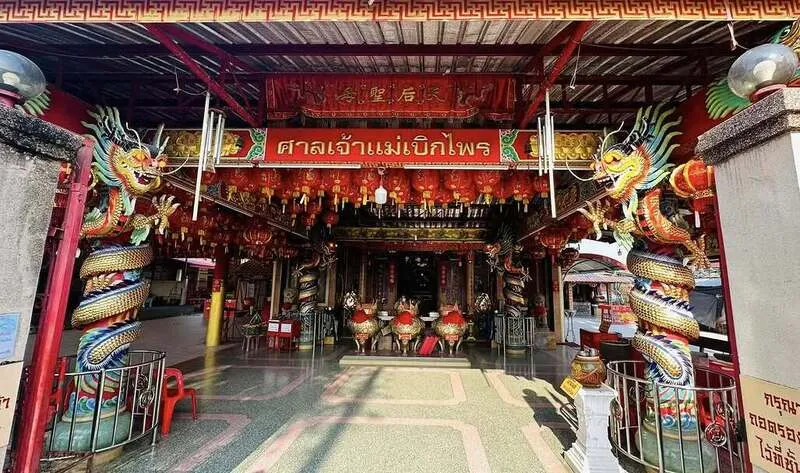

Chao Mae Puek Pai Shrine
Rating: 3.4/5 (8 votes)
Search By |
Map Map Map Have Map Have Map No Map No Map

Ratchaburi attractions

Attractions in Thailand

Open Days: Every Day
Opening Hours: 07:00 – 18:00
 
Chao Mae Puek Pai Shrine is one of the sacred places in Ratchaburi Province that has long been respected by local residents and Thai-Chinese communities in Ban Pong District. Located at 1 Moo 1, Puek Pai Subdistrict, Ban Pong District, Ratchaburi Province, the shrine stands near the Mae Klong River, an area that was historically an important trading route connecting central Thailand with the Gulf of Thailand and international maritime trade.
 
The shrine is not only a place of worship but also a reflection of the cultural connection between Chinese merchants and Siam during the late Ayutthaya and early Thonburi periods. For centuries, Chinese traders traveled by sea to conduct commerce in the region, bringing with them religious traditions and beliefs that eventually became part of the local cultural landscape.
 
The origin of Chao Mae Puek Pai Shrine dates back to approximately the Thonburi period, around the year 1774. At that time, the city of Ratchaburi, particularly the area known as Mueang Khu Bua, served as an important port city. Ships from many regions arrived to trade goods such as rice, agricultural products, and imported items from overseas markets.
 
Among those traders were Chinese merchants who sailed along maritime trade routes and entered the Mae Klong River to reach inland communities. These merchants held deep faith in Tianhou Shengmu, the Chinese sea goddess who is widely known in Thailand as Chao Mae Tubtim. According to traditional Chinese belief, the goddess protects sailors and travelers and ensures safe journeys across the sea.
 
When Chinese traders departed from China, they often carried sacred incense ash associated with Tianhou Shengmu. The incense ash symbolized the spiritual presence of the goddess and served as a source of protection and comfort during long and sometimes dangerous voyages across the ocean.
 
When the merchants reached the port city of Ratchaburi, they continued their journey upstream along the Mae Klong River toward Ban Pong. During that period, the area of Puek Pai was already a thriving trading community where goods were exchanged among nearby settlements such as Ban Khung Phayom and surrounding villages.
 
Historical records found in the book “Mae Klong River Basin” published by Silpakorn University, as well as archival documents preserved at Wat Muang in Ratchaburi, mention that this region once functioned as an active commercial hub connecting river transport with regional markets.
 
When Chinese merchants arrived in Puek Pai, they discovered that the landscape was suitable for building a shrine according to traditional Chinese geomantic principles. The location near the bend of the Mae Klong River was considered auspicious according to feng shui beliefs.
 
The merchants therefore constructed a small shrine beside the river and placed the sacred incense ash of Tianhou Shengmu inside. This symbolic act represented the presence of the goddess and established the shrine as a place where travelers and traders could pray for safety and prosperity.
 
After the shrine was established, the merchants continued their journeys between China and Siam for trade. However, the incense vessel associated with the goddess was never taken back to China, leaving the shrine permanently established in the Puek Pai community.
 
Over time, local residents, especially Thai people of Chinese descent living in Ban Pong District, continued the tradition of worshipping the goddess. Gradually the deity became known locally as “Chao Mae Puek Pai”, named after the subdistrict where the shrine stands.
 
Since then, the shrine has become an important spiritual center for the surrounding community. Residents and visitors often come to pay respect and ask for blessings related to business success, career progress, safe travel, good fortune, and family prosperity.
 
The reputation of the shrine's sacred power spread widely among residents of Ban Pong and nearby provinces. Many people believe that sincere prayers offered to Chao Mae Puek Pai can bring success and protection in various aspects of life.
 
In recognition of its cultural importance, the shrine received the “Outstanding Chinese Shrine Award” in the Central Region of Thailand. The award was presented on Thursday, July 18, 1996, highlighting the shrine's role as a cultural and spiritual landmark of the community.
 
Today the shrine is managed by a local committee. The administration is overseen by Mr. Sommanat Srikham and Mrs. Wanida Srikham, who continue to maintain the shrine as a place of faith and cultural heritage for residents of Ban Pong and visitors to Ratchaburi Province.
 
Place Name Chao Mae Puek Pai Shrine
Location 1 Moo 1, Puek Pai Subdistrict, Ban Pong District, Ratchaburi Province, Thailand
Place Summary An ancient Chinese shrine located near the Mae Klong River with a history dating back to the Thonburi period. It serves as an important spiritual center for Thai-Chinese communities in Ban Pong.
Highlights More than 200-year-old shrine / Worship of the sea goddess Mazu / Historical connection to the Mae Klong River trade route
Shrine Administrators Mr. Sommanat Srikham and Mrs. Wanida Srikham
 
Frequently Asked Questions (FAQ)
Q: Where is Chao Mae Puek Pai Shrine located?
A: The shrine is located at 1 Moo 1, Puek Pai Subdistrict, Ban Pong District, Ratchaburi Province, Thailand.
 
Q: When was Chao Mae Puek Pai Shrine established?
A: The shrine dates back to the Thonburi period, around 1774, when Chinese merchants established it during trading journeys along the Mae Klong River.
 
Q: Who is Chao Mae Puek Pai?
A: Chao Mae Puek Pai refers to Tianhou Shengmu, also known as Mazu or Chao Mae Tubtim, the Chinese sea goddess believed to protect sailors and travelers.
 
Q: What blessings do visitors usually pray for?
A: Visitors often pray for business success, safe travel, career opportunities, prosperity, and good fortune.
 
Q: When can visitors enter the shrine?
A: The shrine is generally open daily from morning until evening.
TelTel: 032200575
MobileMobile: 0818296210
 Chao Mae Puek Pai Shrine Map
Places of Worship Category: Places of Worship
Last UpdateLast Update: 11 HourAgo


Comment

Comment


Keyword (Advance)
   
Email :
Password :
  Register | Forgot password
 

Facebook Fanpage Facebook Fanpage


Region Regionhttps://www.lovethailand.org/

Art, Culture and Heritage Art, Culture and Heritage

Historical Sites and Monuments Historical Sites and Monuments(2)

Landmarks and Memorials Landmarks and Memorials(1)

Art, Craft Centres, Tradition Art, Craft Centres, Tradition(5)

Museums Museums(7)

Art Gallery Art Gallery(1)

Educational Places Educational Places

Educational Gardens, Farm Educational Gardens, Farm(2)

University University

Places of Worship Places of Worship

Temple Temple(18/399)

Other religious and spiritural sites Other religious and spiritural sites(3)

Research and Development Research and Development

Royal Project Royal Project(1)

Suburban Living Suburban Living

Village, Community Village, Community(4)

Local Market Local Market(1)

Floating Market Floating Market(3)

Nature and Wildlife Nature and Wildlife

National Parks and Marine Reserves National Parks and Marine Reserves(2)

Mountain (Doi) Mountain (Doi)(5)

Dam, Reservoir, Lake Dam, Reservoir, Lake(1)

Waterfalls Waterfalls(4)

Hot Springs Hot Springs(3)

Caves Caves(4)

Flower Field Flower Field(2)

River, Canal River, Canal(1)

Other natural attractions Other natural attractions(3)

Entertainment and Agricultural Entertainment and Agricultural

Zoos and Aquariums Zoos and Aquariums(2)

Animal camps and shows Animal camps and shows(1)

Farm, Parks, Gardens and Ecotourism Farm, Parks, Gardens and Ecotourism(2)

Waterpark Waterpark(1)

Outdoor and Adventure Activities Outdoor and Adventure Activities(4)

Shopping Shopping

Shopping and Night Market Shopping and Night Market(2)

Spas and Wellness Spas and Wellness

Spas and Wellness Spas and Wellness(1)

Travel Articles, Recipes Travel Articles, Recipes

Travel Review, Food Review Travel Review, Food Review(1)