

 Home
Home Chiang Mai(
























Rating: 4.2/5 (5 votes)
 |
|  Map
Map 
 Have Map
  No Map
Ratchaburi attractions
Attractions in Thailand
Open Days: The community can be visited every day. For special events and the All About Arts program, visitors should check the latest schedule with the community or municipality before traveling.
Opening Hours: The community and surrounding market area can generally be visited according to each shop’s operating hours, while All About Arts activities usually begin in the evening.
Wat Chet Samian Community is one of the most interesting destinations in Photharam District, Ratchaburi Province, especially for those who want to experience the charm of an old riverside community along the Mae Klong River together with the nostalgic atmosphere of railway travel. The area is located behind Chet Samian Railway Station, a small station on Thailand’s southern railway line that many travelers may have passed through without ever stopping to explore properly. Once you arrive, you will find that this community offers far more than just an old market and an old temple. It is also a place where culture, memories, and contemporary community life continue to exist side by side in a distinctive and appealing way.
The charm of Wat Chet Samian Community lies in its interconnected landscape. The front side of the market adjoins Chet Samian Railway Station, so the first impression visitors receive is the atmosphere of a historic commercial quarter beside the railway. At the rear of the community, the area opens onto the banks of the Mae Klong River, an important waterway that has sustained local people for generations. The close relationship between the railway, the market, the temple, and the river gives Chet Samian a unique identity unlike that of many other local tourist communities, because each element reflects part of the settlement history and economic development of Photharam.
From a tourism perspective, Wat Chet Samian Community is especially suitable for travelers who appreciate old-fashioned places with meaningful stories. Anyone interested in community markets, riverside lifestyles, vernacular architecture, local art, and small-scale festivals that still preserve a genuine community spirit will discover that this place has more details worth observing than one might expect. If you visit during the All About Arts event, you will see another side of the community, one in which art is used to bring an old quarter back to life.
Chet Samian is an old community with long-standing ties to the Mae Klong River. In its early days, people settled mainly along the riverbanks. Later, when modern transport systems such as roads and railways arrived, the settlement expanded and changed accordingly. The original riverside settlement continued to serve as the cultural and religious center of the area, while land near the railway station and the main roads developed into a busier zone for commerce and travel. The coexistence of these two dimensions is one of the most important charms of present-day Chet Samian.
Another aspect that makes this community particularly interesting is its social diversity. Cultural sources indicate that the Chet Samian market community has long been home to local Thai people, Thai-Chinese residents, Lao Wiang descendants, and Thai people of Khmer descent living together. Their lifestyles, traditions, language, and local wisdom have blended into a distinctive multicultural identity. Although many things have changed over time, traces of this diversity can still be seen in the community’s merit-making events, traditions, stories, and shared memories.
When talking about the name “Chet Samian,” many people wonder where it came from. Local stories and several written sources suggest that the name has long been significant as an old place name in Ratchaburi. One explanation mentions seven clerks recording the names of residents, eventually leading to the place becoming known by that name. Beyond the folk narrative, the name “Chet Samian” also appears in literature and travel accounts, which further confirms that this area has existed in the historical and cultural memory of local people for a very long time.
At the heart of the community stands Wat Chet Samian, an old temple that serves as the center of religion, culture, and community activities. This temple belongs to the Mahanikaya sect and is recorded as having been established in 1757, reflecting both its age and the long continuity of the surrounding settlement. In the past, the temple was more than a religious site. It was also a gathering place for local people, a venue for merit-making ceremonies, and a center for the transmission of local cultural traditions in Chet Samian Subdistrict.
At present, Wat Chet Samian is under the leadership of Phra Khru Silawisutthikhun (Phichit Khunasilo) as abbot, and the temple continues to play an active role in the community. It supports religious activities, annual merit-making events, cultural programs, and the use of temple grounds as a place where people in Chet Samian can gather together. Because of this role, the temple is not merely a place for Buddhist ceremonies, but also a spiritual center and an essential part of everyday life in the community.
From a visitor’s point of view, Wat Chet Samian is appealing because it is not separated from the community around it. Instead, it remains fully integrated into the rhythm of local life. Around the temple are the old market, pathways leading toward the river, activity grounds, and residents who continue to use the area naturally as part of daily life. At some times of day, the temple feels quiet, simple, and shaded, while on festival days or during important local events, the same area becomes lively and full of energy.
Another important feature that distinguishes Wat Chet Samian Community from other old market communities is Chet Samian Railway Station. This small station on the southern line has meaning far beyond being a passenger stop. It is a symbol of travel, memory, and the connection between the community and larger urban centers. In the past, river transport was the main means of mobility, but when the railway arrived, Chet Samian became more vibrant as a passing point for both people and goods, and the market expanded in importance as a result.
Travelers who enjoy nostalgic atmospheres are often impressed by the experience of stepping off the train and entering the market community almost immediately. The rhythm of travel here feels very different from simply driving into a modern tourist destination. Arriving by train allows visitors to experience a slower transition into the area, seeing old houses, local people walking by, and the gradual shift from the station to the market, the temple, and the riverside within an easy walking distance.
For those wondering what part of Wat Chet Samian Community is most worth exploring, the answer is to “walk through it all slowly and absorb the atmosphere.” The charm of the area does not lie in one major landmark alone, but in the combination of many smaller elements that together create a larger and more meaningful picture. These include the old market beside the railway station, the temple courtyard used for community activities, the quiet riverside spaces, and the small shops that still preserve the local way of life.
One of the things that has brought renewed attention to Chet Samian is the All About Arts project, an initiative supported by public agencies, private groups, and local residents to bring the 119-year-old Chet Samian Market back to life. The concept of this event goes beyond simply opening a market for shopping. Instead, it uses art, culture, folk performances, and local wisdom to create new value for the historic area. The event is therefore more than a festival. It is a way of restoring meaning to the community through its existing cultural capital.
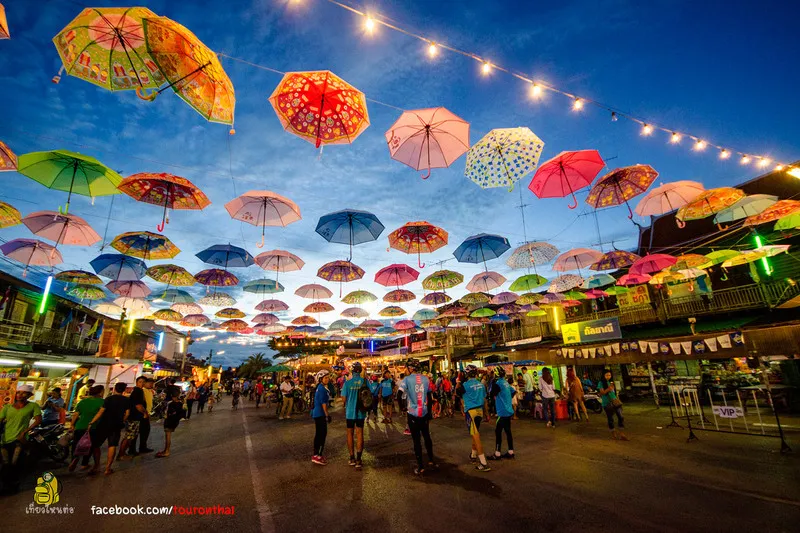
Cultural sources in the community indicate that All About Arts is usually held at the end of the month and features local-style food and shopping, contemporary art performances, exhibitions by local artists, performances by elderly residents, and traditional folk activities that are rarely seen today. Events like this allow younger generations and visitors to discover not only old objects in a material sense, but also the values, ideas, and ways of living together that define the community through art and performance.
From a visitor’s perspective, All About Arts is especially attractive because it combines the feel of a community event with the atmosphere of an arts festival. Visitors may see photographs or paintings by artists from Photharam, enjoy performances by local people, view old household objects that are now rarely encountered in everyday life, and experience the atmosphere of an old market that has not been modernized to the point of losing its identity. For those who enjoy slow travel, photography, observing people, and allowing time to flow with the place, this event fits perfectly.
Another important strength of All About Arts is that it uses several areas of the community as a shared stage. These may include the bodhi tree courtyard in front of the temple, riverside pavilions, and spaces within the market behind the railway station. The distribution of performance spaces and activities throughout the area means that visitors do not experience the event in just one location, but are encouraged to explore the community naturally. Along the way, they also discover shops, old buildings, alleys, local ways of life, and the landscape along the Mae Klong River.
Wat Chet Samian Community also has other forms of cultural capital that deserve mention in order to make this article more complete than typical search results. One important example is the flower procession tradition held at the end of Songkran, which is considered a major local tradition of Chet Samian and has been carried on for a long time. Such activities are part of the community’s identity, and discussing them in this article helps readers understand that Chet Samian is not only a place to walk through an old market, but also a community with deep traditional roots.
In terms of cultural tourism, Wat Chet Samian Community has several advantages. First, it is easy to reach from Bangkok and from Ratchaburi town. Second, it contains all the important elements of an old community in one place: a temple, a market, a railway station, and a river. Third, it hosts cultural and creative activities that remain genuinely connected to local people rather than being staged separately from daily life. For these reasons, the community holds strong appeal for travelers who want to experience a deeper and more meaningful side of Ratchaburi beyond the usual check-in destinations.
If you are planning a one-day trip, Wat Chet Samian Community can be explored comfortably. You may begin at Wat Chet Samian to experience the spiritual and cultural center of the community, then continue to Chet Samian Old Market to see the old buildings, local shops, and the charm of the area in front of the station. Later in the afternoon or evening, you can stroll toward the Mae Klong riverside to enjoy a calmer atmosphere. If your visit coincides with All About Arts, you can stay through the evening to enjoy performances, art activities, and the lively community market experience.
Getting There Wat Chet Samian Community is accessible both by car and by train. If driving from Bangkok, you can follow the route toward Photharam District and continue into Chet Samian Subdistrict, with a total distance of about 90 kilometers. However, if you want a travel experience that best matches the story of the place, taking the southern railway line and getting off at Chet Samian Station is the ideal option, since the station is directly connected to the community and forms an essential part of its identity.
The best times to visit depend on the kind of experience you want. If you prefer a peaceful walk through the community, taking photographs of old buildings, the temple, and the riverside atmosphere, morning to afternoon is ideal. But if you want to see the community at its liveliest, you should visit during All About Arts or on days when cultural activities are taking place, as this is when local people come out to use the space together and the spirit of Chet Samian becomes especially vivid.
Although many old communities today have changed so much that they have lost their identity, Wat Chet Samian Community still preserves the quality of being a “real place for real people” to a remarkable degree. This is a community where the temple remains the heart, the market remains a place of meeting, the river remains a background of memory, and art serves as a means of connecting the past with the present in a natural and harmonious way.
For travelers seeking places to visit in Ratchaburi that go beyond the usual lists, Wat Chet Samian Community is a destination well worth adding to the itinerary. It offers not only attractive scenery and photo opportunities, but also the experience of walking into a living community with stories, history, cultural roots, and an ongoing creative revival through art and local activities.
Viewed as a whole, Wat Chet Samian Community is much more than an ordinary community-based tourist attraction. It is a place where visitors can clearly see the coexistence of temple, market, railway, river, and art within a single landscape. If the goal of travel is to understand a place more deeply than simply stopping for a check-in photo, then this is one of the destinations in Ratchaburi that truly rewards those who are willing to walk slowly and look carefully.
| Place Name | Wat Chet Samian Community |
| Location | Chet Samian Subdistrict, Photharam District, Ratchaburi Province, located behind Chet Samian Railway Station. The market is in front next to the station, while the rear side connects to the Mae Klong River. |
| Summary | A historic community in Photharam with Wat Chet Samian at its center, linking the old market, the southern railway line, and the Mae Klong riverside way of life. It is ideal for cultural tourism and slow community walking tours. |
| Highlights | Historic community behind Chet Samian Railway Station, an old temple established in 1757, an old market by the Mae Klong River, the All About Arts event, and a community atmosphere rich in art and local culture |
| Main Temple / Current Caretaker | Wat Chet Samian – Current abbot: Phra Khru Silawisutthikhun (Phichit Khunasilo) |
| Zones | 1) Wat Chet Samian Zone 2) Chet Samian Old Market Zone 3) Chet Samian Railway Station Zone 4) Mae Klong Riverside Zone 5) All About Arts Activity Zone |
| Nearby Tourist Attractions | 1. Wat Chet Samian – within the community 2. Chet Samian Old Market – within the community 3. Chet Samian Railway Station – within the community 4. Chet Samian Community Museum – about 300 meters 5. Wat Khanon Nang Yai Shadow Puppet Museum – about 15 km. |
| Nearby Restaurants | 1. The River House by Chada – about 300 meters – Tel. 062-998-7446 2. Yaa Leum Chan Cafe Photharam – about 7 km. – Tel. 085-389-9983 3. The Grounds Cafe – about 16 km. – Tel. 086-160-7127 4. Rairak Cafe & Bistro – about 12 km. – Tel. 098-926-9896 5. Idin The River Cafe (inside Rachabhura Hotel) – about 22 km. – Tel. 032-919-999 |
| Nearby Accommodations | 1. The Resort Hotel @ Photharam – about 8 km. – Tel. 097-373-8811 2. Photharam 126 Resort – about 11 km. – Tel. 062-184-9666 3. Rachabhura Hotel – about 22 km. – Tel. 032-919-999 4. Chet Samian Community Museum / Community Information Point – about 300 meters – Tel. 032-397-032, 032-397-026 5. Wat Chet Samian (for nearby area inquiries) – within the community – Tel. 032-397-089, 086-394-6849 |
| Current Status | It remains a real cultural tourism community that can still be visited, and community and temple activities have continued to be mentioned through 2025. |
| Contact Numbers | Wat Chet Samian 032-397-089, 086-394-6849 / Chet Samian Community Museum 032-397-032, 032-397-026 |
Frequently Asked Questions (FAQ)
Q: Where is Wat Chet Samian Community located in Ratchaburi?
A: Wat Chet Samian Community is located in Chet Samian Subdistrict, Photharam District, Ratchaburi Province, behind Chet Samian Railway Station. The market is in front next to the station, while the rear side connects to the Mae Klong River.
Q: What is the highlight of Wat Chet Samian Community?
A: Its highlight is that it is a historic community where the temple, market, railway station, and river all exist within the same area, and it also hosts the All About Arts event, which adds a creative art and cultural atmosphere to the community.
Q: How old is Wat Chet Samian?
A: Wat Chet Samian is a Mahanikaya Buddhist temple established in 1757, making it an old temple and a long-standing center of the Chet Samian community.
Q: Who is the current abbot of Wat Chet Samian?
A: The latest verified information identifies the current abbot of Wat Chet Samian as Phra Khru Silawisutthikhun (Phichit Khunasilo).
Q: When is All About Arts held?
A: All About Arts is a community art and cultural activity that is usually held toward the end of the month. Visitors should check the latest schedule with the community or municipality before traveling.
Q: Can I visit Wat Chet Samian Community by train?
A: Yes. You can take the southern railway line and get off at Chet Samian Railway Station, then walk conveniently into the community, the market, and the temple.
Q: What type of traveler is Wat Chet Samian Community suitable for?
A: It is suitable for travelers who enjoy historic communities, temples, old markets, nostalgic photography, as well as those interested in art, local culture, and riverside ways of life.
 Tel: 032397668
 Mobile: 0818317041
 Wat Chet Samian Community Map
 Category:
  Group:
  Last Update: 8 HourAgo
Comment
 Nearby Attractions
| Keyword (Advance) |
 Facebook Fanpage
 Region
 Art, Culture and Heritage
 Historical Sites and Monuments(
 Landmarks and Memorials(
 Art, Craft Centres, Tradition(
 Museums(
 Art Gallery(
 Educational Places
 Educational Gardens, Farm(
 University
 Places of Worship
 Temple(
 Other religious and spiritural sites(
 Research and Development
 Royal Project(
 Local Market(
 Floating Market(
 Nature and Wildlife
 National Parks and Marine Reserves(
 Mountain (Doi)(
 Dam, Reservoir, Lake(
 Waterfalls(
 Hot Springs(
 Caves(
 Flower Field(
 River, Canal(
 Other natural attractions(
 Entertainment and Agricultural
 Zoos and Aquariums(
 Animal camps and shows(
 Farm, Parks, Gardens and Ecotourism(
 Waterpark(
 Outdoor and Adventure Activities(
 Shopping
 Shopping and Night Market(
 Spas and Wellness
 Spas and Wellness(
 Travel Articles, Recipes
 Travel Review, Food Review(