

 Home
Home Chiang Mai(
















Rating: 3.9/5 (7 votes)
 |
|  Map
Map 
 Have Map
  No Map
Ratchaburi attractions
Attractions in Thailand
Open Days: Open daily
Opening Hours: Please contact the temple before visiting
Wat Surachayaram, Ratchaburi, also known as Wat Lum Din, is a third-class royal monastery of the ordinary type located along the western bank of the Mae Klong River in Lum Din Subdistrict, Mueang Ratchaburi District. This temple has historical roots going back at least to the Ayutthaya period. It was originally known as Wat Lum Din before undergoing a major revival during the reign of King Rama V under the patronage of Than Phu Ying Im Bunnag, after which it received the new royal name “Wat Surachayaram” and was elevated to royal monastery status. The temple’s highlights include the history of the Lum Din community, its connection with pottery production, the ordination hall, the wooden sermon hall, the chedis, the prang, and the atmosphere of an old riverside temple that still conveys a sense of calm and historical weight.
Wat Surachayaram, Ratchaburi is a third-class royal monastery of the ordinary type located on the western bank of the Mae Klong River in Lum Din Subdistrict, Mueang Ratchaburi District, Ratchaburi Province. It is one of the most distinctive temples in Ratchaburi, not only because of its importance as an old religious site, but also because it is connected to the history of a riverside agricultural community, pottery production, the Bunnag family, and the revival of an abandoned temple into a royal monastery during the reign of King Rama V.
At first glance, visitors may simply see Wat Surachayaram as an old riverside temple with a peaceful, shaded, and modest atmosphere. However, when examined more deeply, the temple is one of the places that helps explain Ratchaburi as a city with strong historical continuity. It reflects layers of geography, settlement history, pottery production, networks of riverside temples, and elite patronage of Buddhism during the early and middle Rattanakosin period. Wat Surachayaram is therefore more than a place for paying respect; it is a site that allows readers and travelers to understand the historical layers of Ratchaburi in a concrete way.
Originally, the temple was known as “Wat Lum Din.” This name directly reflected the landscape and economy of the area, because the area around Khlong Lum Din had fine soil suitable for making pottery. The temple’s original name was therefore not just a simple label, but linguistic and cultural evidence showing that this area was once deeply connected with the natural resources of soil and water, as well as the occupations of the people in the community. Many Thai temples are named after local geography or events, and Wat Lum Din is a very clear example of this pattern.
The importance of the Lum Din area is also connected with Wat Khok Mo, which was an old center of pottery production. This relationship means that Wat Surachayaram did not stand in isolation, but formed part of a cultural landscape in which community, production, and religion were closely linked. In the past, temples often served as community centers, while the communities themselves relied on local natural resources for their economy. When an area had good clay and pottery production, the temple naturally became a center for people whose way of life depended on one another over time.
According to historical evidence, Wat Surachayaram may date back to the Ayutthaya period, or perhaps even earlier. This point is very important, because it means that the temple did not simply originate during the Rattanakosin era, but contains an older historical layer beneath its later development. At one stage, however, the temple fell into a deserted condition and only the remains of old brick foundations survived. This abandoned phase actually adds greater historical depth to Wat Surachayaram, because it reflects the changes of political and community life, from a once-thriving place to decline, before being revived again.
The major turning point that brought Wat Lum Din back to life came during the reign of King Rama V, when Than Phu Ying Im Bunnag, the wife of Chao Phraya Surawong Waiyawat (Won Bunnag), found the temple in a ruined and abandoned state, with only brick foundations remaining and the original ordination hall beyond repair. Her decision to build a new ordination hall about 30 wa from the original site was therefore not simply an architectural restoration, but an act of reviving an old sacred place by the Mae Klong River and restoring its social and religious role.
The restoration of the temple by Than Phu Ying Im Bunnag carries great social and historical meaning, because it reflects the role of elite women in that era, who were not limited to domestic life but could also patronize Buddhism, build temples, and leave lasting artistic and religious legacies to the country. In the case of Wat Surachayaram, her patronage directly prevented the old temple from vanishing into obscurity and enabled it to become a royal monastery in due course.
King Chulalongkorn graciously granted the temple a consecrated boundary on 23 July 1884 and bestowed the new name “Wat Surachayaram,” while also elevating it to the status of a royal monastery on 4 December 1884. This shows clearly that Wat Surachayaram was not merely a temple rebuilt through private faith alone, but one that received formal royal recognition and the honor of becoming a royal monastery in the same year.
The name “Wat Surachayaram” itself also reflects the relationship between the patronage of the Bunnag family and the temple. The new name not only elevated the temple’s image from the earlier geographical name “Wat Lum Din,” but also allowed it to enter a new status in the historical memory of both Ratchaburi and the nation. In other words, the renaming of the temple at that time was at once an act of restoration, elevation, and the writing of a new chapter in the history of this sacred place.
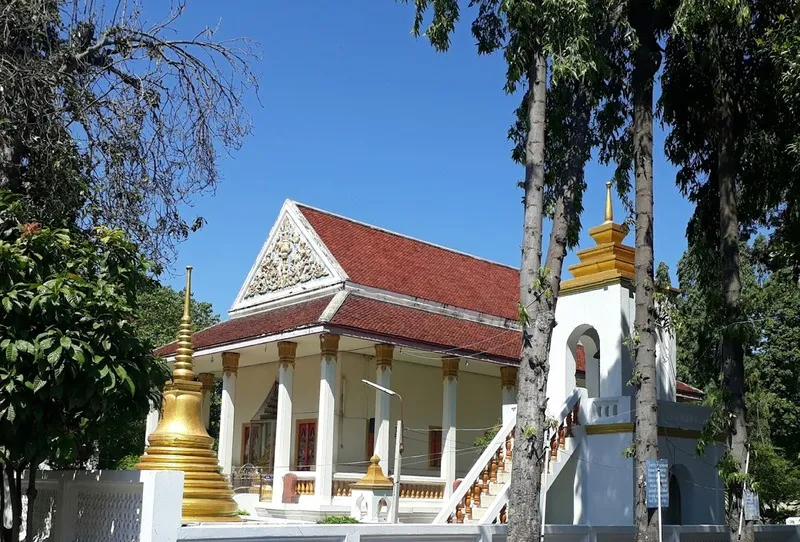
The present ordination hall of Wat Surachayaram is a brick-and-mortar building with a wooden roof covered with tiles and eaves extending on all four sides. One of its most distinctive features is the absence of chofa, bai raka, and hang hong, which sets it apart from the conventional image of many Thai temples. This simplicity of form gives the ordination hall its own distinct character: calm, weighty, and understated, yet still sacred and dignified in its own way.
Inside the ordination hall is the principal Buddha image in the meditation posture, seated in the diamond posture, with one chief disciple standing in prayer on each side. The principal image conveys stillness, stability, and a spiritual atmosphere especially suited to this old riverside temple. Another remarkable aspect is the presence of bronze standing Buddha images in the posture of calming the ocean and the posture of forbidding Phra Kaen Chan, which reflect royal-style Buddhist art associated with the reign of King Rama III. These elements give Wat Surachayaram a rich dimension of Buddhist art beyond its identity as merely an old temple.
The walls of the ordination hall were originally plain, but mural paintings were later added. The presence of mural paintings enhances the artistic dimension of the hall and makes the experience of visiting the temple more complete, because visitors do not only see its architectural form, but also encounter visual narratives that communicate Buddhist worldview and belief. Although the murals were added later, they have now become part of the temple’s contemporary identity.
Outside the crystal wall of the ordination hall stand two round bell-shaped brick-and-mortar chedis built by Than Phu Ying Im Bunnag. These two chedis not only add beauty to the temple layout, but also reflect the intention of the temple’s patron to make the site complete in every sense. In other words, she did not only build an ordination hall so that the temple could function again, but also created sacred architectural elements that enhanced its dignity and holiness.
In addition, on the southern side of the ordination hall, outside the crystal wall, there is another round bell-shaped brick-and-mortar chedi built by Chao Khun Prayurawong, or Chao Chom Manda Phae in the reign of King Rama V, to contain the cremated remains of Prince Krom Khun Suphanphakdi and of Chao Khun Prayurawong herself. This chedi is therefore important not only as an architectural structure, but also as a memorial expressing the close relationship between the royal court elite and Wat Surachayaram, giving the temple an even stronger dimension of court history.
Behind the ordination hall stands a prang paired with a twelve-cornered chedi. The temple’s prang is a Rattanakosin-period brick-and-mortar structure with a square plan and ornamental niches on all four sides. This form distinguishes the prang of Wat Surachayaram from many temples that emphasize only bell-shaped chedis. The presence of both a prang and chedis within the temple layout adds greater artistic richness and makes the area behind the ordination hall especially interesting to explore.
The temple’s sermon hall was built in 1928. It is a raised traditional Thai wooden building constructed entirely of timber, making it a highly valuable example of local architecture and Thai carpentry. Wooden halls of this kind are becoming increasingly rare in urban temples today, and its value becomes even greater because the interior contains mural paintings depicting episodes from the life of the Buddha, executed by artists of the Rattanakosin period. The sermon hall of Wat Surachayaram is therefore both a functional building and a work of art in its own right.
When all these elements are considered together, it becomes clear that Wat Surachayaram has a distinctive identity in that it gathers many historical layers within the same space. These layers range from an old temple that may date back to Ayutthaya, to a major restoration during the reign of King Rama V, to the ordination hall and chedis connected with the Bunnag family and the royal court, and finally to the later wooden sermon hall. Visiting this temple is therefore not merely an act of worship, but an experience of walking through several periods of the history of both Ratchaburi and Siam in one place.
In the life of the community, Wat Surachayaram continues to serve as a center for Buddhist ceremonies, community gatherings, and the learning of religion and Thai history. Riverside temples like this often play a deep role in local life, because they serve as places for ritual, spaces for peace of mind, and anchors of shared memory. When such a temple has deep historical roots and was restored through elite patronage in the Rattanakosin period, it gains a double meaning: it remains both a community temple and a temple of provincial historical importance.
The latest contemporary information indicates that Wat Surachayaram has Phra Khru Sophon Thammasangwon as its abbot. Having an officially appointed abbot with continuing public records is an important indication that the temple remains active in the present day, rather than existing merely as a surviving historical monument. Including the most recent abbot is therefore important both in practical informational terms and for the credibility of the article.
For travelers, Wat Surachayaram is highly suitable for those who want to explore Ratchaburi beyond the usual popular check-in spots, because it offers the peace of an old riverside temple, the richness of local history, and many artistic details worthy of attention. Those who enjoy exploring the meanings of temple names, the background of local communities, and the relationship between temples and landscape will quickly sense that Wat Surachayaram is a temple with far more to tell than many others.
Another strength is that the temple lies not far from Ratchaburi town itself, making it easy to include in a half-day or full-day itinerary together with other important places, such as Wat Khok Mo, the Ratchaburi National Museum, Wat Mahathat Worawihan, and the old market district in town. This helps visitors understand Ratchaburi through its temples, communities, geography, and local food all together, making the journey a connected story rather than simply a series of stops.
Getting There Wat Surachayaram is located in Lum Din Subdistrict, Mueang Ratchaburi District. If traveling from Bangkok, take Highway No. 4, or Phetkasem Road, toward Ratchaburi. Once you reach the city area, take Road No. 3089, or Khathathorn Road, toward Lum Din Subdistrict. Continue straight for around 5 kilometers and the temple will be on the left-hand side. This route is convenient for private vehicles, and even from central Ratchaburi the journey takes only a short time.
Visitors planning to come to the temple should dress respectfully according to Thai standards for religious places, avoiding sleeveless clothing, shorts, or skirts that are too short, and should behave appropriately, especially inside the ordination hall and in areas where religious activities are being carried out. Although the temple has strong tourism value, its essential character remains that of a sacred religious place.
The best times to visit are in the morning through late morning and in the late afternoon, when the riverside atmosphere is more pleasant and the natural light is more beautiful. These times are suitable for worship, for walking among the chedis, prang, and wooden sermon hall, and for photography. For those who enjoy taking pictures, Wat Surachayaram offers images that feel calm, warm, and full of context, because it combines artistic structures with the character of a riverside community.
To summarize clearly, Wat Surachayaram, Ratchaburi, is a temple of complete significance in terms of community history, court history, art, and Buddhist devotion. It stands out through its roots as Wat Lum Din, its connection to clay sources for pottery, its revival by Than Phu Ying Im Bunnag, its royal renaming and elevation to royal monastery status, and its important architectural features such as the ordination hall, chedis, prang, and wooden sermon hall. Combined with its setting along the Mae Klong River, it is truly one of the most meaningful and charming temples in Ratchaburi.
For those who wish to know Ratchaburi more deeply than through mainstream check-in spots, Wat Surachayaram is a very clear answer. It offers not just the image of an old temple, but also the story of the Lum Din community, the revival of an abandoned temple, the role of elite patronage during the reign of King Rama V, and artistic works that still reflect the taste of each historical era. Once you stand inside the temple, walk past the ordination hall, the chedis, the prang, and the wooden hall, and look out toward the Mae Klong River, it becomes very easy to understand why this temple remains so valuable and memorable today.
| Place Name | Wat Surachayaram, Ratchaburi |
| Address | Village No. 3, Lum Din Subdistrict, Mueang Ratchaburi District, Ratchaburi 70000 |
| Place Summary | A third-class royal monastery of the ordinary type along the Mae Klong River, formerly known as Wat Lum Din. It has historical roots dating back at least to the Ayutthaya period before a major restoration in the reign of King Rama V by Than Phu Ying Im Bunnag, after which it received the royal name “Wat Surachayaram.” |
| Highlights | The history of Wat Lum Din, connection with pottery production, the plain ordination hall without chofa or bai raka, 3 chedis, a Rattanakosin-period prang, a wooden sermon hall with Buddhist murals, and the atmosphere of an old Mae Klong riverside temple |
| History | Formerly known as Wat Lum Din and believed to date back to the Ayutthaya period or earlier. During the reign of King Rama V, Than Phu Ying Im Bunnag restored the temple, which then received its consecrated boundary on 23 July 1884 and the royal name “Wat Surachayaram,” before being elevated to royal monastery status on 4 December 1884. |
| Main Features Within the Temple | Ordination hall, principal Buddha image in the meditation posture, chief disciples, Buddha images in the calming-the-ocean posture, Buddha images in the forbidding Phra Kaen Chan posture, chedis, prang, wooden sermon hall, and mural paintings |
| Name Origin | Originally called Wat Lum Din after the landscape at the mouth of Khlong Lum Din, where the soil was suitable for pottery making, before receiving the royal name “Wat Surachayaram” in the reign of King Rama V |
| Current Abbot / Latest Caretaker | Phra Khru Sophon Thammasangwon |
| Open Days | Open daily |
| Opening Hours | Please contact the temple before visiting |
| Fees | No admission fee |
| Facilities | Temple grounds, worship areas, internal walkways, sermon hall, parking within the temple and nearby community, riverside landing area, and a Mae Klong riverside atmosphere |
| Getting There | From Bangkok, take Phetkasem Road into Ratchaburi city, then continue along Road No. 3089 or Khathathorn Road toward Lum Din Subdistrict. The temple is about 5 kilometers from the town center and will be on the left-hand side. |
| Current Status | Still active and continues to play a religious role in the community |
| Temple Contact Number | 032-312-951, 032-337-155 |
| Zone | Lum Din Zone / Mae Klong Riverside / Mueang Ratchaburi District |
| Nearby Attractions with Distance | 1. Wat Khok Mo – approximately 2 km – Lum Din / Pottery Zone 2. Ratchaburi National Museum – approximately 6 km – Old Town / Historical Zone 3. Wat Mahathat Worawihan – approximately 6 km – Historic City Center Zone 4. Koi Ki Old Market – approximately 6 km – Old Commercial and Local Food Zone 5. Ratchaburi City Pillar Shrine – approximately 6 km – City Center / Sacred Zone |
| Nearby Restaurants with Distance | 1. The Mae Klong Cafe and Restaurant – approximately 5 km – Riverside / Khung Krathin Zone – Tel. 062-924-6632, 095-359-9463 2. Kam Cheng Noodles – approximately 6 km – Old Town / Traditional Eatery Zone – Tel. 032-323-278, 093-264-9856 3. R-tee Kopee – approximately 6 km – Breakfast / Old Town Café Zone 4. Den Thai Ice Cream – approximately 7 km – Sanam Ya Market / Dessert Zone – Tel. 081-001-9339 5. Por Pla Phao Ratchaburi – approximately 9 km – City Entrance / Thai-Isan Food Zone – Tel. 089-882-6886, 089-172-9501, 032-737-256 |
| Nearby Accommodations with Distance | 1. Rachabhura Hotel – approximately 6 km – Riverside / Ban Rai Zone – Tel. 032-919-999 2. HOP INN Ratchaburi – approximately 7 km – City Center / Easy Access Zone – Tel. 02-080-2222 3. Numsin Hotel – approximately 6 km – Traditional City Center Zone – Tel. 032-337-551 4. Space 59 Hotel – approximately 7 km – City Center / Modern Loft Zone – Tel. 085-263-4848, 081-638-1909, 082-242-2092 5. Vanilla River – approximately 6 km – Riverside / Old Town Zone – Tel. 092-262-8264 |
Frequently Asked Questions (FAQ)
Q: What is the history of Wat Surachayaram?
A: Wat Surachayaram was formerly known as Wat Lum Din and is believed to date back to the Ayutthaya period or even earlier. During the reign of King Rama V, Than Phu Ying Im Bunnag restored the temple, after which it received the royal name “Wat Surachayaram” and was elevated to royal monastery status in 1884.
Q: Why was Wat Surachayaram formerly called Wat Lum Din?
A: Because the temple stood at the mouth of Khlong Lum Din, an area with fine soil suitable for pottery making. The original name therefore directly reflected the landscape and economic life of the community.
Q: What are the main highlights of Wat Surachayaram?
A: Its highlights include the history of the old riverside temple, the plain ordination hall without chofa or bai raka, the three chedis, the Rattanakosin-period prang, the wooden sermon hall, and its connection with Than Phu Ying Im Bunnag.
Q: Who is the latest abbot of Wat Surachayaram?
A: The latest available information identifies the abbot of Wat Surachayaram as Phra Khru Sophon Thammasangwon.
Q: Where is Wat Surachayaram located in Ratchaburi?
A: The temple is located in Village No. 3, Lum Din Subdistrict, Mueang Ratchaburi District, Ratchaburi Province, on the western bank of the Mae Klong River, not far from the city center of Ratchaburi.
Q: What can be seen inside Wat Surachayaram?
A: Inside the temple are the ordination hall, the principal Buddha image in meditation posture, the chief disciples, Buddha images in the calming-the-ocean posture, Buddha images in the forbidding Phra Kaen Chan posture, chedis, a prang, and the wooden sermon hall with mural paintings depicting the life of the Buddha.
Q: What places can I visit after Wat Surachayaram?
A: Nearby places include Wat Khok Mo, the Ratchaburi National Museum, Wat Mahathat Worawihan, Koi Ki Old Market, and the Ratchaburi City Pillar Shrine, making it easy to continue exploring Ratchaburi through both history and culture.
 Wat Surachayaram Map
 Category:
  Group:
  Last Update: 12 HourAgo
Comment
 Nearby Attractions
| Keyword (Advance) |
 Facebook Fanpage
 Region
 Art, Culture and Heritage
 Historical Sites and Monuments(
 Landmarks and Memorials(
 Art, Craft Centres, Tradition(
 Museums(
 Art Gallery(
 Educational Places
 Educational Gardens, Farm(
 University
 Other religious and spiritural sites(
 Research and Development
 Royal Project(
 Suburban Living
 Village, Community(
 Local Market(
 Floating Market(
 Nature and Wildlife
 National Parks and Marine Reserves(
 Mountain (Doi)(
 Dam, Reservoir, Lake(
 Waterfalls(
 Hot Springs(
 Caves(
 Flower Field(
 River, Canal(
 Other natural attractions(
 Entertainment and Agricultural
 Zoos and Aquariums(
 Animal camps and shows(
 Farm, Parks, Gardens and Ecotourism(
 Waterpark(
 Outdoor and Adventure Activities(
 Shopping
 Shopping and Night Market(
 Spas and Wellness
 Spas and Wellness(
 Travel Articles, Recipes
 Travel Review, Food Review(