

 Home
Home Chiang Mai(


























Rating: 3.4/5 (7 votes)
 |
|  Map
Map 
 Have Map
  No Map
Ratchaburi attractions
Attractions in Thailand
Open Days: Open Daily
Opening Hours: 08.00 – 17.00
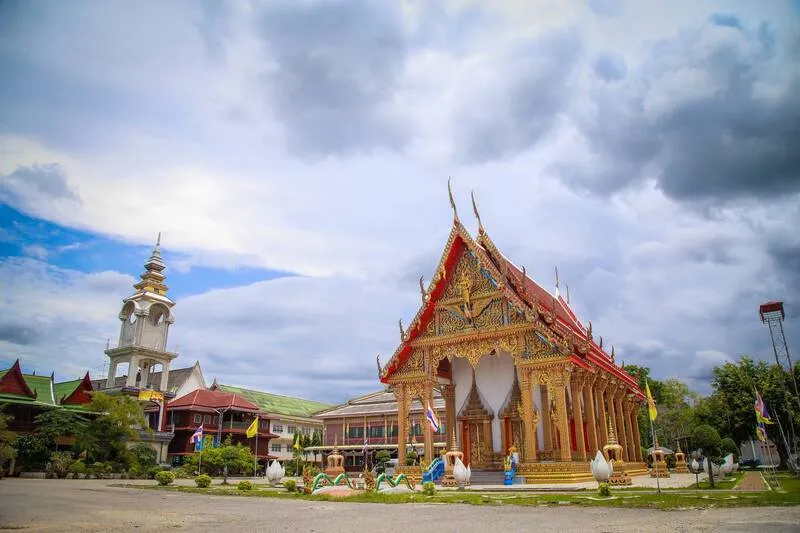
Wat Bua Ngam, Ratchaburi Province is a third-class royal temple of the ordinary type in Damnoen Saduak District. Formerly known as “Wat Bua Loi,” it has a history dating back to 1899. The temple’s highlights include an ordination hall built in 1953, whose doors and windows are decorated with traditional lai rot nam lacquerwork, Thai-patterned gables, a wooden vihara enshrining “Luang Phor Phra Phutthayan Sri Ayutthaya,” and several other important sacred objects. It is therefore both a significant religious site, a source of local historical knowledge, and an attractive destination in Ratchaburi for visitors interested in temple tourism and cultural travel.
Wat Bua Ngam is another important temple in Ratchaburi Province with clear value in terms of history, art, and its role in Buddhism. The temple is located at 1 Moo 1, Bua Ngam Subdistrict, Damnoen Saduak District, Ratchaburi Province, and holds the status of a third-class royal temple of the ordinary type under the Mahanikaya order. Its distinction lies not only in its peaceful atmosphere, but also in the story of its foundation, which is closely tied to the original community of Bua Ngam Subdistrict, as well as in the accumulated artistic heritage and sacred objects that give this temple greater cultural weight than many ordinary temples.
For travelers seeking an important temple in Damnoen Saduak District, many may first think of floating markets or water-based attractions. However, once they become more familiar with Wat Bua Ngam, they will discover that this temple is a destination with a different kind of charm. It offers peace, historical knowledge, and the opportunity to admire Thai architecture that still retains its distinctive beauty. Those interested in old temples, royal temples, or temples with well-documented local stories often feel immediately upon arrival that this place contains many layers of history hidden within every corner.
The history of Wat Bua Ngam began in 1899. Originally, the temple was called “Wat Bua Loi.” Its former name came from the local geography, as the area was a low-lying plain. During the flood season, water would naturally collect there, and many lotus plants would grow in abundance. When the lotus flowers bloomed beautifully across the area, the villagers came to refer to both the place and the temple by what they saw, resulting in the name “Wat Bua Loi.” This story clearly reflects the relationship between the temple and the natural environment around it, since the temple’s earlier name did not arise solely from formal naming, but from what people in the community collectively experienced and remembered.
The beginning of Wat Bua Ngam also clearly reflects the faith of the local people. In its early stage, the establishment of the temple was the result of cooperation among villagers. Phu Yai Si Chantsama took the initiative in encouraging those with faith to donate land for use as temple land, after which Phra Ajarn Nai Khemwaro from Wat Don Khlang was invited to oversee the establishment of the temple. Such an origin shows that Wat Bua Ngam was not merely a religious site created through administrative processes, but rather the result of faith that gradually grew from the roots of the local community.
Later, in 1901, during the tenure of Phra Athikan Sao Samano as abbot, Khun Khachit Bua Ngam, also known as Yoi Saeng-akat, who served as the headman of Bua Ngam Subdistrict, together with the villagers, petitioned the authorities to transfer the temple land into the jurisdiction of Bua Ngam Subdistrict. Once official approval was granted, the temple’s name was changed from “Wat Bua Loi” to “Wat Bua Ngam,” and it has carried this name ever since. This name change meant more than simply adopting a more elegant name; it officially connected the temple with Bua Ngam Subdistrict and more clearly reflected its role as a center of the community.
In terms of meaning, the name “Wat Bua Ngam” also carries an interesting symbolic dimension. The lotus is an especially important flower in Buddhism and is often used as a symbol of purity, calmness, and rising above impurity. Although this symbolic explanation is not the direct origin of the temple’s name, once the name became associated with an environment already filled with lotus plants, the name “Wat Bua Ngam” came to carry meaning both in terms of geography and of Buddhism at the same time.
One of the important moments in the temple’s history was the granting of royal consecrated boundary status, along with the construction of the ordination hall in 1953. This ordination hall is considered the architectural heart of the temple because it demonstrates the refinement of Thai craftsmanship through various features, including the lai rot nam lacquer decoration on the doors and windows, as well as the graceful Thai-patterned gables. These decorative elements mean that the ordination hall is not only a place for religious ceremonies, but also a work of art that expresses aesthetic taste, devotion, and the intention to make the temple suitably dignified.
When walking around the ordination hall of Wat Bua Ngam, visitors are often struck by the craftsmanship details that still preserve the beauty of Thai artistic tradition. The lai rot nam doors and windows help confirm the artistic taste of the period in which the temple was seriously developed, while the Thai-style gables complete the building as a religious architectural work. Those who enjoy visiting temples for their artistic value will find that the ordination hall of Wat Bua Ngam has a charm that does not rely on massive grandeur, but instead prevails through its calm, orderly, and well-structured details.
Within the temple grounds are also several monastic buildings that reflect the temple’s continued growth. These include a Thai-applied sermon hall, a chanting hall, monks’ residences, a wooden vihara, a multipurpose pavilion, a merit-making funeral pavilion, and a bell tower. All of these structures show that Wat Bua Ngam has not remained only an old temple of historical importance, but continues to function as a complete space supporting religious activities, Buddhist learning, and community merit-making in the present day.
The Thai-applied sermon hall reflects the adaptation of Thai architectural style for use in a more modern era, while the chanting hall and monks’ residences support the daily religious life of monks and participants in temple activities. The multipurpose pavilion and merit-making pavilion show that the temple continues to function as the center of the community, since such spaces are often connected with ceremonies, merit-making events, funerals, and gatherings of local people. This is one of the traditional roles that Thai temples have long fulfilled.
The wooden vihara of Wat Bua Ngam is another highly significant point because it houses a laterite Buddha image revered by local people under the name “Luang Phor Phra Phutthayan Sri Ayutthaya.” This Buddha image is made of laterite coated with plaster and was brought from Wat Hantra in Phra Nakhon Si Ayutthaya Province. The story of this Buddha image gives Wat Bua Ngam a clear connection to the artistic and cultural heritage of Ayutthaya, and helps elevate the value of the temple from that of a community temple to one that holds an important sacred object of regional significance.
The fact that Luang Phor Phra Phutthayan Sri Ayutthaya was brought from Phra Nakhon Si Ayutthaya Province means that this Buddha image is important not only in terms of devotion, but also as a representative of the connection between two regions, both of which possess strong Buddhist heritage. Those who come to pay respect often sense the age and venerable quality of the image, and it is therefore no surprise that Luang Phor Phra Phutthayan Sri Ayutthaya has become one of the most important focal points for visitors to this temple.
In addition to the principal Buddha image in the vihara, Wat Bua Ngam also has one principal Buddha image in the ordination hall, which is believed to have been created during the reign of King Rama IV. This detail adds considerable historical value to the temple, as it shows that the sacred objects within the temple are linked to important periods in Thai history. The temple also houses several plaster Buddha images decorated with dok phikun floral motifs, dating from the Ayutthaya period and enshrined in the chanting hall. These Buddha images add to the temple’s appeal both in artistic terms and in the study of the development of Thai craftsmanship across different eras.
Looking at the sacred objects in the temple as a whole, one can see that the strength of Wat Bua Ngam lies in the combination of several historical layers. These include the principal Buddha image in the ordination hall connected to the early or middle Rattanakosin period, the laterite Buddha image from Ayutthaya, and the plaster Buddha images with dok phikun motifs in Ayutthaya style. All of these features make the temple more than simply a place with Buddha images for worship. Instead, it is a place that gathers traces of faith and artistic tradition from several periods together in a compelling way.
Another reason Wat Bua Ngam gained greater importance was its continued development, which earned recognition from the Department of Religious Affairs. The temple was selected as a model developed temple in 1979 and later received recognition as an outstanding developed temple in 1985. These awards do not reflect only orderly buildings or the beauty of the grounds, but also indicate that the temple has good management, consistently promotes religious activities, and has been able to serve as a model for the community and other temples to a certain degree.
The most important milestone in the temple’s development came when it was graciously elevated from a common temple to a royal temple on 22 March 1993. This elevation strongly reaffirmed Wat Bua Ngam’s stability in administration, its significance to the Sangha, and its role in the local community. Becoming a royal temple is not something easily granted, but must reflect the quality, readiness, and overall importance of the temple.
At present, Wat Bua Ngam has Phra Wachirasophon as its abbot, and he also serves as the ecclesiastical district chief of Damnoen Saduak. This role gives Wat Bua Ngam a status beyond that of simply an old temple with an interesting story. It is also a temple of significance in the ecclesiastical administration of the district. The fact that the abbot holds such a role reflects the temple’s religious stability and credibility in the present, while also supporting its continued development and its place as a center of Buddhist activities in the area.
The atmosphere of Wat Bua Ngam is peaceful, orderly, and gives the feeling of a royal temple that still remains closely connected to the local community. Visitors can therefore experience both religious sacredness and the warmth of a local temple at the same time. This feeling makes Wat Bua Ngam suitable both for those who come intentionally to worship and make merit, and for those who wish to quietly admire the architecture and the temple atmosphere without haste.
For cultural travelers, Wat Bua Ngam is a destination with more depth than may first appear, because every element inside the temple can be connected to historical narratives. Whether it is the origin of the temple’s name, the transition from Wat Bua Loi to Wat Bua Ngam, the construction of the ordination hall in 1953, the sacred objects from Ayutthaya, or its elevation to royal temple status, visitors who enjoy reading details, observing craftsmanship, and understanding local context will find that this temple offers much more than a superficial glance would suggest.
In terms of tourism, Wat Bua Ngam also has the advantage of being located in Damnoen Saduak District, an area with a fair number of attractions and restaurants nearby. Visitors can easily combine a temple visit with Damnoen Saduak Floating Market, Lao Tak Lak Floating Market, or continue onward to Amphawa. This means that Wat Bua Ngam is not an isolated destination, but can become part of a cultural or temple-travel itinerary covering the Ratchaburi–Samut Songkhram area.
If you intend to visit the temple in order to fully absorb its atmosphere, allowing at least 1–2 hours is appropriate, as the temple includes the ordination hall, vihara, chanting hall, and other structures worth exploring at a slow pace. Those who enjoy temple photography will find that the angles of the monastic buildings and the Thai decorative motifs on the ordination hall produce beautiful images, especially in the morning or late morning when the light is particularly favorable.
For those traveling from Bangkok, it is not difficult to take the route to Damnoen Saduak District and then continue into Bua Ngam Subdistrict via local roads. The temple is located at 1 Moo 1, Bua Ngam Subdistrict, Damnoen Saduak District, Ratchaburi Province, and is suitable for a stop during a Damnoen Saduak trip or a temple-hopping trip in Ratchaburi. Visitors using private cars will find this the most convenient, while those already exploring the floating market area can continue to the temple in a short amount of time.
Getting There If traveling from Bangkok, you can use the main route to Damnoen Saduak District in Ratchaburi Province, then continue to Bua Ngam Subdistrict via local roads. The temple is located not far from the community area and important attractions in Damnoen Saduak District, making it suitable both for a dedicated temple visit and as a stop during a floating market or temple tour in Ratchaburi.
Overall, Wat Bua Ngam is not simply another old temple in Ratchaburi, but a temple that clearly reflects the development of Thai religious architecture. From its beginnings as a community temple closely tied to the surrounding natural environment, it grew through the faith of local people, was continuously developed until it was recognized as an outstanding developed temple, and was eventually elevated to royal temple status. All of these elements give Wat Bua Ngam complete value in terms of religion, history, art, and cultural tourism.
For anyone looking for a place to visit in Ratchaburi that is not merely a photogenic site, but a place with meaning, story, and substantial cultural heritage, Wat Bua Ngam is another destination worthy of a visit. Coming here provides not only peace of mind, but also an opportunity for visitors to encounter the historical traces of the community and Thai Buddhism that still remain alive today.
| Place Name | Wat Bua Ngam |
| Type Of Place | Royal Temple / Historic Temple / Religious And Cultural Attraction |
| Address | 1 Moo 1, Bua Ngam Subdistrict, Damnoen Saduak District, Ratchaburi Province |
| Main Characteristics | A third-class royal temple of the ordinary type, formerly called Wat Bua Loi, with an ordination hall built in 1953, a wooden vihara, a chanting hall, a Thai-applied sermon hall, and several important sacred objects |
| Period / Era | The temple was founded in 1899. The ordination hall was built in 1953. The principal Buddha image in the ordination hall is believed to date to the reign of King Rama IV, and some Buddha images date to the Ayutthaya period |
| Highlights | 1) Ordination hall with lai rot nam lacquerwork and Thai-patterned gables 2) Wooden vihara 3) Luang Phor Phra Phutthayan Sri Ayutthaya 4) Ayutthaya-period Buddha images with dok phikun motifs 5) Royal temple status 6) Its earlier identity as Wat Bua Loi |
| Important Evidence / Information | The ordination hall was built in 1953, the ordination hall has one principal Buddha image, the laterite Buddha image “Luang Phor Phra Phutthayan Sri Ayutthaya” was brought from Wat Hantra in Phra Nakhon Si Ayutthaya Province, there are Ayutthaya-period plaster Buddha images with dok phikun motifs, and the temple was elevated to royal temple status on 22 March 1993 |
| Name Origin | Formerly called “Wat Bua Loi” because the area was low-lying and lotus flowers appeared in abundance during the flood season. Later, after the land was transferred into Bua Ngam Subdistrict, the temple was renamed “Wat Bua Ngam” |
| Religious Order | Mahanikaya |
| Current Abbot / Administrator | Phra Wachirasophon |
| Main Zones Inside The Temple | 1. Ordination Hall 2. Wooden Vihara 3. Thai-Applied Sermon Hall 4. Chanting Hall 5. Monks’ Residences 6. Multipurpose Pavilion 7. Merit-Making Funeral Pavilion 8. Bell Tower |
| Open Days | Open Daily |
| Opening Hours | 08.00 – 17.00 |
| Fees | No public admission fee information was found in the available data |
| Getting There | Travel to Damnoen Saduak District in Ratchaburi Province, then continue into Bua Ngam Subdistrict. The temple is located at 1 Moo 1, Bua Ngam Subdistrict and is suitable to visit after exploring the Damnoen Saduak Floating Market area |
| Current Status | Open for religious activities and still being continuously developed |
| Temple Contact Numbers | 032-241-130, 032-241-003, 081-921-7030, 087-003-3885, 034-332-607 |
| Nearby Attractions With Distance | 1. Damnoen Saduak Floating Market — Approx. 6 km — 087-003-3885 2. Lao Tak Lak Floating Market — Approx. 7 km — 081-921-7030 3. Wat Choti Thayakaram — Approx. 9 km — 032-241-003 4. Thai Human Imagery Museum — Approx. 22 km — 034-332-607, 034-966-839, 034-332-109, 090-404-0304 5. Amphawa Floating Market — Approx. 25 km — 083-433-5613 |
| Popular Restaurants Nearby With Distance | 1. De Rest Garden — Approx. 6 km — 081-347-9130 2. Baan Tiew Son The Pinery — Approx. 7 km — 091-087-1519, 095-497-9989, 092-832-5979 3. Khum Damnoen Restaurant — Approx. 8 km — 032-241-444 4. Na Tree Tara Restaurant — Approx. 15 km — 034-751-335, 093-592-5635 5. Baan Klong Suan Restaurant — Approx. 10 km — 081-944-5471 |
| Popular Accommodations Nearby With Distance | 1. Khum Damnoen Resort — Approx. 8 km — 032-241-444 2. Reuan Vilawan Cafe & Homestay — Approx. 9 km — 080-999-9958 3. Damnernpawa Resort — Approx. 18 km — 065-069-0152 4. Nopparat Garden Resort Amphawa — Approx. 22 km — 094-102-2464 5. Asita Eco Resort — Approx. 27 km — 084-289-6264, 061-289-6264 |
Frequently Asked Questions (FAQ)
Q: Where is Wat Bua Ngam located?
A: Wat Bua Ngam is located at 1 Moo 1, Bua Ngam Subdistrict, Damnoen Saduak District, Ratchaburi Province.
Q: What was Wat Bua Ngam formerly called?
A: Wat Bua Ngam was formerly called “Wat Bua Loi” because the original area was low-lying and lotus plants would grow in abundance during the flood season.
Q: What is interesting about Wat Bua Ngam?
A: The temple’s highlights include the ordination hall built in 1953, doors and windows with lai rot nam lacquerwork, Thai-patterned gables, a wooden vihara, Luang Phor Phra Phutthayan Sri Ayutthaya, and Ayutthaya-period Buddha images with dok phikun motifs.
Q: What is Luang Phor Phra Phutthayan Sri Ayutthaya?
A: It is a laterite Buddha image coated with plaster, enshrined in the wooden vihara of Wat Bua Ngam, and brought from Wat Hantra in Phra Nakhon Si Ayutthaya Province.
Q: When did Wat Bua Ngam become a royal temple?
A: Wat Bua Ngam was graciously elevated from a common temple to a royal temple on 22 March 1993.
Q: Who is the current abbot of Wat Bua Ngam?
A: The current abbot of Wat Bua Ngam is Phra Wachirasophon.
Q: Is Wat Bua Ngam open every day?
A: Yes. The temple is open daily, with general visiting hours approximately from 08.00 to 17.00.
Q: What places can be combined with a trip to Wat Bua Ngam?
A: Visitors can combine a trip to Wat Bua Ngam with Damnoen Saduak Floating Market, Lao Tak Lak Floating Market, Wat Choti Thayakaram, or continue onward to Amphawa.
 Wat Bua Ngam Map
 Category:
  Group:
  Last Update: 10 HourAgo
Comment
 Nearby Attractions
| Keyword (Advance) |
 Region
|
 Muang Ratchaburi(