
Rating: 4.4/5 (5 votes)
Ratchaburi attractions
Attractions in Thailand
Ritual Date: Depends on the auspicious date determined by each family lineage and each community
Common Period of Observance: Lunar months 4, 6, and 12 according to traditions preserved in many communities, while months 9 and 10 are generally avoided
Sen Heuan Tradition is an important ritual of the Tai Dam or Thai Song Dam people, who are also referred to in many Thai documents as Lao Song or Thai Song. Its main meaning is the offering made to the house spirits or ancestral spirits who protect the family and lineage. This ritual is not only about belief in the supernatural, but also a system of relationships that ties the lives of household members to kinship, community, and the shared memory of their ancestors. Sen Heuan is therefore both a spiritual ceremony, a space of gratitude, and a social mechanism that helps sustain the unity of the family and community.
The term “Sen Heuan” or “Sen Ruean” in the understanding of the Thai Song Dam refers to offerings made to the house spirits, who are believed to be the souls of parents, grandparents, and ancestors who have passed away and have been invited to reside in a sacred space inside the house. This area is often called “Kalor Hong,” an important corner of the room that serves as the spiritual center of the household. Whenever a family performs the Sen Heuan ritual, it is considered an invitation for the ancestors to receive the offerings and to recognize that their descendants still remember their virtues and have not abandoned their ancestral spirit line.
In terms of ethnicity, the Sen Heuan tradition clearly reflects the cultural roots of the Tai Dam or Thai Song Dam people. This group originally came from the Sip Song Chu Tai region, an area connected with northern Vietnam, Laos, and southern China, before migrating or being relocated into Thailand in several waves from the Thonburi period through the early and middle Rattanakosin era. Even after settling in Thailand, the Tai Dam have strongly maintained their belief system, language, clothing, rituals, and kinship structure, especially their belief in ancestral spirits, which remains at the heart of their way of life.
The Sen Heuan tradition therefore did not arise in isolation, but from a worldview that sees the lives of the living and the dead as still connected. Ancestors do not disappear completely from the world of their descendants, but continue to protect, watch over, and sometimes punish or warn them. When a family neglects its duty to care for the house spirits, many Thai Song Dam believe that failing to perform the Sen Heuan ritual may lead to illness, unrest, hardship, or misfortune in the home, because it is equivalent to abandoning those who once nurtured the lineage.
The timing of the Sen Heuan ritual may differ somewhat from one community to another according to lineage and locality. Some communities observe lunar months 4, 6, and 12 because these are periods when food is abundant and household members have time to organize the event. Other field data indicate that Thai Song Dam communities in general often conduct the ritual during lunar months 4 to 6 and avoid months 9 and 10 because they believe the house spirits must go to attend the heavenly power or deity, making the offerings ineffective. Such flexibility shows that while the core of the tradition is shared, practical details remain tied to each community’s context.
What gives the Sen Heuan tradition its great value is not only its sacred nature, but also its deep social meaning. The ritual becomes a reason for relatives who live apart to gather regularly. The host family must invite relatives and close acquaintances to help with the preparations, join the meal, and acknowledge that the lineage continues to fulfill its obligations to the ancestral spirits. In practice, this creates a system of sharing food, taking turns helping each other, and reaffirming the bonds among members of the same lineage on an ongoing basis.
This tradition also reflects a kinship structure in which the male line plays an important role, since the continuation of the house spirit line is often linked to the male head of the household or the successor of the spirit line. When the male head dies, the household must have someone to continue the lineage or inherit the ancestral spirits, usually a suitable son or grandson. This makes the Sen Heuan ritual more than an annual observance; it is also part of the organization of kinship, the assignment of roles within the household, and the preservation of lineage continuity in customary terms.
Preparation for the Sen Heuan ritual begins long in advance. Some households prepare across the year because they must raise a male pig specifically for offering to the house spirits. The pig must be healthy, well-fed, and suitable for the ceremony. Preparing the pig is therefore not only an economic matter, but also a sign of the host family’s intention and readiness toward their ancestors. The better the pig is cared for, the more it reflects the importance the household places on the ritual.
Before the ceremony day, the host must consult a ritual specialist known as a Mor Sen to determine an auspicious date. The Mor Sen plays a very important role in this ritual because he is the keeper of ritual knowledge, the mediator between the human world and the world of the house spirits, and the person who selects the date, recites the names of the ancestral spirits, and announces all required matters in accordance with custom. In many communities, the method of choosing an auspicious day begins with the family’s best day and then counts forward 10 days or 10 meals, but the chosen date must not coincide with the cremation day of the ancestors, which is considered inauspicious. The selection of the date is therefore delicate and depends on the Mor Sen’s specialized knowledge.
On the day of the ceremony, the event begins very early, around 3:00 a.m. The host family kills the pig that has been prepared, cleans it, and brings it up to inform the house spirits in the spirit room that food has been brought for them. The meat is then butchered and arranged as offerings on a “Pan Phuean,” a large woven tray similar to a basket that holds all the main ritual offerings. The image of the Pan Phuean arranged neatly with offerings is considered the material heart of the ceremony and reflects the care taken in honoring the house spirits properly.
The components of the offerings are highly detailed, and the number 7 often appears repeatedly with symbolic meaning, such as 7 pieces of raw pork with bone, 7 pork ribs, 7 pieces of boiled pork, 7 packets of sticky rice, 7 sweet potatoes, 7 taro roots, 7 pieces each of fruit, and 7 pairs of chopsticks. In addition, there are cooked intestines placed around the Pan Phuean, chopped pork salad with banana blossom placed in the center, grilled fish with curry paste, 1 bottle of liquor, a tray of betel nut and betel leaves, pork broth, plain water, and a tooth-cleaning stick. These items are not merely food, but a symbolic language of nourishing the ancestors with completeness and respect.
Once the offerings are arranged, the Mor Sen recites the names of the house spirits or ancestors in order, inviting them to come and receive the offerings from their descendants. This recitation makes the ritual more concrete, because it is not a general act of offering, but a calling forth of the memory of the departed as specific members of the lineage one by one. Sen Heuan is therefore both a folk religious ceremony and a renewal of family memory at the same time.
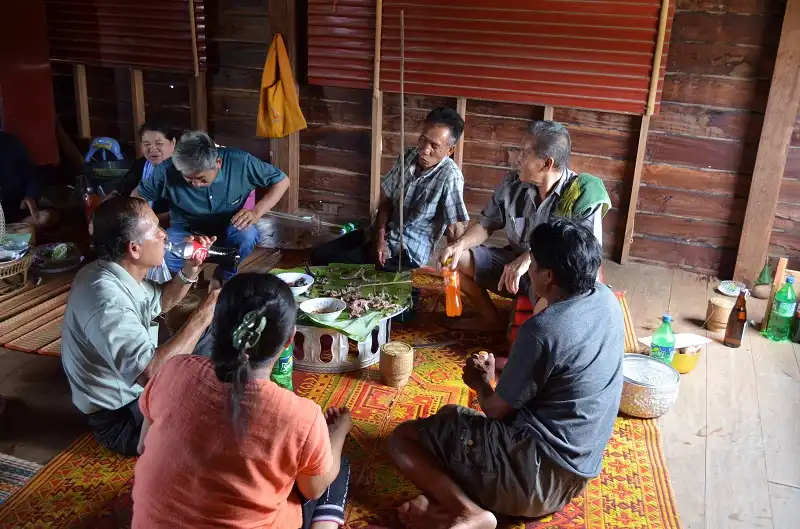
What is especially interesting is that although the ritual belongs to the spirit line within the family, the atmosphere of the event is socially open. The remaining pork is cooked into food for all who attend, including relatives, neighbors, and sometimes people from other ethnic groups who are close to the host family, such as Thai-Lao Wiang, Lao Phuan, or Chinese people from nearby villages. Guests usually bring 1 bottle of local liquor to help the host, as an act of generosity and participation in the community’s support system. The Sen Heuan tradition is therefore a ritual of relationships, not merely a ritual of belief.
In another sense, Sen Heuan clearly reflects the ethic of gratitude. Thai Song Dam believe that if the ritual is not performed, the ancestral spirits may go hungry and may disturb their descendants. This belief makes the ritual an obligation rather than a choice. Not performing it is not seen merely as neglecting tradition, but may also cause society to view the householder as ungrateful, failing to recognize the debt owed to the departed who once nurtured and continued the lineage. Sacred belief and social pressure therefore reinforce one another, allowing the ritual to endure for a long time.
At the same time, the intensity of the Sen Heuan ritual has inevitably changed in the modern era. Some communities still perform it in full form, while others have reduced certain details depending on economic conditions, available time, and the decreasing number of people who still possess ritual knowledge. In many areas, exhibitions or demonstrations of Thai Song Dam traditions are now organized in cultural centers so that younger generations and visitors can understand the roots of the ritual. Although a demonstration is not the same as the actual ceremony, it still plays an important role in preserving the knowledge from disappearing.
Another change is the transformation of the ritual from a private community ceremony into a form of cultural heritage that outsiders have begun to take interest in. Thai Song Dam cultural centers in several provinces, such as Khao Yoi in Phetchaburi, Wat Don Phrom in Bang Phae of Ratchaburi, Don Khlang in Damnoen Saduak of Ratchaburi, and the Thai Song Dam community at Ban Hua Khao Chin in Pak Tho, all play a role in presenting the way of life, beliefs, and rituals of the Thai Song Dam, including knowledge about Sen Heuan or Sen Ruean. This means that the tradition is no longer confined only to the homes of those who inherit the spirit line, but has increasingly entered public learning spaces.
Although Sen Heuan is a ritual centered on ancestral spirits, when examined more deeply it speaks fully about human life together. It teaches people not to forget their roots, to take responsibility for their lineage, to share food, to cooperate in work, and to recognize that no one lives alone, but is supported by ancestors, relatives, and community. The true value of Sen Heuan is therefore not merely feeding spirits, but sustaining relationships among both the living and the dead within the same cultural system.
From an anthropological perspective, the Sen Heuan tradition is a clear example of a ritual that integrates religion, belief, kinship, and household economy. A single ceremony performs many functions at once: communicating with ancestors, affirming the status of the spirit successor, distributing food among relatives, building cooperation in the community, and subtly regulating the moral code of gratitude. For this reason, Sen Heuan should be explained in depth as cultural heritage, not merely mentioned as an old folk tradition.
For contemporary readers, understanding the Sen Heuan tradition also helps open a new perspective on the term “Thai tradition.” It shows that Thai identity does not have a single form, but consists of many cultural worlds belonging to different ethnic groups, each with its own system of values and ritual practices. Sen Heuan is therefore part of the larger picture that helps us see Thailand as a living multicultural society with roots of meaning that go much deeper than superficial tourism.
Access to Learning Sources For those who wish to study the Sen Heuan tradition in a field context, there are now several Thai Song Dam cultural centers and related communities that preserve knowledge about way of life, rituals, clothing, and traditional houses, such as the Thai Song Dam Cultural Center in Khao Yoi, Phetchaburi; the Thai Song Dam Cultural Center at Wat Don Phrom in Ratchaburi; the Don Khlang Thai Song Dam Arts and Culture Conservation Center in Ratchaburi; and the Thai Song Dam community at Ban Hua Khao Chin in Ratchaburi. Visiting these places helps deepen understanding of Sen Heuan within its real-life cultural context, even though the actual ritual date depends on the custom of each lineage.
In conclusion, the Sen Heuan tradition is a highly valuable ritual for understanding the worldview of the Tai Dam or Thai Song Dam people, because it reveals their relationship with ancestors, kinship structure, sharing within the community, and ethics of gratitude in a complete way. Even though modern life has changed some aspects of the ceremony, the essence of Sen Heuan remains powerful as a form of cultural heritage, affirming that a community stays strong when its people do not forget both their roots and their relationships within the household and society.
| Name of Tradition | Sen Heuan Tradition |
| Other Names | Sen Ruean, House Spirit Offering, House Spirit Feeding Ritual |
| Ethnic Group Preserving the Tradition | Tai Dam, Thai Song Dam, Thai Song, Lao Song |
| Tradition Summary | A ritual of offering to the house spirits or ancestral spirits of the Thai Song Dam people, performed to express gratitude, invite ancestors to receive offerings, and ask them to protect the descendants in the household. |
| Highlights of the Tradition | Detailed arrangement of offerings on the Pan Phuean, the use of a male pig as the main ritual offering, the role of the Mor Sen in selecting the auspicious day and leading the ceremony, and the gathering of relatives in a single event. |
| Common Period of Observance | Lunar months 4, 6, and 12 according to the customs of many communities, while months 9 and 10 are generally avoided. |
| Significance | A ritual expressing gratitude to ancestors, strengthening unity among relatives, maintaining the house spirit succession system, and encouraging mutual support in the community through participation and shared meals. |
| History and Origin | Derived from the ancestral spirit belief system of the Tai Dam or Thai Song Dam people, in which the spirits of ancestors are invited to reside in the Kalor Hong inside the house, and the Sen Heuan ritual is performed periodically to nourish and honor them while asking for protection. |
| Main Ritual Participants | The host family, the male head or successor of the house spirit line, and the Mor Sen ritual specialist |
| Main Offerings | A male pig, Pan Phuean tray, 7 pieces of raw pork with bone, 7 pork ribs, cooked intestines, 7 packets of sticky rice, liquor, fruits, sweet potatoes, taro, chopsticks, a tray of betel nut and betel leaves, pork broth, plain water, and a tooth-cleaning stick |
| Important Taboos | It is generally not performed in lunar months 9 and 10 according to some community beliefs, and the ritual date should not coincide with the cremation day of ancestors because that is considered inauspicious. |
| Current Status | Still preserved in some Thai Song Dam communities and increasingly presented through cultural centers and learning centers in several provinces. |
| Related Communities / Learning Centers | 1. Thai Song Dam Cultural Center, Khao Yoi, Phetchaburi – Tel. 032-561200, 032-562061 ext. 24 2. Thai Song Dam Cultural Center (Huen Phu Tai Dam), Wat Don Phrom, Bang Phae, Ratchaburi – Tel. 032-206126, 089-836-5875 3. Thai Song Dam Arts and Culture Conservation Center, Don Khlang, Damnoen Saduak, Ratchaburi – Tel. 084-187-9491, 032-322786 4. Thai Song Dam Cultural Center, Ban Hua Khao Chin, Pak Tho, Ratchaburi – Tel. 061-408-1354, 086-018-9318 5. Ancient Tai Dam Cultural Revival Center, Ban Don, U Thong, Suphan Buri – Tel. 088-458-2266 |
| Travel for Cultural Study | Visitors should contact Thai Song Dam cultural centers or communities in advance, because the actual ritual date depends on family auspicious timing and host readiness, and is not held as a daily tourism program. |
Frequently Asked Questions (FAQ)
Q: What is the Sen Heuan tradition?
A: Sen Heuan is a ritual of offering to the house spirits or ancestral spirits of the Tai Dam or Thai Song Dam people, performed to express gratitude and ask ancestors to protect their descendants in the household.
Q: In which months is the Sen Heuan tradition usually held?
A: Many communities commonly hold the ritual during lunar months 4, 6, and 12, while months 9 and 10 are generally avoided because of the belief that the house spirits must attend the heavenly realm or deity.
Q: Why is a male pig used in the Sen Heuan ritual?
A: The male pig is considered the main ritual offering, raised in advance by the host family for the purpose of feeding the house spirits and serving food to guests, reflecting both readiness and the completeness of the ceremony.
Q: What is the role of the Mor Sen?
A: The Mor Sen determines the auspicious date, recites the names of the house spirits, invites the ancestors to receive the offerings, and ensures that the ritual follows the customs of each lineage correctly.
Q: Why is the Sen Heuan tradition important to the community?
A: In addition to expressing gratitude to ancestors, it helps relatives gather together, encourages mutual support, food sharing, and strengthens unity within the family and community.
Q: Where should I go if I want to learn about the Sen Heuan tradition?
A: It is best to begin with Thai Song Dam cultural centers or communities that continue to preserve Thai Song Dam traditions, such as those in Khao Yoi, Phetchaburi, Bang Phae, Damnoen Saduak, or Pak Tho in Ratchaburi, and you should always contact the community in advance.
Comment
| Keyword (Advance) |
Region
|


Category:
Group: