

 Home
Home Chiang Mai(






















Rating: 4.1/5 (9 votes)
 |
|  Map
Map 
 Have Map
  No Map
Ratchaburi attractions
Attractions in Thailand
Open Days: Open Daily
Opening Hours: 08:00 - 17:00
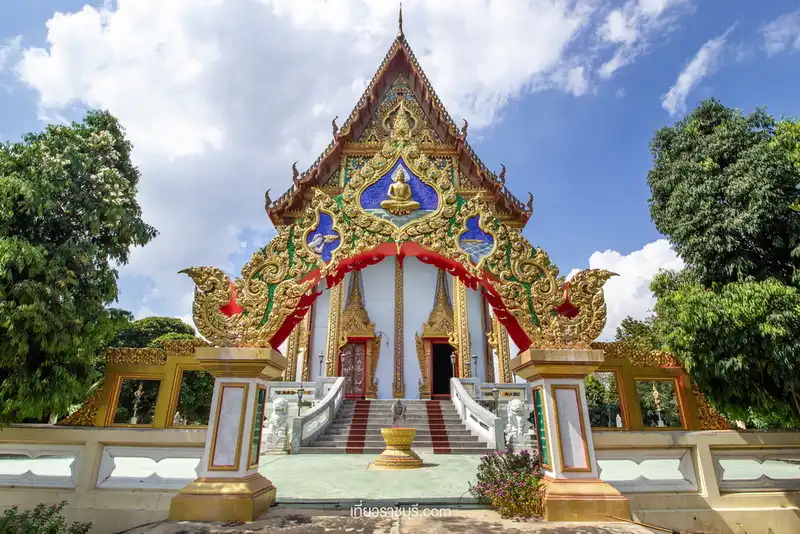
Wat Yai Nakhon Chum, Ratchaburi Province, is an ancient temple of the Mon community in Ban Pong District. It stands out for its Mon art, Mon cultural way of life, and local traditions that are still actively preserved, including Mon Songkran, khao chae, honey alms offering, and long-boat races during Ok Phansa. It is therefore both an important religious site and a cultural attraction with a distinctive charm unlike other temples in Ratchaburi.
Wat Yai Nakhon Chum is one of the most distinctive temples in Ratchaburi Province because it is not merely a place for merit-making and worship, but also the spiritual heart of the Mon community in the Mae Klong River basin. It is a space that clearly reflects the coexistence of religion, ethnicity, tradition, and local architecture. The temple is located in Moo 6, Nakhon Chum Subdistrict, Ban Pong District, Ratchaburi Province, surrounded by a community whose population is largely Thai people of Mon descent who have preserved their cultural heritage for many generations.
For travelers who enjoy visiting temples, Wat Yai Nakhon Chum has a different kind of charm from widely known mainstream temples. Its strength lies in the “living community” that still surrounds the temple at all times. Visitors do not encounter only an ordination hall, vihara, or chedi, but also experience the atmosphere of an old Mon community that continues to preserve its customs, language, food, dress, and rituals in an impressive way. It is therefore an ideal temple for those seeking cultural tourism that goes deeper than taking photographs or simply checking in.
The importance of Wat Yai Nakhon Chum begins with its role as the spiritual center of the Mon people who settled in Thailand hundreds of years ago. The community in this area is rooted in Thai people of Mon descent who migrated into Thailand in several waves, from the late Ayutthaya period through Thonburi and the early Rattanakosin era. Their shared memory is that they were Mon people who came under the royal protection of Thai kings, settled down, worked honestly, lived simple lives, and maintained a deep devotion to Buddhism. This naturally made the temple the center of community life.
From the perspective of ethnic history, the Mon people dispersed across Ratchaburi and the Mae Klong River basin are among the groups that have greatly influenced local culture, whether in language, food, beliefs, music, or religious ceremonies. The Mon community of Nakhon Chum is therefore not merely a small surviving ethnic group, but a community that still plays an active role and preserves its cultural identity with remarkable strength. Wat Yai Nakhon Chum, as the center of the community, functions like a living archive of cultural memory and is far more significant than simply being a village temple.
As for the history of Wat Yai Nakhon Chum, there is no definite evidence of who built it or in what year it was first established. This is one of the charms of old temples in ancient communities, because what has been passed down is often preserved as community memory rather than official written records. Elderly local residents commonly believe that this area may once have been the site of an earlier temple and may possibly date back to the Dvaravati period. However, in terms of formal historical evidence, there is no conclusive confirmation at that level. It is therefore important to understand that this part is “community belief and local hypothesis,” reflecting the remembered past of the area rather than a fixed academic conclusion.
Although there is no firm evidence about the earliest construction, what the community consistently remembers is that Wat Yai Nakhon Chum had once been an abandoned old temple. When Mon migrants later settled firmly in the area, they revived the temple on that original site. In the beginning, it remained only a small monastic residence, just enough for monks to stay and for villagers to come and make merit, listen to sermons, and hear Dhamma teachings. This early simplicity reflects the traditional role of Thai temples as spiritual anchors and centers of communal life, rather than as grand religious monuments built for display.
What makes Wat Yai Nakhon Chum especially distinctive is that the community continues to preserve Mon traditions closely tied to the temple. The temple is not separated from the community, but serves as the place where Mon people carry out major rituals of life, including merit-making, Songkran, ordinations, Ok Phansa, and other ceremonies specific to Mon temples. This relationship gives the temple a cultural density greater than that of many ordinary temples, because every structure, every ritual, and every festival carries meaning for the people of the community.
In terms of ecclesiastical administration, Wat Yai Nakhon Chum was officially recognized as a temple in 1941 and belongs to the Mahanikaya order. This means that the temple is not only significant in the social and cultural sense as an old temple, but is also formally acknowledged within the Thai Sangha system. This recognized status has allowed the temple to continue fulfilling religious and social roles up to the present day.
When speaking of Wat Yai Nakhon Chum, one thing visitors should not overlook is the temple’s permanent architecture, which local residents and knowledgeable people consistently describe as fully reflecting Mon artistic style. Whether in the monks’ residences, pavilions, ordination hall, or chedis, Mon architecture appears not only in outward form, but also in the way sacred space is conceived, in the relationships between buildings, and in the aesthetic mood of calmness, gravity, and delicacy that is specific to the Mon community.
The ordination hall of Wat Yai Nakhon Chum is one of the points that most attracts visitors, because it clearly represents the status of the temple. Although restoration and repair have taken place many times over the years, the overall character of the temple still preserves the narrative of Mon art quite well. The vihara, chedis, and other temple buildings all help tell the story of Mon identity to visitors. There is no need for long explanations; by walking through the temple attentively, one begins to notice an architectural language that differs from that of ordinary Central Thai temples.
Another important point of the temple is the “Wihan Paki,” which enshrines two ancient and sacred Buddha images of the temple and serves as the center of the celebration of Wihan Paki, held according to the temple’s schedule. This vihara is important not only in ritual terms, but also because it reflects the temple’s role as a place for preserving sacred symbols of the community. Many villagers feel deeply connected to Wihan Paki as a focal point of faith and regard it as an essential part of the spiritual identity of Wat Yai Nakhon Chum.
When viewed as a tourist destination, what makes Wat Yai Nakhon Chum especially different is its “living temple” character. The temple is not simply an old site that stands quietly for people to view as a historical monument. It is a place where real traditions, real people, real language, and real food continue to exist together. Anyone who enjoys seeing culture actively lived out in front of them will find that Wat Yai Nakhon Chum offers far more than temples valued only for beautiful buildings.
One of the most outstanding festivals of the temple is “Sangkran Nakhon Chum,” held every year from 13–15 April. This is the Mon Songkran festival, distinctively colorful in dress, language, food, and ritual. Visitors can observe how it differs from ordinary urban Songkran through activities such as the saba game, Mon spirit dance performances, the Mon Songkran queen contest, and exhibitions of Mon food. This festival is therefore not merely a celebration, but a stage on which the identity of the community is fully expressed.
During the same period, there is also the “Mon Songkran Khao Chae Tradition,” which is another highly interesting ceremony for cultural tourists. Thai people of Mon descent in the Mae Klong River basin build small spirit shrines or Hoi Sa Mern Sangkran, complete with offerings and food, especially khao chae, to welcome the new deity in front of nearly every household. This ritual demonstrates the relationship between food culture, belief, and everyday life in a very tangible way. The temple, as the spiritual center, plays a deeply important role in the atmosphere of this festival.
The Mon ordination ceremony is another defining image of Wat Yai Nakhon Chum, because it still preserves Mon traditions firmly, whether in costume, procession, ritual procedure, or atmosphere as a whole. In the Mon community, ordination is not merely a religious act, but also a declaration of ethnic identity and a continuation of cultural roots for younger generations to witness. The beauty of the Mon ordination ceremony therefore lies in the unity of the whole community, not only in the ordinand himself.
Another highly distinctive ritual is the “Honey Alms Offering Tradition,” held on the full moon day of the 10th lunar month. Offering honey has deep meaning in monastic discipline, because honey may be given to monks for medicinal use as a liquid remedy. This tradition is found in several Mon temples, but its presence at Wat Yai Nakhon Chum highlights even more clearly the continuity of Mon religious customs within the community. Visitors who witness this ceremony immediately understand that Mon temples still preserve rituals that differ in many ways from those of ordinary Thai temples.
Ok Phansa at Wat Yai Nakhon Chum is especially lively. In the morning, there is Tak Bat Thewo, or what villagers call “Tak Bat Phra Roi,” which in Mon is called “Long Ha Piang Sangklom.” In the afternoon, long-boat races are held in the Mae Klong River in front of the temple. The atmosphere of Ok Phansa here thus combines religious ceremony with community festivity at the same time. It is an image that clearly shows how closely this temple is tied to the river and the way of life of the Mae Klong people.
The long-boat racing tradition at Wat Yai Nakhon Chum is quite well known, because it is a traditional long-boat competition held on Ok Phansa day for a royal trophy bestowed by His Majesty the King. The event takes place every year on Ok Phansa, and many boats participate annually, making the area in front of the temple especially vibrant. This event is therefore both a sporting activity, a merit-making occasion, and a local festival that beautifully combines faith with collective community effort along the river.
Another ceremony that very clearly reflects the unique character of Mon temples is the “Thukkhata Than” ritual, a Buddhist belief ceremony found more often in Mon temples than in ordinary Thai temples. This ritual is usually held every three years during the period between the 10th and 11th lunar months. Monks draw lots with the names of villagers, and whoever is selected will invite that monk to their home. This is regarded as a great joy for the household, because regardless of financial status, everyone has equal opportunity in the ritual. It therefore reflects both faith and equality within the community in a profound way.
When walking through Wat Yai Nakhon Chum on ordinary days, visitors can clearly feel an atmosphere different from urban temples. The calm here does not come from empty silence, but from the rhythm of community life that unfolds in a simple, thoughtful, and unhurried way. Around the temple is a Mon community that adds depth to the temple visit. Those who enjoy observing local ways of life will immediately sense that this temple is not separated from the village, but has grown together with the community in a very close way.
In artistic terms, Wat Yai Nakhon Chum is ideal for those who want to see the distinctiveness of Mon art in a real setting. Many people may be familiar with the term “Mon temple” only as a label, but when they encounter the actual architecture, they can see Mon identity expressed in the form of the chedis, the spatial layout, and the atmosphere of the religious buildings. It is therefore a temple especially well suited for travel that engages both the eye and the heart.
If planning a visit to Wat Yai Nakhon Chum, the festival periods are the best times for those who want to see Mon identity in its fullest form, especially during Songkran and Ok Phansa, when the community expresses itself vividly through ritual and festivity. However, if you wish to experience peace and explore the buildings fully in a quieter setting, ordinary weekdays or mornings are also excellent times to visit.
In terms of access, Wat Yai Nakhon Chum is located in Ban Pong District, Ratchaburi Province, and is convenient to reach from both Bangkok and Ratchaburi town. Travelers with private cars can easily combine a visit with the Mon community or nearby attractions in Ban Pong. For those exploring Ratchaburi through a cultural route, this temple is certainly one of the places that should not be missed, because it brings together religious, ethnic, and traditional dimensions in a single place.
Getting There If traveling from Bangkok, you can take the route to Ban Pong District, Ratchaburi Province, and then continue into Nakhon Chum Subdistrict by local roads. The temple is located in Moo 6, Nakhon Chum Subdistrict, within an old Mon community, making it suitable both for a dedicated temple visit and for combining with other cultural attractions in Ban Pong District.
Overall, Wat Yai Nakhon Chum is a temple rich in many kinds of value: as an old temple of a Mon community, as the spiritual center of Thai people of Mon descent, as a place that preserves Mon traditions, and as a living cultural attraction. Its distinction does not lie merely in the scale of its buildings, but in the fact that it still remains truly “a place of the community.” That is precisely what gives Wat Yai Nakhon Chum a deeper charm than many ordinary temple attractions.
For those who want to know Ratchaburi in a dimension deeper than its mainstream attractions, Wat Yai Nakhon Chum is a clear answer. Here, one can see how religion, culture, and ethnicity continue to coexist harmoniously. A visit to this temple is therefore not merely an act of paying respect to Buddha images, but a chance to encounter the living heart of the Mon community that still beats strongly today.
| Place Name | Wat Yai Nakhon Chum |
| Type Of Place | Ancient Temple / Mon Temple / Religious And Cultural Attraction |
| Address | Moo 6, Nakhon Chum Subdistrict, Ban Pong District, Ratchaburi Province |
| Main Characteristics | A temple of an old Mon community in the Mae Klong River basin, distinguished by Mon art, Mon cultural life, and Mon traditions that continue to be preserved |
| Period / Era | There is a local belief that the site may overlap an older abandoned temple, but official data states that it was formally recognized as a temple in 1941 |
| Highlights | 1) Ancient Mon community 2) Mon art in monks’ residences, pavilions, ordination hall, and chedis 3) Wihan Paki 4) Two sacred ancient Buddha images 5) Mon Songkran festival 6) Honey alms offering tradition and long-boat races |
| Important Evidence / Information | It is a temple of the Mon community in Nakhon Chum Subdistrict, has Wihan Paki enshrining two sacred ancient Buddha images, preserves several important Mon traditions, and was officially recognized as a temple in 1941 |
| Name Origin | The temple name is connected to the community of “Nakhon Chum,” which is an old Mon settlement in Ban Pong District, and the temple has long served as the spiritual center of the community |
| Religious Order | Mahanikaya |
| Current Abbot / Administrator | Phra Khru Nakhon Khemakit |
| Main Zones Inside The Temple | 1. Ordination Hall 2. Wihan Paki 3. Mon-style Chedis 4. Pavilions and Monks’ Residences 5. Ritual Courtyard and Community Tradition Area |
| Open Days | Open Daily |
| Opening Hours | 08:00 - 17:00 |
| Fees | No admission fee information was found in the checked public sources |
| Getting There | Travel to Ban Pong District, Ratchaburi Province, then continue into Nakhon Chum Subdistrict. The temple is located in Moo 6 of an old Mon community and is suitable for combining with other attractions in Ban Pong and the Mae Klong area |
| Current Status | Still active as a religious center and as the focal point of Mon traditions in the community |
| Contact Numbers | 032-211-422, 081-880-7348, 081-983-4458, 095-961-9464, 082-460-5949 |
| Nearby Attractions With Distance | 1. Ban Pong Market — Approx. 5 km — No publicly verified number found 2. Wat Muang, Ban Pong — Approx. 6 km — 032-221-184 3. Ban Pong Railway Station — Approx. 5 km — 1690 4. Pho Hak Floating Market — Approx. 22 km — 032-720-245 5. Wat Khanon Nang Yai Museum — Approx. 28 km — 032-233-386 |
| Popular Restaurants Nearby With Distance | 1. Khun Mam Egg Noodles, Ban Pong — Approx. 5 km — 089-918-3559 2. Ban Pong Pochana Restaurant — Approx. 6 km — 032-211-314 3. Lum Mae Klong Restaurant — Approx. 8 km — 081-944-5471 4. Rim Nam Mae Klong Restaurant — Approx. 9 km — 081-017-7803 5. Local Nakhon Chum Restaurant — Approx. 2 km — 095-961-9464 |
| Popular Accommodations Nearby With Distance | 1. Space 59 Hotel — Approx. 6 km — 032-206-599 2. My Room Boutique Hotel — Approx. 7 km — 032-219-444 3. Baan Nam Pen Resort — Approx. 9 km — 081-944-5471 4. Western Grand Hotel Ratchaburi — Approx. 19 km — 032-337-111 5. Na Wela Ratchaburi — Approx. 20 km — 032-206-888 |
Frequently Asked Questions (FAQ)
Q: Where is Wat Yai Nakhon Chum located?
A: Wat Yai Nakhon Chum is located in Moo 6, Nakhon Chum Subdistrict, Ban Pong District, Ratchaburi Province, within an old Mon community in the Mae Klong River basin.
Q: What is interesting about Wat Yai Nakhon Chum?
A: The main highlights are its identity as an old Mon temple, Mon architectural style in the temple buildings, Wihan Paki, sacred Buddha images, and Mon traditions that are still actively celebrated every year.
Q: How old is Wat Yai Nakhon Chum?
A: The community believes the site may overlap an ancient abandoned temple, but the officially verified information is that it was formally recognized as a temple in 1941.
Q: When is the best time to visit Wat Yai Nakhon Chum?
A: If you want to experience Mon culture most vividly, the best time is during the Mon Songkran festival on 13–15 April or during Ok Phansa, when there are both Tak Bat Phra Roi and long-boat races.
Q: What important traditions are associated with Wat Yai Nakhon Chum?
A: The temple is known for Sangkran Nakhon Chum, Mon Songkran Khao Chae, Mon ordination ceremonies, the Wihan Paki celebration, the honey alms offering tradition, Ok Phansa boat races, and the Thukkhata Than ritual.
Q: What is Wihan Paki?
A: Wihan Paki is an important sacred space inside the temple where two ancient revered Buddha images are enshrined, and it serves as the center of one of the community’s major ceremonial celebrations.
Q: Is Wat Yai Nakhon Chum open every day?
A: Yes. The temple is open daily, and the opening hours are 08:00 - 17:00.
Q: What places can be visited together with Wat Yai Nakhon Chum?
A: A trip can be combined with Ban Pong Market, Wat Muang in Ban Pong, Ban Pong Railway Station, Pho Hak Floating Market, or the Wat Khanon Nang Yai Museum.
 Tel: 032297346
 Mobile: 0835427601
 Wat Yai Nakhon Chum Map
 Category:
  Group:
  Last Update: 9 HourAgo
Comment
 Nearby Attractions
| Keyword (Advance) |
 Facebook Fanpage
 Region
 Art, Culture and Heritage
 Historical Sites and Monuments(
 Landmarks and Memorials(
 Art, Craft Centres, Tradition(
 Museums(
 Art Gallery(
 Educational Places
 Educational Gardens, Farm(
 University
 Other religious and spiritural sites(
 Research and Development
 Royal Project(
 Suburban Living
 Village, Community(
 Local Market(
 Floating Market(
 Nature and Wildlife
 National Parks and Marine Reserves(
 Mountain (Doi)(
 Dam, Reservoir, Lake(
 Waterfalls(
 Hot Springs(
 Caves(
 Flower Field(
 River, Canal(
 Other natural attractions(
 Entertainment and Agricultural
 Zoos and Aquariums(
 Animal camps and shows(
 Farm, Parks, Gardens and Ecotourism(
 Waterpark(
 Outdoor and Adventure Activities(
 Shopping
 Shopping and Night Market(
 Spas and Wellness
 Spas and Wellness(
 Travel Articles, Recipes
 Travel Review, Food Review(