

 Home
Home Chiang Mai(

















Rating: 2.6/5 (7 votes)
 |
|  Map
Map 
 Have Map
  No Map
Ratchaburi attractions
Attractions in Thailand
Open Days: Open daily
Opening Hours: 08:00 - 17:00
Wat Srisuriyawongsaram Worawihan, also known among local residents as Wat Srisurayong, is a third-class royal monastery of the Worawihan grade under the Dhammayut order and is one of the most important temples in Ratchaburi Province. The temple’s main distinction lies in the fact that it was initiated and privately funded by Somdet Chao Phraya Borom Maha Srisuriyawong (Chuang Bunnag) in 1874 as the temple of the Bunnag family. It is also a major historical landmark reflecting the transformation of Siam during the reign of King Rama V through architecture that blends traditional Thai art with Western influence in a highly distinctive way. For those looking to visit a temple in Ratchaburi that offers deep history, beautiful art, and a peaceful atmosphere in the heart of the city, Wat Srisuriyawongsaram Worawihan is one destination well worth visiting.
Wat Srisuriyawongsaram Worawihan, Ratchaburi is located on Amarin Road, Na Mueang Subdistrict, Mueang Ratchaburi District, Ratchaburi Province. It is a third-class royal monastery of the Worawihan grade under the Dhammayut order and is regarded as one of the most historically valuable temples in the province. The importance of this temple does not rest only on its age as a religious site, but also on its close connection to one of Siam’s key statesmen, Somdet Chao Phraya Borom Maha Srisuriyawong (Chuang Bunnag), who played a major role during an important period of political transition in the country. The significance of the temple therefore extends beyond the local level and is closely connected with Thai political history, architecture, and society in a broader sense.
In terms of location, Wat Srisuriyawongsaram Worawihan stands in a convenient urban area of Ratchaburi, making it easy to connect with other important attractions in the city, whether the Ratchaburi National Museum, Wat Mahathat Worawihan, Koi Ki Old Market, or other contemporary sites within the town. Its location in the Na Mueang area also gives it the character of a true city temple, closely tied to the people, daily life, and historical fabric of Ratchaburi. Visitors who come here therefore do not only come to pay respect or admire the architecture, but also to experience another layer of old Ratchaburi through this temple.
The history of Wat Srisuriyawongsaram Worawihan began in 1874 on abandoned land near a market community, which belonged to Somdet Chao Phraya Borom Maha Srisuriyawong (Chuang Bunnag). He intended to build a temple there to serve as the temple of the Bunnag family. This came after he had already built a royal palace on Khao Sattanat and completed supervision of the construction of Wat Sattanat Pariwat. The creation of this temple was therefore not merely an act of private religious merit in the ordinary sense, but the foundation of a temple with clear significance in terms of religion, family lineage, and history.
The fact that Wat Srisuriyawongsaram Worawihan is the temple of the Bunnag family gives it particular historical weight, because the Bunnag family was one of the most powerful noble families in the Siamese court, especially during the late reign of King Rama IV and the early reign of King Rama V. Somdet Chao Phraya Borom Maha Srisuriyawong himself was a major political figure as Regent of the Kingdom and Minister of Defence. His decision to build this temple with private funds reflects not only his wealth and influence, but also his determination to leave a lasting religious and cultural legacy in Ratchaburi.
Another important distinction of this temple is that it stands as a historical record of Siam’s transformation during the reign of King Rama V, particularly in the field of architecture and art, when Western influence increasingly began to appear. Many traditional Thai temples still retained older forms very firmly, but at Wat Srisuriyawongsaram Worawihan visitors can clearly see the adaptation of Thai and Western forms together, especially in the use of Roman columns, walls painted to imitate marble, and building forms that appear solemn, elegant, and highly ordered in a different stylistic sense.
Once the temple was completed, with its monastic buildings, ordination hall, and chedi already in place, Somdet Chao Phraya Borom Maha Srisuriyawong respectfully presented it to the crown as a royal monastery and requested a royal name together with the granting of a consecrated boundary. King Chulalongkorn graciously bestowed the temple name, and later a royal decree granted the temple its formal boundary in 1879. This event gave the temple complete religious status and further confirmed that this was not merely a privately built memorial temple, but one that had been formally recognized and honored by the monarchy.
It is interesting that early historical records refer to the temple under forms such as “Wat Srisuriyawongsawat” and “Wat Srisuriyawongsaram” before the present official form, Wat Srisuriyawongsaram Worawihan, came into use. Such details about naming help illustrate the fluidity of official documentation and formal language in that era, and they also give the temple an additional dimension in documentary history beyond what is usually found in ordinary temples. The popular local name “Wat Srisurayong” further shows how community memory and official naming can coexist naturally.
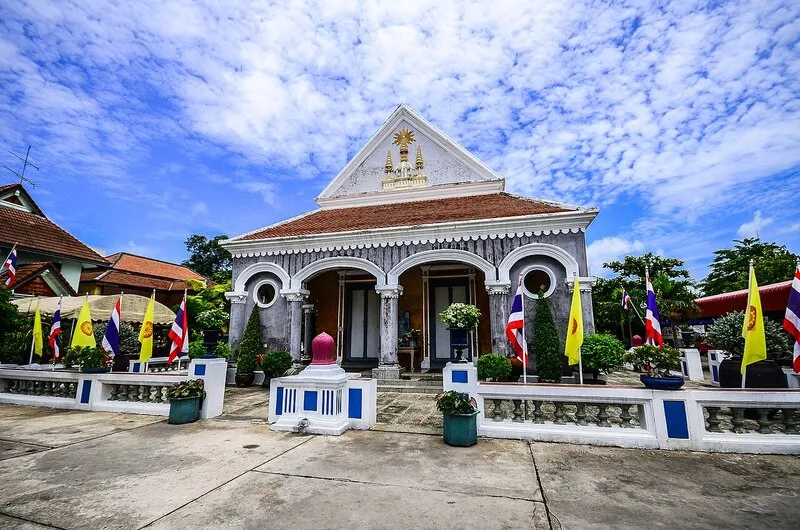
The ordination hall of Wat Srisuriyawongsaram Worawihan is the most important structure in the temple, both in terms of ritual use and artistic value. The building was constructed around 1877–1879 and displays Thai architecture adapted with Western artistic influence, which was fashionable during that period. The building has a low but broad form that conveys stability and dignity. Its brick-and-plaster walls are painted to imitate marble, the veranda columns are round Roman-style columns, and the end sections supporting the veranda are shaped with continuous arched wall forms. These details give the ordination hall a very distinctive character and make it an excellent example of Western influence entering Thai religious architecture.
Even though the building clearly reflects Western influence, the ordination hall still preserves a deeply Thai character in its function, sacred meaning, and overall composition. Inside the hall are portraits of King Chulalongkorn and Somdet Chao Phraya Borom Maha Srisuriyawong, placed there in remembrance of the important individuals who supported the temple. Details like these make the ordination hall more than simply a place for monastic ceremonies; it also becomes a space of memory linking the monarchy, the nobility, and Buddhism together in a remarkably close way.
The principal Buddha image inside the ordination hall is a bronze, lacquered, and gilded image in the Mara-victory posture, created in Rattanakosin style. Its features are calm, graceful, and spiritually grounding. The choice of a Mara-victory image as the principal Buddha image also corresponds to the conventions of important Rattanakosin temples, where the image of the Buddha overcoming Mara symbolizes stability, peace, and steadfastness in the Dhamma. Those who step inside the ordination hall can therefore immediately feel the solemn, composed, and powerful atmosphere of the space.
Another major feature that stands out alongside the ordination hall is the chedi located behind the main building. The chedi of Wat Srisuriyawongsaram Worawihan is a bell-shaped stupa set on a high octagonal base, and it continues the same Roman-column and arched-wall language seen in the ordination hall. The consistency of these design elements shows that the temple was conceived with a unified architectural vision rather than being built in disconnected stages. It is also believed that the chedi was intended to enshrine relics of the Buddha, which adds another important dimension of faith to the temple.
The abbot’s residence is another noteworthy permanent structure in the temple. It is a two-storey brick-and-plaster building with teakwood floors and a roof covered with clay tiles, reflecting the care and seriousness invested in the design of the temple’s living and administrative spaces in its formative years. Temples with such structures often reflect the status and resources of their patron, and in the case of Wat Srisuriyawongsaram Worawihan, the building further emphasizes that this was a temple founded with dignity and clear purpose from the very beginning.
In addition, the temple contains what is known as the “Japanese Kuti,” an element that adds further distinctiveness to the temple beyond what is usually found in city monasteries. Although the deeper details of this building are not as widely discussed as the ordination hall or the chedi, the presence of a structure known by this name suggests that Wat Srisuriyawongsaram Worawihan contains a wider range of architectural and cultural layers than many other temples. Visitors who enjoy exploring temple grounds carefully will find that this temple offers many smaller details worth pausing to observe.
The temple gate is another striking architectural feature. The current gate was built later to replace an earlier one that had to be removed when the temple grounds were expanded, but it still follows the same architectural language as the ordination hall, using brick and plaster, round columns, and a gentle blending of Western artistic influence with Thai temple form. The gate is therefore not simply an entranceway, but acts as a visual introduction that prepares visitors from the very first step to understand that this temple possesses its own distinctive architectural language.
The sermon hall and other functional areas within the temple further demonstrate that Wat Srisuriyawongsaram Worawihan is valuable not only as a historical monument, but also as a living temple in the present day. Various parts of the temple continue to support religious activities, merit-making ceremonies, and everyday use by both the monastic community and the surrounding population. A temple of this kind holds special value for travel writing because it can be described in both its historical and contemporary dimensions, rather than only as an old site frozen in time.
In terms of the history of Ratchaburi itself, Wat Srisuriyawongsaram Worawihan serves as an especially important reference point, because it can be used to connect the story of the Bunnag family, the reform of Siam, the reception of Western influence, and the development of Ratchaburi as an important city in western Thailand all at once. Some temples stand out mainly for devotion, while others are known mainly for beauty, but in the case of Wat Srisuriyawongsaram Worawihan, it stands out both as evidence of architectural change and as evidence of history at the same time.
The latest available information indicates that Wat Srisuriyawongsaram Worawihan has Phra Phrommongkhon Watcharachan (Sai Watthano) as its abbot. Having a senior monk of high ecclesiastical rank overseeing the temple clearly reflects its status and importance within the Dhammayut order, while also confirming that this is not merely an old temple preserved for viewing, but a real center of administration and religious life that continues to function actively today.
For travelers, Wat Srisuriyawongsaram Worawihan is especially suitable for the kind of visit that could be described as “reading the city through its temple,” because beyond admiring major structures such as the ordination hall, the chedi, the abbot’s residence, and the gate, visitors can connect all these elements back to the broader history of Ratchaburi in a systematic way. Those interested in art history will particularly appreciate the Thai-Western architectural blend, while those focused on worship will value the quiet and solemn atmosphere within the grounds.
Another major strength of this temple is its urban location, which makes it much more convenient to reach than temples located deeper outside the town center. Travelers can easily combine it with other important temples and sites in Ratchaburi, such as Wat Mahathat Worawihan, Wat Sattanat Pariwat Worawihan, the Ratchaburi National Museum, and the old market district. This makes a one-day trip in Ratchaburi denser and richer in content without requiring long travel times between stops.
Getting There Wat Srisuriyawongsaram Worawihan is located at 365 Amarin Road, Na Mueang Subdistrict, Mueang Ratchaburi District, Ratchaburi Province. If traveling from Bangkok, visitors can take Phetkasem Road into Ratchaburi city and continue into the Na Mueang area using standard navigation. Because the temple lies in the city area, it is suitable for travel by private car, train, van, or public bus. If traveling by train, visitors can get off at Ratchaburi Railway Station and continue by hired transport or ride-hailing service into the city with little difficulty.
Visitors planning to come to the temple should dress respectfully according to Thai standards for visiting religious sites, avoiding sleeveless clothing and shorts or skirts that are too short, and should behave appropriately, especially in the ordination hall. Since this temple remains a royal monastery and is still actively used by monks and local people, it is important to show proper respect to the place.
The best times to visit are in the morning through late morning and again in the late afternoon, because the light is beautiful and the weather is not too hot. These times are ideal both for worship and for walking around to appreciate the buildings and take photographs. The architecture of the temple appears especially striking when lit by softer angled light, particularly around the ordination hall and the chedi, where the plaster details and Western-inspired forms become more visible.
To summarize clearly, Wat Srisuriyawongsaram Worawihan, Ratchaburi, is a temple that possesses full value in terms of political history, urban history, artistic heritage, and Buddhist devotion. It stands out as the temple of the Bunnag family, as a temple built by Somdet Chao Phraya Borom Maha Srisuriyawong, and as a temple that beautifully reflects Western influence in the religious architecture of the Rama V period. Combined with its convenient access and the surrounding context of old Ratchaburi, it truly deserves to be regarded as one of the most important temples in the province.
For those who want to understand Ratchaburi more deeply than through ordinary check-in spots, Wat Srisuriyawongsaram Worawihan is a very clear answer. It offers not only the image of a beautiful temple, but also the history of a major noble family, the transformation of Siam, blended architectural styles, and the atmosphere of an old city temple with a refined personality of its own. Standing before the ordination hall and carefully observing its architectural details makes it easy to understand why this temple holds a value far beyond that of an ordinary tourist destination.
| Place Name | Wat Srisuriyawongsaram Worawihan, Ratchaburi |
| Address | 365 Amarin Road, Na Mueang Subdistrict, Mueang Ratchaburi District, Ratchaburi 70000 |
| Place Summary | A third-class royal monastery of the Worawihan grade under the Dhammayut order, built by Somdet Chao Phraya Borom Maha Srisuriyawong in 1874. It serves as the temple of the Bunnag family and as an important historical landmark of Ratchaburi. |
| Highlights | Temple of the Bunnag family, Thai-Western ordination hall, chedi, abbot’s residence, Japanese kuti, temple gate, sermon hall, and historical importance connected with the reign of King Rama V |
| History | Construction began in 1874 with the private funds of Somdet Chao Phraya Borom Maha Srisuriyawong. It was laterถวาย as a royal monastery and received its royal boundary for ordination ceremonies in 1879. |
| Main Features Within the Temple | Ordination hall, principal Buddha image in the Mara-victory posture, chedi, abbot’s residence, Japanese kuti, temple gate, sermon hall, bell tower, and sandstone Buddha images |
| Name Origin | Named after Somdet Chao Phraya Borom Maha Srisuriyawong (Chuang Bunnag), the founder of the temple, and established as the temple of the Bunnag family |
| Current Abbot / Latest Caretaker | Phra Phrommongkhon Watcharachan (Sai Watthano) |
| Open Days | Open daily |
| Opening Hours | 08:00 - 17:00 |
| Fees | No admission fee |
| Facilities | Temple grounds, worship areas, pavilions, architectural walking areas, parking in the city zone, and convenient connections to nearby attractions and restaurants |
| Getting There | From Bangkok, take Phetkasem Road into Ratchaburi city, then continue to Amarin Road. If traveling by train, get off at Ratchaburi Railway Station and continue by local transport or a ride-hailing service into town. |
| Current Status | Still open and actively functioning, with ongoing temple activities |
| Temple Contact Number | 032-337-671 |
| Zone | Na Mueang Zone / Ratchaburi City Center / Old Ratchaburi Zone |
| Nearby Attractions with Distance | 1. Ratchaburi National Museum – approximately 0.7 km – Old Town / Historical Zone 2. Wat Mahathat Worawihan – approximately 0.9 km – Historic City Center Zone 3. Wat Sattanat Pariwat Worawihan – approximately 1.2 km – Na Mueang / Important Temple Zone 4. Koi Ki Old Market – approximately 1.3 km – Old Commercial and Local Food Zone 5. Ratchaburi City Pillar Shrine – approximately 1.5 km – City Center / Sacred Zone |
| Nearby Restaurants with Distance | 1. Kam Cheng Noodles – approximately 1.1 km – Old Town / Traditional Eatery Zone – Tel. 032-323-278, 093-264-9856 2. R-tee Kopee – approximately 1.0 km – Breakfast / Old Town Café Zone 3. Thanks – approximately 1.2 km – Café / City Center Zone 4. Den Thai Ice Cream – approximately 1.7 km – Sanam Ya Market / Dessert Zone – Tel. 081-001-9339 5. Por Pla Phao Ratchaburi – approximately 5.0 km – City Entrance / Thai-Isan Food Zone – Tel. 089-882-6886, 089-172-9501, 032-737-256 |
| Nearby Accommodations with Distance | 1. Vanilla River – approximately 1.2 km – Riverside / Old Town Zone – Tel. 092-262-8264 2. HOP INN Ratchaburi – approximately 1.8 km – City Center / Easy Access Zone – Tel. 02-080-2222 3. Numsin Hotel – approximately 1.5 km – Traditional City Center Zone – Tel. 032-337-551 4. Space 59 Hotel – approximately 2.1 km – City Center / Modern Loft Zone – Tel. 085-263-4848, 081-638-1909, 082-242-2092 5. Rachabhura Hotel – approximately 4.5 km – Riverside / Ban Rai Zone – Tel. 032-919-999 |
Frequently Asked Questions (FAQ)
Q: What is the history of Wat Srisuriyawongsaram Worawihan?
A: Wat Srisuriyawongsaram Worawihan began construction in 1874 under the private patronage of Somdet Chao Phraya Borom Maha Srisuriyawong (Chuang Bunnag) to serve as the temple of the Bunnag family. It later received its royal boundary for ordination ceremonies in 1879.
Q: Where is Wat Srisuriyawongsaram Worawihan located?
A: The temple is located at 365 Amarin Road, Na Mueang Subdistrict, Mueang Ratchaburi District, Ratchaburi Province, within the city area and very convenient for visitors exploring Ratchaburi in a single day.
Q: What are the main highlights of Wat Srisuriyawongsaram Worawihan?
A: Its major highlights include its status as the temple of the Bunnag family, the ordination hall with Thai-Western architectural style, the chedi, the abbot’s residence, the temple gate, and its historical importance as a reflection of Siam’s transition during the reign of King Rama V.
Q: What type of temple is Wat Srisuriyawongsaram Worawihan?
A: It is a third-class royal monastery of the Worawihan grade under the Dhammayut order and is one of the most important temples in Ratchaburi Province.
Q: Who is the latest abbot of the temple?
A: The latest verified information indicates that the abbot of Wat Srisuriyawongsaram Worawihan is Phra Phrommongkhon Watcharachan (Sai Watthano).
Q: What time does Wat Srisuriyawongsaram Worawihan open?
A: This article uses the opening hours of 08:00 - 17:00 based on the information provided, but for complete certainty before visiting, it is best to confirm directly with the temple.
Q: What places can I visit after Wat Srisuriyawongsaram Worawihan?
A: It is very convenient to continue to nearby attractions such as the Ratchaburi National Museum, Wat Mahathat Worawihan, Wat Sattanat Pariwat Worawihan, Koi Ki Old Market, and the Ratchaburi City Pillar Shrine, as all of them are located in the city area or only a short distance away.
 Wat Srisuriyawongsaram Worawihan Map
 Category:
  Group:
  Last Update: 9 HourAgo
Comment
 Nearby Attractions
| Keyword (Advance) |
 Facebook Fanpage
 Region
 Art, Culture and Heritage
 Historical Sites and Monuments(
 Landmarks and Memorials(
 Art, Craft Centres, Tradition(
 Museums(
 Art Gallery(
 Educational Places
 Educational Gardens, Farm(
 University
 Other religious and spiritural sites(
 Research and Development
 Royal Project(
 Suburban Living
 Village, Community(
 Local Market(
 Floating Market(
 Nature and Wildlife
 National Parks and Marine Reserves(
 Mountain (Doi)(
 Dam, Reservoir, Lake(
 Waterfalls(
 Hot Springs(
 Caves(
 Flower Field(
 River, Canal(
 Other natural attractions(
 Entertainment and Agricultural
 Zoos and Aquariums(
 Animal camps and shows(
 Farm, Parks, Gardens and Ecotourism(
 Waterpark(
 Outdoor and Adventure Activities(
 Shopping
 Shopping and Night Market(
 Spas and Wellness
 Spas and Wellness(
 Travel Articles, Recipes
 Travel Review, Food Review(