

 Home
Home Chiang Mai(


























Rating: 3.1/5 (11 votes)
 |
|  Map
Map 
 Have Map
  No Map
Ratchaburi attractions
Attractions in Thailand
Open Days: Open daily
Opening Hours: 08:00 - 17:00
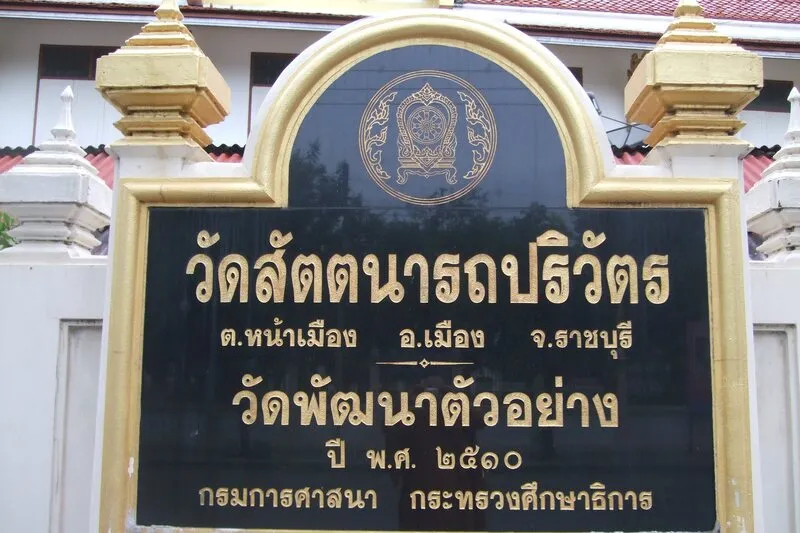
Wat Sattanat Pariwat Worawihan, Ratchaburi is a second-class royal temple of the Worawihan grade under the Dhammayut order. Formerly known as Wat Khao Sattanat, it once stood at the foot of Khao Sattanat before being relocated to its present site along the Mae Klong River when a royal palace was built on Khao Sattanat during the reign of King Rama V. The temple’s importance lies not only in its royal status, but also in the historical meaning of its “relocation,” its connection with the old city of Ratchaburi, its ordination hall, reclining Buddha vihara, chedi, and its role as the administrative center of the Dhammayut monastic order in Ratchaburi Province. For those looking to visit an important temple with deep history that connects Khao Wang, the old town, and the Mae Klong River in one journey, Wat Sattanat Pariwat Worawihan is one destination that should not be missed.
Wat Sattanat Pariwat Worawihan is a second-class royal temple of the Worawihan grade located in Na Mueang Subdistrict, Mueang Ratchaburi District, Ratchaburi Province. It is regarded as one of the province’s most important temples in terms of history, religion, and its relationship with the development of the city of Ratchaburi. This temple is not merely a place for monks and lay Buddhists to perform religious activities, but also a temple with a highly distinctive story, because its history is directly tied to the formal relocation of the temple from its original site at the foot of Khao Sattanat to its present location. As a result, the temple’s very name has become linguistic and historical evidence that clearly records this event.
At first glance, Wat Sattanat Pariwat Worawihan may appear to be simply an old temple in central Ratchaburi with royal temple status. However, when examined more closely, it becomes clear that this temple is one of the places that helps explain the transformation of Ratchaburi during the Rattanakosin period. Its story is linked to political authority, urban development, the construction of a royal palace on Khao Sattanat, and the reorganization of sacred space in the city during an important period of Thai history. Wat Sattanat Pariwat Worawihan is therefore more than a beautiful or well-known temple; it is a temple that records the transition of the city of Ratchaburi in a very concrete way.
The temple’s present location is in the Na Mueang area, a district that has long been important to Ratchaburi in terms of administration, transportation, and daily life. The temple is not far from the Mae Klong River and lies in the same zone as many of the city’s important landmarks. This makes visiting Wat Sattanat Pariwat Worawihan very easy to combine with a broader exploration of Ratchaburi, whether for history enthusiasts who want to visit Khao Wang and the Ratchaburi National Museum, worshippers who want to stop at several important temples in the city, or travelers interested in experiencing the old town more deeply. The temple therefore functions both as a religious site and as a gateway into the story of the city.
The history of Wat Sattanat Pariwat Worawihan began with an earlier temple known as “Wat Khao Sattanat.” This temple was built in 1871 during the time when Chao Phraya Ratchaburi (Klan Wongsarot) served as the governor of Ratchaburi. Originally, it stood at the foot of Khao Sattanat, which corresponds to the area of Khao Wang today. When this history is examined more deeply, it becomes clear that the original temple did not stand in an ordinary place. It occupied a location of great significance in terms of both landscape and authority, because Khao Sattanat had long been a prominent landmark with an important role in Ratchaburi.
The existence of a temple at the foot of Khao Sattanat originally reflects the importance of that place in both sacred and social perception within the city. However, during the reign of King Chulalongkorn, Rama V, the government planned to build a royal palace on Khao Sattanat, which required the original temple land to be released from ecclesiastical status. This event became the turning point that transformed Wat Khao Sattanat into a relocated temple, and in time led to its rebirth under the new name “Wat Sattanat Pariwat.”
The relocation of the temple did not happen in a disorderly manner or as a temporary transfer of buildings. It was carried out formally and systematically. Somdet Chao Phraya Borom Maha Si Suriyawong carried out the compensation process and oversaw the construction of a replacement temple at a new site, at Wat Pho Ngam or Wat Klang Ban, which had been an abandoned temple on the bank of the Mae Klong River in the area of the present site. This is an especially important part of the story, because it shows that even though urban development and royal use of the land forced the original temple to move, there was a deliberate effort to preserve the temple’s status by establishing a complete replacement temple.
From a historical perspective, this period provides a clear example of the relationship between the state, religion, and urban land management during the reign of Rama V. The temple was not simply abolished and allowed to disappear. Instead, it was officially “relocated,” and its status was carefully reestablished at a new site. This process makes Wat Sattanat Pariwat Worawihan more significant than many other temples, because its very history reflects a compromise between the needs of the state and the preservation of Buddhism at the same time.
Once the temple was established at the new site, it was given the name “Wat Sattanat Pariwat.” The word “Pariwat” carries the meaning of change, turning, or relocation. In the context of this temple, it refers to a temple that changed or moved from Khao Sattanat. The name is therefore highly important, because it is not simply a title, but a historical explanation embedded directly in the temple’s identity. Many Thai temples have auspicious names or names derived from geography, but in the case of Wat Sattanat Pariwat Worawihan, the name itself functions as a direct record of an event, which is relatively rare.
At the new site, important permanent structures were built in full, including the ordination hall, the reclining Buddha vihara, pavilions, monks’ quarters, the crystal wall, and the chedi. These structures make it clear that the new temple was not intended as a temporary or merely functional substitute, but was designed as a complete temple with all the necessary elements for religious ceremonies, monastic residence, and the dignified status of a royal monastery. The relocation of the temple therefore did not diminish the role of the original temple, but instead created a fully developed new identity on the new ground.
Wat Sattanat Pariwat Worawihan received its royal boundary for ordination ceremonies in 1875. This grant is another important piece of evidence confirming the temple’s full legitimacy under monastic law, because it allowed the temple to carry out major ecclesiastical acts, such as ordination, in accordance with the formal regulations of the Sangha. When considered together with the history of the relocation, this shows that the temple was managed in a systematic and continuous way, from the move itself to the formal confirmation of its religious standing.
Later, Wat Sattanat Pariwat Worawihan was elevated to the status of a second-class royal temple of the Worawihan grade, and today it also serves as the administrative center of the Dhammayut order in Ratchaburi Province. This status makes the temple clearly more important than an ordinary temple, because it does not merely support local religious life, but also plays a role in the provincial structure of monastic administration. For those interested in Thai temples from the perspective of ecclesiastical governance, this temple has considerable institutional value.
The temple grounds cover 9 rai, 3 ngan, and 11 square wah, and an additional 3 rai of land to the south is occupied by Benchamarachuthit Ratchaburi School. This connection between the temple and educational space is also quite interesting, because it reflects the traditional role of Thai temples as places associated with learning, instruction, and the cultural nourishment of the community. Even though the context of modern education has changed greatly, the fact that the temple’s land still remains closely linked with a school is a reminder of the long-standing bond between temples and the formation of people in Thai society.
Within the temple itself, one of the most notable structures is the ordination hall, which forms the ritual heart of the temple. The ordination hall of Wat Sattanat Pariwat Worawihan has a dignified, restrained, and weighty character in keeping with the Dhammayut style. At the same time, the temple also contains a reclining Buddha vihara, one of the important permanent structures built when the temple was reestablished. A vihara of this type adds another dimension to the temple’s appeal, both in terms of Buddhist art and the atmosphere of worship, because it presents an image of the Buddha in a posture different from the principal Buddha image in the ordination hall.
Another object of devotion that often draws attention from visitors is “Luang Pho To,” one of the temple’s important sacred images that is highly revered by local people. The presence of such a significant Buddha image means that Wat Sattanat Pariwat Worawihan is not only a temple of historical importance, but also one that holds strong spiritual meaning for people today. Many visitors who come to pay respect here do not come simply to view an old temple, but specifically to worship the principal image and the sacred objects within the temple grounds.
The chedi within the temple is another element that strengthens the identity of Wat Sattanat Pariwat Worawihan, because a chedi in a Thai temple is not merely an architectural feature, but also a symbol of sacredness, memory, and the continuity of Buddhism in that place. The presence of a chedi alongside the ordination hall, vihara, crystal wall, and monks’ quarters in a well-organized layout immediately gives visitors the sense that this is a temple built and developed with clear intention and order, rather than one that evolved without a central direction.
In terms of atmosphere, Wat Sattanat Pariwat Worawihan has the charm of an urban temple that still manages to preserve a sense of calm, even though it is located in the city area of Ratchaburi. Visitors can feel a rhythm that combines the living presence of the community, the formality of a royal monastery, and the quietness of a sacred place. A temple of this kind is especially suitable for travelers who want more than a photo stop, and who are looking instead for a place with real historical depth and emotional resonance.
When looking back through the line of abbots and senior monks of the temple, it becomes clear that Wat Sattanat Pariwat Worawihan has long held importance within the Dhammayut tradition of Ratchaburi. The temple has been associated with several influential senior monks, and in the latest verified contemporary information, it remains connected with Phra Mongkhon Thammathon, who holds an important role in the monastic administration of Mueang Ratchaburi District. The presence of monks with responsibilities at district and provincial level further confirms that this temple holds a status beyond that of an ordinary neighborhood monastery.
At present, the latest verified information identifies the temple’s current abbot or caretaker as Phra Mongkhon Thammathon (Thawon Suthammo). Including the latest caretaker is very important in a travel article about a temple, because it confirms that the religious site continues to be actively administered and still plays a real role today, rather than being only a historical place of the past. For readers who need practical or reference information, knowing the latest caretaker is therefore a necessary part of a complete article.
The role of Wat Sattanat Pariwat Worawihan in the Ratchaburi community extends beyond religious rituals. It also serves as a place for annual events, merit-making festivals, and community activities, while maintaining connections with the school and neighborhoods around the temple. When these ongoing activities are considered, it becomes clear that the temple still functions as a social center in a very real way. A temple that continues to host annual events, attract community participation, and remain present in public awareness is a living temple, not simply one that survives only in written records.
For travelers, Wat Sattanat Pariwat Worawihan has the major advantage of being easy to combine with other key sites in Ratchaburi. Starting from this temple, it is possible to continue conveniently to the Ratchaburi National Museum, Wat Mahathat Worawihan, Khao Wang, the Ratchaburi City Pillar Shrine, or the old market area in town, all within a short amount of time. This makes the temple especially suitable for a half-day or full-day itinerary within the city of Ratchaburi, particularly for those who want to understand the city through religion, history, and urban landscape at the same time.
Another aspect that makes Wat Sattanat Pariwat Worawihan especially interesting is that it is a temple whose identity is built around a story of relocation, which differs from many temples that have remained continuously at their original site. This gives the temple two layers of memory: first, the memory of the original temple at the foot of Khao Sattanat, and second, the memory of the new temple on the bank of the Mae Klong River. This overlap of two places means that visiting the temple is not simply about viewing structures, but about walking into the larger story of the city of Ratchaburi itself.
In terms of cultural tourism, Wat Sattanat Pariwat Worawihan is especially suitable for travelers who appreciate temples with clear historical information, high religious status, and convenient access. Some temples are beautiful but lack a clear story; others have deep history but are difficult to reach. In the case of Wat Sattanat Pariwat Worawihan, however, there is strong history, clear royal-monastery status, and an urban context that makes travel easy. It is therefore a temple that appeals to general travelers, history enthusiasts, and devotees who come specifically to worship.
Getting There Wat Sattanat Pariwat Worawihan is located in Na Mueang Subdistrict, Mueang Ratchaburi District. If traveling from Bangkok, visitors can take Phetkasem Road into Ratchaburi Province, then continue into the city center and follow directions to Montri Suriyawong Road or Woradet Road. Because the temple lies within the city area, it is easier to reach than temples located in outlying communities. If traveling by train, visitors can get off at Ratchaburi Railway Station and continue by local transport or ride-hailing service to the temple within a short time. Those arriving by van or public bus can also continue to the temple easily once they reach central Ratchaburi.
One of the advantages of visiting Wat Sattanat Pariwat Worawihan is that it does not require complicated planning, since the temple is well connected to other attractions. For a compact city route, visitors can begin at Wat Sattanat Pariwat Worawihan, continue to Khao Wang, then visit the Ratchaburi National Museum before ending the day at a restaurant or café in town. This approach makes a one-day trip to Ratchaburi feel more meaningful than simply stopping at one place and leaving.
Those who wish to pay respect or take photographs within the temple should dress respectfully according to Thai standards for visiting religious sites. Sleeveless tops, shorts, and overly tight clothing should be avoided, and visitors should behave calmly and respectfully, especially in the ordination hall and areas where people are engaged in religious activities. This temple is a royal monastery and still plays a real role in the community, so showing respect for the place is very important.
The most suitable times to visit are in the morning through late morning, and again in the late afternoon, when the weather is not too hot and the light is beautiful, making it ideal both for worship and for appreciating the architecture. Visitors who want to make merit quietly or experience a peaceful atmosphere should choose an ordinary weekday or a period outside major festivals. On the other hand, those who wish to see the temple in another dimension may find that visiting during the annual festival or other community events reveals its contemporary role even more clearly.
In summary, Wat Sattanat Pariwat Worawihan, Ratchaburi, is a temple of importance in every major sense: urban history, religion, and tourism. What sets it apart from many other temples is that the story of its relocation forms the core of its identity. It holds the status of a second-class royal monastery of the Worawihan grade and plays a major role in the Dhammayut order of Ratchaburi Province. Combined with its location in the city and its easy connection to other important attractions, this temple truly deserves to be regarded as one of the most important temples in Ratchaburi.
For those who want to understand Ratchaburi beyond its familiar images of dragon jars, markets, or hills, Wat Sattanat Pariwat Worawihan is an excellent place to begin. It reveals the relationship between religion, the city, the royal court, and the local community within a single space. Once visitors see the temple in person, walk through the ordination hall, the reclining Buddha vihara, and the chedi, and understand the story of its relocation from Khao Sattanat, it becomes easy to see why this temple is so important to the history of Ratchaburi.
| Place Name | Wat Sattanat Pariwat Worawihan, Ratchaburi |
| Address | 3715 Montri Suriyawong Road, Na Mueang Subdistrict, Mueang Ratchaburi District, Ratchaburi 70000 |
| Place Summary | A second-class royal monastery of the Worawihan grade under the Dhammayut order, formerly known as Wat Khao Sattanat before being relocated to its present riverside site along the Mae Klong River. It later became a major temple in both the history and monastic administration of Ratchaburi Province. |
| Highlights | The history of relocation from Khao Sattanat, second-class royal monastery status, the ordination hall, reclining Buddha vihara, chedi, Luang Pho To, its location near old Ratchaburi and Khao Wang, and its role as the administrative center of the Dhammayut order in Ratchaburi Province |
| History | Formerly known as Wat Khao Sattanat, it was built in 1871 and originally stood at the foot of Khao Sattanat. During the reign of King Rama V, the land was reclaimed for the construction of a royal palace, so a replacement temple was established at the present site and named “Wat Sattanat Pariwat.” It received its royal boundary for ordination ceremonies in 1875. |
| Main Features Within the Temple | Ordination hall, reclining Buddha vihara, chedi, crystal wall, monks’ quarters, pavilions, Luang Pho To, and the principal Buddha image in the Mara-victory posture inside the ordination hall |
| Name Origin | “Sattanat Pariwat” means a temple that changed or moved from Khao Sattanat, reflecting its history of relocation from the original site at the foot of Khao Sattanat to its present location |
| Current Abbot / Latest Caretaker | Phra Mongkhon Thammathon (Thawon Suthammo) |
| Open Days | Open daily |
| Opening Hours | No opening hours directly verified from the temple’s official source were found. It is recommended to contact the temple before visiting. |
| Fees | No admission fee |
| Facilities | Temple grounds, worship areas, pavilions, religious activity spaces, parking in the city area, and convenient access to attractions and restaurants in town |
| Getting There | From Bangkok, take Phetkasem Road into Ratchaburi city, then continue to Montri Suriyawong Road or Woradet Road. If traveling by train, get off at Ratchaburi Railway Station and continue into town by local transport. |
| Current Status | The temple remains active and continues to hold annual festivals and community activities. |
| Temple Contact Number | 032-337-392, 032-323-001 |
| Zone | Na Mueang Zone / Ratchaburi City Center / Old Ratchaburi / Mae Klong Riverside |
| Nearby Attractions with Distance | 1. Ratchaburi National Museum – approximately 0.8 km – Old Town / Historical Zone 2. Wat Mahathat Worawihan – approximately 1.1 km – Historic City Center Zone 3. Khao Wang, Ratchaburi – approximately 1.8 km – Historical Landmark Zone 4. Ratchaburi City Pillar Shrine – approximately 1.4 km – City Center / Sacred Zone 5. Koi Ki Old Market – approximately 1.6 km – Old Commercial and Local Food Zone |
| Nearby Restaurants with Distance | 1. Kam Cheng Noodles – approximately 1.3 km – Old Town / Traditional Eatery Zone – Tel. 032-323-278, 093-264-9856 2. R-tee Kopee – approximately 1.2 km – Breakfast / Old Town Café Zone 3. Thanks – approximately 1.4 km – Café / City Center Zone 4. Den Thai Ice Cream – approximately 1.9 km – Sanam Ya Market / Dessert Zone – Tel. 081-001-9339 5. Por Pla Phao Ratchaburi – approximately 5.3 km – City Entrance / Thai-Isan Food Zone – Tel. 089-882-6886, 089-172-9501, 032-737-256 |
| Nearby Accommodations with Distance | 1. Vanilla River – approximately 1.4 km – Riverside / Old Town Zone – Tel. 092-262-8264 2. HOP INN Ratchaburi – approximately 2.0 km – City Center / Easy Access Zone – Tel. 02-080-2222 3. Numsin Hotel – approximately 1.7 km – Traditional City Center Zone – Tel. 032-337-551 4. Space 59 Hotel – approximately 2.3 km – City Center / Modern Loft Zone – Tel. 085-263-4848, 081-638-1909, 082-242-2092 5. Rachabhura Hotel – approximately 4.7 km – Riverside / Ban Rai Zone – Tel. 032-919-999 |
Frequently Asked Questions (FAQ)
Q: What is the history of Wat Sattanat Pariwat Worawihan?
A: Wat Sattanat Pariwat Worawihan was formerly known as Wat Khao Sattanat and was built in 1871. It originally stood at the foot of Khao Sattanat. During the reign of King Rama V, a royal palace was built on Khao Sattanat, so the temple was relocated to its present site and given the new name “Wat Sattanat Pariwat,” which means a temple that changed or moved from Khao Sattanat.
Q: Where is Wat Sattanat Pariwat Worawihan located?
A: The temple is located in Na Mueang Subdistrict, Mueang Ratchaburi District, Ratchaburi Province, in the city area and close to many important landmarks in Ratchaburi such as Khao Wang, the Ratchaburi National Museum, and Wat Mahathat Worawihan.
Q: What are the main highlights of Wat Sattanat Pariwat Worawihan?
A: Its main highlights include the history of the temple’s relocation from Khao Sattanat, its status as a second-class royal temple of the Worawihan grade, the ordination hall, the reclining Buddha vihara, the chedi, and its role as the administrative center of the Dhammayut order in Ratchaburi Province.
Q: When did Wat Sattanat Pariwat Worawihan receive its royal boundary for ordination ceremonies?
A: The temple received its royal boundary for ordination ceremonies in 1875, an important milestone confirming its full religious status and legitimacy under Buddhist monastic law.
Q: Who is the latest abbot or caretaker of the temple?
A: The latest verified information indicates that the current abbot or caretaker of Wat Sattanat Pariwat Worawihan is Phra Mongkhon Thammathon (Thawon Suthammo).
Q: What time does Wat Sattanat Pariwat Worawihan open?
A: At present, no opening hours directly verified from the temple’s official source have been found, so it is best to contact the temple before visiting, especially if you plan to arrive very early in the morning or later in the evening.
Q: What places can I visit after Wat Sattanat Pariwat Worawihan?
A: It is very convenient to continue to nearby attractions such as the Ratchaburi National Museum, Wat Mahathat Worawihan, Khao Wang, the Ratchaburi City Pillar Shrine, and Koi Ki Old Market, since all of them are located in the city area or only a short distance away.
 Wat Sattanat Pariwat Worawihan Map
 Category:
  Group:
  Last Update: 10 HourAgo
Comment
 Nearby Attractions
| Keyword (Advance) |
 Facebook Fanpage
 Region
 Art, Culture and Heritage
 Historical Sites and Monuments(
 Landmarks and Memorials(
 Art, Craft Centres, Tradition(
 Museums(
 Art Gallery(
 Educational Places
 Educational Gardens, Farm(
 University
 Other religious and spiritural sites(
 Research and Development
 Royal Project(
 Suburban Living
 Village, Community(
 Local Market(
 Floating Market(
 Nature and Wildlife
 National Parks and Marine Reserves(
 Mountain (Doi)(
 Dam, Reservoir, Lake(
 Waterfalls(
 Hot Springs(
 Caves(
 Flower Field(
 River, Canal(
 Other natural attractions(
 Entertainment and Agricultural
 Zoos and Aquariums(
 Animal camps and shows(
 Farm, Parks, Gardens and Ecotourism(
 Waterpark(
 Outdoor and Adventure Activities(
 Shopping
 Shopping and Night Market(
 Spas and Wellness
 Spas and Wellness(
 Travel Articles, Recipes
 Travel Review, Food Review(