

 Home
Home Chiang Mai(









Rating: 4.2/5 (5 votes)
 |
|  Map
Map 
 Have Map
  No Map
Chiang Mai attractions
Attractions in Thailand
Open Days: Daily
Opening Hours: 06.00–18.00
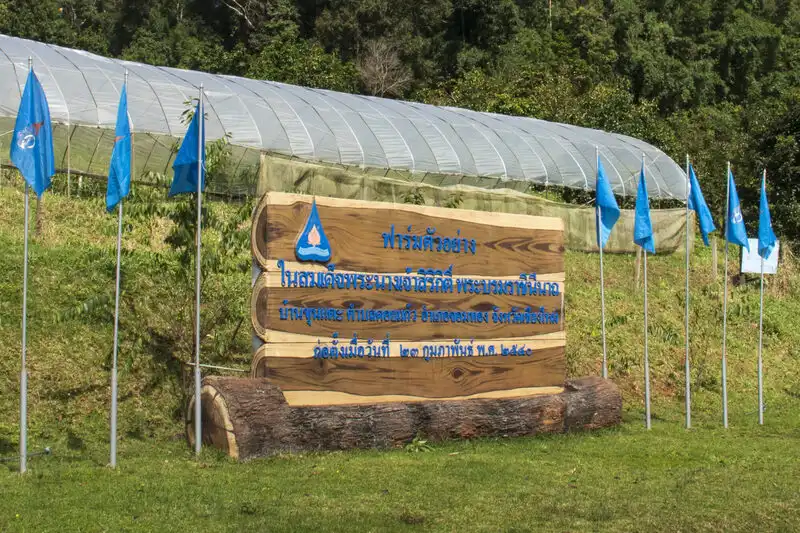
Ban Khun Tae Royal Initiative Demonstration Farm is a place that lets you see the “core” of development work under the Royal Initiative in a way you can actually touch. It is not built to be flashy like a mainstream tourist attraction. Instead, it demonstrates how a community can stand on its own feet when it has the right knowledge, tools, and support systems that truly fit local realities. This farm therefore operates as a demonstration and livelihood-promotion center, focusing on integrated farming that can be done at the household level, and extending into employment for low-income residents within the village and nearby communities—so income circulates back to people in the area in a direct, practical way.
The overall picture of the farm encourages you to think in terms of “systems” rather than isolated activities, because what happens here is not just about raising animals or growing mushrooms. It is about laying out a real-world learning model for food production and diversified income—diverse enough to absorb risks such as unpredictable seasons, price fluctuations, or labor limits within a household. The farm demonstrates raising multiple kinds of animals, including chickens, ducks, quails, fish, frogs, bees, and sheep, to show a range of starting options that do not require a large investment all at once. It also helps diversify household food sources by adding protein, while keeping income streams flexible according to each family’s capacity.
If you like the kind of work where you can “do it and see results quickly,” the mushroom cultivation zone is often the part that makes people stop longer than they expected. Mushrooms are a solid example of a livelihood that can be done continuously, with controllable quality, and can generate short-to-medium term income in rural areas. This style of demonstration helps you see everything from managing the growing house, cleanliness, humidity control, and even how to think about costs and simple, practical marketing—real methods that people can apply, not polished formulas on paper.
Another side that is often overlooked—but very important to rural life—is planting utility trees such as eucalyptus and neem. The farm uses this as a case study for building wood resources at the household/community level, reducing dependence on cutting wood from natural forests, and creating discipline around land-use planning that fits how people actually live. When combined with local employment, this work makes it clearer that “development” does not have to mean distant, large-scale projects. Sometimes it simply means ensuring villagers have work, income, and hope that can be sustained over the long term.
One point that should not be skipped is the establishment of a “Royal Bestowed Rice Bank,” a concept that reflects deep care for community food security. In rural areas, when a year’s harvest is poor or a household faces urgent needs, a rice reserve system in the form of a rice bank helps prevent families from falling into debt too easily and strengthens the community’s ability to support one another in real terms. So this demonstration farm does not only demonstrate “how to produce,” but also demonstrates “how to live together” through systems that keep people from being left behind.
If you want to visit in a way that gives you both atmosphere and meaning, it helps to see this as a living learning space where real work is still happening. Walk through each point at an unhurried pace and observe what the community can “do on its own,” and what parts require knowledge support. The special value here is not staged beauty, but the reality of work that gives local people more choices, more skills, and stronger systems to support a more secure life.
Getting There From Chiang Mai by car, take Highway 108 toward Chom Thong District. Then turn right near the Chom Thong District Office, cross the Mae Klang River at Pracha Uthit Bridge, and continue for about 5 kilometers. You will reach the five-way junction near the Doi Kaeo Subdistrict Municipality office. Pass the junction to Mae Tia Waterfall, then turn right and continue for approximately 25 kilometers. The final stretch is a local road with some curves and inclines, so allow extra time and drive carefully—especially in the rainy season.
| Name | Ban Khun Tae Royal Initiative Demonstration Farm |
| Location | Ban Khun Tae area, Chom Thong District, Chiang Mai (recommended to confirm the exact pin/meeting point with the relevant unit or local community leader before traveling) |
| Highlights | A demonstration and livelihood-promotion center for livestock and integrated farming under the Royal Initiative, supporting community income and food security |
| Zones / On-site Activities Summary | Livestock demonstration zone: chickens, ducks, quails, fish, frogs, bees, sheep Mushroom cultivation zone: cultivation and growing-house management for supplemental income Utility tree planting zone: eucalyptus, neem for community use and to reduce pressure on natural forests Community system: Royal Bestowed Rice Bank (an example of strengthening village food security) |
| Period / Key Milestones | Royal Initiative project (official establishment year to be stated when verified documents from the relevant agency are available) |
| Key Evidence / What Matters | Multi-animal livestock demonstration + mushroom cultivation + utility tree planting + Royal Bestowed Rice Bank + community employment |
| Name Origin | Named after the local community area “Ban Khun Tae,” and its role as a Royal Initiative demonstration farm |
| Travel | Chiang Mai → Highway 108 → Chom Thong District → turn right near the District Office and cross Mae Klang River (Pracha Uthit Bridge) → about 5 km to the five-way junction near Doi Kaeo Subdistrict Municipality → pass the junction to Mae Tia Waterfall → turn right and continue about 25 km |
| Current Status | Recommended to visit by checking conditions in advance (this is a working demonstration / operational area) |
| Nearby Tourist Attractions (approx. distance) | Mae Tia Waterfall ~10–25 km; Wat Phra That Si Chom Thong Worawihan ~25–40 km; Mae Klang Waterfall (Inthanon route) ~35–55 km; Naphamethanidon–Naphaphonphumisiri Stupas ~50–70 km; Doi Inthanon summit ~55–75 km |
| Popular Restaurants Nearby (approx. distance) | Khao Soi Ka-Lhong (Chom Thong) ~25–40 km Tel. 087-189-2619; Krua Fueang Fa (Chom Thong) ~25–40 km Tel. 053-341-274; Coffee Ngeggee ~25–40 km Tel. 088-257-0878; Somtam Huen Mai (Chom Thong) ~25–40 km Tel. 080-124-9542; Thapthimthong Pla Phao (Chom Thong) ~25–40 km Tel. 089-554-8203 |
| Popular Accommodations Nearby (approx. distance) | Touch Star Resort ~25–45 km Tel. 053-033-594; Inthanon Riverside Resort ~30–55 km Tel. 081-530-5767; Inthanon Highland Resort ~25–50 km Tel. 053-802-222; Mae Klang Luang View Resort (Mae Klang Luang village) ~45–65 km Tel. 086-189-4075; Rang Bon Doi (Mae Klang Luang village) ~45–65 km Tel. 081-168-0382 |
| Facilities | Demonstration areas and learning points aligned with the farm’s mission (facilities may vary depending on current operations; recommended to ask before visiting) |
| Fees | Recommended to inquire / check the latest notice before traveling |
Frequently Asked Questions (FAQ)
Q: Who is Ban Khun Tae Royal Initiative Demonstration Farm suitable for?
A: It suits travelers who want Chiang Mai experiences with “real-world learning,” people interested in community development and integrated farming, or families who want children to see practical examples of livelihoods and community food-management systems.
Q: What will you mainly see when you visit?
A: The core focuses are demonstrations of raising multiple types of animals, mushroom cultivation, utility tree planting, and the rice bank concept—showing development work that centers on the community’s security and resilience.
Q: How should you prepare before visiting?
A: It’s best to check conditions in advance because this is a working area for the community and related units. Dress respectfully, follow designated paths, and avoid disturbing animals or demonstration equipment.
Q: Is the drive difficult?
A: The stretch from Chom Thong inward includes local roads with some curves and inclines. Allow extra time, check your vehicle, and drive carefully—especially in the rainy season when roads can be slippery.
Q: If pairing this with other places, where should you go next?
A: You can continue to Mae Tia Waterfall, or connect onward to the Inthanon route—Mae Klang Waterfall, the Royal Twin Stupas, and the Doi Inthanon summit—while planning extra time for road and weather conditions.
Q: What time of year is the most comfortable to visit?
A: You can visit year-round, but the late rainy season into early winter is often more comfortable for driving and walking. In the rainy season, nature is lush and green, but you should allow extra time and watch for mist and slippery roads.
 Ban Khun Tae Royal Initiative Demonstration Farm Map
 Category:
  Group:
  Last Update: 16 HourAgo
Comment
 Nearby Attractions
| Keyword (Advance) |
 Facebook Fanpage
 Region
 Art, Culture and Heritage
 Historical Sites and Monuments(
 Landmarks and Memorials(
 Royal Palace(
 Art, Craft Centres, Tradition(
 Museums(
 Educational Places
 Museum for Study(
 Educational Gardens, Farm(
 Training Center(
 University
 Places of Worship
 Temple(
 Mosque(
 Other religious and spiritural sites(
 Suburban Living
 Village, Community(
 Local Market(
 Nature and Wildlife
 National Parks and Marine Reserves(
 Mountain (Doi)(
 Dam, Reservoir, Lake(
 Waterfalls(
 Hot Springs(
 Caves(
 River, Canal(
 Other natural attractions(
 Entertainment and Agricultural
 Zoos and Aquariums(
 Animal camps and shows(
 Stadium(
 Farm, Parks, Gardens and Ecotourism(
 Waterpark(
 Theater(
 Outdoor and Adventure Activities(
 Shopping
 Shopping and Night Market(
 Restaurant
 Michelin Star(
 Michelin Guide(
 Call Customer Service in Tourism
 Call Customer Service in Tourism(
 Travel Articles, Recipes
 Travel Review, Food Review(
 Food Menu, North Recipes(
 Thai Desserts, North Recipes(