

 Home
Home Chiang Mai(






Rating: 4.3/5 (4 votes)
 |
|  Map
Map 
 Have Map
  No Map
Kanchanaburi attractions
Attractions in Thailand
Open Days: Open Daily
Opening Hours: 08:00 – 17:00
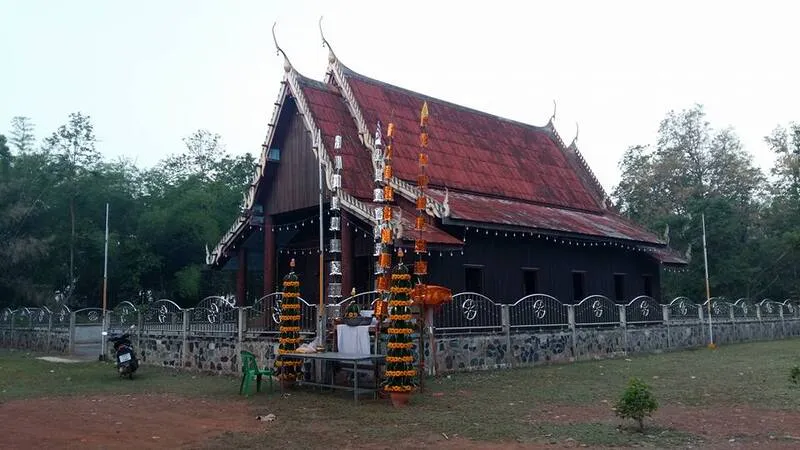
Wooden Ubosot at Wat Si Kasettharam (Pak Na Suan) in Kanchanaburi is one of the rare wooden ordination halls in Thailand and a valuable piece of Buddhist architectural heritage that reflects the deep-rooted wisdom and faith of the local community. The ubosot was built entirely from padauk wood, without any reinforced concrete structure, and emerged from the historical geography and transportation limitations of Si Sawat District. In the past, access to the area was difficult and travel by car was not feasible, making modern construction materials and methods impractical. As a result, local people relied primarily on natural resources that were readily available around them.
Wat Si Kasettharam, commonly known among villagers as “Wat Pak Na Suan,” is located in an area that was once closely tied to riverside life and surrounding forest landscapes. Early settlement patterns depended heavily on waterways and natural routes. When the temple needed an ubosot to conduct monastic rites in accordance with Buddhist discipline, the community joined together in collective devotion. Worshippers donated large pieces of padauk and makha wood for the construction, a process that took many years to complete.
This wooden ubosot follows a Thai-style design, measuring approximately 11.50 meters wide and 21.50 meters long. The entire structure, from pillars and floorboards to walls and roof framing, is made of wood. Each padauk pillar is so large that it takes two people to embrace it fully. The floor is made from 16-inch-wide planks, providing strength and durability. The walls are clad with the same type of wood throughout, showing the builders’ careful workmanship and dedication in every step of the process.
Inside the ubosot, worshippers will find the world’s largest Phra Tha Kradan, cast in tin-lead alloy (takkua nom). This revered Buddha image is deeply respected by the local community. The Phra Tha Kradan posture symbolizes calmness, stability, and firm commitment to the Dhamma. Having this sacred image enshrined within a wooden ubosot further emphasizes the spiritual value and enduring faith that have been passed down through generations.
Today, the wooden ubosot at Wat Si Kasettharam remains in excellent condition and continues to serve as an active religious space for the people of Pak Na Suan. Beyond its role in temple ceremonies, it stands as an architectural testament to local life, collective effort, and community craftsmanship. It is a heritage structure worthy of preservation and study, so that future generations can learn from its cultural and religious significance and so that its benefits to Buddhism may continue.
Getting There Wat Si Kasettharam is located in Si Sawat District, Kanchanaburi. Visitors can travel by private car from Kanchanaburi town using Highway 3199 toward Si Sawat District. From there, follow local roads and directional signs to Pak Na Suan Subdistrict. The temple is not far from the community area, and travelers may ask local residents for guidance if needed.
| Place Name | Wooden Ubosot at Wat Si Kasettharam (Pak Na Suan) |
| Location | Pak Na Suan Subdistrict, Si Sawat District, Kanchanaburi, Thailand |
| Highlights | Entirely wooden ubosot, massive padauk pillars (two-person embrace), world’s largest Phra Tha Kradan |
| Abbot / Caretaker | Phra Athikan Wimon Sujinno |
| Nearby Tourist Attractions | 1) Srinagarind Dam (approx. 25 km) 2) Erawan Waterfall (approx. 35 km) 3) Srinagarind Dam National Park (approx. 30 km) 4) Huai Mae Khamin Waterfall (approx. 45 km) 5) Tham Chaliang (approx. 20 km) |
| Nearby Restaurants | 1) Floating Restaurants near Srinagarind Dam (approx. 25 km) 2) Khrua Pa Som (approx. 20 km) 3) Riverside Restaurants in Si Sawat (approx. 22 km) 4) Pak Na Suan Community Eateries (approx. 5 km) 5) Local Cooked-to-Order Shops in Si Sawat (approx. 18 km) |
Frequently Asked Questions (FAQ)
Q: When was the wooden ubosot at Wat Si Kasettharam built?
A: The exact year is not clearly recorded, but the construction took many years and was supported by the faith and donations of local villagers.
Q: What types of wood were used for the ubosot?
A: Padauk wood was used as the primary material, with makha wood included in parts of the structure.
Q: Is the world’s largest Phra Tha Kradan enshrined here?
A: Yes. The Phra Tha Kradan enshrined in this ubosot is cast in tin-lead alloy and is regarded as the largest of its kind in the world.
Q: Can visitors enter the ubosot every day?
A: Yes, visitors can generally enter during the temple’s opening hours. Modest and respectful attire is recommended.
Q: Why is this wooden ubosot important to the community?
A: It is a religious center, an architectural heritage site, and a symbol of unity, shared effort, and local craftsmanship.
 Bot Mai Map
 Category:
  Group:
  Last Update: 2 DayAgo
Comment
 Nearby Attractions
| Keyword (Advance) |
 Region
|
 Muang Kanchanaburi(