

 Home
Home Chiang Mai(










Rating: 4/5 (5 votes)
 |
|  Map
Map 
 Have Map
  No Map
Kanchanaburi attractions
Attractions in Thailand
Open Days: Open Daily (Public Area Around the Dam)
Opening Hours: 06:00 – 18:00
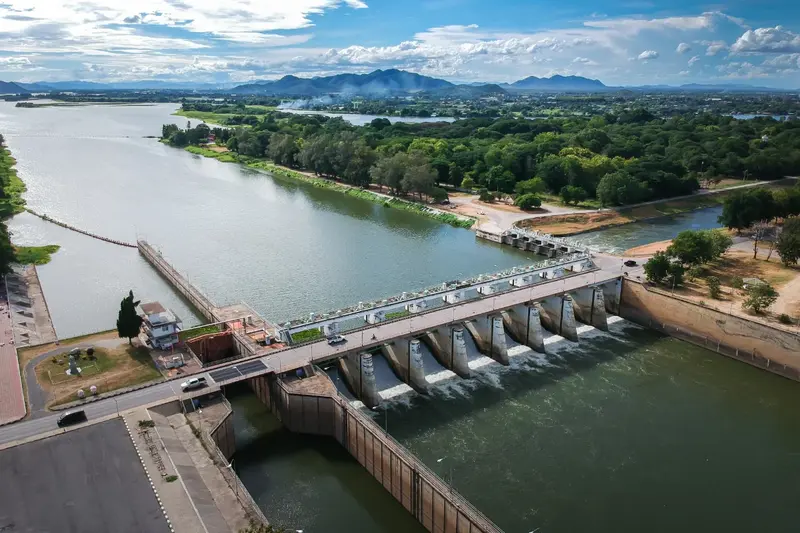
Mae Klong Dam is located in Tha Muang District, Kanchanaburi Province. It is a diversion dam under the Royal Irrigation Department and has long served as the “key control point” of the Mae Klong River Basin. Since construction began around 1965, this dam has become critical infrastructure shaping the lives of many people—from riverside farmers, fish growers, and market communities to downstream areas that sometimes face seawater intrusion pressure in certain seasons. This article explains the dam in depth across history, engineering, ecology, the local economy, and community experience, showing that Mae Klong Dam is not merely a structure but an ongoing water-management mechanism that continuously sustains the region.
The construction context of Mae Klong Dam emerged during a period when Thailand accelerated efforts to strengthen food security. The Mae Klong River Basin is highly fertile, but water conditions fluctuate considerably. In the rainy season, flooding often occurs as runoff from upstream areas increases, while in the dry season, water shortages can limit cultivation. Choosing a “diversion dam” instead of a large storage dam reflects a distributed water-management concept. Mae Klong Dam was designed to raise water levels to divert flows into irrigation canals, using 8 sluice gates to release or retain water depending on real-time conditions. This allows flexible allocation and helps protect riverside areas.
From an engineering perspective, Mae Klong Dam is a reinforced-concrete structure with 8 spillway/sluice openings, each approximately 12.50 meters wide. Gate operations are determined by upstream and downstream water levels. During floods, gates are opened to release excess water, reducing flood risk in Tha Muang and downstream communities. During dry periods, gates are adjusted to raise water levels and feed irrigation canals that serve extensive agricultural areas. This capability for fine-grained level control gives Mae Klong Dam a systems-level role beyond that of many typical river structures.
The dam’s irrigation role is clearly reflected in its broad beneficiary area covering Kanchanaburi, Ratchaburi, and Nakhon Pathom. Farmers can plan cultivation throughout the year, reducing risk from dry spells and sudden flooding. Canal networks connected to the dam distribute water more consistently, improving yield stability for rice fields, orchards, and other economic crops. Over time, reliable water security reduces costs, increases income, and enhances quality of life for many agricultural households.
Flood Case Study In years when heavy rainfall persists under monsoon influence, large volumes of upstream water flow into the Mae Klong River. Mae Klong Dam acts as a “first barrier” to help slow and release this flow. Staged gate operations gradually lower water levels. Communities in Tha Muang recall that before the dam, floodwater could inundate markets and riverside homes quickly; after the dam, flash flooding decreased and water levels rose more slowly, giving residents time to move belongings and reduce damage. This experience highlights how systems-based water management can meaningfully reduce losses.
Downstream Case Study and Seawater Intrusion Downstream areas in Samut Songkhram have historically faced seawater intrusion, allowing saline water to move into agricultural zones. Mae Klong Dam helps push back seawater intrusion by controlling freshwater levels in the river. When freshwater levels are high enough, saltwater pressure is resisted, reducing impacts on soil and crops. Downstream farmers report improved water quality and noticeably reduced damage from salinity.
Ecologically, Mae Klong Dam creates a calmer upstream water zone suitable for freshwater fish breeding. A fish hatchery station near the dam supports breeding and fingerling release. Many riverside communities gain supplementary income from raising economic fish species. Stable water conditions help support aquatic life cycles, while management is needed to avoid disrupting fish migration—an issue monitored collaboratively by agencies and communities.
In more recent years, Mae Klong Dam has also been developed to support hydropower generation using existing infrastructure. Installing appropriately sized turbines increases the value of water resources without building a new dam. The electricity produced can support public utilities, reduce dependence on fossil fuels, and align with sustainable development goals.
The dam’s social and cultural dimension is evident in the daily lives of Tha Muang communities. The river remains a place for relaxation, small-scale fishing, and community activities. Elder residents share that the dam has made life more “predictable”; younger generations can plan work and education with less fear of sudden flooding. This connection has made the dam an informal part of local identity.
Getting There Visiting Mae Klong Dam is convenient from Kanchanaburi town. Travel toward Tha Muang District. The public area around the dam is accessible during daytime hours, making it suitable for learning about irrigation systems, taking photos, and experiencing the Mae Klong River atmosphere up close.
| Place Summary | A Royal Irrigation Department diversion dam, built around 1965, controlling and managing water in the Mae Klong River Basin |
| Highlights | 8 sluice gates; irrigation; flood mitigation; seawater intrusion control; freshwater fish breeding; hydropower development |
| Nearby Tourist Attractions | 1) Wat Tham Suea — approx. 10 km 2) Bridge Over the River Kwai — approx. 15 km 3) Kanchanaburi War Cemetery — approx. 14 km 4) Thailand–Burma Railway Museum — approx. 14 km 5) Tha Muang Market — approx. 3 km |
| Nearby Restaurants | 1) Krua Mae Klong Restaurant — approx. 4 km — Tel. 034-611-111 2) Tha Muang Riverside Restaurant — approx. 3 km — Tel. 034-612-222 3) Tha Muang Noodle Shop — approx. 3 km — Tel. 034-613-333 4) Tha Muang Market Cooked-to-Order Food Stalls — approx. 3 km — Tel. 034-614-444 5) Tha Muang Local Cuisine Restaurant — approx. 3 km — Tel. 034-615-555 |
| Nearby Accommodations | 1) River Kwai Hotel — approx. 15 km — Tel. 034-511-111 2) Mae Klong Riverside Guesthouse — approx. 5 km — Tel. 034-522-222 3) Tha Muang Resort — approx. 4 km — Tel. 034-533-333 4) Tha Muang Community Homestay — approx. 4 km — Tel. 034-544-444 5) Kanchanaburi Town Hotel — approx. 15 km — Tel. 034-555-555 |
Frequently Asked Questions (FAQ)
Q: When was Mae Klong Dam built?
A: Construction began around 1965 to support the development of the Mae Klong River Basin irrigation system.
Q: How does Mae Klong Dam help prevent flooding?
A: The dam uses 8 sluice gates to release and slow floodwater, reducing the severity of sudden flooding.
Q: Who benefits from Mae Klong Dam?
A: Farmers and communities in Kanchanaburi, Ratchaburi, Nakhon Pathom, and downstream areas benefit from its water management.
Q: How does Mae Klong Dam affect the ecosystem?
A: It creates calmer upstream waters suitable for fish breeding, with management coordinated between agencies and communities.
Q: What time is best to visit Mae Klong Dam?
A: 06:00 – 18:00, which is the typical access period for the public area around the dam.
 Mae Klong Dam Map
 Category:
  Group:
  Last Update: 1 DayAgo
Comment
 Nearby Attractions
| Keyword (Advance) |
 Region
|
 Muang Kanchanaburi(