

 Home
Home Chiang Mai(







Rating: 3.3/5 (8 votes)
 |
|  Map
Map 
 Have Map
  No Map
Kanchanaburi attractions
Attractions in Thailand
Open Days: Open Daily
Opening Hours: 08:00 – 16:30
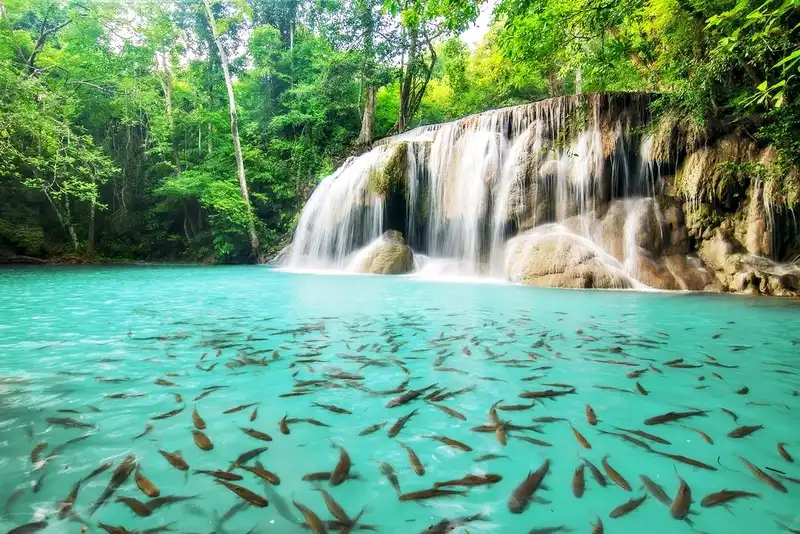
Erawan National Park is one of Kanchanaburi’s best-known national parks among both Thai nature lovers and international travelers, largely because it is home to the iconic “Erawan Waterfall.” With emerald-green water that shifts by season, multiple natural pools suitable for swimming, and a nature study trail, a visit here is far more than a quick photo stop. It is a chance to experience real forest rhythms, real flowing water, and the still-impressive ecology of Thailand’s western forests. The park is located in Si Sawat District, Kanchanaburi, at a distance that works well for a day trip from Kanchanaburi town. However, if you plan to hike up through many tiers or prefer a relaxed pace, staying overnight near the park or along the same route can significantly improve the overall trip quality without feeling rushed.
The appeal of Erawan National Park begins with its “establishment history.” The park was originally named &ldquoKhao Salop National Park” and was officially declared a national park on June 19, 1975. It was later renamed “Erawan National Park,” inspired by a strong, story-driven image tied to the landscape: the highest tier of the waterfall features rock contours that, in certain angles, resemble the “head of Erawan,” the legendary elephant in Thai tradition. This renaming was not merely for aesthetics. It helped define a clearer identity for the destination in tourism terms and naturally connected the park’s narrative to the Thai cultural practice of naming places through distinctive natural features.
What sets Erawan apart from many other waterfalls is the “experience structure” contained within a single protected area. From the parking zone and visitor services, the trail gradually guides you upward through the waterfall tiers step by step, allowing visitors of different ages and fitness levels to choose an appropriate challenge. If you want a light swim and beautiful photos, the lower tiers are comfortable and accessible. If you want more of a challenge and prefer quieter scenery, you can continue to higher tiers, where the atmosphere gradually shifts from lively and crowded to noticeably calmer and more forest-like. This gradual transition is a key charm of visiting the park at a “slow, unhurried pace.”
Erawan Waterfall lies on the banks of the Khwae Yai River. Its headwaters originate from the Mong Lai stream, flowing down from high ridges and steep cliffs, creating a waterfall system that stretches about 1,500 meters and is divided into 7 tiers. Each tier forms natural pools where you can swim (as long as you follow the park’s safety rules). The fun here is not simply that there are “7 tiers,” but that each tier has its own character. Some pools are wide and crystal-clear, ideal for families. Others feature shaded rock formations that make for excellent photos. In several sections, water flows over limestone, adding depth to the color and clarity. On bright days when the water is clear, you can see the signature turquoise-green reflections that have become Erawan’s visual identity.
Another strong point is the park’s “nature study trail,” which adds an educational layer to the trip. The Erawan Nature Study Trail is about 1,060 meters long and typically takes around 30 minutes, passing through montane evergreen forest, viewpoints, and beautiful deciduous forest. Interpretive signs along the way transform the walk into more than just moving from point A to point B. They encourage observation of plants, forest structure, and how vegetation communities change with moisture and light. On days when you do not want to push for higher waterfall tiers, this trail is an excellent option because it offers calm, knowledge, and a broader perspective of the landscape beyond the main waterfall route.
To enjoy Erawan in a way that feels both “worth it” and safe, start by setting goals that match your time and physical condition. If you aim to reach all 7 tiers, arrive early to avoid peak crowds and midday heat, and bring enough drinking water because the upper tiers include steeper sections that require real effort. Footwear should have good grip and should not be slippery; flip-flops are not recommended because parts of the trail stay wet and can develop algae. It is also wise to bring a waterproof bag for your phone and valuables, especially if you plan to swim, as many pools are natural, can be deeper than expected, and often have slippery rock surfaces.
A key point that many visitors overlook is “responsible nature tourism etiquette.” A national park is not a private swimming pool or an amusement park. The essentials are to keep noise low, avoid playing music, do not leave food scraps or litter, and never feed wild animals. Feeding wildlife changes animal behavior, encourages dependence on people, and can quickly destabilize the local ecosystem, especially in high-traffic waterfall areas. When everyone helps reduce impact, the park remains beautiful and safer over the long term, and future visitors can continue to experience Erawan in conditions that are as close to nature as possible.
Another useful thing to know before visiting is the park’s rules regarding “swimming time and access to upper tiers.” In many periods, access times are managed for safety and crowd control. In principle, lower tiers can be enjoyed longer, while access to higher tiers may be restricted earlier so staff can manage safety and maintain the area before closing. This matters greatly if you plan to hike to tiers 5–7. Arriving too late may prevent you from reaching your goal. A smart approach is to enter early, plan rest breaks, and avoid the mindset of “we’ll figure it out when we get there,” because early planning helps you avoid frustration and reduces the risk of rushing, which can lead to accidents.
Getting There If you drive from Kanchanaburi town, take Highway 3199 (Kanchanaburi–Si Sawat) toward the Srinagarindra Dam area. Around kilometer marker 56, look for the left turn that crosses a bridge into the Srinagarindra Dam market area, then continue straight for about 3 kilometers to the parking lot. From there, walk approximately 500–700 meters to reach the Tier 1 waterfall zone. Overall, the route is straightforward and well signposted. If you do not have a private car, you can take the Kanchanaburi–Erawan bus line from the Saeng Chuto bus terminal, which operates daily and typically takes about 1.5–2 hours (actual time depends on stops and traffic). For groups, hiring a taxi or private vehicle for the day is also a practical option for better time control; agree clearly on pricing and pickup time for the return trip.
If your goal is to “avoid crowds,” weekdays are usually best, especially in the early morning when the water is clear, temperatures are cooler, and visitor numbers are still manageable. In the rainy season, the forest turns especially lush and the waterfall often has stronger flow, but trails can be slippery and water can be fast-moving in certain sections. In the cool season, hiking is more comfortable and it becomes easier to reach higher tiers without excessive heat. If photography is a priority, start early for softer natural light and fewer people in your shots.
Entrance Fee Erawan National Park currently sets entrance fees at the following rates: Thai nationals — adults 60 baht, children 30 baht; foreign visitors — adults 300 baht, children 150 baht. In general, there are additional vehicle fees depending on the vehicle type (such as cars or motorcycles). These fees help support park maintenance, waste management systems, visitor safety, and long-term conservation. Paying the fee and following park rules are therefore part of responsible travel that helps keep the area sustainable.
Within the park, basic visitor services are available, such as welfare shops, information points, and some rest areas. However, it is important to remember this is a protected conservation zone, not a commercial entertainment complex. Preparation matters, especially snacks, drinking water, personal medication, and rain gear depending on the season. For families with seniors or anyone with limited mobility, it is usually best to focus on tiers 1–2, which are easier to access and still provide a beautiful waterfall experience without long hikes.
If you want to make your trip “deeper than just swimming,” try shifting from using the waterfall as a backdrop to observing the relationship between water, rock, and forest. For example, notice why the water color changes by season, why some pools are calmer and clearer than others, and why certain parts of the trail have denser understory vegetation. In more humid zones, you will often see more ferns, mosses, and plants that require consistently high moisture. Traveling this way gives your visit more “meaning” and helps you understand why specific rules are necessary inside the park.
For photographers, Erawan can require a bit of “patience” because it is popular during peak hours. But if you arrive at the right time and choose angles carefully, you can capture beautiful compositions of tiered rock, flowing lines of water, and natural pools. When sunlight filters through leaves onto the water surface, it adds depth and life to images. If photography is a main goal, bring a lens cloth (spray can fog lenses quickly), and be careful with tripods on busy walkways to avoid obstructing other visitors.
Overall, Erawan National Park suits travelers who want a complete nature day in one place: swimming, light hiking, ecological learning, and a mental break from city pace. The core of a quality trip, however, comes down to preparation and behavior. If you visit without rushing, avoid pushing beyond your limits, and help protect the area, you will take home both beauty and calm — and that is a major reason Erawan has remained one of Kanchanaburi’s top destinations for so long.
| Place Name | Erawan National Park |
| Address | Moo 4, Tha Kradan Subdistrict, Si Sawat District, Kanchanaburi, Thailand |
| Place Summary | A famous national park in Kanchanaburi best known for the 7-tier Erawan Waterfall, natural swimming pools, and a nature study trail — ideal for day trips or relaxed overnight stays nearby. |
| Highlights | 7-tier Erawan Waterfall, seasonal emerald pools, trails with varying difficulty, interpretive nature trail, family-friendly lower tiers and quieter upper-tier scenery for hikers. |
| Open Days | Open Daily |
| Opening Hours | 08:00 – 16:30 |
| Entrance Fee | Thai Nationals: Adults 60 THB, Children 30 THB Foreign Visitors: Adults 300 THB, Children 150 THB |
| Getting There | From Kanchanaburi town, take Highway 3199 (Kanchanaburi–Si Sawat) toward the Srinagarindra Dam market area, then continue about 3 km to the parking lot. Walk about 500–700 m to Tier 1. |
| Contact Number | 034-574-722, 034-574-222, 034-574-234 |
| Nearby Attractions (Actual Distance) | 1) Srinagarindra Dam Market (3 km) 2) Srinagarindra Dam (15 km) 3) Huai Mae Khamin Waterfall (45 km) 4) Hellfire Pass Memorial Museum (55 km) 5) Bridge Over the River Kwai (67 km) 6) Mallika R.E. 124 (70 km) |
| Nearby Restaurants (Actual Distance + Phone) | 1) Park Service Area Restaurant (0 km) Tel. 034-574-722 2) Binlha Raft Restaurant (19 km) Tel. 089-747-6446 3) River Kwai Jungle Rafts Restaurant (35 km) Tel. 034-552-124 4) Koh Mueangkarn Paradise View Resort Restaurant (40 km) Tel. 034-510-751 5) Mida Resort Kanchanaburi Restaurant (50 km) Tel. 034-919-606 |
| Nearby Accommodations (Actual Distance + Phone) | 1) Erawan National Park Bungalows / Camping Area (0 km) Tel. 034-574-722 2) Binlha Raft Resort (19 km) Tel. 089-747-6446 3) River Kwai Jungle Rafts (35 km) Tel. 034-552-124 4) Koh Mueangkarn Paradise View Resort (40 km) Tel. 034-510-751 5) Mida Resort Kanchanaburi (50 km) Tel. 034-919-606 |
Frequently Asked Questions (FAQ)
Q: Is Erawan National Park open every day, and what are the opening hours?
A: Yes. It is generally open daily from 08:00 – 16:30.
Q: How many tiers does Erawan Waterfall have, and what time should I start if I do not want to rush?
A: The waterfall has 7 tiers. If you want to climb several tiers or aim for the top, it is best to enter in the morning so you have enough time for breaks and a steady pace.
Q: What is the entrance fee for Erawan National Park?
A: Thai nationals pay 60 THB (adults) and 30 THB (children). Foreign visitors pay 300 THB (adults) and 150 THB (children).
Q: Can I visit Erawan National Park without a private car?
A: Yes. There is a Kanchanaburi–Erawan bus route from the Saeng Chuto bus terminal. You can also hire a taxi or private vehicle if you want better control over timing.
Q: Is it difficult to hike to the upper tiers, and what should I prepare?
A: Some sections are steep and can be slippery. Wear shoes with good grip, carry enough drinking water, and plan to arrive early to avoid rushing.
 Erawan National Park Map
 Category:
  Group:
  Last Update: 1 DayAgo
Comment
 Nearby Attractions
| Keyword (Advance) |
 Facebook Fanpage
 Region
 Art, Culture and Heritage
 Historical Sites and Monuments(
 Landmarks and Memorials(
 Art, Craft Centres, Tradition(
 Museums(
 Art Gallery(
 University
 Places of Worship
 Temple(
 Church(
 Other religious and spiritural sites(
 Research and Development
 Royal Project(
 Suburban Living
 Village, Community(
 Local Market(
 Mountain (Doi)(
 Dam, Reservoir, Lake(
 Waterfalls(
 Hot Springs(
 Caves(
 River, Canal(
 Other natural attractions(
 Entertainment and Agricultural
 Zoos and Aquariums(
 Animal camps and shows(
 Farm, Parks, Gardens and Ecotourism(
 Cinema(
 Outdoor and Adventure Activities(
 Travel Articles, Recipes
 Travel Review, Food Review(