

 Home
Home Chiang Mai(










Rating: 3.6/5 (5 votes)
 |
|  Map
Map 
 Have Map
  No Map
Kanchanaburi attractions
Attractions in Thailand
Open Days: No official open days (this is a community water source/natural area; it is recommended to check the latest conditions and any local restrictions with residents before traveling)
Opening Hours: No official hours (recommended: 06.00 – 09.00 and 16.30 – 18.30 for comfortable weather and good light)
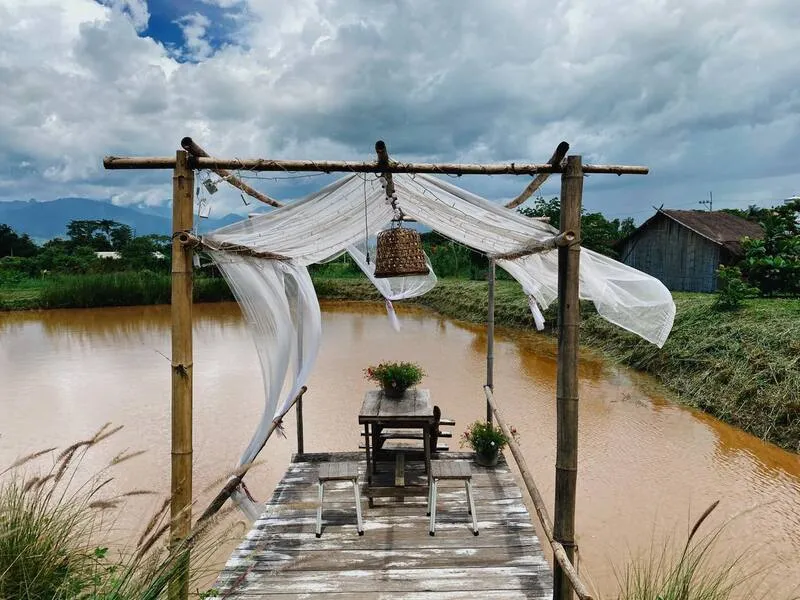
Ban Pong Nok Reservoir in Village No. 4, Dan Makham Tia Subdistrict, Dan Makham Tia District, Kanchanaburi Province, is a quiet, natural “community water source” that suits travelers who want open space to rest their eyes and mind without rushing. The appeal of this kind of reservoir is not a staged, headline-grabbing landmark, but the gentle beauty created by the water surface, the sky, the breeze, and the trees along the bank—all of which shift in mood with time of day and season. If you are looking for a lesser-crowded place in Kanchanaburi and do not need a packed itinerary, Ban Pong Nok Reservoir fits a slow-life style trip especially well, particularly for those who prefer simplicity and personal space over checking in at many spots in one day.
In general, community reservoirs primarily store water for household use and agriculture, and they also act as a local ecological buffer. The water surface and the vegetation along the shoreline help maintain humidity in nearby areas, shaping both the landscape and how visitors feel when they arrive. What makes Ban Pong Nok Reservoir interesting is the way it places “rural life and a water source” in the same frame—seasonal traces of farming, birds along the waterside trees, and early-morning calm when the air is often still and lighter than in town. If you enjoy nature photography or everyday-life scenes, reservoirs like this typically offer soothing visuals and plenty of open space for composition without having to squeeze through crowds.
Many people search with information-style questions such as “What is Ban Pong Nok Reservoir?” or “Where is Ban Pong Nok Reservoir?” In the most straightforward terms, it is a water source in the Ban Pong Nok area of Dan Makham Tia Subdistrict and is considered a local water resource. For best accuracy, it is recommended to open a map and confirm that the pin matches what locals refer to as “Ban Pong Nok Reservoir,” because in rural areas, names of water bodies can sometimes overlap with village names or nearby ponds.
What makes a community reservoir like this “worth visiting” is that you do not need special skills or equipment. You can walk along the bank, sit and watch the water to calm your thoughts, or bring a mat and rest in a spot that does not disturb others (and does not cross into private property). If you visit in the morning, you will often get fresher air, softer light, and less noise, which makes relaxation feel noticeably more effective. In the late afternoon, the atmosphere warms up, and reflections on the water add depth to photos—ideal for those who want warm tones or simply want to watch the sky change color without hiking or walking far.
From a nature perspective, reservoirs often become gathering points for local wildlife—water birds, resident birds, insects, and small animals along the grasses and shrubs. Early morning is usually the best time to observe wildlife activity, making it suitable for quiet birdwatching or long-distance photography if you have a zoom lens. Even without equipment, simply listening to birds and noticing movement along the treeline can feel like a mental “reset.” The key is to stay gentle with the space: avoid loud noise, do not chase animals, and do not throw food scraps into the water, because these actions can affect water quality and the ecosystem over time.
If you prefer activities, you might wonder, “Can you swim here?” or “Can you fish here?” The safest answer is that it depends on local rules and the real conditions on the day. Some reservoirs are under community or agency supervision with specific conditions, and water levels, currents, and shoreline ground can change by season. It is best to ask locals first and put safety first. If you plan any water activity, choose areas that locals normally use, wear a life jacket when near the water, and avoid entering areas where depth is unclear or where the ground is muddy and can be slippery or sink—especially after rain.
In terms of “history and local context,” many community water sources in Kanchanaburi were developed to support agriculture and to address seasonal water shortages by using existing streams or natural drainage lines, then creating embankments or retention structures to provide more reliable water in the dry season. This is why a reservoir is not only a place to visit but also a structure tied to community livelihoods: water supports crops, livestock, and household routines. In the case of Ban Pong Nok Reservoir, its role as a local water resource reinforces the importance of respectful travel etiquette—do not litter, do not damage shoreline plants, do not drive into areas that could erode or break the soil surface, and do not enter zones that may be farmland or private property unless necessary.
When visiting Ban Pong Nok Reservoir, it helps to think of it as a natural/community area rather than a fully managed tourist site. Essentials to bring include enough drinking water, a hat, a light layer for sun and wind, comfortable walking shoes (non-slip soles help if the ground is damp), and a trash bag to take your waste back. Many rural areas do not provide the same trash and facility systems as major attractions. Taking your trash with you is a small action that has a major impact on the area’s livability and also makes community-based tourism easier to sustain over the long term.
Getting There For Ban Pong Nok Reservoir, a private car is recommended because it is a village-level destination and public transport may not be as frequent as on main routes. A practical approach is to use Dan Makham Tia District as your starting point, then navigate to Ban Pong Nok (Village No. 4) using an online map. Along the way, watch for village signs and drive at an appropriate speed, as rural routes have many small junctions and are shared with local traffic. If traveling in the rainy season or right after rain, allow extra time and be more cautious, because some sections may be slippery or muddy, especially near water and on paths down toward the bank.
If you want a smooth “half-day” plan, the simplest flow is to go in the morning and spend about 1–2 hours enjoying the reservoir atmosphere, then move on to restaurants or cafes in the Dan Makham Tia/Klondo area. Options range from bold-flavored local jungle curry restaurants to garden-style cafes. If you prefer an even more relaxed pace, you can also treat the reservoir as a “rest-your-eyes stop” before continuing to Kanchanaburi town or larger attractions on the same route, because Dan Makham Tia is not far from the Tha Muang–town area and connects fairly conveniently.
What many people enjoy most about a reservoir like this is the feeling of “space and slowness.” When you look at a wide water surface and open sky, the mind naturally settles, especially for those who work heavily on screens or have been surrounded by noise and urgency. Pausing for even 30 minutes without doing anything demanding can be surprisingly restorative. But this kind of quiet beauty only remains possible if the area stays clean, calm, and safe. Responsible travel is therefore the core reason Ban Pong Nok Reservoir can remain “worth visiting” over the long term.
| Place Summary | Ban Pong Nok Reservoir is a community water source in Village No. 4, Dan Makham Tia Subdistrict, Dan Makham Tia District, Kanchanaburi. It suits quiet relaxation, shoreline walks, sitting to enjoy the water-and-sky view, nature photography, and slow-life travel. Visitors should respect the community context and always take trash back. |
| Highlights | 1) Quiet, peaceful atmosphere for genuine rest 2) Open water-and-sky views with changing moods at morning/evening light 3) Suitable for nature photography and unhurried rural scenery 4) A real community setting that reflects local context and everyday life 5) Easy to plan as a half-day stop and continue to cafes/restaurants in Dan Makham Tia |
| Address | Ban Pong Nok Reservoir, Village No. 4, Dan Makham Tia Subdistrict, Dan Makham Tia District, Kanchanaburi, Thailand |
| Coordinates | Latitude 13.846982, Longitude 99.338737 |
| Getting There | Private car recommended. Use Dan Makham Tia District as a base, then navigate to Ban Pong Nok (Village No. 4) via an online map. Rural roads have small junctions; allow extra time and drive carefully, especially after rain. |
| Open Days | No official open days |
| Opening Hours | No official hours (recommended: 06.00 – 09.00 and 16.30 – 18.30) |
| Fees | No official fees |
| Nearby Attractions (Approx. Real-Route Distance) | 1) Ban Khao Pu Khong Community Forest (Klondo Subdistrict) – 12 km – 085-429-2911 2) Dan Makham Tia district center area – 10 km 3) Kanchanaburi town area (River Kwai zone) – 35 km 4) Bridge over the River Kwai – 38 km 5) Kanchanaburi War Cemetery (Don Rak) – 36 km |
| Nearby Restaurants (Approx. Distance + Verified Phone) | 1) Trio Farm Cafe (Dan Makham Tia) – 15 km – 095-854-8108 2) Chai Jungle Curry (Klondo) – 18 km – 034-510-365, 081-293-2152 3) Manoch Jungle Curry (Sam Yaek Yang Ko/Klondo) – 18 km – 081-943-4964, 034-918-588 4) Ban Rai Rim Lam (Dan Makham Tia) – 16 km – 093-559-8892 5) Som Tam Nong Nuch (Teng Nam, Wat Makham Tia area) – 14 km – 094-826-7492 |
| Nearby Accommodations (Approx. Distance + Verified Phone) | 1) Kung Fu Home (Dan Makham Tia) – 18 km – 087-818-7611 2) Chom Thung Homestay (Kanchanaburi) – 22 km – 084-421-1915, 064-515-8980 3) Mida Resort Kanchanaburi – 45 km – 034-919-606 4) River Kwai Resotel – 60 km – 02-642-5497 5) Suan Saiyok Resort – 65 km – 02-967-8181-4, 0-3451-0488 |
Frequently Asked Questions (FAQ)
Q: What is the best time to visit Ban Pong Nok Reservoir?
A: 06.00 – 09.00 is recommended for fresh air and soft light, or 16.30 – 18.30 for warm light and a more relaxing atmosphere.
Q: Where is Ban Pong Nok Reservoir located?
A: It is in Village No. 4 (Ban Pong Nok), Dan Makham Tia Subdistrict, Dan Makham Tia District, Kanchanaburi Province.
Q: What kind of place is Ban Pong Nok Reservoir?
A: It is a community water source that supports local water use and reflects the local rural context, so it is best visited with respect for community space and everyday life.
Q: Can I swim or fish at the reservoir?
A: It is best to ask locals about rules and conditions first, because restrictions may apply depending on safety and water use. A safe approach is to focus on low-impact activities such as walking, photography, and enjoying the view.
Q: What should I bring if I want to relax by the water?
A: Bring drinking water, a sun hat, a light layer, comfortable walking shoes, and a trash bag to take waste back, as facilities may be limited in a natural/community area.
Q: Are there restaurants or cafes nearby?
A: Yes. There are several options in Dan Makham Tia and Klondo, such as Trio Farm Cafe, Chai Jungle Curry, and Manoch Jungle Curry, which work well as the next stop after visiting the reservoir.
 Ban Pong Nok Reservoir Map
 Category:
  Group:
  Last Update: 1 DayAgo
Comment
 Nearby Attractions
| Keyword (Advance) |
 Region
|
 Muang Kanchanaburi(