

 Home
Home Chiang Mai(










Rating: 4.5/5 (4 votes)
 |
|  Map
Map 
 Have Map
  No Map
Kanchanaburi attractions
Attractions in Thailand
Open Days: Access by prior permission (generally more accessible for the public/visitors during December – May)
Opening Hours: Government office hours (recommended to contact officials before traveling every time)
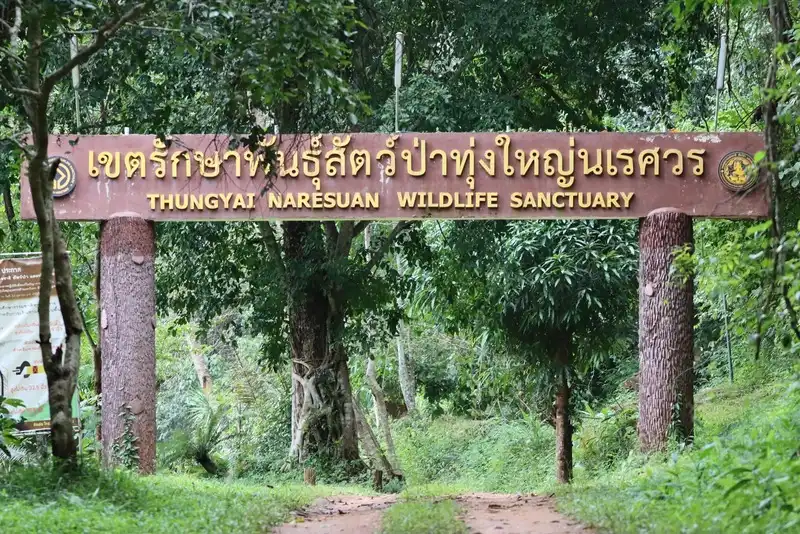
Thung Yai Naresuan Wildlife Sanctuary is one of Thailand’s most significant conservation areas, and a name that often makes nature-minded people pause and reflect. This is not a destination in the usual sense of an easy, relaxing trip. It is a strictly protected area designed primarily to preserve ecosystem integrity. Entering Thung Yai Naresuan therefore begins with a shared understanding that “limited accessibility” and “restrictions on the number of visitors” are not obstacles to be removed, but essential mechanisms that allow a vast forest landscape to continue functioning on its own terms without being pressured into becoming a recreation site that must accommodate large crowds.
Thung Yai Naresuan Wildlife Sanctuary spans Sangkhla Buri District in Kanchanaburi Province and Umphang District in Tak Province. The terrain is rugged and mountainous, with long ridgelines and deep valleys that clearly convey the character of true wilderness. The highest peak in the area is Khao Yai, located near the central part of the sanctuary, and it plays a crucial role as the source area for multiple streams that flow down into lower landscapes. This reality means Thung Yai Naresuan is valuable not only for its scenic and ecological richness, but also for its importance to local water security. When headwater forests remain intact, streams and tributaries within the ecosystem are better able to sustain life and maintain natural balance over time.
The sanctuary’s defining strength is the “diversity of landscapes” within a single forest expanse. The area contains multiple forest types, including grasslands, mixed deciduous forest, dry dipterocarp forest, and evergreen rainforest. Such diversity directly supports high biodiversity, because each forest type has different vegetation structures, humidity, temperature, and food resources. As a result, the sanctuary can sustain a wide range of wildlife, from large herbivores that depend on grasslands to species that require the moist, shaded conditions of dense evergreen forest. Meanwhile, mixed deciduous and dry dipterocarp forests often function as transition zones, helping maintain connectivity of habitats so wildlife movement and plant dispersal can still occur naturally.
Grasslands in western Thailand’s forest ecosystems are more important than many people assume. They are not just open spaces, but key components that help balance food cycles, especially for herbivores that need feeding grounds and visibility to detect predators. Dry dipterocarp forest typically occurs in relatively drier areas with more pronounced seasons, shaping distinctive tree communities and understory plants. Mixed deciduous forest contributes greater variety of tall trees, shrubs, and ground vegetation. Evergreen rainforest, usually found in wetter microclimates, has dense structure and retains coolness naturally, becoming habitat for many organisms that depend on specific environmental conditions.
Where forest diversity is high, wildlife diversity often follows. Thung Yai Naresuan has long been recognized as habitat for numerous wildlife species, including large mammals, predators, birds, and other groups that serve as indicators of ecosystem health. The presence of diverse wildlife suggests that food webs still function in a relatively complete way. If a system loses critical elements—such as feeding grounds, water sources, or shelter—some species decline rapidly. Therefore, the fact that Thung Yai Naresuan continues to be discussed as a major wildlife habitat is a strong reason to keep human pressure as low as possible.
Historically, the name “Thung Yai Naresuan” is frequently mentioned alongside the broader conservation vision for Thailand’s western forests, because this is one of the largest forest landscapes that still retains a high level of natural integrity. The designation and protection as a wildlife sanctuary marked a major step toward systematic management—controlling land use, preventing poaching, and establishing standards for access permissions primarily for nature study. These measures underscore that Thung Yai Naresuan is not an area that can be entered freely at will; it requires intensive management to preserve its original condition for as long as possible.
One practical reality that prospective visitors should understand is that travel into Thung Yai Naresuan remains relatively difficult. Some road segments are in poor condition, and the route is more demanding than typical tourist destinations. A commonly cited travel reference is from the Thong Pha Phum–Sangkhla Buri road at Huai Suea Junction to Ban Klee Ti, a distance of about 42 km. From there, there is a junction leading toward the sanctuary office and Huai Song Thai, approximately another 40 km. While the total distance might not seem excessive on paper, the real constraints are road quality, weather, and the need to prepare vehicles and communications because forest and mountain areas often have limited signal and services.
Because the area is a wildlife sanctuary with a primary mission of conservation, anyone intending to enter Thung Yai Naresuan must request official permission in advance and should allow sufficient lead time. A widely referenced guideline is to submit the request at least 15 days prior. This requirement is not merely procedural; it enables the responsible agency to assess the purpose of entry, planned activities, duration, group size, and overall risk so impacts on the sanctuary can be minimized and visitor safety can be better managed. Especially during the rainy season, or when road conditions change quickly, official approval and staff guidance can reduce risk more effectively than relying on general travel information.
In practical terms, the sanctuary’s limited accessibility means it is not suitable for rushed trips or travelers with very limited time. It is more appropriate for people who are seriously interested in nature study—those who want to learn about ecosystems, observe forest types, and understand the role of protected areas rather than focusing on photos or entertainment. Visiting Thung Yai Naresuan should begin with setting the right objective: learning, and appreciating the value of keeping a natural area functioning on its own terms.
Conceptually, Thung Yai Naresuan reflects an important conservation lesson: some forms of nature require “space and quiet” more than amenities. When protected areas face excessive human pressure, habitats become fragmented, wildlife retreats, migration routes are disrupted, and overall ecological integrity declines in ways that can be difficult to reverse. Managing Thung Yai Naresuan as a strictly protected sanctuary is therefore not “too strict,” but a choice consistent with its value. Effective conservation does not require allowing large numbers of people to see everything. It requires keeping the ecosystem viable over the long term while providing appropriate pathways for study and learning without placing burdens on the forest.
It is also important to emphasize that Thung Yai Naresuan involves coordinated work across multiple efforts: field staff responsible for the area, patrol operations, research, and broader conservation collaboration. Strict compliance by those who enter—following permission procedures, adhering to guidance, not leaving trash, keeping noise down, and not disturbing wildlife—is not just etiquette. It is part of shared responsibility toward a protected landscape.
In summary, Thung Yai Naresuan Wildlife Sanctuary is a natural area of exceptional national and global value. That value comes from forest continuity, diverse forest types, headwater significance, and its capacity to support diverse wildlife. Difficult travel conditions and the need for advance permission are therefore not disadvantages, but filters that help ensure entry aligns with conservation goals, and that the sanctuary can remain a thriving forest landscape for protection and learning in the future.
| Place Summary | Thung Yai Naresuan Wildlife Sanctuary is a strictly protected part of Thailand’s western forest landscape, featuring rugged mountains and vital headwaters. It contains multiple forest types (grasslands, mixed deciduous forest, dry dipterocarp forest, and evergreen rainforest) and supports many wildlife species. It is best suited for nature study, and access requires prior permission. |
| Highlights | 1) Vast, highly intact forest landscape 2) Rugged mountains and major headwater sources 3) Multiple forest types within one protected area (grasslands to rainforest) 4) Habitat for diverse wildlife populations 5) Strong conservation controls suited to responsible nature study |
| Location | Covers Sangkhla Buri District (Kanchanaburi) and Umphang District (Tak) |
| Terrain | Rugged mountains; highest peak is Khao Yai (central area), a source zone for multiple streams |
| Forest Types | Grasslands, mixed deciduous forest, dry dipterocarp forest, evergreen rainforest |
| Getting There (Referenced Distances) | From the Thong Pha Phum–Sangkhla Buri route at Huai Suea Junction → Ban Klee Ti: approx. 42 km From Ban Klee Ti → junction to the sanctuary office / Huai Song Thai: approx. 40 km Note: Some road sections are in poor condition; confirm route conditions with officials before travel |
| Access Requirements | Advance permission is required (commonly referenced as at least 15 days prior), and all agency regulations must be followed strictly |
| Responsible Agency / Contact | Tourism Authority of Thailand (attraction information): 034-685-639 Area/office contact information: 034-546-671, 080-855-2970 |
| Nearby Attractions (Approx. Distance) | 1) Mon Bridge (Sangkhla Buri) – 0 km 2) Wat Wang Wiwekaram (Sangkhla Buri) – 3 km 3) Phutthakhaya Pagoda (Sangkhla Buri) – 5 km 4) Three Pagodas Pass – 22 km 5) Kroeng Krawia Waterfall – 43 km |
| Nearby Restaurants (Approx. Distance + Phone) | 1) Sri Daeng Restaurant (Sangkhla Buri) – 2 km – 095-987-3566, 034-595-088 2) Faya Cafe @sangkhlaburi – 4 km – 092-521-7776 3) Niche Cafe (Sangkhla Buri) – 3 km – 080-995-3359 4) Ahlaylay Sangkhla Buri – 6 km – 096-974-9155 5) Pa Yin Local Food / Mon Khanom Jeen – 4 km – 089-808-3002 |
| Nearby Accommodations (Approx. Distance + Phone) | 1) P. Guest House and Country Resort – 4 km – 081-450-2783, 034-595-061 2) Songkaria River Hut & Resort – 3 km – 092-994-2492, 034-595-023 3) Porpailin Riverside Resort – 4 km – 034-595-355, 034-595-322 4) The Nature Club Resort – 5 km – 089-510-8444 5) Haiku Guesthouse – 3 km – 087-519-9150 |
Frequently Asked Questions (FAQ)
Q: Is Thung Yai Naresuan Wildlife Sanctuary suitable for general tourism?
A: As a wildlife sanctuary, the area prioritizes conservation and nature study rather than recreational tourism. Anyone entering should have an appropriate purpose and follow regulations strictly.
Q: Do I need to request permission in advance to enter the area?
A: Yes. Prior permission is required. A commonly referenced guideline is to submit the request at least 15 days in advance so the agency can assess purpose, group size, duration, and safety before entry.
Q: How difficult is the journey to Thung Yai Naresuan?
A: Travel is relatively challenging because some road sections are in poor condition. Referenced distances include about 42 km from Huai Suea Junction to Ban Klee Ti, and about 40 km from Ban Klee Ti toward the office/Huai Song Thai. Contact officials to confirm route conditions before traveling.
Q: What natural features are most distinctive inside the sanctuary?
A: Key features include rugged mountain terrain, major headwater sources, and multiple forest types—grasslands, mixed deciduous forest, dry dipterocarp forest, and evergreen rainforest—which together support very high biodiversity.
Q: If I plan to visit for nature study, how should I prepare?
A: Prepare the required permission documents, allow sufficient travel time, check road and weather conditions, bring appropriate communication and safety equipment for remote forest areas, and follow staff guidance to minimize impacts on wildlife and the ecosystem.
 Thung Yai Naresuan Wildlife Sanctuary Map
 Category:
  Group:
  Last Update: 1 DayAgo
Comment
 Nearby Attractions
| Keyword (Advance) |
 Region
|
 Muang Kanchanaburi(