

 Home
Home Chiang Mai(










Rating: 2.9/5 (7 votes)
 |
|  Map
Map 
 Have Map
  No Map
Chiang Mai attractions
Attractions in Thailand
Open Days: Generally daily (this is a reservoir and local development project area; please visit respectfully and avoid disturbing staff and community activities)
Opening Hours: Recommended 06:00 – 18:00 (morning and late afternoon light is beautiful, ideal for lakeside walks, photography, and sunset views)
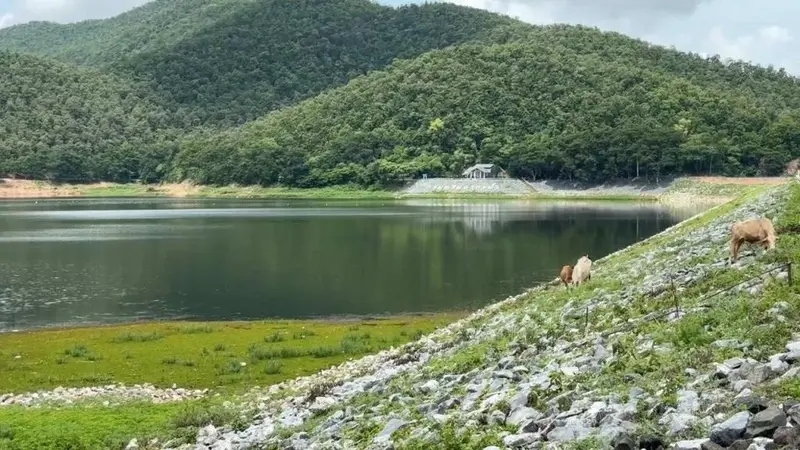
Huai Lan Reservoir might look, at first glance, like a breezy “mountain lake” with open views and a relaxed vibe that suits a simple picnic or an easy camping plan. But if you look a little deeper, this place is the heart of a watershed-scale water management system designed to make “the forest work again” and to help ensure “year-round water for people” at the same time. The calm water in the cool season, or the deep green tones after the rains, are not just scenery — they are the end result of upstream care, forest restoration, and a thoughtful allocation of water so local agriculture and community fisheries can move forward together.
The story of Huai Lan begins with a very real local problem: headwaters that had been heavily used until the forest deteriorated, streamflow that became less consistent, and communities facing water risk for farming. On 16 February 1987, His Majesty the King visited the Huai Lan area at Ban Pong, Village No. 8 (at that time under San Kamphaeng District, before later administrative changes that formed Mae On District). Royal guidance emphasized upstream development, including nursery work and reforestation to restore moisture around the reservoir, and the transfer of proven forest–water management lessons from the Huai Hong Khrai Development Study Centre to be applied in the Huai Lan area — so that approaches already tested and suited to local conditions could be expanded to other communities in a systematic way.
From there, the concept became clearer: “water” at Huai Lan should not be treated as an isolated storage point at the end of the stream. It must be connected to the entire landscape — from ridgelines to foothills, tributaries, and farmlands — because if the headwaters collapse, even the largest reservoir cannot reliably deliver good water quality or stable flow. Project objectives summarized by Chiang Mai Province therefore went beyond building a reservoir; they focused on protecting ecosystems, restoring forest, and ensuring that waterways have both water and good water quality throughout the year, ultimately improving livelihoods across the watershed.
What makes Huai Lan especially interesting from a watershed perspective is that it was designed to work together with other local water sources rather than standing alone like a typical “tourism reservoir.” Based on the area information you provided, the project covers about 12,500 rai across the Huai Lan, Huai Pa Rai, and Doi Ton watersheds, with elevations ranging from about 478–1,015 meters above sea level and average rainfall around 1,129 mm per year. This reveals two key realities: (1) the terrain has strong elevation differences, so runoff can be fast and can carry soil and sediment into the reservoir if upstream forests are not healthy; and (2) rainfall is not necessarily low, but the real challenge is “concentrated rain” and a “long dry season.” The reservoir system therefore needs to store wet-season water for dry-season use, while also reducing erosion by restoring forest so the landscape can absorb water and filter sediment naturally.
If you visit Huai Lan and observe how the shoreline is used, you can see a careful, gradual approach. Some areas function as simple recreation and photo spots, but the core remains a working landscape for both the project and the community. This is not a fully equipped city-style attraction. It suits people who want nature without staging — a slow walk by the water, wind across the surface, and the quiet understanding that this calm exists because resource management here is taken seriously.
If you ask, “How is Huai Lan different from other reservoirs in Mae On?” think of Mae On as a transition zone between mountains and lowlands. It includes well-known destinations (like Mae Kampong) as well as protected headwater landscapes and project areas (like Mae Takhrai). Reservoirs here often serve two layers at once: first, as water sources for communities (agriculture, fisheries, and daily use), and second, as a public landscape where people come for fresh air and a mental reset. Huai Lan stands out because it directly ties into forest restoration and the transfer of knowledge from the Huai Hong Khrai Development Study Centre under the Royal Initiative — giving it a stronger identity as a “watershed demonstration area” than many reservoirs built primarily for irrigation alone.
To visualize the system more clearly: smaller reservoirs such as Doi Ton and Huai Pa Rai (mentioned as part of the same local set) can function like backup batteries for sub-watersheds — storing water locally, reducing dry-season risk, and easing pressure on the main reservoir. Huai Lan, meanwhile, acts more like a balancing hub for a broader area. When the system works well together, you gain three benefits at once: (1) more stable water supply, (2) less sedimentation because upstream forest returns to absorb runoff, and (3) better water quality because upstream management is done across the whole landscape, not only at the downstream endpoint.
A “quiet place with a real sky” is another angle worth noting, because the area has also been communicated within a dark-sky / stargazing theme (with community and local management contact information). That means Huai Lan is not only a quick sunset stop; it can also be planned for gentle night activities such as stargazing, Milky Way photography, or learning about reducing light pollution together with the community — typically coordinated through local agencies and the On Tai Subdistrict Municipality.
Most people do only a few things at Huai Lan, but it is easy to do them well if you manage your timing: a morning lakeside walk for cool air and calm reflections, an evening visit for a sunset that glows on the water, a low-impact picnic with every piece of trash taken home, and — if you plan to camp or spend time at night — coordinating with the community or staff first for safety and to avoid disturbing those who live and work in the area.
Getting There If you are driving from Chiang Mai city, the simplest approach is to head toward the San Kamphaeng–Mae On area and use “Huai Lan Reservoir” on your navigation app (the destination is in On Tai Subdistrict, Mae On). The final stretch is often local community roads and an access route into the project area, so drive slowly, watch for curves and local vehicles, and be especially cautious in the rainy season when roads can be slippery and small rocks or debris may appear on the surface. If you are coming from the Mae Kampong / Ban Sahakon area, you can also plan Huai Lan as part of the same short trip loop, because the connecting distances are not far (one strength of this area is that you can build a meaningful day trip without having to drive back into the city between stops).
Responsible travel at Huai Lan is genuinely doable — and it genuinely matters — because nature and community use this place together year-round. The basics are simple: (1) do not litter and do not throw food scraps into the water, (2) keep noise down in the evening if there are people resting or homes nearby, (3) avoid overly bright lighting if you come for stargazing because light pollution ruins both the experience and the sky’s value, (4) avoid risky activities in areas that are not designated for them, and (5) if traveling with children or elderly visitors, prioritize easy-access areas and safer ground rather than walking along unstable banks.
If you want to “understand Huai Lan as a complete system,” try observing it in three layers: first, the landscape layer (ridges–forest–water surface); second, the use layer (agriculture–fisheries–public space); and third, the management layer (forest restoration, stream care, and coordination among local agencies). With this lens, Huai Lan becomes more than a check-in spot — it becomes a short, real-world lesson on how a watershed works in a single day.
Huai Lan feels different from large landmark reservoirs built around tourism, because its calm comes from being a working landscape and a community resource first — with travel always secondary. Yet within that simplicity, you still get the view, the wind, the sky, and a clear sense of why “reforestation–water management–balanced livelihoods” are one story, not separate ones.
| Name | Huai Lan Reservoir (On Tai Subdistrict, Mae On District, Chiang Mai) |
| Highlights | A mountain reservoir within a Royal Initiative development area; suitable for scenic views, sunsets, picnics, and slow-paced nature time |
| Watershed System Concept | Focus on headwater forest restoration, water quality, and year-round community water security; linked to knowledge transfer from the Huai Hong Khrai Development Study Centre and coordinated with smaller local reservoirs |
| Project / Coordination | Huai Lan Development Project under the Royal Initiative (contact during office hours) |
| Contact Numbers | 083-714-2654, 083-153-3402 |
| Nearby Attractions (Distance & Phone) | |
| San Kamphaeng Hot Springs | Approx. 10 km | 065-502-3346, 087-184-4953 |
| Mae Kampong Village | Approx. 20 km | 095-456-9904 |
| The Giant Chiang Mai (Viewpoint / Cafe) | Approx. 23 km | 086-343-3854 |
| Mae Takhrai National Park | Approx. 25 km | 052-001-360 |
| Huai Hong Khrai Development Study Centre | Approx. 25 km | 053-389-228 to 9 |
| Mae Kuang Udom Thara Irrigation Project | Approx. 30 km | 053-865-685 |
| Nearby Restaurants (Distance & Phone) | |
| Khrua Jira (Mae On) | Approx. 9 km | 087-193-9709 |
| Lap Kum Mae On | Approx. 12 km | 085-035-3476 |
| Chom Nok Chom Mai Cafe (Mae On) | Approx. 14 km | 081-886-5898 |
| OonBox Cafe | Approx. 15 km | 081-783-1742 |
| Tharnthong Kitchen / Tharnthong Lodge | Approx. 18 km | 091-079-8703 |
| “Na Mae Kampong” Restaurant | Approx. 20 km | 065-595-6544 |
| The Giant Cafe | Approx. 23 km | 086-343-3854 |
| Nearby Accommodations (Distance & Phone) | |
| The White House: Farmstay & Camping (Mae On) | Approx. 10 km | 081-895-9008 |
| Lakeview Resort Chiang Mai (Mae On) | Approx. 11 km | 092-889-5622 |
| 100 Love Resort (Mae On) | Approx. 12 km | 065-462-5627, 092-629-6249 |
| Sippa Hotspring Resort (Mae On) | Approx. 13 km | 098-295-2652 |
| Chiangmai Highlands Golf and Spa Resort | Approx. 18 km | 053-261-354, 081-961-0028 |
| Tharnthong Lodge | Approx. 18 km | 091-079-8703 |
| The Giant Chiang Mai (Stay / Cafe) | Approx. 23 km | 086-343-3854 |
Frequently Asked Questions (FAQ)
Q: When is the best time to visit Huai Lan Reservoir?
A: For the most comfortable weather and the best light, go in the morning (cool air, fewer people) or in the late afternoon before sunset (the reflection on the water is especially beautiful). During the rainy season the landscape is greener and the reservoir is fuller, but roads can be slippery and weather can change quickly.
Q: Is this place only for sightseeing, or is it part of a development project too?
A: It is a reservoir within the Huai Lan Development Project under the Royal Initiative. The key goals include restoring headwater ecosystems and forest so water quality improves and water is available year-round, while also supporting community livelihoods.
Q: How can I contact the project staff?
A: You can contact the Huai Lan Development Project at 083-714-2654 or 083-153-3402 (recommended during office hours).
Q: Is Huai Lan related to dark-sky / stargazing activities?
A: The area has also been communicated within a dark-sky / stargazing theme with local coordination information. If you plan night activities, it is best to plan in advance and coordinate with local community or relevant agencies.
Q: How should visitors behave to avoid negatively affecting the community?
A: Take all trash home, do not throw food scraps into the water, keep noise down in the evening, avoid unnecessary bright lights if stargazing, and avoid risky activities in undesignated areas — this is both a community water source and a working project landscape.
 Huai Lan Reservoir Map
 Category:
  Group:
  Last Update: 18 HourAgo
Comment
 Nearby Attractions
| Keyword (Advance) |
 Region
|
 Muang Chiang Mai(