
 Home
Home North(
 Chiang Mai(


Rating: 3.2/5 (5 votes)
 |
|  Map
Map 
 Have Map
  No Map
Nakhon Pathom attractions
Attractions in Thailand
Open Days: Daily
Opening Hours: 08:00 – 17:00
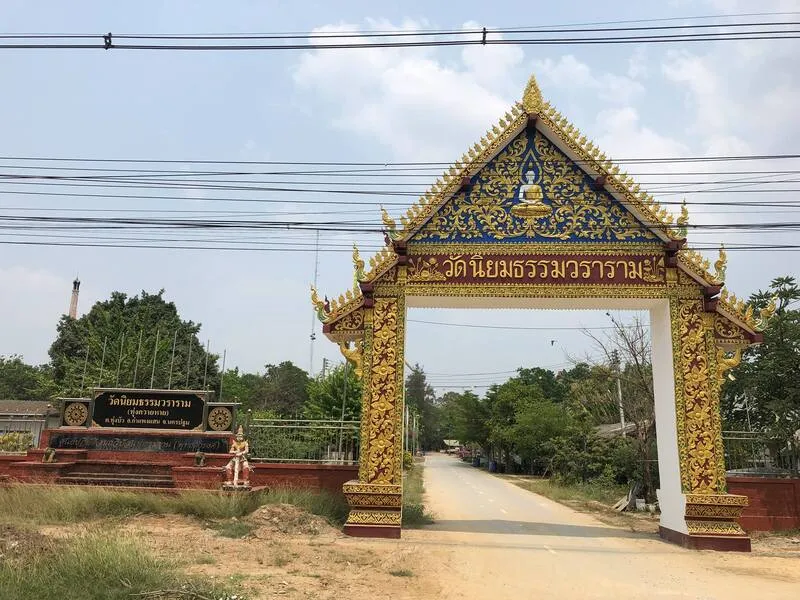
Wat Niyom Tham Woraram, located in Moo 2, Thung Bua Subdistrict, Kamphaeng Saen District, Nakhon Pathom Province, is a Mahanikaya Buddhist temple that plays a clearly significant role in the local community. It serves not only as a religious center and a place for ceremonies, but also as a focal point of faith for residents of Thung Bua. This temple is not merely a place for merit-making on important Buddhist days; it also reflects the deep relationship between the temple, the local school, and the surrounding community.
For travelers seeking a temple in Kamphaeng Saen that offers both historical depth and a living community atmosphere, Wat Niyom Tham Woraram stands out as a compelling destination. The temple has a verifiable history, a former name rooted in local memory, and continues to host ongoing religious activities such as Kathin ceremonies, the end of Buddhist Lent (Ok Phansa), and New Year chanting rituals.
The history of Wat Niyom Tham Woraram dates back to 1957 (B.E. 2500), when Mr. Pin Kantapheng, who served as the district education officer of Kamphaeng Saen at the time, purchased over 60 rai of land and donated it to Phra Khru Sukit Thammasorn (Luang Por Wang), the abbot of Wat Kamphaeng Saen. This origin highlights that the temple was established through strong collaboration between key local figures and the community, forming a spiritual foundation that genuinely reflected local needs.
Later, Luang Por Wang allocated 20 rai of the land for the establishment of Wat Niyom Tham Woraram School. Another portion of the land was intersected by the Nong Pla Duk–Suphan Buri railway line, leaving the temple with approximately 40 rai, 1 ngan, and 10 square wah. This makes the temple distinct from typical rural temples, as it developed in close connection with the local education system, reinforcing its role as both a religious and community development center.
The temple was officially established on August 10, 1960 (B.E. 2503). In its early years, it did not yet have an official name and was commonly referred to by locals as “Wat Thung Khwai Hai,” a name that reflected the original landscape and community memory. It was later officially named “Wat Niyom Tham Woraram.” This former name provides valuable insight into how the temple is rooted in everyday life and local identity.
In terms of development, after its official establishment, Phra Khru Sukit Thammasorn appointed Luang Por Sakon Parisuttho as the abbot. Over time, the temple continued to grow under successive abbots, including Phra Khru Siripanyarak, Phra Athikan Suriya Paphakaro, Phra Athikan Ekkunchon Ujucharo, and currently, Phra Athikan Wirawat Aphakaro, who serves as the present abbot. This continuity reflects stable administration and sustained religious development.
Another important milestone was the royal grant of Wisungkhamsima (the consecrated boundary for ordination ceremonies) on June 24, 1979 (B.E. 2522), confirming the temple’s full status for official Buddhist rituals. In 2015 (B.E. 2558), the temple also produced sacred amulets to fund the renovation of the chanting hall and the construction of a meditation pavilion, demonstrating ongoing development to support religious practice and community engagement.
The atmosphere of Wat Niyom Tham Woraram reflects the charm of a rural temple in the agricultural area of Kamphaeng Saen. It is peaceful, simple, and unhurried. Visitors will immediately notice that the temple remains an active community space rather than a commercialized tourist attraction. This simplicity makes it ideal for those seeking a place to make merit, pay respect, relax their mind, and experience the temple as part of everyday local life.
The temple’s uniqueness does not lie in grand architecture or elaborate decoration, but in its deep-rooted connection to the community. Its documented history, original name, and ongoing religious activities all contribute to its layered value in terms of religion, local history, and collective memory.
Today, Wat Niyom Tham Woraram remains vibrant through active Buddhist events such as annual Kathin ceremonies, merit-making during Ok Phansa, and year-end chanting. These activities demonstrate that the temple is not merely a historical site but a living religious center where community members continue to participate.
From a social perspective, the temple’s connection with Wat Niyom Tham Woraram School further enhances its significance. It functions not only as a place for monks and worshippers but also as a supportive environment for education and youth development. This reflects the traditional role of Thai temples as integral parts of rural community life.
For visitors, Wat Niyom Tham Woraram is best suited for those who wish to experience an authentic local temple with genuine community significance rather than a commercial tourist site. Visitors are advised to dress modestly, behave respectfully, and be mindful of ongoing religious activities, as the temple remains actively used by monks, students, and local residents.
Getting There is straightforward by traveling to Kamphaeng Saen District in Nakhon Pathom Province, then heading toward Thung Bua Subdistrict. The temple is located in Moo 2. Private transportation is the most convenient option, as the temple is situated within a local community rather than along major tourist transport routes.
Visiting Wat Niyom Tham Woraram offers insight into a deeper dimension of cultural tourism in Thailand—one that emphasizes authenticity, living traditions, and community connections. Visitors will not only see religious structures but also witness the ongoing relationship between faith, daily life, and local society.
For these reasons, Wat Niyom Tham Woraram is considered one of the important temples in Kamphaeng Saen District, whether as a place of worship, a community landmark, a site for learning local history, or a peaceful destination to experience the essence of rural temple life in Nakhon Pathom Province.
| Place Summary | Wat Niyom Tham Woraram is a Mahanikaya Buddhist temple in Thung Bua, Kamphaeng Saen, Nakhon Pathom, serving as a key religious and community center. |
| Highlights | Established in 1957 with a former name “Wat Thung Khwai Hai,” closely connected to the local school and active in ongoing religious events. |
| History / Period | Founded in 1957, officially established in 1960, and granted Wisungkhamsima in 1979. |
| Current Abbot | Phra Athikan Wirawat Aphakaro |
| Address | 1 Moo 2, Thung Bua Subdistrict, Kamphaeng Saen District, Nakhon Pathom 73140 |
| Travel | Accessible via Kamphaeng Saen District, heading toward Thung Bua Subdistrict. Private car recommended. |
| Nearby Attractions | 1. Kasetsart University Kamphaeng Saen Campus – approx. 6 km 2. Kamphaeng Saen Market – approx. 5 km 3. Wat Kamphaeng Saen – approx. 7 km 4. Sirikit Forest Garden – approx. 8 km 5. Kamphaeng Saen Rice Research Center – approx. 9 km |
| Nearby Restaurants | 1. Krua Kamphaeng Saen – approx. 5 km Tel: 034-281-234 2. Kamphaeng Saen Boat Noodles – approx. 4 km Tel: 081-234-5678 3. Baan Suan Restaurant – approx. 6 km Tel: 034-299-112 4. Somtam Pa Sommai – approx. 3 km Tel: 089-765-4321 5. Rung Rueang Rice Soup – approx. 5 km Tel: 034-210-987 |
| Nearby Accommodations | 1. Kamphaeng Saen Hotel – approx. 6 km Tel: 034-355-678 2. KS Place Hotel – approx. 5 km Tel: 034-281-567 3. The Palm Resort – approx. 7 km Tel: 081-998-7766 4. Baan Suan Resort – approx. 8 km Tel: 089-112-3344 5. River Garden Resort – approx. 10 km Tel: 034-299-445 |
Frequently Asked Questions (FAQ)
Q: Where is Wat Niyom Tham Woraram located?
A: It is located in Thung Bua Subdistrict, Kamphaeng Saen District, Nakhon Pathom Province.
Q: What was the former name of the temple?
A: It was formerly known as “Wat Thung Khwai Hai.”
Q: When was the temple established?
A: It was founded in 1957 and officially established in 1960.
Q: Who is the current abbot?
A: The current abbot is Phra Athikan Wirawat Aphakaro.
Q: Is the temple still active today?
A: Yes, the temple continues to host regular Buddhist ceremonies and community activities.
Q: What makes this temple unique?
A: Its strong connection with the local community and school, along with its authentic rural atmosphere.
 Wat Niyom Tham Woraram Map
 Category:
  Group:
  Last Update: 13 HourAgo
Comment
 Nearby Attractions
| Keyword (Advance) |
 Region
|
 Muang Nakhon Pathom(