

 Home
Home Chiang Mai(










Rating: 3.5/5 (4 votes)
 |
|  Map
Map 
 Have Map
  No Map
Chiang Mai attractions
Attractions in Thailand
Open Days: Generally daily (recommended to check each garden’s official announcements/pages before you go, as hours or certain zones may change by season)
Opening Hours: Mostly around 07:30 – 17:00 (may vary slightly by garden)
Orchid Gardens and Butterfly Farms (Mae Rim–Samoeng Route) If you want a Chiang Mai day trip that’s both “easy to walk” and “quietly educational without feeling like a lecture,” the Mae Rim–Samoeng route delivers. This stretch is dotted with orchid gardens and butterfly farms, and within just a few dozen kilometers it manages to feel like a half-nature, half-agriculture, half-conservation, half-family-activity day — all in one. You can start from Chiang Mai city, drive out to breathe in Mae Rim’s greener air, then gradually climb toward Pong Yaeng–Mon Jam. Or you can keep it compact and finish in half a day, because most gardens are designed for comfortable strolling with rest areas, on-site food, learning corners, and a “pleasantly watchable” vibe that even non-plant people tend to enjoy.
The heart of the experience is “orchids.” Thailand has both famous cultivated varieties and genuinely fascinating wild orchids, and Chiang Mai (plus the surrounding mountains) is one of the provinces where diverse ecosystems allow many wild orchid species to exist naturally. From misty montane evergreen forests to seasonal deciduous and dipterocarp forests, this variety supports everything from Dendrobium (a classic and familiar genus), to Vanda (including Thai Vanda groups with bold colors and strong forms), to Bulbophyllum (a wild-orchid favorite with small flowers but complex structures), and even Paphiopedilum (slipper orchids) — known for being especially delicate and threatened by over-collection from nature.
Before we go deep into wild orchids, it helps to “set a base” with the Mae Rim–Samoeng orchid gardens that are easy for visitors. These places function like well-organized outdoor classrooms: how orchids grow, what kind of air and light they prefer, why some species cling to trees while others can grow in soil, and how farm management turns a sensitive plant into both a tourism asset and a real local economy.
There are several well-known orchid farms along this route. This article highlights 4 key spots with distinct personalities that line up nicely for a day trip. If you want a “one garden is enough” kind of visit, choose the one that matches your style. If you want to “compare the differences with your own eyes,” visiting 2–3 gardens in one day is surprisingly fun — you’ll start noticing what each place specializes in and why the displays feel different.
The first stop many people begin with is Sai Nam Phueng Thai Orchid Museum, located about kilometer 2 on the Mae Rim–Samoeng road. It’s often described as a large orchid garden in Chiang Mai with a “complete package” approach: beyond orchids, it also features a butterfly farm, Thai cats, and other animals. That makes it friendly for families or anyone who wants variety rather than orchids-only. The strength of this kind of garden is zoning: clear walking paths that guide you from orchid displays to activity areas. Once you reach the butterfly section, the experience becomes instantly more alive — butterflies drifting through the enclosure naturally slow people down and gently shift them into a more observant, nature-first mindset.
The second is Mae Ram Orchid. Its hours and entrance fees sit in the same general range as other gardens nearby, but the atmosphere leans more toward “people who came specifically for orchids.” The walk is more focused on cultivation houses, bouquet presentation, color and form. The advantage of a garden like this is that you can see a fairly systematic standard of care: light control, humidity management, spacing for airflow, preventing root rot, and a visitor layout that lets people get close without harming plants.
The third is Bua Mae Sa Orchid Garden, a name many Thai visitors recognize. It has been established for a long time and offers more than “just orchids” — there are lotus features, landscaped garden areas, and food options. It’s the kind of place you can linger. If you like photography, gardens with water and lotus add stillness to the frame — quite different from the leaf-and-root patterns you see inside orchid houses. That calm space also gives you time to look closely at orchid details without rushing.
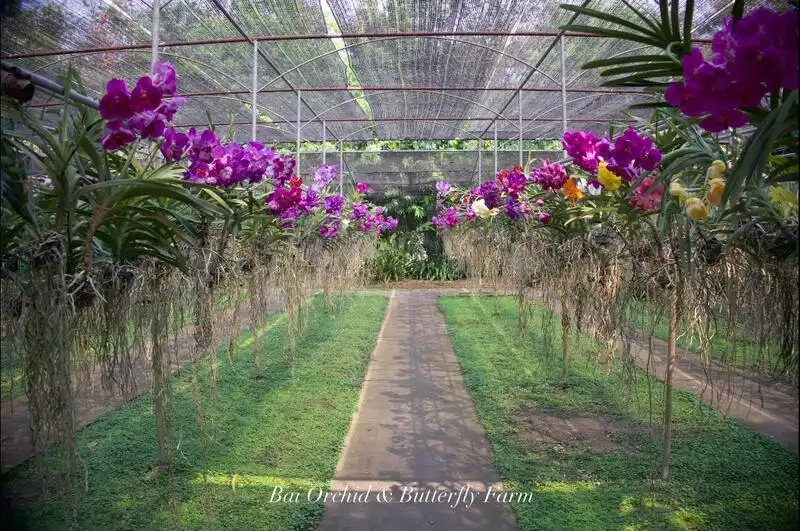
The fourth is Bai Orchid and Butterfly Farm, which opens quite early and closes a little later than some places. It’s a good choice if you want a balanced mix of orchids and butterflies. There are food and drinks, and the site can accommodate groups as well. Many gardens like this are laid out as a loop: orchid houses first, then butterflies or activity zones, and ending at the restaurant or souvenir area — a “complete one-stop day” format that family tours tend to love.
Now we get to the layer you asked for: more serious detail on specific orchid groups and a more systematic look at seasons. Orchids are not only pretty flowers — they reflect climate and ecosystems clearly. Once you start seeing the patterns, you’ll understand why orchids look especially fresh in some months, seem to rest in others, and why blooming in nature is closely tied to rainfall, fog, temperature, and forest fire dynamics in Northern Thailand.
Broadly, most orchids you see in tourist gardens are cultivated orchids — selected for toughness and consistent flowering, especially hybrid Dendrobiums commonly sold as cut flowers. The reasons are straightforward: Dendrobiums are flexible for breeding, flowers are durable, arrangements look good, and the market is strong. But gardens that position themselves as learning spaces often show other groups too — Vanda/Arachnis/Ascocenda (and related hybrids), which have vivid colors and modern forms and are popular in premium cut-flower markets. You’ll also see what people sometimes call “cultivated wild-type orchids” — species native to Thailand that are propagated in farm systems (various ‘ueang’ types), often with charming Thai names and local stories.
When you shift your attention from cultivated orchids to “Chiang Mai wild orchids,” the experience becomes deeper. Chiang Mai doesn’t have only one forest type, and orchids aren’t always in open, garden-like settings. Many wild orchids are epiphytes, living on large trees in evergreen or mixed forests. Some are terrestrial orchids that grow on the forest floor in moist areas or forest edges. Some are mycoheterotrophs that rely heavily on fungi in the soil and appear to have little chlorophyll. These relationships make wild orchids highly system-fragile: it’s not only about “don’t pick the flower.” If the forest system is disrupted — intense fires, reduced humidity, loss of big host trees, changes in soil fungi — orchids disappear too.
The zone that connects this picture especially well is the “Doi Suthep–Pui – Chiang Mai headwater forests cluster.” Doi Suthep–Pui is a key natural area for the city, a headwater landscape feeding multiple streams, and a place where orchid diversity has been studied seriously. Surveys and academic discussions often talk about notable species and compare the effects of forest fires between disturbed and less-disturbed areas. That makes one thing clear: “beautiful flowers” don’t float in isolation. They are tied directly to forest structure and fire management in Northern mountain ecosystems.
Think of it simply: Mae Rim–Samoeng orchid gardens are the classroom where light, water, and shade are set so you can see clearly. Doi Suthep–Pui is the classroom nature sets up itself, where we’re only guests learning with light hands. If you want this article to function as a larger content cluster, you can position “orchid gardens and butterfly farms” as the hub page, then connect outward to headwater forests, Doi Suthep–Pui, and nature routes — so readers see that the orchids in gardens are one page of a bigger ecosystem story, and that the real forest requires more care than a moment of aesthetic excitement.
Seasonally, if someone asks “When is the best time to visit orchid gardens on the Mae Rim–Samoeng route?” the most honest answer is: it can be beautiful all year, but the details change. Late rainy season into early winter (roughly Oct–Dec) brings comfortable temperatures and balanced humidity; many flowers look especially fresh, colors photograph well, and light is softer. Winter (Dec–Feb) is busier, but walking is easy and if you continue toward Pong Yaeng–Mon Jam you’ll feel the “real mountain” atmosphere. Hot season (Mar–May) has stronger light and drier air; many gardens increase misting and watering to maintain humidity, so you can see farm management in action and understand why orchids don’t love direct heat-dry conditions. Rainy season (Jun–Sep) is when the forest feels most alive; for wild-orchid interest, some species can bloom well then — but it’s also the season to consider safety on slippery routes and changing weather.
Start with “Thai wild Dendrobiums.” The name may make some people think of the common hybrid Dendrobiums sold in markets, but wild Dendrobiums can be very different in personality. Some have slender canes and bloom in attractive sprays; some carry more natural, muted tones; many bloom sharply by season; and many correlate strongly with elevation and humidity. In Chiang Mai and nearby mountains, species recorded in the Doi Suthep–Pui forest cluster include Dendrobium falconeri and Dendrobium heterocarpum, both familiar to serious orchid enthusiasts. There is also a locality-linked species like Dendrobium sutepense, whose name pulls you straight back to Doi Suthep. The key point is that in forests, you’re not only looking at flowers — you’re looking at habitat: what host trees they cling to, what forest types they prefer, and whether the area is frequently affected by fires. These details reveal both vulnerability and conservation priorities.
Next is “Thai Vanda.” Simply put, Vandas appeal to people who love bold color and a dignified form: clear structure, thicker petals, intense pigment, and sometimes a faint fragrance. System-wise, many Vandas are epiphytes that need excellent airflow, enjoy more light than many Dendrobiums, and are sensitive to stagnation and excess dampness. In Doi Suthep–Pui contexts, a species such as Vanda brunnea has been discussed as part of the area’s orchid diversity, suggesting that Chiang Mai’s mountain forests can support this group. But “seeing it in the wild” should not be a high-risk goal. Entering forests specifically to search for ‘ueang’ or Vandas can easily become disturbance. A better approach is to learn from well-managed institutions (botanical gardens, curated orchid collections) and use observation and reading to connect the dots — rather than “taking it from the forest.”
Now “Chiang Mai wild orchids.” For a truly academic approach, we should acknowledge that Chiang Mai has many recorded orchid species and different micro-areas vary a lot. In this article, we mention examples that appear in surveys or referenced sources tied to Doi Suthep–Pui and nearby protected areas — a cluster aligned with Chiang Mai headwater forest ecology. This range runs from familiar genera like Dendrobium to Bulbophyllum, and includes Paphiopedilum slipper orchids, a group with high conservation concern. A species like Paphiopedilum callosum var. callosum is often raised in survey contexts, and this is where “serious conservation” matters: slipper orchids have long been pressured by illegal collecting and trade. So the message should be clear — enjoy and learn responsibly, do not support suspicious sources, and if someone truly wants to grow orchids, choose legally propagated plants with credible origin.
Serious orchid conservation doesn’t end at “don’t pick.” It needs three layers working together.
The first layer is understanding that many wild orchids depend on specific ecosystems: host trees, a certain humidity range, and compatible soil/host fungi. Removing an orchid from the forest is not only removing a plant — it severs an entire relationship set. Even if a dug-up plant survives briefly, it often declines later, and repeated collecting can erase natural populations.
The second layer is forest fires and Northern Thailand mountain management — directly relevant to Doi Suthep–Pui and Chiang Mai headwater forests. Surveys in protected areas suggest that orchid assemblages can differ between fire-disturbed and less-disturbed zones. Fire doesn’t only burn trees; it changes humidity, light, host tree availability, and forest-floor conditions. Supporting fire reduction (community action and system-level management) is one of the most concrete ways to protect wild orchid ecosystems, beyond sharing pretty photos.
The third layer is helping tourists “love without harming.” Mae Rim–Samoeng orchid gardens and butterfly farms are good at this because they are accessible middle spaces that still teach nature. If your article is built as a big cluster, readers can start with gardens (safe learning), then move toward headwater forest understanding (deeper learning), and end with a real realization: “the beauty in gardens” is rooted in “complexity in forests,” and forests need ongoing care, not just admiration.
Another element that strengthens this article is “butterflies.” Butterflies aren’t only pretty moving objects; they can indicate ecosystem health and they make life-cycle learning easy for the general public. Many butterfly houses show eggs, caterpillars, chrysalises, and adults — a gentle lesson that nature transforms and requires time and suitable environments. This kind of viewing builds a “soft but real” conservation understanding — without preaching — by inviting people to notice relationships and cycles.
| Place Name / Topic | Orchid Gardens and Butterfly Farms (Mae Rim–Samoeng Route), Chiang Mai |
| Zones | Rim Tai–Mae Ram (Mae Rim), Mae Sa zone (Mae Sa Waterfall area), Pong Yaeng–Mon Jam (mountain route), Doi Suthep–Pui / Chiang Mai headwater forests cluster linkage |
| Main Stop 1 | Sai Nam Phueng Thai Orchid Museum (includes a butterfly farm / Thai cats / other animals) |
| Opening Hours (Main Stop 1) | 07:30 – 17:00 (recommended to check latest announcements) |
| Entrance Fee (Main Stop 1) | Children 20 THB, Adults 40 THB |
| Contact (Main Stop 1) | Tel. +66 53 298 771-2, +66 53 297 152 |
| Main Stop 2 | Mae Ram Orchid |
| Opening Hours (Main Stop 2) | 08:00 – 16:00 (recommended to check latest announcements) |
| Entrance Fee (Main Stop 2) | Children 20 THB, Adults 40 THB |
| Contact (Main Stop 2) | Tel. +66 53 298 801 |
| Main Stop 3 | Bua Mae Sa Orchid Garden |
| Opening Hours (Main Stop 3) | 07:30 – 16:30 (recommended to check latest announcements) |
| Entrance Fee (Main Stop 3) | Thai visitors 20 THB, Foreign visitors 50 THB (children half price) |
| Contact (Main Stop 3) | Tel. +66 53 298 564 |
| Main Stop 4 | Bai Orchid and Butterfly Farm (can accommodate groups up to around 200; food and drinks available) |
| Opening Hours (Main Stop 4) | 07:30 – 17:00 (recommended to check latest announcements) |
| Entrance Fee (Main Stop 4) | Children 20 THB, Adults 40 THB |
| Contact (Main Stop 4) | Tel. +66 53 299 588, +66 53 299 222 |
| Wild Orchid Species Recorded in Chiang Mai (Academic) | Examples reported/mentioned in the Doi Suthep–Pui forest cluster and nearby protected areas: Dendrobium falconeri, Dendrobium heterocarpum, Dendrobium sutepense, Bulbophyllum sichyobulbon, Cirrhopetalum skeatianum, Eria truncata, Coelogyne prolifera, Paphiopedilum callosum var. callosum, Vanda brunnea |
| (Doi Suthep–Pui / Chiang Mai Headwater Forests) | Doi Suthep–Pui National Park, Chiang Mai headwater forests, Mae Sa Waterfall, Queen Sirikit Botanic Garden |
| Nearby Attractions (Approx. Distance) | Queen Sirikit Botanic Garden (approx. 10 km) Tel. 053-114-630 / 053-114-633 Mae Sa Waterfall (approx. 6 km) Tel. 069-632-0881 Tiger Kingdom Chiang Mai (approx. 2 km) Tel. 061-268-2669 Pong Yaeng–Mon Jam (approx. 25 km) (multiple viewpoints; check contacts per site) Doi Suthep–Pui National Park (HQ/main routes) (approx. 25 km) Tel. 053-210-244 |
| Nearby Restaurants (Approx. Distance) | Pongyang Angdoi (approx. 18 km) Tel. 085-618-8885 The Ironwood Mae Rim (approx. 4 km) Tel. 081-831-1000 Tiger Kingdom (café/activities zone) (approx. 2 km) Tel. 061-268-2669 Pansawan Boutique Restaurant (Baan Hong Nok) (approx. 20 km) Tel. 088-251-4157 Bua Mae Sa Orchid Garden Restaurant (on-site) (approx. 7 km) Tel. +66 53 298 564 |
| Nearby Accommodations (Approx. Distance) | Four Seasons Resort Chiang Mai (approx. 12 km) Tel. 053-298-181 Panviman Chiang Mai Spa Resort (Pong Yaeng) (approx. 22 km) Tel. 053-879-540 Raya Heritage (Mae Rim) (approx. 18 km) Tel. 053-111-670 Howie’s HomeStay (Mae Ram/Mae Rim) (approx. 10 km) Tel. 081-882-8345 Pak Ram (Mae Rim) (approx. 12 km) Tel. 094-696-1456 |
Frequently Asked Questions (FAQ)
Q: Which months are best for visiting orchid gardens on the Mae Rim–Samoeng route?
A: It can be beautiful year-round, but for comfortable walking and especially fresh-looking blooms, late rainy season to early winter (roughly Oct–Dec) and winter (Dec–Feb) are excellent. The rainy season is great for people who want to connect the trip to wild-orchid ecology, but be mindful of rain and slippery paths.
Q: If I want to learn about Chiang Mai wild orchids, where should I go?
A: Start with well-managed learning spaces like Queen Sirikit Botanic Garden, or learn through academic/interpretive information connected to protected areas such as Doi Suthep–Pui. If you visit nature areas, do so in a way that does not disturb habitats (it is not recommended to enter forests specifically to search for wild orchids, as it can harm ecosystems).
Q: Why should an orchid-garden article be linked to Doi Suthep–Pui and Chiang Mai headwater forests?
A: Because wild orchids are part of headwater-forest ecosystems. Helping readers see the link from “cultivated collections” to “the real forest home” builds conservation understanding and helps reduce behaviors that pressure orchids in the wild.
Q: If I’m traveling with kids, which gardens are most suitable?
A: Gardens with butterfly farms are especially kid-friendly because children can observe life cycles and enjoy the movement — for example Sai Nam Phueng Thai Orchid Museum or Bai Orchid and Butterfly Farm.
Q: What conservation principles should visitors follow when traveling around orchids?
A: Do not collect. Do not buy from suspicious sources that may come from forests. Avoid sharing overly precise locations of wild orchids. Support legal propagation and credible learning institutions, and help reduce risks to headwater forests such as fires and habitat disturbance.
 Tel: 053298801
 Orchid Gardens and Butterfly Farms Map
 Category:
  Group:
  Last Update: 2 MonthAgo
Comment
 Nearby Attractions
| Keyword (Advance) |
 Region
|
 Muang Chiang Mai(