

 Home
Home Chiang Mai(










Rating: 3.9/5 (7 votes)
 |
|  Map
Map 
 Have Map
  No Map
Chiang Mai attractions
Attractions in Thailand
Open Days: Generally daily (subject to Doi Inthanon National Park announcements and weather conditions, especially during heavy rain)
Opening Hours: Generally 08:00 – 17:00
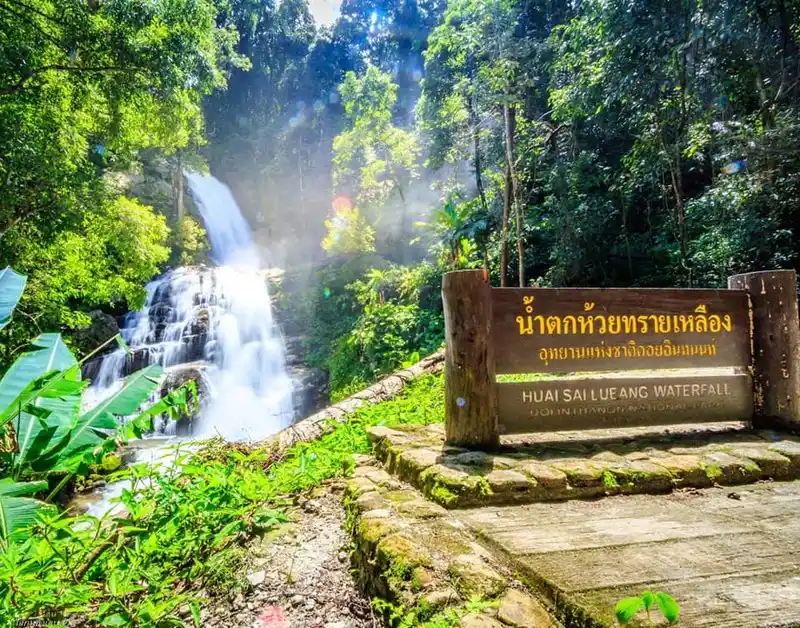
Huai Sai Lueang Waterfall (often casually called “Sai Lueang Waterfall”) is one of the waterfalls on the Inthanon–Mae Chaem side where the charm doesn’t come from fame, but from how naturally “unpolished” the forest still feels. The waterfall sits near the lower slopes of Doi Inthanon along the route that cuts down toward Mae Chaem District, so the atmosphere is noticeably different from the popular stops along Highway 1009—fewer people, less traffic noise, and a kind of humidity that seems to wrap around you as you get closer.
To be blunt, Huai Sai Lueang isn’t a waterfall that tries to impress with dramatic, showy power. It’s a medium-sized waterfall with fairly consistent flow, cascading down in steps over layered rock rather than dropping as a single massive plunge. What many people remember is the local story of “yellow sand” that once traveled with the rainy-season current—some compare it to tiny golden grains shimmering in the stream. That story doesn’t need scientific proof to matter; it reflects how local people observe the forest, the water, and the seasons closely enough to name nature in a way that feels intimate and true.
Ecologically, Huai Sai Lueang is one of the points where a mountain stream releases energy as it moves from higher elevations to lower ground. Water flowing over rock steps can carry fine sediment and minerals, especially during the first rains when runoff gently flushes the forest floor. That seasonal shift changes the stream’s color and texture from one period to the next. It’s a reminder that a waterfall isn’t only a beautiful image—it’s part of the forest’s transport system, moving moisture, temperature, sediment, and small forms of life downstream.
One of the first things you notice as you approach is how quickly the air turns wetter. The ground feels cooler and softer, and the sound of water grows louder in sync with the canopy filtering the sunlight into shade. This is where understory plants—mosses, ferns, and other moisture-loving species—thrive. Right after a fresh rain, the scent of soil, leaves, and water becomes so clear it can feel like the forest is speaking without words.
If you enjoy details, this side of the mountain is fun because of the “shape of the rock” and the “paths of the water.” The flow doesn’t fall as a single ribbon; it splits into grooves, reunites into small pools, and shifts according to the stone’s contours and the algae that clings to it. If you stand and watch long enough, you can see the water “choose” different routes—sometimes strong, sometimes soft, sometimes seeming to change its mind midstream.
Another reason Huai Sai Lueang deserves respect is how fragile the riverside zone can be—especially the water-holding soil layers and ground cover plants. Repeated trampling or waste and food scraps entering the stream can disrupt these micro-systems quickly. And in the end, local communities feel the impact first, because the water doesn’t stop at the waterfall; it continues downstream to support agriculture and everyday life.
Many travelers driving the Inthanon–Mae Chaem route will also hear about “Mae Pan Waterfall,” since it’s in the same general zone and is often described as a “long-ribbon waterfall”—a white stream line visible against green forest from far away. Mae Pan’s character is different: its standout feature is the extended, vertical length of its flow along a high cliff, rather than short, stepped drops. Put simply: Huai Sai Lueang feels like “rock steps and close-up water layers,” while Mae Pan feels like a “long white ribbon” that looks grand from a distance.
This is where the contrast between “Doi Inthanon-side” and “Mae Chaem-side” waterfalls becomes clearer. Waterfalls along the main Highway 1009 corridor—such as Wachirathan, Mae Ya, or Siriphum—are typically easier to reach and have more defined parking and viewing points. They work well for travelers with limited time or families who want nature without much rough travel. By comparison, the Mae Chaem cut-down route—including Huai Sai Lueang and Mae Pan—often delivers a different flavor: more quiet, more of the feeling that you’re stepping into a living forest, and a stronger dependence on road and rain conditions for comfort and safety.
If you like journeys with “stories,” the Mae Chaem side often brings you closer to people and everyday mountain life. This route connects to terraced rice landscapes, Ban Pa Bong Piang, highland agriculture, and communities that have lived with steep terrain for generations. Stopping at a waterfall here can feel less like a quick pit stop and more like a pause—the kind that lets you see another face of Doi Inthanon: less postcard-famous than the headline kilometers, but rich with real life.
In the rainy season, the waterfall can look “fully powered,” but that comes with slick rocks, stronger currents, and higher risk on damp trails. Late rainy season into early cool season is often the sweet spot—the forest stays lush, water remains strong, air begins to cool, and the chance of heavy downpours drops. In the dry season, the flow may decrease, but the payoff is easier walking, calmer photography, and clearer views of the rock layers and water steps.
Getting There Use the Inthanon–Mae Chaem route as your main axis. Start on Highway 1009 (Doi Inthanon Road), pass the checkpoint area around Km 38, then turn onto the Inthanon–Mae Chaem Road (Highway 1192). Follow signs toward the waterfall. Along the way, there may be a further turn-in before reaching the parking area, and from the parking point you’ll typically walk a short distance to the falls (plan extra time and check rain conditions—heavy rain can make the road slick and rough with potholes).
One practical tip before you arrive: set expectations to match the place. If you want full convenience, curated photo spots, and a quick walk-and-done experience, the major waterfalls along 1009 may suit you better. But if you’re okay with driving a bit deeper and walking a little more in exchange for quiet and that feeling of the forest simply being itself, Huai Sai Lueang is a great choice.
And as mentioned from the start—places like this “lose” quickly to trash and loud noise. Responsible travel isn’t a nice slogan; it’s the condition for keeping the site worth visiting. Pack out all waste, don’t throw food scraps into the stream, don’t trample ground cover off-trail, and if you’re traveling with children or older adults, prioritize safety over photos every time.
| Name | Huai Sai Lueang Waterfall (Sai Lueang Waterfall) |
| Location | Lower Doi Inthanon zone, on the route down to Mae Chaem District, Chiang Mai (near Highway 1009 connecting to Highway 1192) |
| Highlights | Medium-sized stepped waterfall with fairly steady flow, humid forest atmosphere, quieter than the main 1009 corridor, and a local rainy-season story about “yellow sand” in the current |
| Best For | Travelers who want calm nature, a short walk, humid forest scenery, and a quiet stop along the Inthanon–Mae Chaem route |
| Cautions | Slippery surfaces after rain, potential stronger flow during heavy rain, avoid stepping off-trail onto moss/ground cover, and pack out all trash |
| Getting There | Take Highway 1009 (Doi Inthanon Road), connect to Highway 1192 (Inthanon–Mae Chaem Road), follow signs to the waterfall, park, then walk a short distance |
| Current Status | Generally open as a natural attraction in the Doi Inthanon zone (check announcements and weather conditions before traveling) |
| Park Contact | Doi Inthanon National Park Tel. 053-286729, 053-286728 |
| Nearby Attractions (Approx. Distance) | Mae Pan Waterfall (9 km) Ban Pa Bong Piang (25 km) Wachirathan Waterfall (20 km) Siriphum Waterfall (18 km) Naphamethinidon–Naphaphonphumisiri Pagodas (25 km) Doi Inthanon Summit (35 km) |
| Popular Nearby Restaurants (Approx. Distance) | Mae Chaem Gate Restaurant (30 km) Tel. 085-671-3061 Pema Cafe (35 km) Tel. 088-229-5692 Khanom Nuch Cafe (35 km) Tel. 081-586-5804 Krua Fueang Fah (45 km) Tel. 053-341274 Krua Khonmai (45 km) Tel. 095-685-3563 |
| Popular Nearby Accommodations (Approx. Distance) | Touch Star Resort (35 km) Tel. 053-033594 Bansuan Inthanon Eco Resort (40 km) Tel. 086-429-1642 Inthanon Riverside Resort (55 km) Tel. 081-530-5767 Inthanon Highland Resort (45 km) Tel. 053-033-552 Mae Chaem Resort (35 km) Tel. 053-287-581 |
Frequently Asked Questions (FAQ)
Q: When is the best time to visit Huai Sai Lueang Waterfall?
A: Late rainy season to early cool season is ideal because the flow is still strong, the forest is lush, and the risk of heavy storms is lower. During peak rainy months, watch for slippery surfaces and sudden high water.
Q: How is Huai Sai Lueang different from Mae Pan Waterfall?
A: Huai Sai Lueang is best for close-up stepped cascades and a calm, humid forest feel. Mae Pan is often described as a long “white ribbon” of water visible from farther away, giving a grander long-drop impression. Same route zone, different vibe.
Q: Is the access road difficult?
A: You can reach it via the Inthanon–Mae Chaem route, but comfort depends on rain and road conditions. During heavy rain, sections can be slick and rough, so check the forecast and allow extra time.
Q: What safety cautions should I keep in mind?
A: Be careful on slippery rocks, avoid entering fast-flowing water, don’t climb steep boulders, and supervise children and older adults closely.
Q: What does responsible travel look like here?
A: Pack out all trash, don’t toss food scraps into the stream, stay on the trail to avoid damaging moss and ground cover, keep noise down, and follow park rules so the forest can recover.
 Huai Sai Lueang Waterfall Map
 Category:
  Group:
  Last Update: 15 HourAgo
Comment
 Nearby Attractions
| Keyword (Advance) |
 Region
|
 Muang Chiang Mai(