

 Home
Home Chiang Mai(




Rating: 3.4/5 (9 votes)
 |
|  Map
Map 
 Have Map
  No Map
Phetchaburi attractions
Attractions in Thailand
Open Days: Daily
Opening Hours: Recommended 08:00 – 17:00 (Actual hours may depend on temple activities)
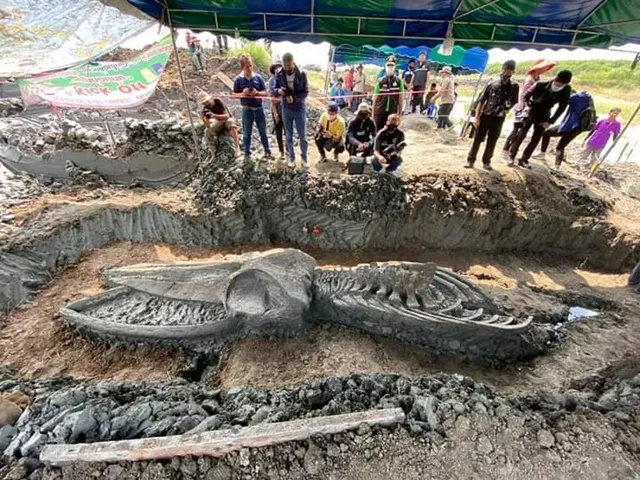
Bryde’s Whale Skeleton If you are looking for a Phetchaburi attraction that goes beyond the usual beach-and-café itinerary yet remains easy to reach and genuinely meaningful, the Bryde’s whale skeleton display at Wat Haad Chao Samran deserves a spot on your list. This is not just an unusual exhibit for photos; it is a tangible “piece of the sea” that helps you understand the relationship between coastal communities and the Upper Gulf of Thailand ecosystem within a few hours. The temple is located in Haad Chao Samran Subdistrict, Mueang Phetchaburi District, roughly 15 km from Phetchaburi town, and it functions as more than a religious site. It is also an accessible learning space for the public, especially families, students, and nature-minded travelers who want a seaside trip to have real substance rather than being only a quick check-in.
The heart of this place is the Bryde’s whale skeleton (Bryde’s whale), linked to a local event in which a whale died and later washed ashore at Haad Chao Samran in December 1975. This moment became the starting point of a community story that placed a “fragment of the ocean” within a space of faith and everyday village life. The skeleton is not simply a display piece for pictures; it invites a quiet pause to reflect on what the sea provides for people and, in return, what people may be doing to the sea without realizing it. Seeing real bones up close turns “whales”—often imagined through documentaries or distant images—into something concrete, making marine learning feel natural in a place that is calm and respectful of life.
What makes a whale skeleton displayed inside a temple especially compelling is the atmosphere. Visitors tend to slow down and observe with more composure than they would in a purely commercial attraction. The temple’s stillness gives you time to read the whale’s anatomy through its bones: the skull structure, the spine, and the ribcage arranged with a rhythm that feels like nature’s own architecture. Standing before a large, real skeleton often triggers a clear sense of scale—the vastness of nature that naturally humbles us. It is a rare feeling in places designed for speed or high-energy activities. Here you can simply stand, quietly look, and let questions arise on their own: What did this whale eat? How far did it travel? Why did it wash ashore? How alive is this stretch of sea?
From a knowledge standpoint, Bryde’s whales are baleen whales (filter-feeding whales) found in many parts of the world, including Thai waters. They primarily feed on fish and plankton, moving in response to food availability and sea conditions. Whale sightings are therefore not pure coincidence; they are connected to the productivity and balance of coastal ecosystems. When you look at a Bryde’s whale skeleton at Wat Haad Chao Samran, you are not only seeing something big. You are looking at a living design that once functioned in an ocean food web and serves as a meaningful indicator of marine health, because whales require suitable habitats and reliable food sources to thrive. Learning through a real skeleton becomes a textbook without pages, and it works especially well for children who learn best by seeing—because the memory lasts far longer than a classroom paragraph.
In the language of value-based travel, this site fits travelers who want to “understand the place they visit.” Haad Chao Samran and Phetchaburi’s coastline are not only leisure zones; they are working landscapes and delicate ecosystems. From salt fields and aquaculture ponds to mangroves, canals, and the winds and tides that shape coastal routines, everything is interconnected. The whale skeleton becomes a bridge between the ocean’s world and the human world, revealing how seafood, beach cleanliness, and the survival of marine animals are linked more closely than many people assume. Visiting here is a practical chance to help yourself and your family see the sea with deeper awareness—without pressure, without fatigue, and without needing a full-day schedule.
The visit can be planned in several easy formats. If you have limited time, stopping specifically for the whale skeleton display and a short walk around the temple grounds typically takes about 30–60 minutes, which is enough to gain the key insights and a strong visual memory. If you want a more unhurried experience, set aside 1–2 hours to observe the local context around the temple, feel the sea breeze in the Haad Chao Samran area, and then enjoy a nearby seafood meal. This approach makes the trip feel less like seeing a single object and more like reading an entire coastal system—temple, community, and shoreline together—which is exactly what makes travel writing about Phetchaburi more meaningful for readers.
Another reason this location works well for deeper storytelling is that it opens the door to the idea of “responsibility to the sea” without preaching. A real whale skeleton often prompts awareness of how large and complex the life around us is, and it naturally leads to questions about risks faced by marine animals—plastic waste, fishing gear, vessel traffic, or water quality—without forcing harsh conclusions. Good travel writing should help readers care and respect nature with information and context, not create fear or hostility. That is why the message here can remain practical: high-quality seaside travel begins with small actions such as not littering, reducing single-use plastics, not feeding marine life, and supporting operators who care for the environment responsibly. Small actions accumulate into real support for coastal ecosystems.
Because this is a functioning temple, appropriate behavior matters. Even though the whale skeleton is the highlight, the space is still a religious site where monks and local residents come to make merit. Basic etiquette—modest clothing, controlled volume, not running in important areas, and never climbing or touching the skeleton—helps tourism coexist with the temple’s everyday life. If you visit with small children, guiding them to observe respectfully and explaining in simple terms—for example, showing how ribs once protected the heart and lungs—turns the visit into a lesson they will remember while also building a valuable habit: traveling in a way that does not harm the place you came to enjoy.
The trip is easy to make worthwhile as a half-day outing because Wat Haad Chao Samran is not far from Phetchaburi town. You can start in town, drive out on the main route, visit the whale skeleton display at the temple, then continue to Haad Chao Samran Beach or enjoy seafood nearby. If you still have time, you can extend the route toward Laem Phak Bia or Bang Tabun to see more coastal dimensions of Phetchaburi. The strength of this area is how naturally destinations connect, allowing a single day to include a temple, the sea, learning, and local flavors without exhausting long-distance driving.
Getting There Wat Haad Chao Samran is located in Haad Chao Samran Subdistrict, about 15 km from Phetchaburi town. You can drive via Highway 3117, passing Phetchaburi Rajabhat University and continuing for around 13 km to reach the Haad Chao Samran area. For travelers using public transport, you can take a local songthaew (shared pickup truck) running between the town area and Haad Chao Samran; it commonly parks near Krungthai Bank (Islamic) on Wat Tho Road close to the clock tower. After arriving in the area, continue to Wat Haad Chao Samran via local community roads.
| Name | Bryde’s Whale Skeleton Display at Wat Haad Chao Samran |
| Address | Wat Haad Chao Samran, 80 Moo 2, Haad Chao Samran Subdistrict, Mueang Phetchaburi, Phetchaburi 76100, Thailand |
| Quick Summary | A coastal learning spot in Phetchaburi featuring a real Bryde’s whale skeleton displayed in a community temple near Haad Chao Samran Beach. Ideal for families, students, and nature-focused travelers. Typical visit time is about 30–120 minutes. |
| Highlights | A rare chance to see a real Bryde’s whale skeleton in a calm seaside temple setting, combining travel with marine learning and easy connections to Haad Chao Samran and Phetchaburi’s coastal route. |
| History | The skeleton is from a Bryde’s whale that died and washed ashore at Haad Chao Samran in December 1975, then was preserved for local learning and display. |
| Abbot / Temple Custodian | Phra Khru Sangharak Saranphirom Kittitharo (Luang Ta Kai) |
| Contact | 032-478-007, 081-758-0839 |
| Travel | Drive via Highway 3117 from Phetchaburi town, passing Phetchaburi Rajabhat University and continuing about 13 km to Haad Chao Samran / Songthaew from town to Haad Chao Samran |
| Nearby Attractions With Distance | 1) Haad Chao Samran Beach — approx. 2 km 2) Wat Phra Phuttha Saiyat (Reclining Buddha), Haad Chao Samran — approx. 4 km 3) Laem Phak Bia Environmental Research & Development Project (Royal Initiative) — approx. 14 km 4) Had Chom Chan (Ban Pak Khlong Bang Thalu) — approx. 16 km 5) Bang Tabun (Estuary Community & Seafood Area) — approx. 22 km |
| Popular Restaurants Nearby | 1) Krua Chao Samran Seafood — approx. 3 km — 089-515-2351 2) Khiang Khluen Seafood (Haad Chao Samran) — approx. 4 km — 081-448-5608 3) Ban Talay Seafood, Laem Phak Bia — approx. 14 km — 085-405-2856 4) Krua Liang Hoi (Bang Tabun) — approx. 22 km — 081-920-3554 5) Krua Loong Mun Seafood (Cha-Am) — approx. 28 km — 080-917-4597 |
| Popular Accommodations Nearby | 1) Fisherman’s Resort Haad Chao Samran — approx. 3 km — 032-471-077 2) i Tara Resort & Spa — approx. 14 km — 032-709-999 3) Merito Boutique Beach Resort — approx. 16 km — 082-693-5155 4) Chomtalay Resort Had Chao Samran — approx. 17 km — 032-478-488 5) The Regent Cha-Am Beach Resort — approx. 34 km — 032-451-240 |
Frequently Asked Questions (FAQ)
Q: Where is the Bryde’s whale skeleton display located?
A: It is inside Wat Haad Chao Samran (80 Moo 2, Haad Chao Samran Subdistrict, Mueang Phetchaburi, Phetchaburi), near the Haad Chao Samran Beach area.
Q: What is the origin of this whale skeleton?
A: It is from a Bryde’s whale that died and washed ashore at Haad Chao Samran in December 1975 and was later preserved for learning and display.
Q: How much time should I plan for this visit?
A: About 30–60 minutes is enough to focus on the display and walk around the temple, while 1–2 hours works well if you also want to enjoy the nearby beach area and a seafood meal.
Q: Is it suitable for kids, and what should families be careful about?
A: Yes. It is a strong educational stop. Families should ensure children do not climb or touch the skeleton, keep voices low inside the temple area, and dress modestly.
Q: How do I get to Wat Haad Chao Samran from Phetchaburi town?
A: Drive via Highway 3117, passing Phetchaburi Rajabhat University and continuing about 13 km to the Haad Chao Samran area, then proceed to the temple. Alternatively, take a songthaew from town to Haad Chao Samran and continue locally to the temple.
Q: Is there an admission fee?
A: Generally, entry follows normal temple access. If there is an optional donation for maintenance, it is voluntary and visitors should follow the temple’s guidance on the day of the visit.
 Whale Skeleton Map
 Category:
  Group:
  Last Update: 19 HourAgo
Comment
 Nearby Attractions
| Keyword (Advance) |
 Facebook Fanpage
 Region
 Art, Culture and Heritage
 Historical Sites and Monuments(
 Landmarks and Memorials(
 Royal Palace(
 Art, Craft Centres, Tradition(
 Museums(
 Educational Places
 Educational Gardens, Farm(
 University
 Places of Worship
 Temple(
 Other religious and spiritural sites(
 Research and Development
 Royal Project(
 Suburban Living
 Village, Community(
 Floating Market(
 National Parks and Marine Reserves(
 Mountain (Doi)(
 Dam, Reservoir, Lake(
 Waterfalls(
 Hot Springs(
 Caves(
 River, Canal(
 Bays and Beaches(
 Islands(
 Entertainment and Agricultural
 Zoos and Aquariums(
 Farm, Parks, Gardens and Ecotourism(
 Waterpark(
 Theater(
 Outdoor and Adventure Activities(
 Travel Articles, Recipes
 Travel Review, Food Review(