

 Home
Home Chiang Mai(




Rating: 4.2/5 (5 votes)
 |
|  Map
Map 
 Have Map
  No Map
Phetchaburi attractions
Attractions in Thailand
Open Days: Daily (subject to weather conditions and boat-operator arrangements)
Opening Hours: 07:00 – 12:00 (boat trips are generally in the morning; please confirm the departure time with the operator before traveling)
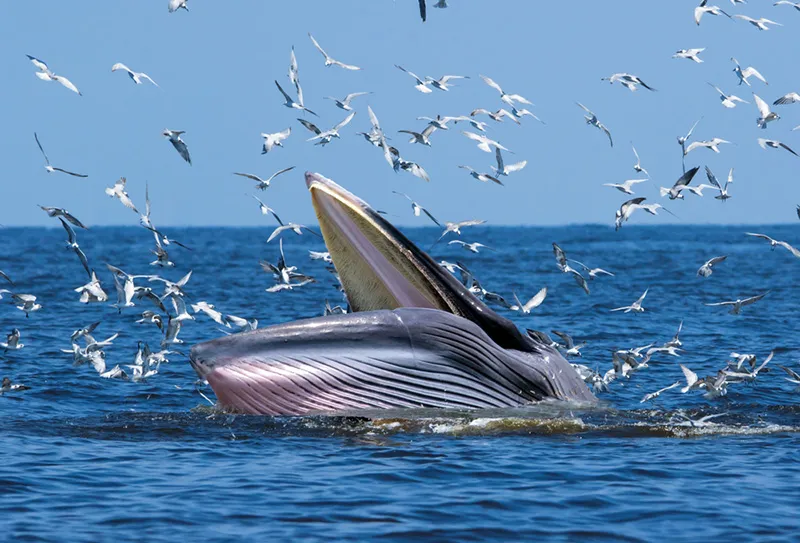
Bryde’s Whale Watching in Phetchaburi (Laem Phak Bia Pier) If you’re looking for a sea experience that isn’t just “a scenic boat ride,” but a real encounter with the living Gulf of Thailand at a distance that makes your heart race without trying, Bryde’s whale watching in Phetchaburi stands out clearly. This is a trip where you may spot Bryde’s whales feeding close to shore, and if luck is on your side, you’ll witness the most iconic moment of this area: a whale surfacing to lunge-feed with its mouth open above the water. It’s the kind of split second that makes everyone on the boat go quiet at once, followed by camera clicks and an unplanned, collective breath of awe. This isn’t a staged show — it’s nature, driven by seasonality, currents, and the richness of the Ban Laem coastal ecosystem.
The most talked-about period for Bryde’s whale watching in Phetchaburi is from August to December, when locals refer to the season as “Nam Biat”. In local usage, “Nam Biat” describes a time when large volumes of freshwater flow from rivers into the Gulf, changing nearshore water conditions — salinity, turbidity, nutrient levels — and increasing the concentration of small organisms at the base of the food chain. When food for small fish becomes abundant, small fish gather in dense schools, and when those schools form, the chance of seeing top predators like Bryde’s whales feeding near the coastline increases. That’s why “season” matters for this trip far more than many people expect.
Bryde’s whales are baleen whales, meaning they feed by filtering rather than using teeth. The behavior most visitors hope to see is the whale surging upward and opening its mouth at the surface to sweep prey inside. Sometimes you’ll also see seabirds circling above, because birds take advantage of the same moment to catch small fish that scatter or get pushed toward the surface. So the scene is often not just a whale — it can become a full “ecosystem frame” that tells the Gulf’s story in one shot: fish, birds, currents, and a boat positioning carefully to avoid disrupting natural timing.
The key to making this article genuinely useful is setting expectations correctly from the start. Whale watching is a nature-based activity, and no one can guarantee sightings every time. Whale locations depend on schooling fish movement, wind direction, waves, currents, and the day’s weather. Even in a season when the odds are “high,” there can still be days with no sightings, or sightings far enough away that you only catch brief surfaces. That’s why the value of this trip shouldn’t be judged only by “saw whales vs. didn’t see whales,” but also by the experience of being out on the Gulf, observing seabirds, noticing coastal fishing life, sensing tidal rhythm, and experiencing a shoreline where nature is still actively working.
Most trips begin at Laem Phak Bia Pier in Ban Laem District, Phetchaburi — a practical meeting point and departure pier for this coastal route. From the pier, the boat generally takes about 45 minutes to reach the Gulf area where whales may appear (actual travel time depends on route, sea conditions, and where whales are on that day). Some days you may encounter whales sooner or later than that, because the boat often searches gradually using field signs such as seabird activity over the water, surface disturbance, or observations shared among local boats operating in the same area.
What makes Bryde’s whale watching in Phetchaburi special is the sense of being “close, without crossing the line.” If the boat operator follows responsible wildlife-watching practices, you’ll notice the boat doesn’t rush, doesn’t cut in front of the whale, and doesn’t force the whale to change behavior to avoid the vessel. The best whale-watching photo is not the closest possible photo — it’s the photo where the whale remains calm and behaves naturally, and the people onboard choose to “give space” to the sea more than chasing a dramatic shot. When wildlife is pressured into changing behavior, the meaning of wildlife watching disappears immediately, even if the image looks sharp.
Preparing for this trip is simple, but small details can make it much more comfortable and safe. First is sun and wind on the boat. Early morning sunlight may feel mild, but out on the Gulf wind can be continuous and glare reflects strongly off the water. A wide-brim hat, sunglasses, and sunscreen genuinely help, not just as “nice to have.” Also choose footwear that is secure and non-slip, especially when boarding and disembarking at the pier, where surfaces can be wet and slightly sloped. Clothing should prioritize comfort and mobility; lightweight long pants or sun-protective fabric helps reduce irritation from sun and wind.
If you are prone to motion sickness, prepare the right medication for yourself before departure, because once you’re out at sea, symptoms can come quickly and ruin the experience. Sitting where you can see the horizon, staying hydrated, and avoiding long periods looking down at a screen can help. Most importantly, follow the skipper’s instructions and wear a life jacket throughout the trip, because any sea activity should start with safety, every time.
From a photography perspective, whale watching is different from shooting on land because everything is moving at once — the boat, the waves, the subject, and the light. Use a shutter speed fast enough to freeze motion, and bring a cloth or waterproof cover to protect against sea spray. A common mistake is “shooting so hard you forget to look.” The magic of a whale encounter is the brief moment your eyes register it before your camera does. If you lift your head frequently, you’ll read timing better and know when to raise the camera — instead of holding it up for the entire trip, getting tired, and missing the most important moments.
Bryde’s whale watching in Phetchaburi has been discussed for quite some time as a nature-based Gulf activity, with multiple sources mentioning departures from Laem Phak Bia Pier from both tourism and local documentary angles. What makes this area stand out is its proximity to Bangkok and the practicality of a true day trip. It also connects smoothly with the Ban Laem coastal route toward Had Chao Samran, making it suitable for Thai travelers and international visitors living in Thailand who want a deeper Gulf-of-Thailand nature experience than a typical beach walk.
Once you return to shore, this area still offers several easy add-ons without a long drive. Around Ban Laem you can combine Had Chao Samran Beach, cultural stops in Phetchaburi town, and riverside community routes like Bang Tabun, known for seafood and canal-side atmosphere. With good planning, you can start with the sea in the morning, enjoy seafood at midday, and end with coastal golden light — without rushing. That’s one of Phetchaburi’s strengths as a travel destination: distances don’t exhaust you, but experiences can be far richer than expected.
Getting There From Phetchaburi town, take the Phetchaburi–Had Chao Samran route (Highway 3177) to the Had Chao Samran intersection, then turn left onto Highway 4028 for about 5 km to reach Laem Phak Bia Pier (the whale-watching departure point). The boat ride out into the Gulf generally takes about 45 minutes (actual time depends on sea conditions and where whales appear that day).
If you had to describe the charm of Bryde’s whale watching in Phetchaburi in one sentence, it’s this: the trip shows you that the Gulf of Thailand isn’t just a backdrop for relaxation — it’s a living place, and when you witness a whale lunge-feeding at the surface with your own eyes, you understand the meaning of “unforgettable” without needing any extra explanation.
| Place Name | Bryde’s Whale Watching, Phetchaburi (Laem Phak Bia Pier), Ban Laem District, Phetchaburi |
| Address (Departure Point) | Laem Phak Bia Pier, Laem Phak Bia Subdistrict, Ban Laem District, Phetchaburi |
| Place Summary | A nature-based boat trip to watch Bryde’s whales feeding in the nearshore Gulf of Thailand. Most popular from August–December (the “Nam Biat” season). If conditions are favorable, you may see surface lunge-feeding. Practical as a day trip. |
| Highlights | 1) Higher chances during the “Nam Biat” season when whales may feed closer to shore 2) Possible surface lunge-feeding sightings (depends on the day and sea conditions) 3) Easy access from Phetchaburi town and the Had Chao Samran coastal route 4) Simple to combine with Ban Laem–Had Chao Samran–Bang Tabun coastal day plans |
| Recommended Season | August – December (Nam Biat season) / boat trips are generally in the morning |
| Costs | Usually a private boat charter fee (varies by operator and group size). Some sources mention 5,000 THB per trip (about 10 people). Please confirm directly with the operator before booking. |
| Facilities | Community pier for boarding/disembarking / safety equipment depends on the operator / advance arrangement recommended |
| Travel | From Phetchaburi town, take Highway 3177 to the Had Chao Samran intersection, then Highway 4028 about 5 km to Laem Phak Bia Pier, then boat out into the Gulf (generally ~45 minutes). |
| Current Status | Operates by arrangement and weather conditions (sea activities may be postponed or cancelled during strong wind/waves) |
| Contact (Verified) | Boat Booking (as listed by travel sources): 092-713-9730, 081-856-4939 |
| Nearby Attractions (Approx. Distance) | 1) Had Chao Samran Beach – 5 km 2) Puek Tian Beach – 13 km 3) Phra Ram Ratchaniwet (Ban Puen Palace) – 16 km 4) Phetchaburi Old Town – 16 km 5) Phra Nakhon Khiri National Museum (Khao Wang) – 17 km |
| Popular Restaurants Nearby (Approx. Distance + Phone) | 1) Baan Talay Restaurant, Laem Phak Bia – 2 km – 085-405-2856 2) Krua Baan Ton Mai Seafood (Ban Laem) – 10 km – 083-436-3942 3) Khong Nam, Ban Laem – 12 km – 062-226-9544 4) Bang Tabun Bay – 20 km – 082-499-9993 5) Krua Bang Tabun (Lung Ya) – 20 km – 032-581-297 |
| Popular Accommodations Nearby (Approx. Distance + Phone) | 1) i Tara Resort & Spa (Laem Phak Bia Area) – 6 km – 032-478-301 2) Fisherman’s Resort (Had Chao Samran) – 7 km – 032-478-020 3) Merito Boutique Beach Resort (Had Chao Samran) – 7 km – 086-001-3499 4) Seaman Resort (Had Chao Samran) – 8 km – 081-846-1327 5) Chomtalay Resort Had Chao Samran – 7 km – 099-097-7271 |
Frequently Asked Questions (FAQ)
Q: Which months are best for Bryde’s whale watching in Phetchaburi?
A: August to December is the most popular period because it coincides with the “Nam Biat” season when whales may feed closer to shore, but sightings still depend on the day and sea conditions.
Q: What does “Nam Biat” mean, and why does it matter for whale sightings?
A: “Nam Biat” refers to a period when a large amount of freshwater flows from rivers into the Gulf, changing nearshore conditions and increasing nutrients. This can concentrate prey such as small schooling fish, which may increase the chances of Bryde’s whales feeding near the coastline.
Q: Where is the departure point for whale-watching boats?
A: Boats typically depart from Laem Phak Bia Pier in Ban Laem District, Phetchaburi, and then travel into the Gulf to search for whales where they appear that day.
Q: How long is the boat ride before I may have a chance to see whales?
A: The trip commonly takes about 45 minutes out to the general offshore area, but actual encounter timing depends on whale location, sea conditions, and schooling fish movement on that day.
Q: What should I prepare for a whale-watching trip?
A: Bring a hat, sunglasses, sunscreen, a light wind layer, drinking water, motion-sickness medicine if needed, and wear a life jacket throughout the trip as advised by the skipper for safety.
Q: If I don’t see whales, is the trip still worth it?
A: Whale watching is nature-based and not guaranteed every time, but the trip can still be rewarding for the Gulf atmosphere, seabird sightings, coastal life, and ecosystem learning — especially when expectations are set appropriately.
 Balaenoptera Brydei Map
 Category:
  Group:
  Last Update: 4 HourAgo
Comment
 Nearby Attractions
| Keyword (Advance) |
 Region
|
 Muang Phetchaburi(