

 Home
Home Chiang Mai(




Rating: 3.6/5 (5 votes)
 |
|  Map
Map 
 Have Map
  No Map
Phetchaburi attractions
Attractions in Thailand
Open Days: Daily
Opening Hours: 07.00 – 17.00
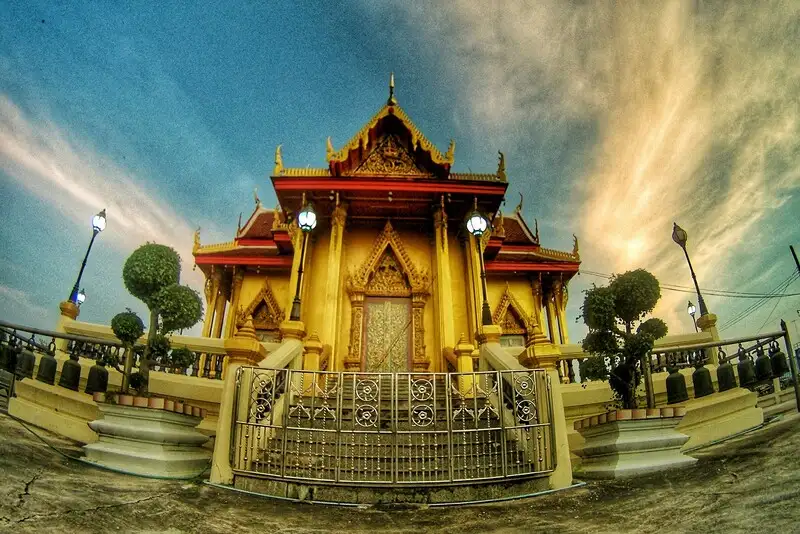
Wat Ton Son, located in Moo 2, Ban Laem Subdistrict, Ban Laem District, Phetchaburi Province, is one of the community’s most important temples. Locals regard it as a continuing center of faith and a place where cultural activities are naturally anchored. For this reason, the temple is not merely a site for merit-making on Buddhist holy days or major religious occasions; it is also a space where residents “keep their lives connected” through ceremonies, traditions, community activities, and everyday gatherings. The Phetchaburi River, which flows through Ban Laem, forms a living backdrop to local fishing culture and community life, giving the temple an atmosphere distinctly different from urban temples.
What makes Wat Ton Son immediately appealing is its “riverside setting.” The area in front of the temple lies along the Phetchaburi River, and a high concrete bridge spans the water nearby. This opens the view outward, revealing the scenery of a fishing community where boats are moored in lines according to the practical rhythm of a local pier. At many times of day—especially mornings and late afternoons—the river breeze makes the air feel light and comfortable. Visitors often sit at the Thai-style riverside pavilion, watching the current and the community’s houses in a quiet, unhurried mood. This is why a visit to Wat Ton Son often feels like a genuine pause for the mind, rather than a quick stop to pay respects and move on.
In terms of local devotion, Wat Ton Son is home to what Ban Laem residents consider an auspicious symbol of the area: Luang Pho Samrit. This revered Buddha image is deeply respected and spoken of with a sense of closeness, not simply because it is the temple’s principal sacred object, but because it is regarded as a steady source of spiritual support in important moments of life. People come to pay respects for family merit-making, to dedicate merit to departed relatives, and to set a calm intention for life to move forward smoothly. The practice of “coming to pay respects to Luang Pho Samrit” has therefore become part of Ban Laem’s shared memory and a key reason the temple remains active in the community’s everyday rhythm, not only during festival seasons.
Another feature many visitors notice immediately is a statue of Admiral Prince Abhakara Kiartivongse, Prince of Chumphon (Krom Luang Chumphon Khet Udomsak). Its presence adds a distinctive character to the temple space, because statues associated with the Prince of Chumphon are commonly found in coastal areas or places closely tied to naval history and maritime life. When such an element appears within a temple in a bay-mouth community like Ban Laem, it reflects the local relationship with the sea, navigation, coastal livelihoods, and the kind of spiritual protection revered by people whose lives are shaped by the water.
A local detail often described as unusual is that, behind this area, there is also a standing statue of Luang Pu Thuat positioned quite close by. For many visitors, this creates an immediate impression of “multiple lines of devotion coexisting” naturally within one space. This is a familiar contemporary pattern in many Thai community temples, where Buddhism remains the central foundation, while forms of protective devotion for travel, livelihoods, and revered historical figures are present alongside it without conflict in daily life. If visitors pay attention, they often find that this layered devotion helps sustain morale in a bay-mouth community whose routines depend on nature and the rhythms of tides.
Beyond devotional elements, Wat Ton Son is also remembered for another distinctive local feature: swiftlets that nest in and around the temple grounds. This has led to community stories about the collection of edible bird’s nests in the area and the construction of tall buildings designed to provide swiftlets with habitat. The scene reflects the relationship between people and nature in a bay-mouth environment, because Ban Laem is a fishing community accustomed to living alongside coastal ecosystems and using natural resources in ways aligned with seasonal and environmental rhythms. In this sense, swiftlets around the temple are not merely an interesting detail for tourists; they are part of the lived landscape that makes Ban Laem distinctive within Phetchaburi.
Historically, Wat Ton Son has an important limitation: there is no clear, definitive evidence identifying the temple’s original founder or the exact year of construction. However, local accounts commonly frame the temple’s tangible continuity from the period when it already had an appointed abbot overseeing monastic administration. In that context, Phra Athikan Khlam is identified as the first abbot, serving from 1783 to 1804 (B.E. 2326–2347). This provides at least a time frame indicating that the temple has functioned as a community religious site since the late Thonburi era into the early Rattanakosin period, and it also suggests that Ban Laem had a sufficiently strong community structure to maintain a temple as a central institution across generations.
Another compelling component is a story recorded in the book “Tamnan Thai” by Aap Chaiyakam. It refers to a period around 1859–1862 (B.E. 2402–2405) when Somdet Chao Phraya Borom Maha Sri Suriyawongse (Chuang Bunnag) was involved with major projects in Phetchaburi. The account mentions mobilized labor for large-scale work, the building of a fire shelter or lighthouse structure near the entrance of the Ban Laem bay, and the establishment of a floating residence along the river near what is now known as the area by Saphan Yao. It then links this to the building of Wat Ton Son as well, noting that locals also referred to it as “Wat Nok” or “Wat Pak Ao” (the temple outside / the bay-mouth temple). The narrative paints a picture of Ban Laem as a place connected to navigation, water travel, and the structured organization of bay-mouth space, with the temple functioning as one of the community frameworks supporting people who lived and worked along the coast and the bay entrance.
Read through a cultural geography lens, this narrative is valuable because it clarifies Ban Laem’s identity as a strategic bay-mouth area linked to maritime movement and regional water-based trade in earlier times. If the bay-mouth required a lighthouse-like structure, watchers, and organized labor, the community was not small or isolated; it was embedded in broader economic and mobility networks. In that context, having a temple that served as a spiritual center, a site for ceremonies, and a social anchor for the community aligns with Ban Laem’s wider historical role as a living bay-mouth settlement rather than simply a riverside village.
Wat Ton Son’s present-day role therefore operates on two levels at once. The first is its core religious function: a place for merit-making, listening to Dhamma teachings, and conducting ceremonies tied to family life. The second is its social and cultural function: a gathering space where community activities take place and where the cohesion of a fishing community is maintained in an era of change shaped by economics and the environment. In Ban Laem, calling the temple a “center of cultural activities” is not a decorative phrase, but a description rooted in how local people actually use the space as a meeting point and a place for shared merit-making.
In terms of temple administration, publicly shared appointment information indicates that Phra Khru Arunwachiranuyut (Phruek) has been designated as the acting abbot of Wat Ton Son.
For visitors, Wat Ton Son is best enjoyed without rushing, because its appeal lies in the riverside atmosphere and the fine-grained details of local life. In the morning, the air feels fresh and you can sense the natural movements of the fishing community. In the late afternoon, the light becomes softer and the riverside view is especially pleasing. Many people choose to spend time at the Thai-style riverside pavilion, watching boats and water and letting the mind settle. Visitors should dress respectfully, keep the temple area quiet, and take extra care near the river—especially when traveling with children or elderly family members—because a riverside setting, while beautiful, requires attention to safety.
Getting There Wat Ton Son is located in Ban Laem Subdistrict, Ban Laem District, Phetchaburi Province, and is convenient to reach by private car. It is recommended to use navigation and search for “Wat Ton Son Ban Laem Phetchaburi” to follow the most suitable route from your starting point. Upon arrival, you will immediately feel the riverside atmosphere of the Phetchaburi River, and you can easily extend your day trip to nearby coastal or bay-mouth attractions within Ban Laem District.
| Place Summary | A key community temple in Ban Laem on the Phetchaburi River, revered for Luang Pho Samrit and known for its Thai-style riverside pavilion with scenic views of the local fishing village. |
| Address | Moo 2, Ban Laem Subdistrict, Ban Laem District, Phetchaburi, Thailand |
| Key Highlights | Luang Pho Samrit, the statue of Admiral Prince Abhakara Kiartivongse (Prince of Chumphon), and the riverside pavilion with views of the Phetchaburi River and the fishing community. |
| Abbot / Temple Steward | Phra Khru Arunwachiranuyut (Phruek) (Acting Abbot) |
| Popular Accommodations Nearby | 1) Siriporn Riverside Stay, Bang Tabun (≈12 km) Tel. 081-375-2321 2) Ban Bol Resort, Bang Tabun (≈12 km) Tel. 086-364-3536 3) Maleelai Homestay (≈12 km) Tel. 081-587-5958 4) Samphao Ngoen Homestay (≈13 km) Tel. 096-579-1551 5) Ban Mai Chai Len Resort (≈35 km) Tel. 034-764-789 |
| Nearby Tourist Attractions | 1) Ao Bang Tabun (≈12 km) 2) Wat Khao Yi San (≈18 km) 3) Wat Khao Takrao (≈20 km) 4) Laem Phak Bia (≈25 km) 5) Wat Khao Bandai It (≈28 km) |
| Popular Restaurants Nearby | 1) Krua Ya Riw at Bang Tabun (≈12 km) Tel. 081-587-5958 2) Bang Tabun Seafood Restaurant (≈12 km) Tel. 081-375-2321 3) Ban Laem Seafood Restaurant (≈3 km) Tel. 032-481-094 4) Ban Laem Noodle Shop (≈3 km) Tel. 032-481-094 5) Ban Laem Riverside Coffee (≈3 km) Tel. 032-481-094 |
Frequently Asked Questions (FAQ)
Q: Where is Wat Ton Son located?
A: Wat Ton Son is located in Moo 2, Ban Laem Subdistrict, Ban Laem District, Phetchaburi Province. It is a riverside temple on the Phetchaburi River within the Ban Laem fishing community area.
Q: What makes local residents feel closely connected to Wat Ton Son?
A: The temple is a center for community cultural activities and is home to Luang Pho Samrit, regarded as an auspicious symbol of Ban Laem. Its riverside pavilion also offers a calm viewpoint into local fishing-community life.
Q: Why does the temple have a statue of the Prince of Chumphon?
A: Ban Laem is a bay-mouth area with strong ties to maritime life and navigation. The statue reflects local devotion to a revered historical figure who is widely respected as a spiritual protector for people of the sea.
Q: Who is the current abbot of Wat Ton Son?
A: Phra Khru Arunwachiranuyut (Phruek) serves as the Acting Abbot.
Q: What is the easiest way to get to Wat Ton Son?
A: Traveling by private car is convenient. Use navigation and search for “Wat Ton Son Ban Laem Phetchaburi” to reach the temple, and you can easily continue to nearby coastal or bay-mouth attractions within Ban Laem District on the same day.
Q: What time of day is best for visiting?
A: Morning and late afternoon are ideal. The weather is comfortable, the light is soft and scenic, and you can enjoy the Phetchaburi River view and the fishing-community atmosphere at a relaxed pace.
 Wat Ton Son Map
 Category:
  Group:
  Last Update: 6 HourAgo
Comment
 Nearby Attractions
| Keyword (Advance) |
 Facebook Fanpage
 Region
 Art, Culture and Heritage
 Historical Sites and Monuments(
 Landmarks and Memorials(
 Royal Palace(
 Art, Craft Centres, Tradition(
 Museums(
 Educational Places
 Educational Gardens, Farm(
 University
 Other religious and spiritural sites(
 Research and Development
 Royal Project(
 Suburban Living
 Village, Community(
 Floating Market(
 Nature and Wildlife
 National Parks and Marine Reserves(
 Mountain (Doi)(
 Dam, Reservoir, Lake(
 Waterfalls(
 Hot Springs(
 Caves(
 River, Canal(
 Bays and Beaches(
 Islands(
 Other natural attractions(
 Entertainment and Agricultural
 Zoos and Aquariums(
 Farm, Parks, Gardens and Ecotourism(
 Waterpark(
 Theater(
 Outdoor and Adventure Activities(
 Travel Articles, Recipes
 Travel Review, Food Review(