
 Home
Home North(
 Chiang Mai(


Rating: 2.9/5 (8 votes)
 |
|  Map
Map 
 Have Map
  No Map
Nonthaburi attractions
Attractions in Thailand
Open Days: Daily
Opening Hours: Monday-Friday 08.00-17.00 and Saturday-Sunday 08.00-18.00
Wat Boromracha Kanchanapisek Anusorn, widely known as Wat Leng Noei Yi 2, is one of the most impressive Chinese Buddhist temples in Nonthaburi and one of the easiest grand Chinese-style temples to visit from Bangkok. It stands out not only for its scale and visual richness, but also for its role as a royal commemorative temple, its importance within Thai Chinese Mahayana Buddhism, and its strong appeal to visitors who come to pray for blessings, improve their fortune, make offerings for the Year of Conflict, and admire refined Chinese Buddhist art in a setting that feels far more monumental than many first-time visitors expect.
The temple is located on Bang Kruai-Sai Noi Road in Sanoloi Subdistrict, Bang Bua Thong District, Nonthaburi Province. The location is practical and easy to work into a day trip because it is reachable by road from both Bangkok and central Nonthaburi, while the surrounding Bang Bua Thong area offers markets, local food, and additional places to visit. That combination of religious significance and travel convenience is one reason the temple has become such a well-known landmark for both worshippers and cultural travelers.
The site began as a small joss house before being developed into a much larger and more complete temple by the abbot of Wat Mangkon Kamalawat in Bangkok, together with Thai-Chinese Buddhist supporters. The project was created as a royal commemorative temple in honor of His Majesty the King on the occasion of the 50th anniversary of the reign. Construction took 12 years, and the official opening ceremony was held on March 20, 2008. This background gives the temple a special historical position. It is not simply a beautiful Chinese temple in Thailand, but a major modern religious project shaped by devotion, craftsmanship, and national significance.
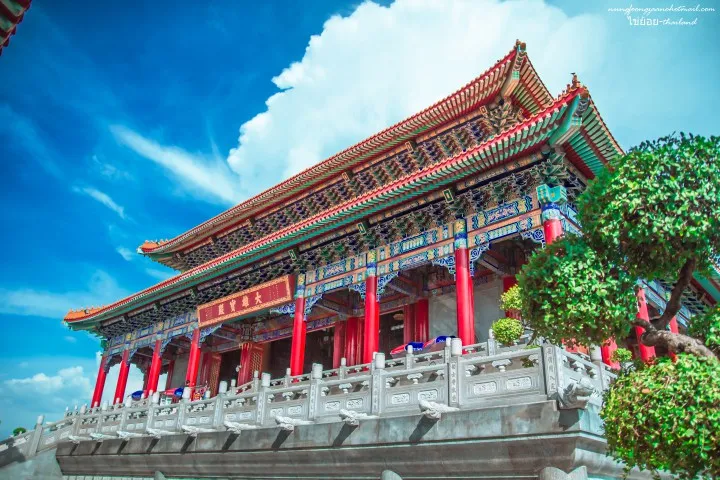
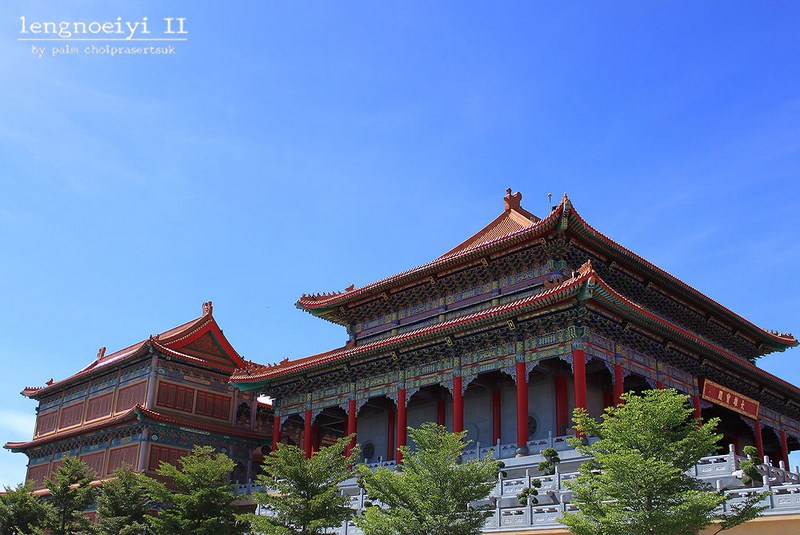
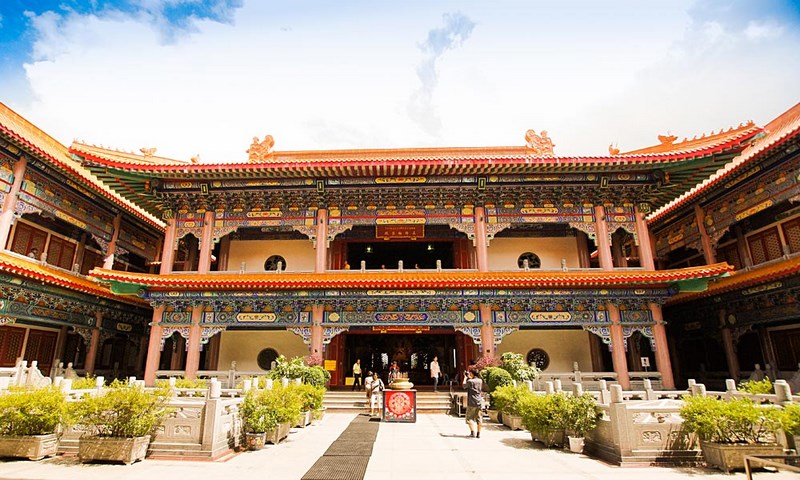
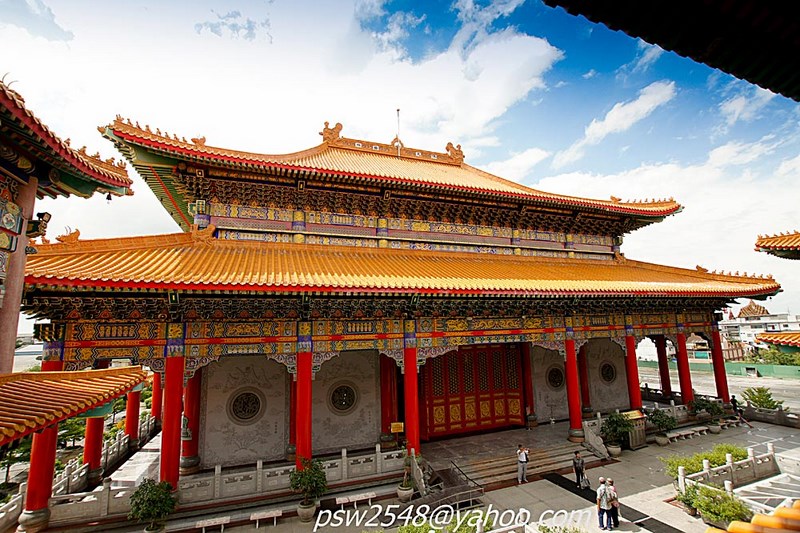
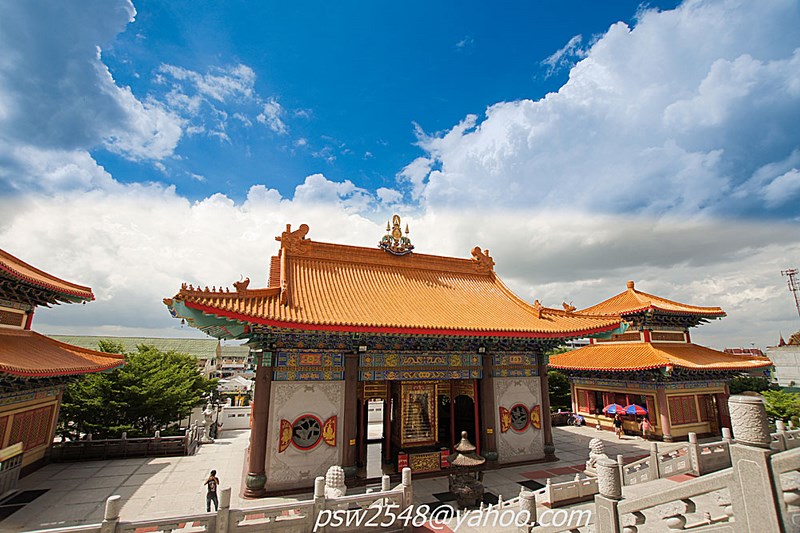
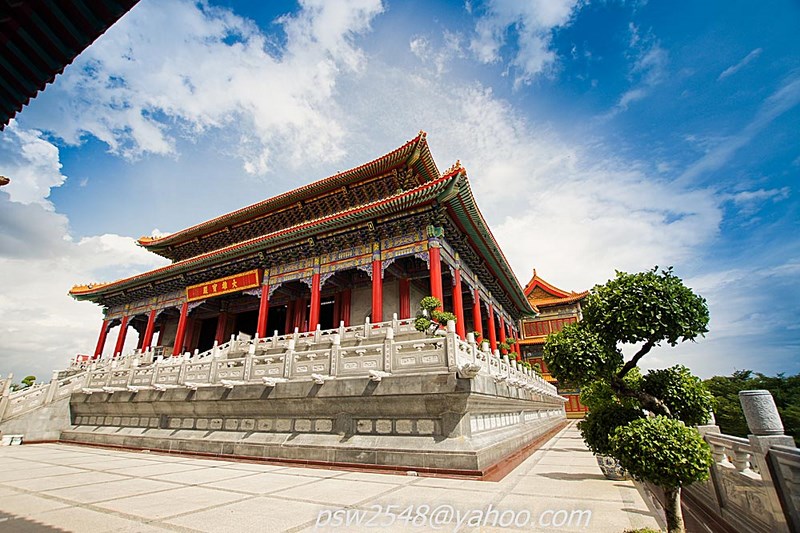
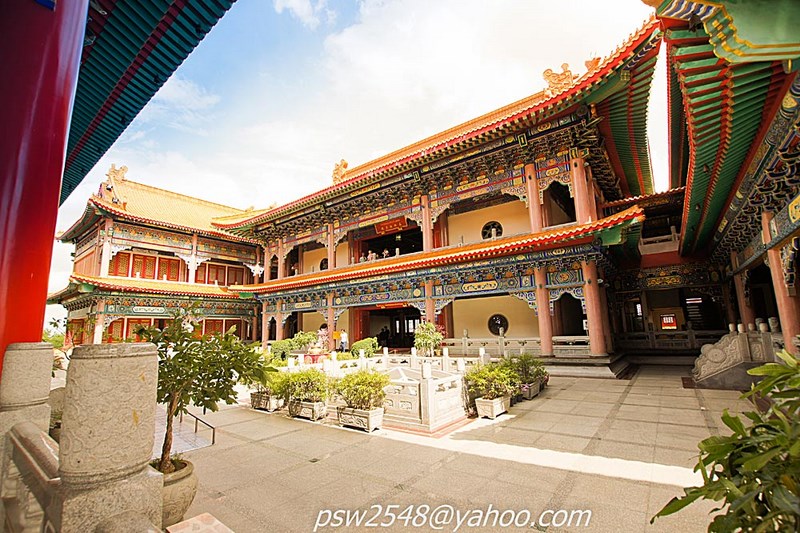
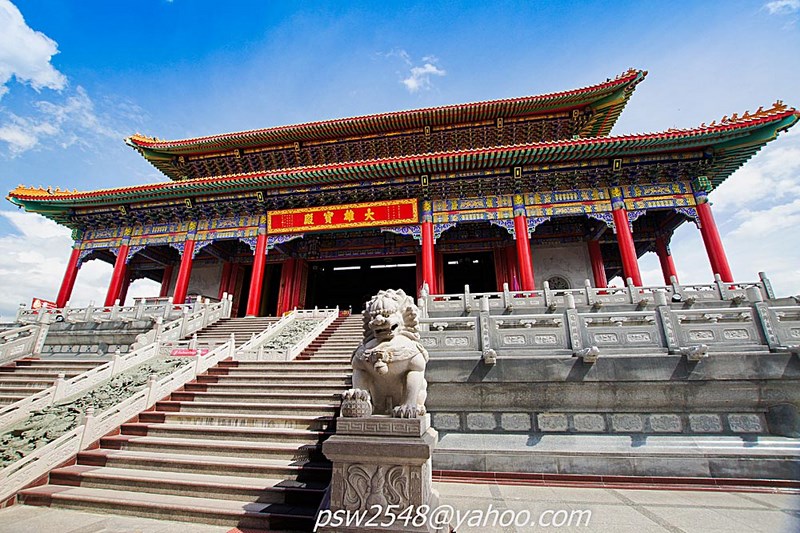
The moment visitors enter the grounds, the architectural ambition becomes clear. Wat Boromracha Kanchanapisek Anusorn was designed in the style of the Ming and Qing dynasties, with a visual concept inspired by the Forbidden City in Beijing. The symmetry, the central axis, the hierarchy of buildings, the courtyards, the gateways, and the sweeping roofs all work together to create an atmosphere that feels ceremonial, orderly, and deeply Chinese in character. Even travelers with no prior background in Chinese Buddhist architecture usually recognize immediately that this is a carefully planned temple of unusual scale and seriousness.
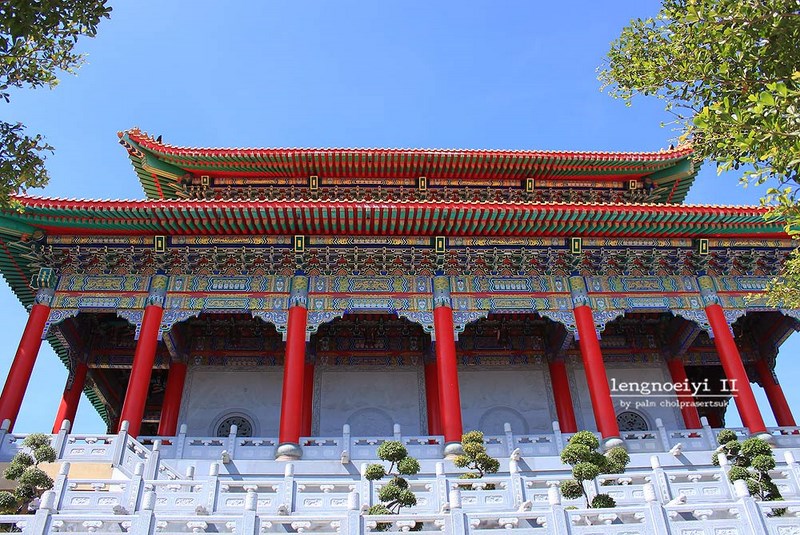
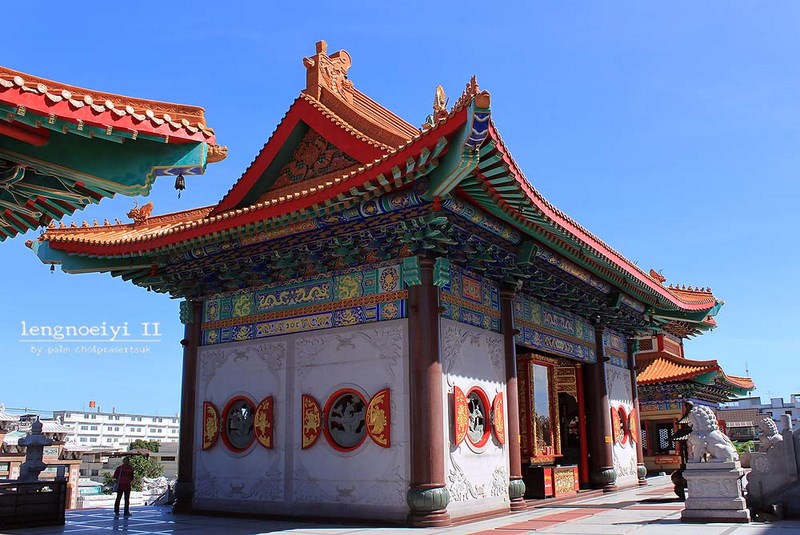
One of the most important reasons the temple feels so authentic is that master craftsmen from China were invited to take part directly in the construction and decorative work. The result is visible in the woodwork, painted surfaces, roof detailing, structural rhythm, and ornamental composition across the entire site. Blue, red, and gold are the dominant colors, and they create a strong visual identity that feels both regal and sacred. In changing daylight, especially during the morning and late afternoon, the color palette becomes even more striking and gives the temple some of the most photogenic architecture in the province.
Golden inscriptions of the mantra “Om Mani Padme Hum” appear on walls and ceilings in several parts of the temple. For believers, these inscriptions carry protective and auspicious meaning. For visitors interested in symbolism, they also reveal how the temple integrates devotion into decoration. The mantra is not treated as a secondary design motif. It is woven into the visual field of the temple, reinforcing the sense that every surface has spiritual intent as well as artistic value.
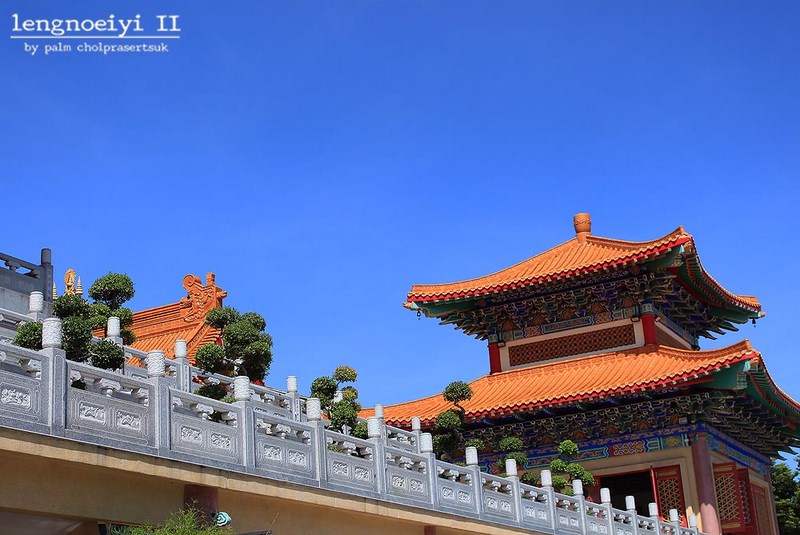
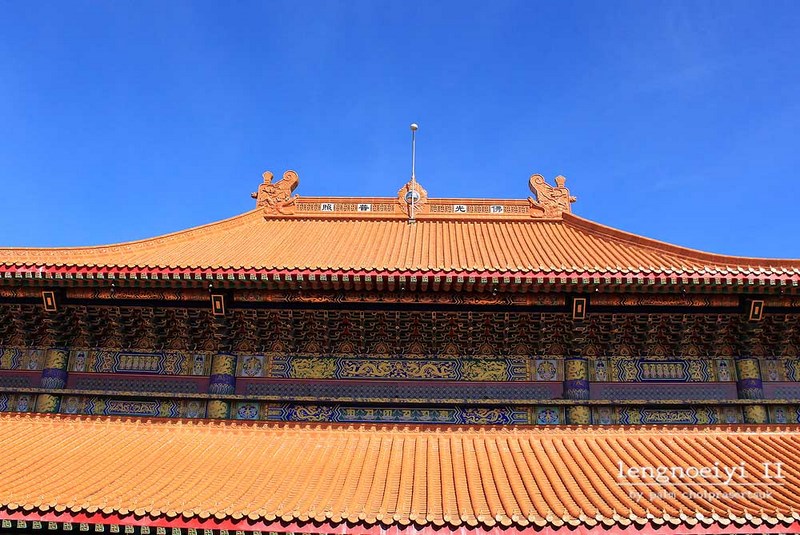
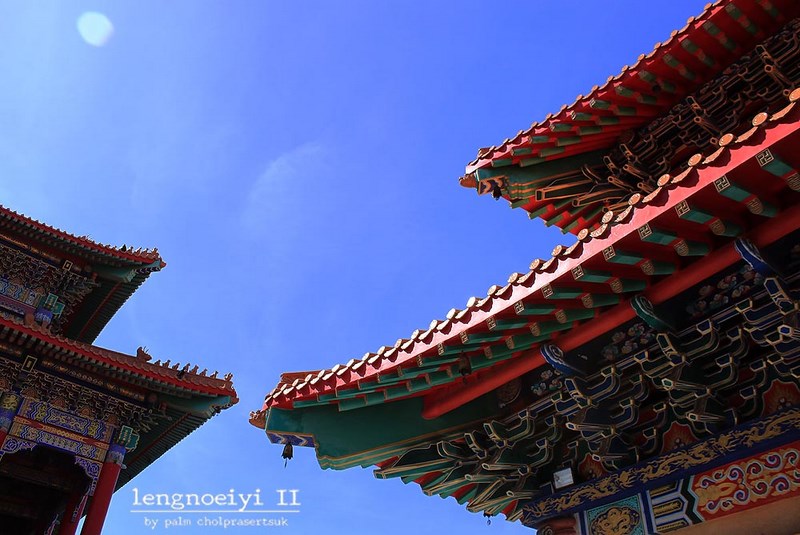
The roofs are another major highlight. They are covered with deep yellow Chinese tiles, and the corners are decorated with auspicious figures and mythical animals that enrich the temple’s ceremonial presence. These details reward close attention. What might look impressive from a distance becomes even more interesting up close, where visitors can appreciate the symbolic language of dragons, heavenly creatures, and protective figures placed along the rooflines. For anyone interested in Chinese visual culture, even a slow walk around the exterior can be highly rewarding.
Stone carvings imported from China are also found throughout the grounds. They appear around halls and open spaces, contributing texture, weight, and a sense of completeness to the temple environment. This is one of the reasons the site feels more immersive than many temple visits. It is not only the main halls that attract attention. The pathways, viewpoints, boundary details, and decorative stone elements all contribute to the experience, making the entire compound feel cohesive and carefully finished.
The first major building visitors encounter is the Hall of the Four Heavenly Kings, a significant entrance space in Chinese Buddhist temple planning. It houses bodhisattvas and guardian deities who protect the Buddhist faith. On either side are the drum tower and bell tower, which help establish the temple’s formal atmosphere from the beginning. This hall serves as a threshold between the outside world and the deeper sacred spaces within the temple grounds.
At the center of the complex stands the Main Ordination Hall, the largest building on the site and the heart of the temple. Inside are 3 principal Buddha images: Sakyamuni Buddha, Amitabha Buddha, and Bhaisajyaguru Buddha. Each image stands about 4.30 meters tall, and together they form one of the most visually commanding Chinese-style principal Buddha groups in Thailand. The expressions are compassionate, dignified, and serene, and the scale of the hall allows the sacred atmosphere to unfold fully as visitors move inward.
The interior of the ordination hall is rich in visual and symbolic detail. Large columns beside the principal images carry Chinese poetic inscriptions, while the walls are decorated with 7 teakwood carved panels showing stories of Buddhas of the past, arhats, and the 4 sacred mountain realms. These carvings give the space a second layer of meaning beyond worship. They transform the hall into a place where artistic narrative, doctrinal memory, and ceremonial reverence all meet. Travelers who enjoy craftsmanship will find the wood carving work particularly impressive.
Outside the hall, Chinese-style boundary stones reinforce the temple’s distinct identity. This is a subtle but important feature. It shows that the temple was not designed as a Thai structure with a few Chinese decorations added afterward. Instead, the entire architectural language was developed to support a coherent Chinese Mahayana Buddhist environment. That consistency is part of what makes the temple so memorable.
Another important section of the temple is the Hall of Thousand-Armed Thousand-Eyed Avalokitesvara together with the Ten Thousand Buddhas Pure Land Hall, arranged within a 2-storey building behind the ordination hall. The lower floor is dedicated to Avalokitesvara, while the upper floor is the Pure Land Hall, where Amitabha Buddha, Avalokitesvara, and Mahasthamaprapta Bodhisattva are enshrined. The walls are lined with 10,000 small Buddha images, producing an interior that feels both powerful and meditative. Many visitors consider this one of the most unforgettable parts of the temple.
The Pure Land imagery has deep meaning in Mahayana Buddhism. It evokes Sukhavati, the Western Pure Land, a realm associated with peace, liberation, and spiritual fulfillment. Because of that, the hall is more than a spectacular visual space. It is also a place of contemplation for those who come to pray, recite, or reflect quietly. Even for travelers with no doctrinal background, the overall stillness and order of the hall often leave a lasting impression.
Other buildings within the temple include a Dharma hall, an ancestral masters hall, and an educational building for monastic studies. These elements show that the temple is not merely a sightseeing destination or a ceremonial shell. It functions as a living Buddhist institution with religious, educational, and community roles. That living quality matters. It gives the site more depth than a purely monumental attraction and explains why it remains important to worshippers as well as to visitors.
For many Thai visitors, Wat Leng Noei Yi 2 is especially associated with praying for blessings, improving fortune, and making offerings for difficult zodiac years. This is one of the reasons the temple becomes especially busy around Chinese New Year and in the early part of the year. Yet the appeal of the temple goes beyond fortune-related devotion. Its deeper strength lies in the way it combines contemporary faith, ceremonial atmosphere, and authentic Chinese Buddhist aesthetics in one place, making it meaningful for very different kinds of visitors.
The atmosphere is grand without feeling overwhelming. The grounds are spacious, the circulation is easy to follow, and the visual axis between buildings helps visitors take in the entire complex naturally. Photographers often prefer early morning or later afternoon because the light enriches the reds, golds, and yellow roof tiles. The open courtyards, gateways, and layered rooflines make the temple especially rewarding for architectural photography.
Practical facilities are in place for general visitors, including parking, restrooms, offering shops, and broad areas that can accommodate large numbers of worshippers. The nearby Bang Bua Thong market area also makes it easy to continue the day with local food or short stops at other nearby attractions. That convenience adds to the temple’s appeal as a half-day or full-day destination.
From a travel perspective, the temple answers several kinds of search intent at once. It works for people looking for a beautiful Chinese temple near Bangkok, for those searching where to pray for good fortune in Nonthaburi, for travelers wanting a photogenic cultural site, and for visitors who want to learn more about Chinese Buddhist art in Thailand. Few places manage to satisfy all of these expectations so effectively in one visit.
Getting There by car is straightforward. From central Nonthaburi, travelers can take Rattanathibet Road, cross Phra Nang Klao Bridge, continue to Bang Phlu intersection, and turn toward Bang Bua Thong. The temple entrance is on the left before the municipal school of Wat Lahan. Another approach from Bangkok is via Kanchanaphisek Road, then turning back toward the route that passes the Blessed Virgin Mary church area and local municipal youth center before reaching the temple. Visitors using public transport can travel into Bang Bua Thong market and continue locally to the temple.
The temple also works well as part of a wider Bang Bua Thong itinerary. Nearby places such as Wat Lahan, Bang Bua Thong Market, the Blessed Virgin Mary church, Preecha Date Palm Garden, and Sai Noi Floating Market can be added to the same day, making the visit more rewarding for travelers who want a fuller picture of the area beyond a single stop.
In the end, Wat Boromracha Kanchanapisek Anusorn is one of the strongest Chinese cultural landmarks in Nonthaburi and one of the most visually impressive Mahayana Buddhist temples in Thailand. Whether visitors come to pray, admire architecture, take photographs, or simply experience a different side of religious art close to Bangkok, the temple offers depth, beauty, and a sense of purpose that stays with people long after the visit ends.
| Name | Wat Boromracha Kanchanapisek Anusorn (Wat Leng Noei Yi 2) |
| Location | Bang Kruai-Sai Noi Road, Sanoloi Subdistrict, Bang Bua Thong District, Nonthaburi Province |
| Address | 959 Moo 4, Tessaban 9 Road, Sanoloi, Bang Bua Thong, Nonthaburi 11110 |
| Highlights | Grand Ming-Qing style Chinese temple, monumental main ordination hall, 3 principal Buddha images, Ten Thousand Buddhas Pure Land Hall, and a popular place for blessings and year-conflict rituals |
| History | Developed from a small joss house into a royal commemorative temple; construction began in 1996, took 12 years, and the official opening ceremony was held on March 20, 2008 |
| Distinctive Features | Chinese red-and-gold halls, deep yellow roof tiles, Buddhist murals, golden mantras, imported Chinese stone carvings, and an overall palace-inspired layout |
| Travel Information | Accessible by car via Rattanathibet Road or Kanchanaphisek Road, then into Bang Kruai-Sai Noi Road near Wat Lahan school; public transport users can continue from Bang Bua Thong Market |
| Current Status | Open and active for visitors and religious activities |
| Open Days | Daily |
| Opening Hours | Monday-Friday 08.00-17.00 and Saturday-Sunday 08.00-18.00 |
| Facilities | Parking area, restrooms, offering shops, and large visitor spaces |
| Main Areas / Zones | Hall of the Four Heavenly Kings, Drum Tower, Bell Tower, Main Ordination Hall, Thousand-Armed Avalokitesvara Hall, Ten Thousand Buddhas Pure Land Hall, Dharma Hall, and Ancestral Masters Hall |
| Main Contact Number | 02-571-1155 |
| Official Website | www.watboromracha.com |
| 1. Nearby Tourist Attractions | 1) Bang Bua Thong Market 1 km 2) Wat Lahan 1 km 3) The Blessed Virgin Mary Church 1 km 4) Preecha Date Palm Garden 3 km 5) Sai Noi Floating Market 12 km |
| 2. Nearby Restaurants | 1) Arsenal 0.1 km 2) Hia Phan Stewed Beef and Pork, Bang Bua Thong Branch 0.1 km 3) Toni Coffee Roasters 0.2 km 4) Present Simple 2 km 5) Tanwa : The Food Project 2 km |
| 3. Nearby Accommodations | 1) Sasi Nonthaburi Hotel 5 km 2) SSP Residence Bang Bua Thong 5 km 3) Westgate Residence Hotel 8 km 4) Villa Baron Hotel Impact 14 km 5) Fine Bed Hotel 15 km |
Frequently Asked Questions
Q: Is Wat Leng Noei Yi 2 the same place as Wat Boromracha Kanchanapisek Anusorn?
A: Yes. Wat Leng Noei Yi 2 is the popular name, while the full formal name is Wat Boromracha Kanchanapisek Anusorn.
Q: Where is the temple located?
A: It is on Bang Kruai-Sai Noi Road in Sanoloi Subdistrict, Bang Bua Thong District, Nonthaburi Province.
Q: What are the opening hours?
A: It is generally open daily, with Monday-Friday hours around 08.00-17.00 and Saturday-Sunday hours around 08.00-18.00.
Q: What is the main highlight of the temple?
A: Its biggest highlights are the Ming-Qing inspired Chinese architecture, the grand main ordination hall, the 3 principal Buddha images, and the Ten Thousand Buddhas Pure Land Hall.
Q: Is this temple popular for praying about zodiac-year conflicts?
A: Yes. Many visitors come here to pray for blessings, improve their fortune, and perform rituals related to difficult zodiac years, especially around Chinese New Year.
Q: Is it worth visiting even if I am mainly interested in culture and photography?
A: Yes. The temple is highly rewarding for architecture lovers, photographers, and travelers interested in Chinese Buddhist art and cultural travel near Bangkok.
 Tel: 025711155, 029202131
 Fax: 025711155
 Wat Boromracha Kanchanapisek Anusorn Map
 Category:
  Group:
  Last Update: 2 HourAgo
Comment

Photo Gellery(12) 
 Thank you photo(6) from: Iampalmz
|
|
|
|
|
|
 |
● Photographer: Plam Cholprosetsuk ● Link: pixpros.net/forums/showthread.php ● Ref: pixpros.net |
Thank you photo(6) from: Psw2548
|
|
|
|
|
|
|
● Photographer: psw2548@yahoo.com ● Link: pixpros.net/forums/showthread.php?t=6963 ● Ref: pixpros.net |
● Copyright Photography. (800*500)
● View full size images from the photographer.
● View full size images from the photographer.
 Nearby Attractions
| Keyword (Advance) |
 Facebook Fanpage
 Region
 Art, Culture and Heritage
 Royal Palace(
 Art, Craft Centres, Tradition(
 Museums(
 Historical Houses and The Ancient City(
 Art Gallery(
 Educational Places
 Museum for Study(
 University
 Mosque(
 Other religious and spiritural sites(
 Suburban Living
 Village, Community(
 Floating Market(
 Nature and Wildlife
 National Parks and Marine Reserves(
 Flower Field(
 River, Canal(
 Islands(
 Entertainment and Agricultural
 Animal camps and shows(
 Farm, Parks, Gardens and Ecotourism(
 Shopping
 Shopping and Night Market(