
 Home
Home North(
 Chiang Mai(


Rating: 3.8/5 (5 votes)
 |
|  Map
Map 
 Have Map
  No Map
Nakhon Pathom attractions
Attractions in Thailand
Open Days: Daily
Opening Hours: 08:00 – 17:00
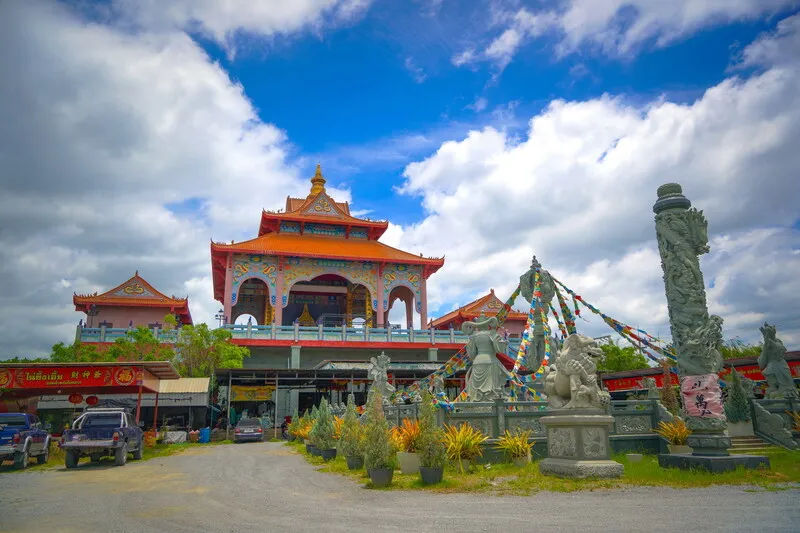
Guanyin of Thung Phichai, Nakhon Pathom, also known as the Guanyin Bodhisattva Shrine of Thung Phichai, is an important religious site in Don Tum District. It is clearly visible from Highway No. 3036 in Huai Phra Subdistrict. The uniqueness of this place lies not only in being a destination for worshippers seeking blessings, but also in the grandeur of the seated Guanyin Bodhisattva statue, which is widely recognized as one of the most beautiful gold-lacquered wooden Guanyin sculptures in Thailand. Travelers passing along this route are often drawn to the large Chinese-style hall and its distinct architectural atmosphere, making this site an important landmark for both faith and cultural tourism in Nakhon Pathom.
The heart of this place is the seated Guanyin Bodhisattva known as “Guan Xi Yin Pu Sak.” It is created in traditional Chinese artistic style from ancient wood aged over 1,000 years. What distinguishes this statue is that it is carved from a single piece of wood, from the face down to the lap, before being finished with gold lacquer. This makes it not just a large statue, but a masterpiece of craftsmanship that combines deep faith with refined Chinese artistry.
In terms of size, the statue has a lap width of 5.50 meters and a total height of 12 meters. This scale immediately impresses visitors. Beyond its physical size, it also reflects the intention of the creators to establish this site as a major center of faith in Don Tum District and Nakhon Pathom Province. Large-scale gold-lacquered wooden sculptures in meditation posture like this are rare in Thailand, making this shrine particularly outstanding among Chinese shrines and Mahayana Buddhist sites.
The creation of the statue is directly connected to China. The carving ceremony began on May 29, 2007, at a carving workshop in Chaozhou, People’s Republic of China. The statue was later enshrined on March 15, 2009. This history gives the shrine greater depth, linking it directly to a major center of Chinese craftsmanship and confirming its significance as a large-scale national-level Guanyin statue.
In addition to the statue, the hall that houses it is another key highlight. The hall is designed in a combination of Chinese and Tibetan Buddhist architectural styles, built on an area of over 5 rai. It measures 63 meters wide, 73 meters long, and 51 meters high, with the ground floor standing 8 meters tall. From the outside, the structure appears grand and distinctly Chinese, yet it is adapted to suit practical religious use in Thailand.
The ground floor serves as a multipurpose space for religious study and ceremonies, while the second floor houses the Guanyin statue where visitors can worship and pray for blessings. This upper area is designed as a Chinese pavilion measuring 30 by 30 meters with a height of 32 meters, with two additional side buildings. At the top of the pavilion is a Chinese-style pagoda used to enshrine Buddha relics. These elements make the hall an integral part of the spiritual experience.
Visitors often come here to worship and seek blessings from Guanyin, who symbolizes compassion, protection, and mercy. People pray for success in life, career, health, peace of mind, and family harmony. The atmosphere combines tranquility with the solemn presence of a large religious complex, offering a deeper experience than smaller shrines.
The shrine continues to host religious activities, ceremonies, and announcements. It remains an active center of faith, not just a historical site. Visitors can experience both its historical background and its ongoing role in the community.
The site also features other deities and sacred figures within the complex. Visitors can explore detailed artistic elements and the spatial layout of the hall. Decorative carved pillars further emphasize the grandeur of Chinese religious architecture.
For spiritual travelers, this site is highly suitable as part of a Don Tum or Nakhon Pathom itinerary. Its roadside location allows easy access and convenient travel to nearby attractions such as Wat Huai Phra, Thai Song Dam Cultural Center, and local community attractions. Nearby restaurants also make it a convenient stop for both worshippers and tourists.
First-time visitors are often impressed by the strong visual identity of the site. The large-scale structure, Chinese-style architectural details, and the elegant Guanyin statue create a memorable experience. Viewing the statue up close reveals the fine carving details and powerful presence, making this more than just a roadside attraction.
From a cultural tourism perspective, this site expands the image of Nakhon Pathom beyond well-known landmarks such as Phra Pathom Chedi and Sanam Chan Palace. It highlights another dimension of the province as a place where Chinese shrines and Mahayana Buddhist sites continue to thrive.
Getting There The shrine can be accessed by both public transport and private vehicles. Visitors can take a yellow songthaew on the Nakhon Pathom–Don Tum route from the bus stop along Chedi Bucha Canal near the Bangkok–Nakhon Pathom terminal. By car, drive from Nakhon Pathom city along Highway No. 3036 for approximately 12 kilometers. The shrine will be visible on the left side.
Overall, Guanyin of Thung Phichai is a place of great value in terms of faith, Chinese artistic craftsmanship, and religious tourism. With its 1,000-year-old wooden statue, grand Chinese–Tibetan style hall, and ongoing religious activities, it is suitable for both worshippers and cultural travelers.
| Place Name | Guanyin of Thung Phichai / Guanyin Bodhisattva Shrine |
| Overview | A major Guanyin shrine in Don Tum featuring a gold-lacquered wooden statue carved from over 1,000-year-old wood, housed in a large Chinese–Tibetan style hall. |
| Highlights | Seated Guanyin statue carved from a single wooden log, 5.50 meters wide and 12 meters tall, finished with gold lacquer. |
| History / Period | Carving began on May 29, 2007, in Chaozhou, China, and the statue was enshrined on March 15, 2009. |
| Architecture | Chinese-style seated statue; hall combines Chinese and Tibetan Buddhist architecture on over 5 rai. |
| Address | 144 Moo 3, Ban Thung Phichai, Huai Phra, Don Tum, Nakhon Pathom 73150 |
| Coordinates | 13.926209, 100.065092 |
| Getting There | Located along Highway 3036 in Don Tum. Accessible by songthaew or private car. |
| Facilities | Large hall, ceremonial spaces, multipurpose buildings, worship areas, donation points. |
| Current Status | Active religious site with ongoing ceremonies and public visits. |
| Contact Number | 085-428-4385 |
| Nearby Attractions | 1. Wat Huai Phra – 2 km 2. Amber Terrace – 1 km 3. Thai Song Dam Cultural Center – 3 km 4. Wat Kong Lad – 2 km |
| Nearby Restaurants | 1. Amber Terrace – 1 km Tel: 095-551-4716, 085-677-7727 |
Frequently Asked Questions (FAQ)
Q: Where is Guanyin of Thung Phichai located?
A: It is located at 144 Moo 3, Huai Phra Subdistrict, Don Tum District, Nakhon Pathom, along Highway 3036.
Q: What is the highlight of this place?
A: The highlight is the seated Guanyin statue carved from over 1,000-year-old wood, with a width of 5.50 meters and a height of 12 meters.
Q: When was the statue created?
A: The carving began on May 29, 2007, in Chaozhou, China, and the statue was enshrined on March 15, 2009.
Q: What is the architectural style of the hall?
A: It is a combination of Chinese and Tibetan Buddhist architecture.
Q: How can I get there?
A: You can travel by yellow songthaew from Nakhon Pathom city or drive via Highway 3036.
Q: Is the shrine still active?
A: Yes, it remains active with ongoing religious ceremonies and visitors.
 Mobile: 0854284385
 Fax: 034975622-3
 Kuan Yin (Thung Phichai) Map
 Category:
  Group:
  Last Update: 16 HourAgo
Comment
 Nearby Attractions
| Keyword (Advance) |
 Region
|
 Muang Nakhon Pathom(