
 Home
Home North(
 Chiang Mai(


Rating: 4/5 (5 votes)
 |
|  Map
Map 
 Have Map
  No Map
Bangkok attractions
Attractions in Thailand
Open Days: Open daily
Opening Hours: 04:30 – 21:00
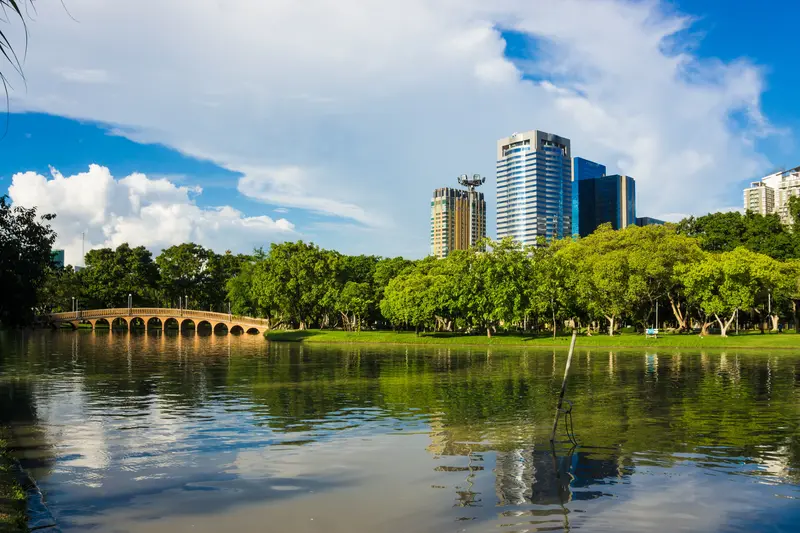
Chatuchak Park is one of Bangkok’s principal public parks, serving a role far greater than that of an ordinary green space. It functions as a place where the city collectively slows down and breathes. Located in the Chatuchak area—an important hub of transportation, commerce, and everyday urban life—the park is not merely a destination for exercise or leisure, but a space that reflects Bangkok’s rhythm on both a metropolitan and deeply human scale.
Geographically, Chatuchak Park is surrounded by major arterial roads: Phahonyothin Road to the east, Vibhavadi Rangsit Road to the north, and Kamphaeng Phet 3 Road to the west and south. This positioning means the park is not hidden behind quiet neighborhoods but stands openly amid the city’s constant movement. Having a large green space at such a transportation crossroads allows the park to act as a counterbalance between urban urgency and the human need for pause.
The origins of Chatuchak Park date back to 1975, when the State Railway of Thailand graciously presented approximately 100 rai of land to be developed as a public park in accordance with the royal wish of His Majesty the King, on the auspicious occasion of His 4th cycle birthday (48 years) on 5 December 1975. On 8 January 1976, His Majesty graciously bestowed the name “Chatuchak Park,” derived from Sanskrit and meaning “four cycles.” The park officially opened to the public on 4 December 1980.
Beyond its historical background, Chatuchak Park represents an urban planning vision that prioritizes public benefit during a period of rapid city expansion. Establishing a park within an area surrounded by major transportation networks reflects the idea that green spaces are not meant to be escapes from the city, but essential spaces that the city passes through and relies on every day.
Key features that give Chatuchak Park its identity include the clock tower and the floral clock—both long-standing visual symbols of the park—as well as sculptures representing six ASEAN countries. These artworks do more than decorate the landscape; they symbolize openness and regional connection. Placed in open areas, the sculptures become part of daily life, forming the backdrop for walking, jogging, resting, and casual encounters among visitors.
In terms of use, Chatuchak Park accommodates a wide spectrum of activities. Early mornings are filled with dedicated runners and exercisers, midday hours offer respite for workers seeking a mental break, and evenings and weekends see families and groups spending time together. This diversity does not come from rigid programming, but from the park’s openness, allowing people to define how they use the space according to their own pace.
The park’s urban community dimension is particularly compelling. Its users do not form a fixed or closed community, but a constantly rotating one. Some people recognize each other from daily morning routines without knowing names, while others use the park as a meeting point before heading elsewhere. This form of familiarity without obligation is a uniquely urban expression of community, made possible only by high-quality public space.
Human experiences at Chatuchak Park rarely come from grand events. Instead, they emerge from small, quiet details: the sound of footsteps along the paths, birdsong briefly overtaking traffic noise, or seeing people of different generations sharing the same space without competition. In these moments, the park allows the city itself to soften.
Getting There Chatuchak Park is easily accessible via public transportation. Visitors can take the BTS Skytrain to Mo Chit Station or the MRT to Chatuchak Park Station, both of which connect directly to the park. Numerous bus routes also pass along Phahonyothin, Vibhavadi Rangsit, and Kamphaeng Phet roads, making the park convenient for those who prefer not to drive in a heavily trafficked area.
| Place Summary | A major public park in the Chatuchak area, offering expansive open space, excellent transport connections, and suitability for all age groups. |
| Highlights | Clock tower, floral clock, ASEAN sculptures, and open areas supporting diverse recreational and leisure activities. |
| Nearby Attractions (Approx. Distance) | Queen Sirikit Park – 1.2 km – Tel. 02-272-4374 Vachirabenjatas Park (Rot Fai Park) – 2.0 km – Tel. 02-537-9221 Chatuchak Weekend Market – 1.5 km – Tel. 02-272-4440 Or Tor Kor Market – 2.0 km – Tel. 02-279-2080 Children’s Discovery Museum Bangkok – 1.4 km – Tel. 02-272-4500 |
| Nearby Restaurants (Approx. Distance) | Laem Charoen Seafood (Central Ladprao) – 4.0 km – Tel. 02-066-1000 MK Restaurants (Central Ladprao) – 4.0 km – Tel. 083-099-6025 After You Dessert Cafe (Central Ladprao) – 4.0 km – Tel. 02-937-1547 Pepper Lunch (Central Ladprao) – 4.0 km – Tel. 089-895-5540 Fuji Japanese Restaurant (Central Ladprao) – 4.0 km – Tel. 02-541-1506 |
| Nearby Accommodations (Approx. Distance) | Best Western Chatuchak – 3.0 km – Tel. 02-666-4695 Craftsman Bangkok – 3.5 km – Tel. 02-279-7299 Centara Grand at Central Plaza Ladprao Bangkok – 4.5 km – Tel. 02-541-1234 The Quarter Ladprao by UHG – 5.5 km – Tel. 02-056-2999 The Bazaar Hotel Bangkok – 6.5 km – Tel. 02-553-5555 |
Frequently Asked Questions (FAQ)
Q: Is Chatuchak Park open every day?
A: Yes, the park is open daily.
Q: Is the park suitable for visitors who are not runners?
A: Yes. The park offers walking paths, seating areas, and relaxed spaces, making it enjoyable without intensive exercise.
Q: What is the best time to visit?
A: Early mornings or late afternoons provide the most comfortable weather and atmosphere.
Q: What other places can be visited nearby?
A: You can easily combine a visit with Queen Sirikit Park, Rot Fai Park, Chatuchak Market, or the Children’s Discovery Museum in one trip.
 Chatuchak Park Map
 Category:
  Group:
  Last Update: 2 MonthAgo
Comment
 Nearby Attractions
| Keyword (Advance) |
 Facebook Fanpage
 Region
 Art, Culture and Heritage
 Historical Sites and Monuments(
 Landmarks and Memorials(
 Royal Palace(
 Art, Craft Centres, Tradition(
 Museums(
 Historical Houses and The Ancient City(
 Art Gallery(
 Educational Places
 Museum for Study(
 Library(
 University
 Places of Worship
 Temple(
 Church(
 Mosque(
 Other religious and spiritural sites(
 Research and Development
 Royal Project(
 Suburban Living
 Village, Community(
 Local Market(
 Floating Market(
 Nature and Wildlife
 River, Canal(
 Bays and Beaches(
 Other natural attractions(
 Zoos and Aquariums(
 Animal camps and shows(
 Stadium(
 Amusement Park(
 Waterpark(
 Theater(
 Cinema(
 Shopping
 Shopping and Night Market(
 Department Store(
 Spas and Wellness
 Spas and Wellness(
 Restaurant
 Michelin Star(
 Accommodation
 Hotel(
 Call Customer Service in Tourism
 Call Customer Service in Tourism(
 Travel Articles, Recipes
 Travel Review, Food Review(
 Royal Thai Desserts, Traditional Dessert, Thai Dessert Recipes(