
 Home
Home North(
 Chiang Mai(


Rating: 4.6/5 (5 votes)
 |
|  Map
Map 
 Have Map
  No Map
Phranakhon Si Ayutthaya attractions
Attractions in Thailand
Open Days: Daily
Opening Hours: 08:00 – 16:30 (hours may change; please recheck before your visit)
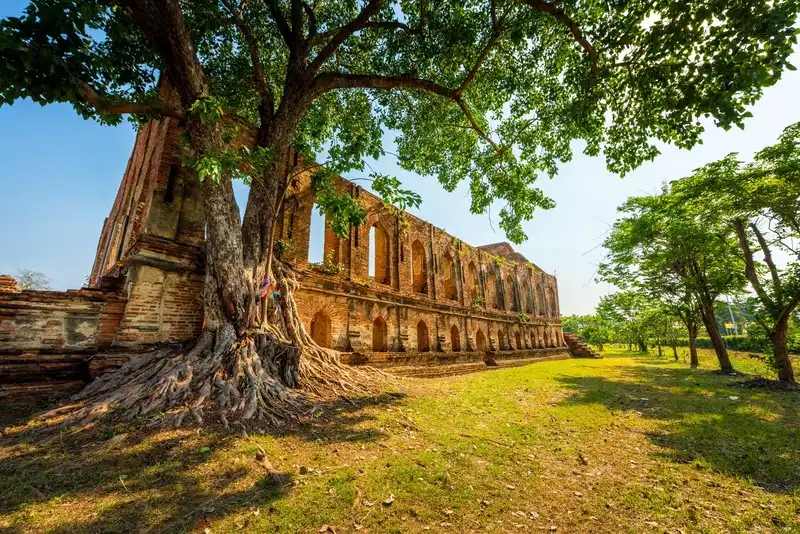
Wat Kudi Dao is one of those Ayutthaya spots that feels almost strange in the best way — it’s so close to people, yet it’s easy to miss. Located in front of Ayutthaya Railway Station on the eastern side, it’s convenient to reach without complicated planning. But once you step inside, you’ll find an archaeological ruin that still carries the charm and power of old craftsmanship. Although it is now an abandoned temple, leaving only building remnants, lotus-base columns, and a chedi that has collapsed, the shapes that remain still clearly reflect the beauty of the past. If you enjoy photography, architectural details, or a quiet atmosphere with a story behind it, this is a stop that can feel far more worthwhile than you’d expect.
What makes an abandoned temple like Wat Kudi Dao compelling is that it doesn’t try to impress the way famous temples on the island do. Instead, it invites you to “look closely” rather than “look from afar,” because its beauty lives in the broken pieces themselves — the line of columns, the details of the lotus capitals, and traces of stucco work that still reveal the hands of skilled artisans. Exploring here feels like reading history without opening a book, using your eyes and imagination to reconstruct the scene from what remains right in front of you.
Historically, the founder is “not clearly identified,” but there is information suggesting that the temple was originally built during the reign of King Narai the Great and later restored during the reign of King Borommakot around 2254 – 2256 BE. Accounts also mention a royal pavilion built for observing the restoration, known as “Tamnak Kammalian” (the Kammalian Pavilion). This hints that Wat Kudi Dao was not merely a small local temple, but once a large and significant site during a period of Ayutthaya’s history.
What helps confirm the temple’s former “scale” is that key elements are still recognizable in the ruins: a large vihara (assembly hall) showing late Ayutthaya elegance such as a slightly arched central base, along with round chedi forms featuring vertical rib-like details. There is also a large chedi believed to have been the principal chedi of the temple, even though its bell-shaped section has collapsed. The sight of a fallen chedi does not make the place feel meaningless — instead, it creates the mood of an old city still alive through its traces. It’s also an excellent storytelling photo spot: stand in the right place and you can capture beauty, stillness, and the feeling of time in a single frame.
Another point that detail-oriented visitors tend to love is the area around the columns and their lotus capitals. Some sources suggest that the artistic style at Wat Kudi Dao resembles royal-temple architecture from early to middle Ayutthaya, especially the “lotus capital” form arranged in clustered lotus motifs. It is described as using terracotta lotus-petal pieces as an inner form, a feature that has been compared to work found in the royal vihara of Wat Phra Si Sanphet. This kind of detail makes the walk more engaging, because you’re not only seeing beautiful ruins — you can also roughly sense the “period” and the “craftsmanship” through the architectural language that still remains.
If you don’t have much time, it helps to explore in a simple order so you don’t miss the highlights. Start by taking in the overall layout — the building lines and the main structural points — then move in closer to the lotus-base columns and the building base details. Finish at the principal chedi ruin, which tends to offer the strongest “storytelling” photos. The best light is often early morning or late afternoon, when shadows enhance the texture and dimension of old brick surfaces, making the scene feel less flat and much more “Ayutthaya”.
Because this is a ruined archaeological site, the main concerns are safety and preservation. Some areas may have uneven ground, loose bricks, or small holes, so it’s best to wear comfortable, non-slip shoes. Avoid climbing on chedi ruins or weathered walls. Most importantly, do not write on surfaces, move pieces, or pull at parts that look loose. Damage at places like this often comes from small acts of “just a little curiosity” more than from natural decay.
The best thing about Wat Kudi Dao is that it’s perfect for a quick “stop.” You can pair it with arriving in Ayutthaya by train and begin your trip here on foot, or if you’re driving, you can drop by before heading into the more famous temple clusters on the island. That flexibility makes it suitable for both half-day visitors and those who want quieter corners outside the typical popular route.
Getting There If you are driving, an easy route to remember is to head about 1 km north from the intersection near the roundabout of Chedi Wat Sam Pluem; the site is along the road on the left. Since the temple is in the area in front of Ayutthaya Railway Station on the eastern side, it’s also fairly easy to spot. If you arrive by train, it’s even more convenient — you can get off at the station and walk over, which is ideal for visitors who want to start exploring without renting a car immediately.
For a one-day plan, it’s a good idea to use Wat Kudi Dao as the opening stop and then continue to nearby historical sites in the same area, because distances are short and the route stays smooth without too much backtracking. If you’re serious about photography, this also gives you a nice balance: raw, atmospheric ruins from this site, then iconic famous temples later in the day for a complete Ayutthaya visual story.
| Place Name | Wat Kudi Dao |
| Address | In front of Ayutthaya Railway Station (East Side), Phra Nakhon Si Ayutthaya District, Phra Nakhon Si Ayutthaya Province 13000 |
| Summary | An abandoned Ayutthaya-period archaeological site near the railway station, featuring a large vihara ruin, lotus-base columns, and the collapsed remains of the principal chedi — ideal for architecture lovers and atmospheric old-city photography. |
| Highlights | Large late-Ayutthaya vihara ruins (arched central base), lotus-base columns and lotus capitals, principal chedi ruins that capture the feeling of “time”, easy access near the railway station. |
| Type / Status | Abandoned Temple / Archaeological Site |
| Caretaker / Abbot (Current) | Not available (abandoned site) |
| Phone Number | 035-246076 |
| Getting There | By car: about 1 km north from the intersection near the Chedi Wat Sam Pluem roundabout; the site is along the road on the left. By train: get off at Ayutthaya Railway Station and walk, as the site is in front of the station on the east side. |
| Nearby Attractions (Approx. Distance) | Wat Chakrawat (Ayutthaya) – 0.18 km Wat Samanakottharam – 0.25 km Ayothaya Floating Market – 0.41 km Wat Pradu Song Tham – 0.45 km Wat Maheyong – 0.46 km |
| Nearby Restaurants (Distance + Phone) | Yachit Restaurant – 1.02 km – 035-246-136 Gingkaew Restaurant – 1.38 km – 035-241-352 Je Nid Restaurant – 1.50 km – 035-241-252 Suanphumitarn – 1.79 km – 035-241-555 Phae Krung Kao – 1.90 km – 035-241-555 |
| Nearby Accommodations (Distance + Phone) | Sri Krung Deluxe Hotel – 0.91 km – 086-324-7707 Ayutthaya Grand Hotel – 0.96 km – 035-252-800 Kameo Hotel Ayutthaya – 1.12 km – 035-212-535 Krungsri River Hotel – 1.45 km – 035-244-333 Sala Ayutthaya – 4.80 km – 035-242-588 |
Frequently Asked Questions (FAQ)
Q: Where is Wat Kudi Dao, and what is the easiest way to get there?
A: It is located in front of Ayutthaya Railway Station on the east side. It’s easy to reach by both car and train. If driving, head about 1 km north from the intersection near the Chedi Wat Sam Pluem roundabout; the site is along the road on the left.
Q: Is Wat Kudi Dao really an abandoned temple, and is there still anything to see?
A: Yes, it is an abandoned temple / archaeological site. You can still see the ruins of a large vihara, lotus-base columns and lotus capitals, and the collapsed remains of the principal chedi, which clearly reflect Ayutthaya-era craftsmanship and make the site great for walking and storytelling photography.
Q: What is the most overlooked highlight at Wat Kudi Dao?
A: Many people miss the remaining craftsmanship details in the ruins, such as the arched central base typical of late Ayutthaya structures and the lotus-base column and capital forms, which still show the quality of construction even though the temple has long collapsed.
Q: How much time should I plan for visiting Wat Kudi Dao?
A: For a relaxed stop with photos, plan about 30 – 60 minutes. If you enjoy closely examining craftsmanship details, you may want 60 – 90 minutes.
Q: Is there anything special I should be careful about when visiting an abandoned temple?
A: Wear comfortable shoes, watch for uneven ground and loose bricks, avoid climbing on ruins or weathered walls, and do not write on surfaces or move any pieces. This helps keep you safe and helps preserve the archaeological site.
 Wat Kudi Dao Map
 Category:
  Group:
  Last Update: 2 MonthAgo
Comment
 Nearby Attractions
| Keyword (Advance) |
 Region
|
 Phranakhon Si Ayutthaya(