
 Home
Home North(
 Chiang Mai(


Rating: 3.8/5 (6 votes)
 |
|  Map
Map 
 Have Map
  No Map
Chiang Mai attractions
Attractions in Thailand
Open Days: Daily
Opening Hours: 05.00–19.30
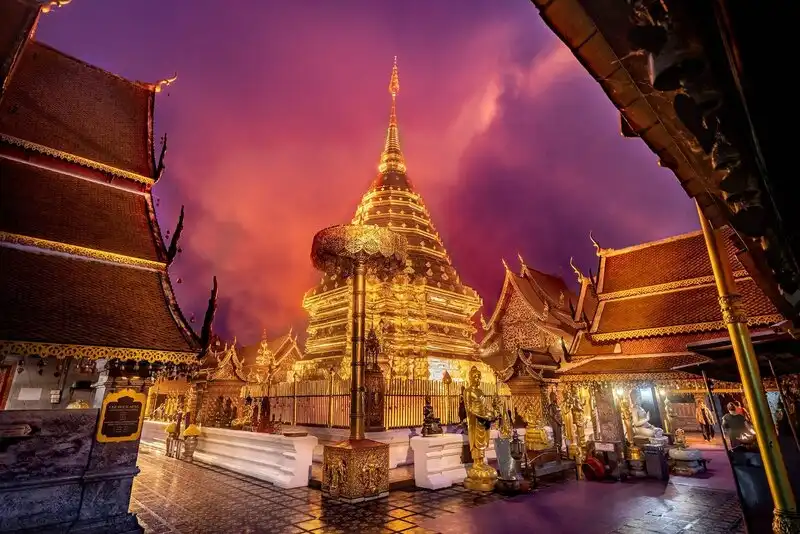
Wat Phra That Doi Suthep Ratchaworawihan, commonly known as Wat Phra That Doi Suthep, is the most revered sacred site of Chiang Mai and has long been regarded as the spiritual heart of the city. Located atop Doi Suthep Mountain to the west of Chiang Mai, the temple stands as a symbol of faith, history, and cultural identity for the people of Lanna. It is widely said that anyone who visits Chiang Mai but does not ascend Doi Suthep has not truly arrived in the city.
The journey to Wat Phra That Doi Suthep begins along Huay Kaew Road, passing the Monument of Kruba Srivichai, the revered monk of Lanna. From there, the road winds gently up the mountain through lush forest scenery. Along the way, visitors are rewarded with panoramic views of Chiang Mai city stretching out below. The distance from the base of the mountain to the temple is approximately 11 kilometers and typically takes around 30 minutes by car. As the ascent continues, the atmosphere gradually shifts from urban bustle to serene mountain tranquility.
According to legend, Doi Suthep was once the dwelling place of a hermit named “Suthep,” from whom the mountain derives its name. This legend reflects the long-standing belief that the mountain has been a sacred place for spiritual practice since ancient times, even before the establishment of the temple itself.
Wat Phra That Doi Suthep was constructed in the early 14th century during the reign of King Kuena Thammikarat, the sixth ruler of Chiang Mai. The temple was built to enshrine a sacred relic of the Lord Buddha, which the king had brought from Si Satchanalai. Since then, the relic has served as a powerful symbol of protection and prosperity for Chiang Mai and its people.
One of the most well-known legends surrounding the temple tells of how King Kuena divided the Buddha relic into two parts. One portion was enshrined at Wat Suan Dok, while the other was placed upon the back of a white elephant. The king made a solemn vow that wherever the elephant chose to stop, a stupa would be built at that location. The elephant climbed Doi Suthep, circled the summit three times in a clockwise direction, and then collapsed and passed away. In response, the king ordered the construction of the sacred stupa at that very spot, establishing Wat Phra That Doi Suthep as the guardian shrine of Chiang Mai.
Visitors to the temple may reach the main sanctuary either by ascending the approximately 300-step Naga staircase, symbolizing devotion and perseverance, or by using the cable car, which operates daily between approximately 05.30 and 19.30. From the temple terrace, sweeping views of Chiang Mai city can be enjoyed, particularly in the early morning and late afternoon when the light is soft and atmospheric.
A significant cultural event associated with the temple is the “Tiao Khuen Doi” tradition, held annually on the night before Visakha Bucha Day. During this event, monks, novices, and Buddhist devotees from various communities join a ceremonial procession carrying sacred water to bathe the stupa. The procession represents collective faith, unity, and devotion, and remains one of the most important religious traditions of northern Thailand.
In terms of belief, worshipping Phra That Doi Suthep is said to bring good fortune, success, and protection from misfortune. Devotees typically prepare flowers, incense, candles, and puffed rice, then circumambulate the stupa clockwise three times while making wishes with sincere intention. It is also customary to pay respect to the stupa at all four cardinal directions, each believed to grant specific blessings: the north for wisdom, the south for ordination and devotion to Buddhism, the east for heavenly rebirth, and the west as the highest form of reverence.
Another important act of merit is paying respect to the Kruba Srivichai Monument, located at the foot of Doi Suthep. Kruba Srivichai is revered as the spiritual leader who led the construction of the road up Doi Suthep, making access to the sacred site possible for future generations.
Getting There From Chiang Mai city center, Wat Phra That Doi Suthep can be reached via the route passing Chiang Mai University and Chiang Mai Zoo. Visitors without private transportation may use red songthaew taxis departing from the area near Chiang Mai University along Huay Kaew Road, operating approximately between 05.00 and 17.00. Visitors are advised to dress modestly and be mindful of changing weather conditions on the mountain.
| Name | Wat Phra That Doi Suthep Ratchaworawihan |
| Location | Doi Suthep, Mueang Chiang Mai District, Chiang Mai Province |
| Key Characteristics | Sacred stupa, panoramic city views, Lanna religious landmark |
| Historical Period | Early 14th century, reign of King Kuena |
| Current Status | Open year-round for worship and tourism |
| Nearby Attractions | Bhubing Palace, Kruba Srivichai Monument, Chiang Mai University |
| Nearby Restaurants | Royal Project Doi Suthep Restaurant, roadside eateries along Doi Suthep route |
| Nearby Accommodations | Hotels in Chiang Mai city center and Nimmanhaemin area |
| Facilities | Cable car, elevators for the disabled, ramps, accessible restrooms |
Frequently Asked Questions (FAQ)
Q: What is the best time to visit Wat Phra That Doi Suthep?
A: Early morning and late afternoon are ideal, offering cooler temperatures and beautiful views of Chiang Mai city.
Q: Is there an entrance fee to Wat Phra That Doi Suthep?
A: Thai visitors may enter free of charge, while foreign visitors may be subject to an admission fee as announced by the temple.
Q: Can elderly or disabled visitors access the temple?
A: Yes. The temple provides elevators, ramps, and a cable car to assist elderly and disabled visitors.
Q: When is the Tiao Khuen Doi tradition held?
A: It is held annually on the night before Visakha Bucha Day.
Q: How much time should be allocated for visiting the temple?
A: Approximately 1–2 hours is recommended, depending on personal pace and time spent worshipping or sightseeing.
 Wat Phra That Doi Suthep Map
 Category:
  Group:
  Last Update: 3 MonthAgo
Comment
 Nearby Attractions
| Keyword (Advance) |
 Region
|
 Muang Chiang Mai(