
 Home
Home North(
 Chiang Mai(


Rating: 3.6/5 (5 votes)
 |
|  Map
Map 
 Have Map
  No Map
Chiang Mai attractions
Attractions in Thailand
Open Days: Daily
Opening Hours: 05.00–18.00
Wat Umong (Suan Phutthatham) is one of Chiang Mai’s most distinctive and tranquil temples, standing apart from typical tourist-oriented sites through its deep historical roots, unique underground architecture, and forest-like surroundings. Located on Suthep Road in Mueang Chiang Mai District, the temple is enveloped by lush greenery and natural woodland, making it widely recognized as a meditation-oriented temple rather than a place for hurried sightseeing.
Reaching Wat Umong is relatively easy. From Ton Payom Market, visitors can drive past the Irrigation Canal intersection behind Chiang Mai University for approximately 500 meters, then turn left into the side road and continue for about 2 kilometers to reach the temple entrance. From the moment one enters the grounds, the atmosphere noticeably shifts—cooler, quieter, and far removed from the bustle of the city.
Wat Umong was originally established during the reign of King Mangrai around 1296 CE (B.E. 1839). It was intended as a residence for forest-dwelling monks of the Aranyavasi tradition, who emphasized solitude, simplicity, and meditation practice. The temple’s secluded setting reflects the Buddhist forest tradition, where spiritual cultivation is closely connected to nature and detachment from worldly distractions.
Later, during the reign of King Kuena, the temple underwent a significant transformation. The king commissioned the construction of underground tunnels to serve as a meditation retreat for Phra Maha Thera Chan, a highly respected monk of the time. These tunnels became the defining feature of the temple and the origin of the name “Wat Umong,” meaning “Tunnel Temple.” The tunnel structure consists of thick masonry walls and interconnected passageways, creating a dim, cool, and contemplative environment ideal for meditation practice.
Historically, the interior walls of the tunnels were adorned with mural paintings, believed by scholars to have been created between approximately 1357 and 1457 CE (B.E. 1900–2000). These murals likely once covered the walls of each chamber entirely. Although only fragments remain today, they still offer valuable insight into early Lanna artistic expression. Common motifs include lotus flowers, peonies, and various birds such as peacocks, cranes, parrots, and ducks—imagery symbolizing peace, nature, and spiritual harmony.
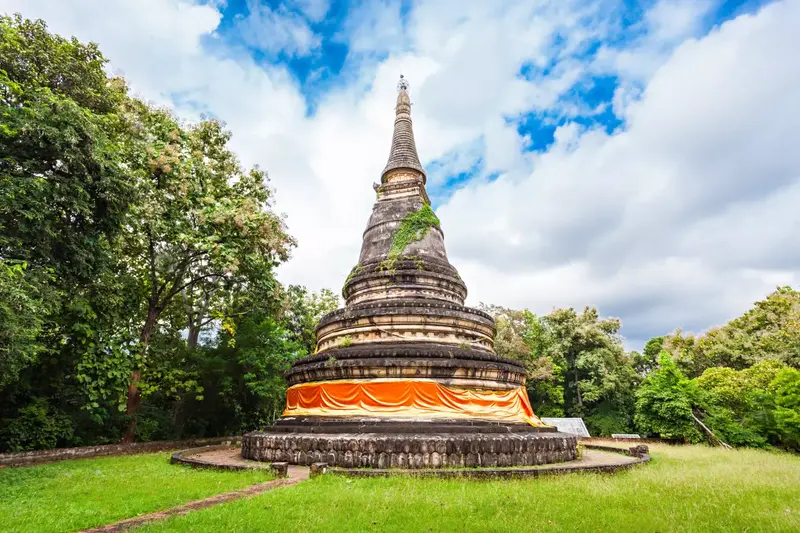
Above the tunnels stands an ancient stupa, which archaeologists estimate was constructed in the early 15th century. This stupa follows the classic Lanna bell-shaped design, featuring three rounded tiers resembling layered lotus petals and crowned with a slender spire. Despite its simplicity, the structure represents an important stage in the evolution of early Lanna Buddhist architecture.
At the entrance to the tunnel area, visitors can also observe a stone-carved Buddha head attributed to the Phayao school of craftsmanship, dating approximately from 1407 to 1567 CE (B.E. 1950–2100). This artifact serves as further evidence of the artistic and cultural connections between major cities within the Lanna Kingdom.
The surrounding grounds of Wat Umong have been developed into a Buddhist garden, shaded by a wide variety of mature trees and natural vegetation. Quiet walking paths invite visitors to stroll, sit, or meditate in silence. Behind the temple lies a protected forest area designated as a sanctuary for animals, where visitors may walk freely and observe birds in their natural habitat. As a result, Wat Umong is not only a religious site but also an important green space and birdwatching location within the city.
With its long history, distinctive underground tunnels, and serene forest environment, Wat Umong offers a unique experience for those seeking respite from the pace of modern Chiang Mai. It appeals equally to travelers interested in Lanna history, Buddhist practice, and quiet contemplation, providing a rare opportunity to engage with both spiritual heritage and nature in one place.
Getting There
Wat Umong is located on Suthep Road in Mueang Chiang Mai District. The temple can be reached conveniently by private car, rental vehicle, taxi, or ride-hailing services from the city center or the Nimmanhaemin area. Local red songthaews are also available. Visitors are advised to dress modestly and maintain a respectful silence, as the temple remains an active meditation site.
| Name | Wat Umong (Suan Phutthatham) |
| Location | Suthep Road, Mueang Chiang Mai District, Chiang Mai Province |
| Key Characteristics | Forest meditation temple, ancient tunnels, Buddhist garden, peaceful atmosphere |
| Period | Lanna Kingdom era (King Mangrai – King Kuena) |
| Current Status | Open to visitors and active for meditation and religious practice |
| Contact Number | +66 53 278 620 |
| Nearby Attractions | Doi Suthep (approx. 5 km) Chiang Mai University (approx. 2 km) Ton Payom Market (approx. 1.5 km) |
| Nearby Restaurants | Huen Muan Jai Tel. +66 53 404 998 Khao Soi Samer Jai Tel. +66 53 222 456 Huen Phen Tel. +66 53 814 548 |
| Nearby Accommodations | U Nimman Chiang Mai Tel. +66 52 005 111 Eastin Tan Hotel Chiang Mai Tel. +66 52 001 999 Novotel Chiang Mai Nimman Journeyhub Tel. +66 52 012 777 |
Frequently Asked Questions (FAQ)
Q: Who is Wat Umong suitable for?
A: Wat Umong is ideal for visitors seeking tranquility, those interested in Lanna history, and anyone looking for a peaceful place to meditate or reflect.
Q: Can visitors enter the tunnels?
A: Yes, visitors may walk through the tunnels, but should speak quietly and avoid disturbing those practicing meditation.
Q: Is there an entrance fee?
A: There is no entrance fee; visitors may donate according to personal faith.
Q: Is Wat Umong suitable for photography?
A: Yes, especially for nature, architecture, and atmospheric photography, though visitors should be mindful not to disturb practitioners.
Q: How long should I spend visiting Wat Umong?
A: Approximately 1–2 hours is recommended for exploring the tunnels, Buddhist garden, and surrounding forest areas at a relaxed pace.
 Wat Umong Map
 Category:
  Group:
  Last Update: 3 MonthAgo
Comment
 Nearby Attractions
| Keyword (Advance) |
 Region
|
 Muang Chiang Mai(