
 Home
Home North(
 Chiang Mai(


Rating: 3.5/5 (6 votes)
 |
|  Map
Map 
 Have Map
  No Map
Chiang Mai attractions
Attractions in Thailand
Open Days: Wednesday–Sunday (closed on Monday–Tuesday and public holidays)
Opening Hours: 09:00–16:00
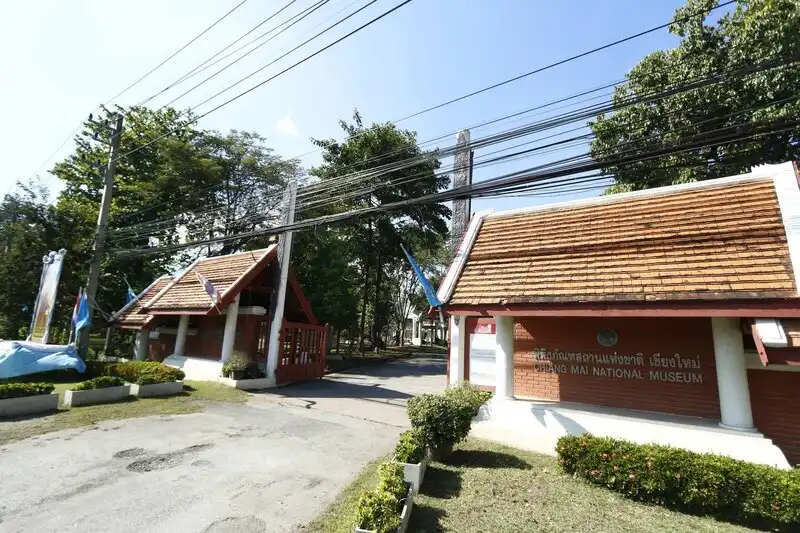
Chiang Mai National Museum, often simply called the Chiang Mai Museum, is an excellent starting point for anyone who wants to understand Chiang Mai and the Lanna region more deeply than just walking through temples or cafés. The museum stands along the Chiang Mai–Lampang Super Highway near Wat Jed Yod, on land designated by the Fine Arts Department as a regional national museum. It serves as a center for study, preservation, and the provision of cultural and historical information relating to Chiang Mai and the entire Upper Northern Region, historically known as “Lanna.” The main building is a two-storey cruciform structure in a Thai–Lanna hybrid style, with traditional Lanna gable finials (kalāe) adorning the roof. From the very first impression, visitors can sense that this is not just an ordinary exhibition building, but a space intentionally designed to tell the story of the “capital of Lanna” in a systematic and elegant way.
The Chiang Mai National Museum was officially opened to the public on 6 February 1973 in a royal ceremony presided over by His Majesty the King and Her Majesty the Queen, who also viewed the permanent exhibitions inside the building. The architectural design, which blends central Thai and Lanna characteristics, helps connect the atmosphere outside with the content inside seamlessly. Later, in 1996, the museum underwent repairs, building extensions, and a major upgrade of its permanent exhibitions. The academic content was strengthened and a wider range of display techniques was introduced, including visual media, scale models, and original artifacts, so that visitors of all ages could access Lanna’s stories more easily and experience them in a livelier way.
Inside the museum, information about Chiang Mai and the Lanna region is presented in a clear sequence and from multiple perspectives. Exhibitions begin with the geography, climate, geology, and prehistoric life of Northern Thailand, illustrating that this land was once home to ancient humans and animals long before it became a flourishing kingdom. The first exhibition section also tells the story of prehistoric human settlements and the Lua people, considered the original inhabitants of the North, before the rise of the Hariphunchai Kingdom, the first organized state in the region. Seeing ancient artifacts, stone tools, ceramics, and skeletal remains from various soil layers allows visitors to perceive the long timeline of the Lanna landscape more vividly.
The exhibition then leads visitors into the history of the Lanna Kingdom in a structured manner, beginning with the founding of Chiang Mai by King Mangrai, its prosperity as a center of trade, religion, and art in the North, and the subsequent period of decline caused by warfare, politics, and regional change. This section displays inscriptions, ritual objects, religious items, Buddha images, and artworks from different eras that reflect the Lanna identity, such as gilded lacquer decoration, stucco work, and woodcarving. Together they help visitors understand that Lanna is not just a geographical designation, but a civilization with its own systems of thought, beliefs, and distinct artistic traditions.
Another particularly interesting section tells the story of Chiang Mai under the umbrella of the Siamese kingdom after liberation from Burmese rule and the re-establishment of Chiang Mai in 1796 (B.E. 2339). The exhibition describes the relationship between Chiang Mai and Bangkok, including administration, officials, trade, and the adaptation of Lanna to the modern world. Visitors can observe economic development through trade records from the first phase, between 1856–1920 (B.E. 2399–2463), when land and river trade routes began to grow, and into the second phase, between 1924–1939 (B.E. 2467–2482), after the Northern Railway reached Chiang Mai. The arrival of the railway not only changed modes of transport but also had a significant impact on commerce, mobility, and cultural exchange.
The exhibitions also include a section that explains in detail the daily life and social development of people in Chiang Mai and Lanna. Topics include agriculture, mining and early industries, finance and banking, education, and public health. Visitors can see examples of everyday household items, farming tools, weighing scales, early medical instruments, and historical photographs of Chiang Mai that reveal the city’s transformation from a riverside community along the Ping River into a major tourism city. The final sections present the evolution of Lanna art in comparison with art from other regions of Thailand, making both the similarities and differences between artistic traditions clearly visible.
The exhibitions at Chiang Mai National Museum are divided into six main sections that form a continuous narrative. The first section covers the background of the Lanna region, from geology and prehistoric life to Northern environmental conditions, including the Lua people and the Hariphunchai Kingdom. The second section tells the history of the Lanna Kingdom during its rise and decline. The third explains Chiang Mai under Siamese rule after liberation from Burma. The fourth describes economic and trade development in two key phases, before and after the railway arrived. The fifth provides an overview of daily life and social development, linking agriculture, industry, finance, education, and public health. The sixth section presents the evolution of Lanna art alongside Thai art in general, giving visitors a comprehensive overview of Lanna in historical, economic, social, and artistic dimensions.
The atmosphere inside the museum is calm and simple, encouraging visitors to walk through the displays without rushing. Information panels in both Thai and English enable Thai and foreign visitors to learn side by side with ease. For those who wish to study further, the museum serves as an important resource for students, researchers, and anyone interested in Lanna history, as it houses a large collection of artifacts, documents, and reference materials in one place. Walking from one display case to the next feels like slowly walking back through time, from the prehistoric era to the period when Chiang Mai became one of Thailand’s major tourism hubs.
Getting There to the Chiang Mai National Museum is convenient by both private car and public transport. By car, from the Chiang Mai University area, follow Huay Kaew Road toward Rin Kham Intersection, then turn left onto the Chiang Mai–Lampang Super Highway. Continue past Wat Jed Yod for about 500 meters and the museum will be on your left, near the entrance to Wat Jed Yod. There are clear signs and a parking area directly in front of the building. Those traveling by red songthaew can ask the driver to drop them near Wat Jed Yod or the Chiang Mai National Museum and then walk a short distance into the museum grounds. Its location is not far from the northern side of the old city moat, Rin Kham Intersection, and MAYA Lifestyle Shopping Center, making it easy to combine a visit here with nearby temples or a meal in the Chang Puak area.
As for opening times, the Chiang Mai National Museum currently welcomes visitors from Wednesday to Sunday, 09:00–16:00, and is closed on Mondays, Tuesdays, and public holidays. Those planning a visit should check the latest announcements from the Fine Arts Department or the museum’s official channels in case of temporary closures. Entrance fees are approximately 20 baht per person for Thai nationals and about 100 baht per person for foreign visitors. Students in uniform, monks, novices, clergy of various religions, and individuals eligible under Fine Arts Department regulations are exempt from admission fees when presenting valid identification. These accessible rates make the Chiang Mai National Museum one of the most worthwhile historical and cultural learning sites to visit while in Chiang Mai.
Overall, the Chiang Mai National Museum functions as a kind of “grand classroom of Lanna,” opening its doors to everyone who wishes to learn about the roots of the northern people through artifacts, documents, photographs, and carefully curated exhibitions. Spending just 1–2 hours here can sharpen one’s picture of Chiang Mai far beyond beautiful temples and popular tourist streets. Behind the lively city of today lies the long history of the Lanna Kingdom, its integration into the modern Thai state, and the economic and social developments of each era. For anyone who wants their trip to Chiang Mai to be both enjoyable and deeply insightful, the Chiang Mai National Museum is a destination that should not be overlooked.
| Name | Chiang Mai National Museum (พิพิธภัณฑสถานแห่งชาติ เชียงใหม่) |
| Location | Chiang Mai–Lampang Super Highway, near Wat Jed Yod, Chang Phueak Subdistrict, Mueang Chiang Mai District, Chiang Mai 50300, Thailand |
| Key Characteristics | A regional national museum under the Fine Arts Department, serving as a center for education, preservation, and dissemination of historical, archaeological, ethnographic, and artistic information related to Chiang Mai and the Upper Northern Region. The museum presents permanent exhibitions on the geological background of Lanna, the history of the Lanna Kingdom, trade and the economy, daily life, and the evolution of Lanna art. |
| Period / Era | Exhibitions cover history from prehistoric times and the Hariphunchai Kingdom through the Lanna Kingdom and into the modern era when Chiang Mai became part of the Thai nation-state and developed into a modern economic and tourism city. |
| Key Evidence | Prehistoric artifacts, stone tools, ceramic vessels, inscriptions and stone steles, Buddha images and Lanna artworks from various periods, household items from traditional Lanna urban life, archival photographs of Chiang Mai, and scale models of the city plan and important sites in Northern Thailand. |
| Name Origin | The name “Chiang Mai National Museum” indicates its role as the national museum for Chiang Mai and the Upper Northern Region under the Fine Arts Department, functioning as a regional center for Lanna cultural and historical information. |
| Getting There | From Chiang Mai University and Huay Kaew Road, drive to Rin Kham Intersection and turn left onto the Chiang Mai–Lampang Super Highway. Continue past Wat Jed Yod for about 500 meters; the museum is on the left with parking available. Red songthaews from the city can drop passengers at Wat Jed Yod or directly at the Chiang Mai National Museum. The museum is approximately 2–3 km from the northern moat and Rin Kham Intersection. |
| Current Status | Open to the public as the regional national museum for the Upper Northern Region, with permanent exhibitions throughout the year and support for academic events, educational visits, and out-of-class learning activities for schools, universities, and the general public. |
| Opening Days & Hours | Open Wednesday–Sunday, 09:00–16:00. Closed on Monday, Tuesday, and public holidays. (Visitors are advised to check the latest announcements in case of temporary closures.) |
| Admission Fee | Thai nationals: approximately 20 THB per person. Foreign visitors: approximately 100 THB per person. Students in uniform, monks, novices, clergy of various religions, and eligible groups under Fine Arts Department regulations may enter free of charge upon presenting valid identification. |
| Facilities | Parking area, visitor restrooms, exhibition spaces with air-conditioning in some sections, information panels in Thai and English, seating areas, and an office for arranging group visits and academic activities. |
| Nearby Attractions | Wat Jed Yod (about 0.5 km), Chang Phueak Market and Chang Phueak Gate area (about 2 km), MAYA Lifestyle Shopping Center and Nimmanhaemin Road (about 2–3 km), and the northern side of Chiang Mai Old City moat (about 2–3 km). |
| Popular Nearby Restaurants | Baan Mae Cafe & Restaurant (Thai fusion café and restaurant in Chang Phueak area, about 1.5 km from the museum, Tel. +66 91-854-7289); Khao Soi Mae Sai (famous northern noodle restaurant on Ratchaphuek Road, about 1–2 km away, Tel. +66 53-213-284); Good Day Cafe & Restaurant (cozy café and restaurant near Chang Phueak area and the outer moat, about 2 km from the museum, Tel. +66 83-486-7528). Opening times should be checked in advance as they may change. |
| Popular Nearby Accommodations | Wintree City Resort Chiang Mai on the Chiang Mai–Lampang Road, about 1 km from the museum, Tel. +66 52-081377, +66 93-689-1955; Chiangmai Grandview Hotel & Convention Center on Chiang Mai–Lampang Road near Rin Kham Intersection, about 1.5 km away, Tel. +66 53-220-100; Chiangmai S.P. Hotel in Chang Phueak area, about 2 km from the museum, Tel. +66 53-406-396–8. Distances are approximate; visitors should confirm locations and details before booking. |
| Contact Number | Chiang Mai National Museum Tel. +66 53-221-308 (some sources also list +66 53-408-568 ext. 10 or 13 for the office). |
Frequently Asked Questions (FAQ)
Q: On which days and at what times is the Chiang Mai National Museum open?
A: The Chiang Mai National Museum is open Wednesday–Sunday from 09:00–16:00 and closed on Mondays, Tuesdays, and public holidays. Visitors are advised to check the latest announcements from the Fine Arts Department or the museum’s official channels in case of temporary closures.
Q: What is the admission fee for the Chiang Mai National Museum, and are there any discounts or exemptions?
A: In general, Thai nationals pay an admission fee of about 20 THB per person, while foreign visitors pay about 100 THB per person. Students in uniform, monks, novices, clergy of various religions, and groups eligible under Fine Arts Department regulations may enter free of charge upon presenting valid identification. Admission fees are subject to change, so checking the latest information before visiting is recommended.
Q: What kind of content is exhibited inside the Chiang Mai National Museum?
A: The museum displays a wide range of content related to Lanna and Chiang Mai, including geology, prehistoric life, early human settlements, the history of the Lanna Kingdom, Chiang Mai under Siamese rule, economic and trade development, agriculture and industry, as well as the daily life of Lanna urban communities and the evolution of Lanna art compared with Thai art in general.
Q: How much time should I allow to see the Chiang Mai National Museum properly?
A: For a general visit, reading selected information panels and viewing the main artifacts, it is recommended to allow about 1–2 hours. Visitors with a particular interest in history or Lanna art may wish to spend longer, depending on how closely they read and observe each exhibit.
Q: Is it possible to visit the Chiang Mai National Museum without a private car?
A: Yes. Visitors can easily reach the museum by red songthaew from the city center. Simply ask the driver to stop near Wat Jed Yod or the Chiang Mai National Museum and then walk a short distance into the museum grounds. Taxis and app-based ride services can also be used by entering “Chiang Mai National Museum” or “Wat Jed Yod” as the destination.
Q: Is the Chiang Mai National Museum suitable for children and families?
A: Very much so. The museum’s exhibitions are easy to understand and supported by images, models, and real artifacts, which help children learn about Lanna history and culture in a relaxed way. Parents can explain and discuss the exhibits with their children while walking through the galleries, and should remind them not to run or touch the artifacts directly to help preserve the collections for future visitors.
 Tel: 053221308
 Chiang Mai National Museum Map
 Category:
  Group:
  Last Update: 3 MonthAgo
Comment
 Nearby Attractions
| Keyword (Advance) |
 Region
|
 Muang Chiang Mai(