
 Home
Home North(
 Chiang Mai(


Rating: 3.7/5 (7 votes)
 |
|  Map
Map 
 Have Map
  No Map
Chiang Mai attractions
Attractions in Thailand
Open Days: Daily
Opening Hours: 08.00–17.00
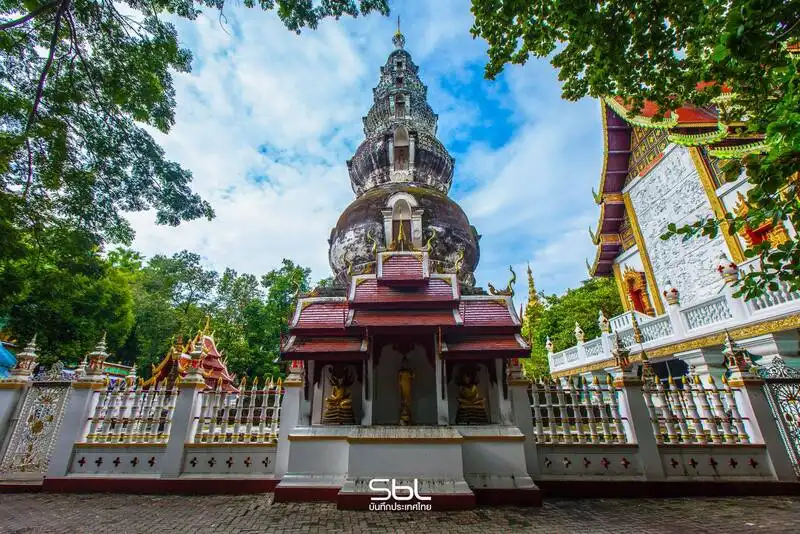
Wat Ku Tao in Chiang Mai, officially known as Wat Weluwanaram, is an ancient temple of significant historical, artistic, and cultural value. Located in Si Phum Subdistrict, Mueang Chiang Mai District, adjacent to the Chiang Mai Municipal Stadium, the temple sits within a lively urban area while preserving a serene atmosphere that reflects the layered history of Chiang Mai during periods of foreign rule.
The most distinctive feature of Wat Ku Tao is its iconic Ku Tao Chedi, a structure unlike any other stupa in Thailand. The chedi consists of multiple rounded tiers stacked vertically, resembling a pile of watermelons placed one upon another. This unusual form gave rise to the name “Ku Tao,” which has since become synonymous with the temple itself. Beyond its visual uniqueness, the chedi embodies symbolic meanings related to cosmology, continuity, and the sustaining power of Buddhism.
Although no definitive historical record confirms the exact date of the temple’s construction, local legends and historical evidence suggest that Wat Ku Tao is closely associated with the period when Chiang Mai was under Burmese rule between 1579 and 1607 CE. One widely told legend states that the Ku Tao Chedi was built to enshrine the ashes of Prince Sarawadi, a son of King Bayinnaung of Burma, who governed Chiang Mai during that era.
Another historical narrative links the chedi to King Mangshanrathamangdui, a Burmese noble who led military campaigns against Ayutthaya under the command of Crown Prince Nanda Bayin. After suffering defeat by King Naresuan the Great and subsequently pledging allegiance, he became estranged from the Burmese court and was unable to return to his homeland. He passed away in Chiang Mai in 1613 CE. His younger brother later arranged royal cremation rites and commissioned the Ku Tao Chedi to enshrine his ashes and relics, subsequently establishing a temple in a bamboo forest area and naming it Wat Weluwan Ku Tao.
Architecturally, the Ku Tao Chedi represents a rare blend of Lanna and Burmese artistic influences. Each tier of the chedi features niches containing Buddha images in various postures, facing all four cardinal directions. The surface of the chedi is decorated with small pieces of colored glass arranged in delicate floral patterns. Scholars believe that the chedi was originally plain stucco, and that the ceramic and glass decorations were added later, likely during the reign of King Rama V, when Chinese ceramics became widely used in temple restoration projects.
The uppermost section of the chedi is crowned with a small gilded stupa and a metal umbrella finial, elements characteristic of Burmese religious architecture. These features contribute to the chedi’s graceful silhouette and further emphasize the historical context of Chiang Mai during a time of Burmese influence.
Local Traditions and Community Role Wat Ku Tao continues to serve as a spiritual center for the Si Phum community. On major Buddhist holy days such as Makha Bucha Day, Visakha Bucha Day, and Asalha Bucha Day, local residents gather at the temple to make merit, perform candlelit processions, and pay respect to the Ku Tao Chedi for good fortune and spiritual well-being. While it may not host large-scale city-wide festivals, the temple remains deeply embedded in the religious life of the neighborhood.
Getting There Wat Ku Tao is located near the Chiang Mai Municipal Stadium. From the old city moat, head toward Maneenopparat Road and turn into the side street next to the stadium. The temple is easily accessible on foot or by car. Public transportation options include red songthaews and taxis; simply tell the driver “Wat Ku Tao near the Chiang Mai Municipal Stadium.”
| Name | Wat Ku Tao (Wat Weluwanaram) |
| Location | Si Phum Subdistrict, Mueang Chiang Mai District, Chiang Mai |
| Highlights | Multi-tiered round chedi resembling stacked watermelons, Lanna-Burmese art |
| Historical Period | Burmese rule of Chiang Mai (16th–17th century) |
| Key Monuments | Ku Tao Chedi, Buddha niches, Burmese-style finial |
| Nearby Attractions | Chiang Mai Municipal Stadium (0.1 km), Wat Lok Moli (0.9 km), Chang Phueak Gate (1.2 km) |
| Current Status | Open for worship and historical visits |
| Contact | +66 53 219 833 |
Frequently Asked Questions (FAQ)
Q: What makes Ku Tao Chedi unique?
A: Its unusual tiered, rounded shape resembling stacked watermelons is unique in Thailand and reflects Burmese artistic influence.
Q: When was Wat Ku Tao built?
A: The exact construction date is unknown, but it is believed to have been built during the Burmese rule of Chiang Mai in the 16th–17th century.
Q: Why does the chedi resemble watermelons?
A: The rounded, layered design is a distinctive architectural style not found in traditional Lanna stupas.
Q: Is Wat Ku Tao suitable for cultural tourism?
A: Yes, it is ideal for visitors interested in Lanna and Burmese history, architecture, and religious heritage.
Q: Can I visit other temples nearby?
A: Yes, Wat Lok Moli, Chang Phueak Gate, and other old-city attractions are easily accessible from Wat Ku Tao.
 Wat Ku Tao Map
 Category:
  Group:
  Last Update: 3 MonthAgo
Comment
 Nearby Attractions
| Keyword (Advance) |
 Region
|
 Muang Chiang Mai(