
 Home
Home North(
 Chiang Mai(


Rating: 4.2/5 (5 votes)
 |
|  Map
Map 
 Have Map
  No Map
Nakhon Nayok attractions
Attractions in Thailand
Open Days: Daily
Opening Hours: 08.00 - 17.00
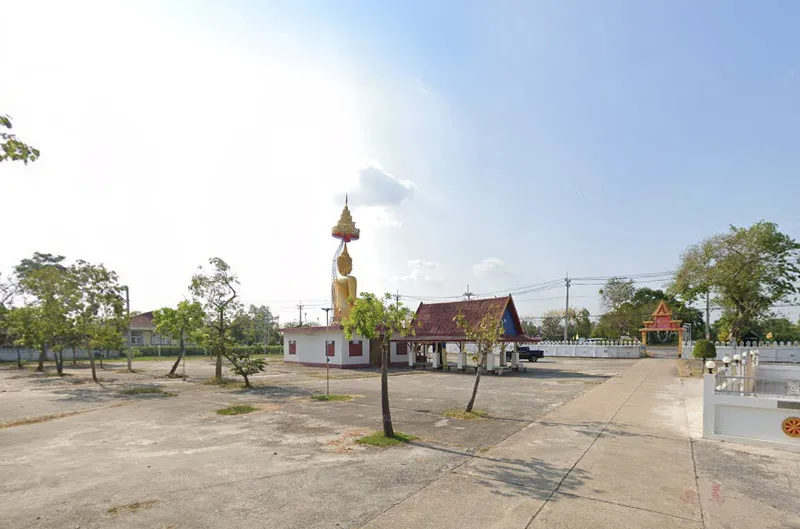
Wat Thaweepoon Rangsan is a local Buddhist temple under the Maha Nikaya sect, located at 53 Moo 6, Sai Mun Subdistrict, Ongkharak District, Nakhon Nayok Province. The temple stands in an area clearly connected to riverside community life and the network of canals in Ongkharak District. It is not only a place for religious activities for local residents, but also a center for merit-making events, traditional festivals, and public community activities. In particular, the Thai Sart Festival and boat racing tradition have made the temple well known throughout the province.
Viewed as a whole, Wat Thaweepoon Rangsan has the charm of a community temple in the central river basin. Its role goes beyond being a quiet place for making merit. It also serves as a stage reflecting the real life of local people, from gathering together to organize merit-making events, to preserving traditional foods, to hosting local games and folk sports closely tied to the waterways. The distinctiveness of the temple lies in how it keeps the relationship between Buddhism, community life, and local culture alive within one shared space.
Wat Thaweepoon Rangsan was officially registered as a temple on 5 October 1965 and is located in Sai Mun Subdistrict, Ongkharak District, Nakhon Nayok Province, in the Khlong 29 area, a place long associated with agricultural communities and water-based transportation. Although details from the temple’s earliest period are not yet clearly known, its role as the center of important local traditions clearly reflects its continuity and stability within the area.
One of the temple’s most distinctive identities is that it serves as the venue for the Thai Sart Festival and Boat Races, an event long known among local residents in Ongkharak District and nearby communities. The festival is held from late September to early October, with its main traditional activities centered in October each year. The event includes merit-making according to the Thai Sart tradition, boat racing, a krayasart stirring competition, entertainment activities, and a lively temple fair atmosphere that brings together people from many communities into one place. As a result, the temple becomes both a religious center and a cultural center at the same time.
The Thai Sart Festival is a merit-making tradition with deep meaning in Thai society because it is connected with dedicating merit to ancestors, making merit for auspiciousness, and bringing relatives or community members back together to participate in shared activities. Wat Thaweepoon Rangsan is therefore not merely the place where the event is held, but a setting in which the true meaning of this tradition can still be experienced in a tangible way. Visitors do not see only symbolic rituals, but also the real process of local participation, from preparing offerings, gathering villagers together, and organizing various activities, to the games and competitions that keep the tradition vibrant and alive.
Among all the activities in the festival, the boat races are one of the biggest highlights because they clearly reflect the riverside way of life in the Ongkharak community. In the context of Wat Thaweepoon Rangsan, boat racing is not merely about winning or losing, but about bringing together people of many ages in the community, including rowers, supporters, organizers, and spectators. The races therefore carry more cultural meaning than that of a sport alone. They present an image of harmony, unity, and the preservation of the bond with waterways, which once formed the core of local life before roads and modern transportation became more dominant.
Another activity that makes Wat Thaweepoon Rangsan different from an ordinary temple fair is the krayasart stirring competition, which connects traditional food with merit-making during the Thai Sart Festival. Krayasart is an ancient Thai sweet made from many ingredients and requires time, labor, and cooperation to prepare properly. When it is turned into a competition at the community level, it highlights the value of local wisdom even more clearly, because stirring krayasart is not only about successfully making the dessert. It is also about passing down traditional methods, dividing responsibilities among participants, and expressing the spirit of cooperation within the community.
The appeal of stirring krayasart lies as much in the process as in the finished result. Many ingredients must be prepared with great care, and the stirring itself requires physical effort, patience, and an understanding of the right heat and texture. It is therefore an activity that must be done collectively. Wat Thaweepoon Rangsan becomes a place where traditional food is no longer confined to the household kitchen, but is elevated into a community ritual that everyone can witness and take part in. Visitors during the festival will immediately sense that krayasart here is not simply a sweet, but a symbol of gratitude, abundance, and sharing.
The temple’s annual festival is also connected with the gilding of Luang Pho Phutthanimitmongkhon, an important Buddha image within the temple. This gives the temple’s Sart season festival both a dimension of faith and a dimension of community tradition. People who come to join the event do not come only to watch the boat races or enjoy the lively atmosphere, but also to make merit, pay respect to the Buddha image, and take part in activities closely tied to Buddhist belief. This makes the festival deeper in meaning than a general entertainment fair, because its core remains centered on the temple and the faith of the community.
As for the atmosphere of the temple on ordinary days, Wat Thaweepoon Rangsan has the image of a rather simple community temple, surrounded by local settlements and canal-side landscapes in Sai Mun Subdistrict. The calm atmosphere of the temple grounds makes it suitable for stopping by to make merit, pay respect, or simply spend time in an unhurried setting. However, when the annual festival arrives in late September or early October, the same area transforms completely. It becomes filled with people, vendors, announcementเสียง, the cheers of boat-race spectators, the aroma of food and sweets, and the vibrant atmosphere of a traditional temple fair. This contrast allows visitors to see both dimensions of the temple: its peacefulness on ordinary days, and its energy as a public gathering place during the festival season.
In terms of cultural importance, Wat Thaweepoon Rangsan is a clear example of a temple that preserves local traditions through real practice, not merely through stories or written records. The Thai Sart Festival, boat races, and krayasart stirring competition continue to take place year after year. People still participate, and the community still recognizes the festival as something that truly belongs to them. This continuity is especially valuable in an era when many places face rapid social and cultural change. The temple thus functions almost like a shared memory bank for the community, helping younger generations still experience tradition in a living form, rather than knowing it only from books.
Beyond its traditional dimension, the temple also remains important as a center for meeting and organizing collective activities among local people. Temples of this kind often support merit-making events, public functions, and relationships among people at the village and subdistrict levels. This is why the name of Wat Thaweepoon Rangsan is tied to local memory as a place of gathering, not merely a place for monks or visitors making merit. When the annual festival arrives, this central role becomes even more visible, because many groups return to use the same space together, including villagers, vendors, tourists, and festival participants from neighboring subdistricts.
For those who enjoy cultural travel, Wat Thaweepoon Rangsan is especially suitable for a visit during the festival season, because that is when the full value of the temple can be experienced across all dimensions: religion, society, and tradition. Visitors will see that a community merit-making event is not separate from everyday life, but something that connects people in the area through activities that are enjoyable, meaningful, and rooted in long-standing belief. In particular, visiting during the krayasart stirring competition or the boat-race day will give a much stronger sense of the local character than visiting at other times.
In terms of access, the temple is located in Sai Mun Subdistrict, Ongkharak District, which is conveniently reachable from Bangkok by private car. Travelers from Bangkok can take the Rangsit–Nakhon Nayok route into Ongkharak District, then turn onto local roads heading toward Sai Mun Subdistrict. The temple is located in the Khlong 29 area, a place well known among local residents, and it is suitable for a one-day round trip, especially during the annual festival when visitors can conveniently continue on to other attractions in Ongkharak District.
Getting There to Wat Thaweepoon Rangsan is most convenient by private car. Visitors can navigate using the address 53 Moo 6, Sai Mun Subdistrict, Ongkharak District, Nakhon Nayok Province, or refer to the coordinates 14.1776531, 101.0293984 and Plus Code 52HH+3Q6. The main route from Bangkok is along the Rangsit–Nakhon Nayok Road, then into Ongkharak District before turning onto local roads in Sai Mun Subdistrict. Those planning to visit during the annual festival should allow extra travel time and extra time for parking, as the number of visitors is clearly much higher than on normal days.
Visitors planning to go during the festival should pay close attention to timing, because the activities of the Thai Sart Festival and boat races are usually concentrated between late September and early October, with the peak of the excitement occurring on the days of the krayasart stirring competition and the boat races. Those who want the most lively atmosphere should go on the main activity days, while those who prefer to see the temple in a peaceful setting and spend more time paying respects should choose ordinary days outside the festival period.
One thing visitors should know is that this type of temple is rooted in real community life. It is not a staged tourist attraction designed purely for photographs. The charm of Wat Thaweepoon Rangsan therefore lies in the authenticity of the place. Visitors should dress respectfully, honor the sacred religious space, and if visiting during the festival, prepare for the weather, the heat, and the larger crowds that come compared to an ordinary temple visit. At the same time, being open to the atmosphere of a genuine community festival will make the visit more meaningful, because it allows people to witness faith and everyday life unfolding together within the same place.
In conclusion, Wat Thaweepoon Rangsan is a temple of strong value in religious, cultural, and communal terms. Its greatest strength is not the grandeur of its architecture, but the continuity of traditions that still take place there every year, especially the Thai Sart Festival, the boat races, and the krayasart stirring competition. These events make the temple a place where Thai tradition still has a living presence. For travelers who want to understand Nakhon Nayok in a way that goes deeper than nature attractions and mainstream tourist spots, Wat Thaweepoon Rangsan is one of the destinations that clearly reflects the heart of the Ongkharak community.
| Place Summary | A local Buddhist temple under the Maha Nikaya sect in Sai Mun Subdistrict, Ongkharak District, Nakhon Nayok Province. It is a community temple well known for the Thai Sart Festival, boat races, and the krayasart stirring competition. |
| Highlights | It is the venue for Nakhon Nayok’s Thai Sart Festival and boat races, includes a krayasart stirring competition, and serves as a center of community activities along Khlong 29. |
| History / Period | The temple was officially registered on 5 October 1965 and has continued to play an important role as the center of traditional community events in Ongkharak. |
| Address | 53 Moo 6, Sai Mun Subdistrict, Ongkharak District, Nakhon Nayok Province 26120 |
| Coordinates | 14.1776531, 101.0293984 (Plus Code: 52HH+3Q6) |
| Getting There | The temple is conveniently accessible by private car from Bangkok via the Rangsit-Nakhon Nayok Road into Ongkharak District, then turning into Sai Mun Subdistrict toward the Khlong 29 area. |
| Facilities | Religious spaces within the temple, a community activity ground, and areas that can accommodate annual traditional festivals and merit-making events. |
| Zones | The sacred temple zone, the festival ground zone, and the waterside activity area used for boat-racing events during the festival season. |
| Nearby Attractions with Distance | 1. Wat Ongkharak Thammapanyaram, approximately 2 km. 2. Ongkharak Market, approximately 8 km. 3. Srinakharinwirot University, Ongkharak Campus, approximately 9 km. 4. Wat Prasitthiwet, approximately 14 km. 5. Suan Pa In, Khlong 15, approximately 18 km. |
| Nearby Restaurants with Distance and Phone Numbers | 1. Khrua Lung Dam Ongkharak, approximately 8 km. Tel. 098-547-4465 2. Lung Yang Pla Phao, approximately 10 km. Tel. 081-683-0530, 084-289-6469 3. Khrua Mae Lamyai, approximately 10 km. Tel. 089-458-1101, 083-815-4551, 081-400-8978 4. Khrua Nai Sit Kai Yang Chum Phae, approximately 11 km. Tel. 087-752-0572 5. NIYOM is my father Ongkharak Nakhon Nayok, approximately 11 km. Tel. 098-564-4244 |
| Nearby Accommodations with Distance and Phone Numbers | 1. Ruam Sap Resort, approximately 4 km. Tel. 089-117-9647 2. Imrak Resort, approximately 9 km. Tel. 083-887-7344 3. Ruenporn Resort, approximately 10 km. Tel. 037-349853, 064-845-8459, 094-685-6585 4. Tonrak Resort Khlong 15, approximately 16 km. Tel. 088-570-7938, 037-333042-3 5. Nik Nik Town, approximately 12 km. Tel. 089-990-5116 |
| Main Contact Number | 081-405-1506 |
Frequently Asked Questions (FAQ)
Q: Where is Wat Thaweepoon Rangsan located?
A: Wat Thaweepoon Rangsan is located at 53 Moo 6, Sai Mun Subdistrict, Ongkharak District, Nakhon Nayok Province.
Q: What are the highlights of Wat Thaweepoon Rangsan?
A: Its main highlights are that it hosts Nakhon Nayok’s Thai Sart Festival and boat races, as well as the krayasart stirring competition, which is a distinctive part of its annual festival.
Q: When is the annual festival at Wat Thaweepoon Rangsan held?
A: The festival is usually held from late September to early October, with the core of the Thai Sart tradition and the boat races taking place in October each year.
Q: What can visitors enjoy at the festival?
A: Visitors can enjoy Thai Sart merit-making rituals, boat races, the krayasart stirring competition, entertainment activities, and the lively atmosphere of a traditional temple fair.
Q: How is krayasart connected to Wat Thaweepoon Rangsan?
A: Krayasart is an important traditional dessert associated with the Thai Sart Festival, and Wat Thaweepoon Rangsan features a krayasart stirring competition as one of the key activities of its annual event.
Q: How do I get to Wat Thaweepoon Rangsan?
A: The most convenient way is by private car from Bangkok via the Rangsit-Nakhon Nayok Road into Ongkharak District, then onward to the Khlong 29 area in Sai Mun Subdistrict.
Q: What type of visit is Wat Thaweepoon Rangsan suitable for?
A: It is ideal for travelers interested in cultural tourism, community-temple atmosphere, and living local traditions, especially during the Thai Sart Festival and boat-racing season.
 Wat Taweepoon Rungsan Map
 Category:
  Group:
  Last Update: 2 DayAgo
 Nearby Attractions
 Region
 Muang Nakhon Nayok(