
 Home
Home North(
 Chiang Mai(


Rating: 3.2/5 (6 votes)
 |
|  Map
Map 
 Have Map
  No Map
Nakhon Nayok attractions
Attractions in Thailand
Open Days: Daily
Opening Hours: 08.00 - 17.00
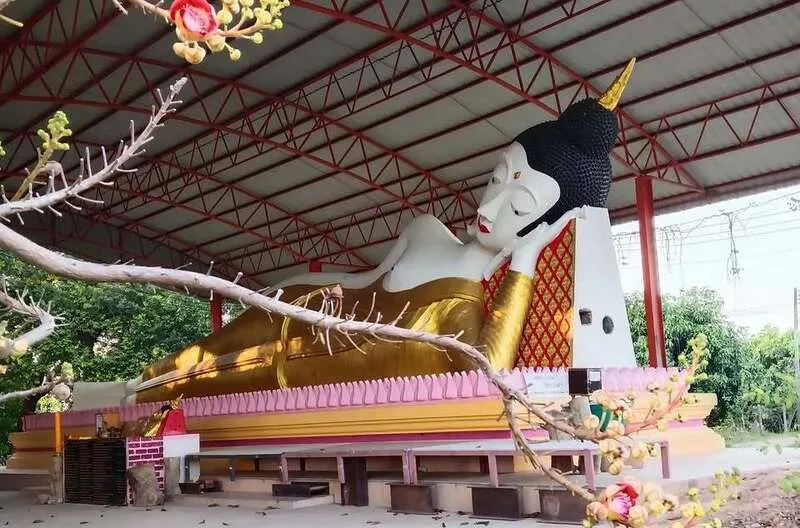
Wat Don Ban Klang, Nakhon Nayok Province, is an old site that has stood alongside the community since the earliest period of settlement in the subdistrict. It remains one of the places of faith that local people continue to value to this day. Although the original condition of the temple can no longer be seen in complete form, the meaning of this place has not faded with time. On the contrary, the community has preserved the area as a spiritual center and has built a pavilion over it to protect the original site from disappearing from collective memory.
The importance of Wat Don Ban Klang does not lie in the grandeur of its architecture, but in the continuity of the relationship between the place and the people. This site is like evidence of the community’s early settlement, showing that as soon as people began to establish homes, fields, and livelihoods, a sacred place for spiritual support emerged alongside them. In the case of Don Ban Klang, this place has served that role for well over 100 years and continues to do so even though its outward appearance has changed significantly.
The word “don” reflects a geographical feature of slightly elevated ground or a rise above the surrounding area, which was often suitable for settlement in the past because it helped avoid flooding and supported habitation. Combined with the words “ban klang,” meaning the center of the village or a shared central area for local people, the name “Wat Don Ban Klang” clearly conveys the meaning of a sacred place on elevated land in the middle of the community, serving as a focal point for local people from the very beginning.
In terms of local history, Wat Don Ban Klang holds great value as a shared memory space for the community. Even though the original form of the temple is no longer clearly visible, local people still recognize this place as an important point in the subdistrict, a place where their ancestors once performed rituals, made merit, and gathered for different occasions. The fact that the community continues to remember and preserve this area shows that the “value of a temple” does not depend on buildings alone, but also on the meaning people assign to it.
As the original condition of the temple gradually faded over time, whether because of environmental change, the deterioration of structures, or shifts in community life, what local people chose to do was not to let the place disappear. Instead, they built a pavilion to cover and preserve the original site. This act carries deep significance because it expresses respect for the past and represents the way the community protects a place of emotional importance, even if the original form cannot be fully restored.
The pavilion built over the original temple site is therefore not simply a new structure, but a symbol of the effort to preserve the roots of the community so that later generations can still see how important this place once was. In many Thai communities, preserving an old site even when the original form no longer survives is one form of conservation centered on “shared memory,” and Wat Don Ban Klang is a clear example of this kind of preservation.
What keeps Wat Don Ban Klang truly alive in cultural terms is its role in the “Bun Bang Fai tradition in the middle of the sixth lunar month,” which is still held every year with continued participation from the community. Bun Bang Fai, or the Rocket Festival, is a tradition deeply rooted in the agricultural way of life of Thai and Lao societies, especially in areas that depend heavily on rainfall for cultivation. The launching of rockets is therefore both a rain-invoking ritual and an expression of the community’s hope for the coming planting season.
In the context of Don Ban Klang, the Bun Bang Fai tradition is not merely an annual festivity, but an activity that reinforces the role of this place as the center of the subdistrict. Even though the original temple is gone, when the middle of the sixth lunar month arrives, people still return to this site to perform rituals, make merit, and take part in community activities. This is important evidence showing that cultural places do not die with the loss of buildings, but can continue to exist through use and the continuation of tradition.
The beliefs surrounding Bun Bang Fai are closely tied to asking for rain and showing respect to the forces of nature. In traditional agricultural societies, rain was directly linked to survival. Organizing a Bun Bang Fai festival was therefore not simply a matter of entertainment, but a ritual reflecting the relationship between people and the seasons, between the community and the land, and between belief and real-life livelihood. As long as this tradition continues to be held at Wat Don Ban Klang every year, the meaning of the place becomes even more strongly affirmed.
The atmosphere of the Bun Bang Fai festival in the middle of the sixth lunar month is generally lively and vibrant. Villagers gather to make merit, meet one another, and work together to organize the community event. A place that on ordinary days may seem calm, simple, or even quiet becomes filled with life again during such an important tradition. Conversations, folk music, shared preparations, and a spirit of unity all make Wat Don Ban Klang remain the heart of the community in a very tangible way.
From the perspective of cultural tourism, Wat Don Ban Klang is highly interesting because it helps visitors understand that the “value of a place” does not come only from the physical completeness of its buildings, but from the continuity of memory, tradition, and community participation. People who come here are not merely visiting an old temple in the sense of a large historical monument, but are experiencing a place that still lives through ritual and the shared use of space by local people.
Wat Don Ban Klang is also suitable for those interested in studying changes in Thai communities, because it reflects the image of a sacred place that has adapted over time. From an original temple that once had a clearly visible form, it has become a place where the community has built a pavilion to preserve the core of its memory. Even though the form has changed, its social and cultural functions continue. A place like this shows that conservation does not always mean preserving every original feature, but may instead mean preserving the meaning of a place through its continued use.
Viewed from the perspective of the community, Wat Don Ban Klang is a place that connects the older generation with the younger generation. Older people remember it as a place that has existed since the earliest settlement of the area, while younger people inherit that memory through annual merit-making events and rituals. The Bun Bang Fai tradition as the central focus of communal gathering helps ensure that this place is not cut off from the present, and allows the story of Don Ban Klang to continue in a living form rather than remaining only as a fading oral account.
For visitors, what matters most is to respect the context of the place. Wat Don Ban Klang is not a fully commercial tourist attraction, but a place of deep meaning for the local community. Visitors should therefore dress modestly, behave respectfully, and if arriving during the festival period, should respect local customs and avoid disturbing community activities or ritual spaces.
Getting There Wat Don Ban Klang is best reached by private car. Travel to Pak Phli District, Nakhon Nayok Province, and then continue to Khok Kruat Subdistrict, where the Ban Klang Don Bot community is located. This area is suitable for planning as a short half-day or full-day trip, and the route can also be linked with natural attractions and other community temples in Nakhon Nayok. A visit to Wat Don Ban Klang can therefore combine paying respect, learning about local culture, and understanding the roots of the community in one trip.
Overall, Wat Don Ban Klang may not stand out for physical grandeur, but it is a place of deep cultural value because it reflects the history of community settlement, the transformation of place over time, and the strength of the local people in preserving original meaning through the pavilion and the annual Bun Bang Fai festival in the middle of the sixth lunar month. Those who open themselves to the story of the place will discover that this is one of the important examples of local culture in Nakhon Nayok that is still very much alive in the life of the community.
| Place Summary | An old temple site of the Ban Klang Don Bot community in Pak Phli District, Nakhon Nayok Province. It has stood alongside the subdistrict since the beginning of settlement. Although the original condition no longer remains, the community has built a pavilion over the area and continues to use it as the center of important local merit-making events. |
| Highlights | An old temple site more than 100 years old, a pavilion built by the community to preserve the original area, the annual Bun Bang Fai festival in the middle of the sixth lunar month, and a clear reflection of the cultural roots of the community |
| History / Period | An old place of the subdistrict dating back to the earliest settlement of the community, more than 100 years old. The original temple condition no longer remains, and the community has built a pavilion over the site in its place. |
| Address | Ban Klang Don Bot Community, Moo 5, Khok Kruat Subdistrict, Pak Phli District, Nakhon Nayok Province 26130 |
| Getting There | Best reached by private car. Travel into Pak Phli District and continue to Khok Kruat Subdistrict and the Ban Klang Don Bot community. It can be combined with nearby natural attractions and community temples. |
| Open Days / Opening Hours | Please contact in advance before visiting or joining community activities |
| Facilities | Pavilion covering the original temple site, community ritual area, and an activity ground for annual merit-making events |
| Zones | Pavilion over the former temple site, merit-making gathering area, and Bun Bang Fai festival activity space |
| Nearby Tourist Attractions | 1. Wat Nong Song Hong, about 8 km 2. Suan Ngam Sanit, about 9 km, Tel. 086-769-9084 3. Huai Prue Reservoir, about 23 km 4. Khun Dan Prakan Chon Dam, about 31 km 5. Nang Rong Waterfall, about 33 km |
| Nearby Restaurants | 1. Je Kai Restaurant, Ban Nong Hua Suea, about 4 km, Tel. 098-180-5007 2. Daeng Kaeng Pa Nakhon Nayok, about 30 km, Tel. 089-073-4516 3. Krua Manao, about 34 km, Tel. 037-328327, 037-328313 4. Krua Manao, about 34 km, Tel. 03-732-8446 5. Srisunee Restaurant, about 27 km, Tel. 037-311529 |
| Nearby Accommodations | 1. Baan Suan Khun Yai Resort, about 28 km, Tel. 098-347-6289 2. Phumontra Resort Nakhon Nayok, about 33 km, Tel. 037-349-258, 093-616-3561 3. Chotip Resort Pak Phli, about 25 km 4. Baan Suan Khun Yai Banna Nakhon Nayok, about 31 km, Tel. 096-952-5225, 086-332-7068, 097-963-5291 5. Wangyao Riverside Resort, about 34 km, Tel. 085-655-5665 |
Frequently Asked Questions (FAQ)
Q: Where is Wat Don Ban Klang located?
A: Wat Don Ban Klang is located in the Ban Klang Don Bot community, Moo 5, Khok Kruat Subdistrict, Pak Phli District, Nakhon Nayok Province. It is an old sacred site of the community that has stood alongside the subdistrict for a long time.
Q: What is interesting about Wat Don Ban Klang?
A: Its highlight is that it is an old temple site more than 100 years old. Although the original condition no longer remains, the community has built a pavilion to preserve the site and continues to use it as the center of the annual Bun Bang Fai festival in the middle of the sixth lunar month.
Q: Why is Wat Don Ban Klang important to the community?
A: Because it has stood alongside the settlement of the people in the subdistrict since the beginning and remains a unifying place for the community in terms of religion, shared memory, and annual tradition.
Q: When is the Bun Bang Fai festival at Wat Don Ban Klang held?
A: The community continues to hold the Bun Bang Fai festival in the middle of the sixth lunar month every year. It is regarded as an important tradition connected with beliefs about asking for rain and seeking abundance for the planting season.
Q: What kind of visit is Wat Don Ban Klang suitable for?
A: It is suitable for those interested in local culture, community history, old temple sites, and folk traditions, because it offers a deeper view of the relationship between the community and sacred space.
Q: Is it convenient to travel to Wat Don Ban Klang?
A: The most convenient way is by private car, heading into Pak Phli District, Nakhon Nayok Province, and then continuing to Khok Kruat Subdistrict and the Ban Klang Don Bot community.
 Wat Don Ban Klang Map
 Category:
  Group:
  Last Update: 2 DayAgo
 Nearby Attractions
 Region
 Muang Nakhon Nayok(