
 Home
Home North(
 Chiang Mai(


Rating: 3.3/5 (7 votes)
 |
|  Map
Map 
 Have Map
  No Map
Nakhon Nayok attractions
Attractions in Thailand
Open Days: Daily
Opening Hours: 08.00 – 17.00 hrs.
Phumirak Thammachat Center in Nakhon Nayok is a royal initiative learning center that turns the concepts of water, soil, forest, energy, and sufficiency-based living into something visitors can clearly see and understand through a real landscape. It is suitable for travelers interested in educational tourism, families who want to bring children to learn outside the classroom, and anyone interested in the King’s development philosophy who wants to see practical applications at the community level.
Phumirak Thammachat Center is located in Ban Tha Dan, Hin Tang Subdistrict, Mueang Nakhon Nayok District, near Khun Dan Prakarn Chon Dam. It is a learning site that clearly connects nature, development, and royal initiatives in one place. This area does not serve merely as a tourist attraction, but as a demonstration ground where visitors can understand that meaningful development does not always begin with complexity. When it begins with a true understanding of soil, water, forests, and the way local people live, development can become both stable and sustainable.
What makes Phumirak Thammachat Center different from ordinary tourist attractions is that it transforms the idea of the “Royal Philosophy” from something found only in books or stories into something tangible through exhibitions, learning buildings, and outdoor demonstration plots that visitors can walk through, study, and connect directly to everyday life. While walking around the site, visitors can see that every section has been arranged to explain the wise use of resources, from water systems and soil conservation to the selection of suitable plants and the appropriate use of energy within a community context.
The background of this center is highly significant because the land belongs to the Chaipattana Foundation, which acquired the site covering 14 rai, 2 ngan, and 18 square wah. Later, the Vajiravudh College Old Boys’ Association under Royal Patronage requested permission to use the land to establish a center that would gather and present development ideas based on royal initiatives in a way that the public could easily access. Later, Her Royal Highness Princess Maha Chakri Sirindhorn graciously bestowed the name “Phumirak Thammachat Center,” and the center was officially opened in 2008. It stands as one of the important places in Nakhon Nayok that reflects the role of royal development projects in public education.
In terms of content, Phumirak Thammachat Center does not communicate only about agriculture or the environment in isolation. Instead, it tries to show visitors the systematic relationship among all elements. Water relates to forests, forests relate to soil, soil relates to cultivation, and all of these connect back to people’s quality of life. This concept gives the visit a sense of continuous learning. Visitors do not receive fragmented information, but gradually see the larger picture that sustainable development requires a deep understanding of nature and decisions that truly fit the local landscape.
Within the center, there are exhibition buildings, a tourist reception building, a meeting hall, shops, an outdoor exhibition area, and various demonstration plots. Each section serves a distinct role. The exhibition building lays the foundation for understanding royal duties and development concepts, while the outdoor areas expand those ideas into concrete examples, such as using plants for soil conservation, managing water in agricultural land, designing learning systems in line with the landscape, and selecting technology that is appropriate, not excessive, yet still effective.
One of the center’s most important themes is its demonstration of water management, a crucial issue for Thailand for a long time, especially in areas that must cope with both flooding during the rainy season and water shortages during the dry season. The concept of the “Monkey Cheek” theory presented here helps visitors understand that storing excess water is not only about large-scale infrastructure, but also about designing land to receive and drain water systematically. This concept is particularly valuable in the Thai context because it shows that solving water problems requires thinking about both the large-scale and small-scale picture at the same time.
Another outstanding element is the demonstration of vetiver grass, a plant that plays a major role in soil and water conservation. For many people, vetiver may seem like an ordinary plant, but when seen and explained in the real setting, it becomes clear that its root system helps hold the soil, reduce erosion, retain moisture, and restore land quality effectively. The vetiver plots at the center are therefore not just decorative features, but an important lesson showing that restoring nature can sometimes begin with small things that are truly suitable for the land itself.
In the section on New Theory Agriculture, Phumirak Thammachat Center helps visitors see what balanced land allocation really means. The idea of dividing land for water storage, cultivation, residential use, and other necessary functions may appear simple, but it is powerful because it reduces livelihood risks and creates household stability. This concept is not useful only for farmers. It also offers urban visitors a clearer understanding of what “sufficiency” means in practice: not deprivation, but a rational way of organizing life so that it can adapt to change.
Beyond knowledge about water, soil, and agriculture, the center also includes demonstration areas related to energy and the environment, broadening visitors’ understanding even further. It shows that good development must include the efficient use of resources, whether through solar energy, wastewater management, or technology suited to community life. This makes Phumirak Thammachat Center especially interesting for school groups, university students, and people working in development fields because it demonstrates that environmental problems and quality of life can be addressed through knowledge, design, and balance.
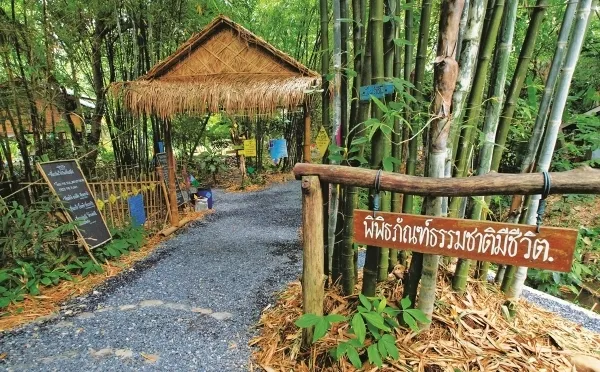
The atmosphere of the center has a distinctive charm unlike that of typical natural attractions. Although it is surrounded by greenery and offers the calm feeling of an area near a dam, the site does more than simply invite visitors to relax their eyes. It encourages them to walk slowly, read, reflect, and gradually absorb what is in front of them. Many parts feel like an open-air classroom that is not overly formal, combining shade, simplicity, and a natural environment that helps visitors feel relaxed while remaining open to learning.
Another charm of visiting Phumirak Thammachat Center is the way it tells its story, beginning with royal duties and gradually connecting them to the daily lives of Thai people. As visitors move through the site, many concepts they may have heard about before through the media, such as the Monkey Cheek theory, vetiver grass, or the sufficiency economy, become far more meaningful when seen in a real landscape. As a result, visitors do not simply “travel”; they leave with a new understanding of how to live with nature respectfully and wisely.
For travelers planning a trip to Nakhon Nayok, Phumirak Thammachat Center is an excellent destination to combine with visits to Khun Dan Prakarn Chon Dam, Nang Rong Waterfall, or nearby attractions. It lies within the same zone, making travel connections convenient, and it adds a deeper dimension to a trip that might otherwise focus only on natural scenery. This makes it especially suitable for families who want children to experience learning beyond textbooks, or for student groups who want to understand royal development projects through a real site.
For those interested in the history of development thinking, this center is important as a place that communicates a national development approach rooted in local geography and society. Rather than pushing growth that is disconnected from nature, it emphasizes balance between people and resources. The center’s present-day importance has therefore not diminished over time. On the contrary, as the world faces growing environmental problems, climate instability, and economic uncertainty, the ideas presented here have become even more relevant as contemporary lessons that still work in practice.
Visitors should allow a reasonable amount of time to explore because the details of the site are not limited to the buildings, but are spread throughout the demonstration plots and learning points. A rushed visit may reveal only the general picture, but with time and a slower pace, visitors will find far more detail than expected, whether in the landscape design, route planning, or the content hidden in each section. Comfortable walking shoes, a hat, or sun protection are therefore worth preparing, especially for those who plan to explore the outdoor areas thoroughly.
Getting There by private car is the most convenient option. Visitors can head toward Nakhon Nayok and continue into the Khun Dan Prakarn Chon Dam area, then enter Ban Tha Dan following the center’s coordinates. For those planning to visit several places in one day, combining the route with Khun Dan Prakarn Chon Dam, Nang Rong Waterfall, or Kaeng Sam Chan will make the trip more efficient without too much backtracking. If not traveling by private car, visitors should first check public transport to Nakhon Nayok town, then continue by local transport or hired service into the Ban Tha Dan area. It is advisable to call the center in advance to confirm visiting arrangements.
Overall, Phumirak Thammachat Center is a destination for those who want to see the “meaning of development” through a real landscape rather than through short written explanations alone. It is a place that offers peace, knowledge, and inspiration at the same time. For anyone looking for a place to visit in Nakhon Nayok that offers more than taking photos or playing in the water, this is a destination worth including seriously in the itinerary. After leaving the center, what remains may not only be the memory of a green and peaceful landscape, but also a new perspective on how to live with resources in a balanced and sustainable way.
| Summary | A royal initiative learning center on natural resource management, agriculture, the environment, and sufficiency-based living near Khun Dan Prakarn Chon Dam in Nakhon Nayok |
| Highlights | Exhibition buildings and real demonstration plots on the Monkey Cheek theory, vetiver grass, New Theory Agriculture, energy, and environmental management presented in an easy-to-understand way |
| History / Period | The Chaipattana Foundation acquired the land on 21 December 1989; the name “Phumirak Thammachat Center” was bestowed on 14 December 2002; the center was officially opened on 3 June 2008 |
| Address | 98/1 Moo 2, Ban Tha Dan, Hin Tang Subdistrict, Mueang Nakhon Nayok District, Nakhon Nayok 26000 |
| Coordinates | 14.30317, 101.314335 |
| Getting There | Most convenient by private car via the Nakhon Nayok route into the Khun Dan Prakarn Chon Dam zone, then into Ban Tha Dan following the center’s coordinates. If using public transport, continue from Nakhon Nayok town and contact the center in advance. |
| Open Days | Daily |
| Opening Hours | 08.00 – 17.00 hrs. |
| Facilities | Exhibition building, tourist reception building, meeting hall, shop, outdoor exhibition area, and walking areas around the demonstration plots |
| Zones | Indoor exhibition zone, environmental demonstration plots, vetiver zone, New Theory Agriculture zone, Monkey Cheek zone, energy zone, and outdoor learning areas |
| Nearby Attractions with Distance | 1. Suan Lung Lek — approximately 700 m. 2. Nakhon Nayok River Rafting — approximately 1.1 km. 3. Kaeng Sao Noi Waterfall — approximately 1.1 km. 4. Suan Khun Lek Nakhon Nayok — approximately 1.5 km. 5. Kaeng Sam Chan — approximately 2.1 km. 6. R ATV — approximately 2.2 km. 7. Nang Rong Waterfall — approximately 2.8 km. |
| Nearby Restaurants with Distance and Phone Numbers | 1. Khrua Rim Than Nakhon Nayok — approximately 1.8 km. — Tel. 080-443-1545 2. Khrua Lung Kang — approximately 2.2 km. — Tel. 098-164-2362, 097-240-2426 3. Chor Chamuang Nakhon Nayok — approximately 2.5 km. — Tel. 092-864-9292, 037-385-222 4. Khrua Sarika, Nakhon Nayok — approximately 2.6 km. — Tel. 062-501-2606 5. Cafe Laura Bar & Restaurant, Sarika Branch 3 — approximately 2.7 km. — Tel. 061-902-0918 |
| Nearby Accommodations with Distance and Phone Numbers | 1. Ingthan Resort Nakhon Nayok — approximately 1.5 km. — Tel. 087-139-9937 2. Makham Forest Resort — approximately 1.8 km. — Tel. 086-555-7507, 095-164-1921 3. Rimthan Resort — approximately 1.8 km. — Tel. 092-772-8888, 092-772-9999, 063-958-8380 4. Phusakthan Resort Nakhon Nayok — approximately 2.3 km. — Tel. 089-245-8661 5. Phumantra Resort — approximately 2.4 km. — Tel. 093-616-3561, 037-349-258 |
| Main Contact Number | Project Administration Office, Chaipattana Foundation Office. Tel. 02-282-4425-8 ext. 120-122, 081-970-3779 |
Frequently Asked Questions (FAQ)
Q: Where is Phumirak Thammachat Center located?
A: Phumirak Thammachat Center is located at 98/1 Moo 2, Ban Tha Dan, Hin Tang Subdistrict, Mueang Nakhon Nayok District, Nakhon Nayok, near Khun Dan Prakarn Chon Dam.
Q: What is interesting about Phumirak Thammachat Center?
A: Its main highlights are the exhibition buildings and real demonstration plots related to the Royal Philosophy, such as the Monkey Cheek theory, vetiver grass, New Theory Agriculture, energy, and environmental management.
Q: Who is Phumirak Thammachat Center suitable for?
A: It is suitable for travelers interested in educational tourism, families who want to bring children for learning outside the classroom, students, and people interested in royal development projects.
Q: How much time should visitors allow for Phumirak Thammachat Center?
A: Visitors should allow at least 1–2 hours to explore both the exhibitions and the outdoor demonstration areas without rushing.
Q: What is the most convenient way to get to Phumirak Thammachat Center?
A: The most convenient way is by private car, using the route into Nakhon Nayok and continuing toward the Khun Dan Prakarn Chon Dam area, then entering Ban Tha Dan according to the center’s coordinates.
Q: What places can visitors continue to after Phumirak Thammachat Center?
A: Visitors can continue their trip to Suan Lung Lek, Kaeng Sam Chan, Nang Rong Waterfall, or Nakhon Nayok River rafting, as these places are all in the same nearby area.
 Tel: 037384049
 Mobile: 0917073073
 Fax: 037384049
 Bhumirak Dhamachart Centre Map
 Category:
  Group:
  Last Update: 2 DayAgo
 Nearby Attractions
 Region
 Muang Nakhon Nayok(