
 Home
Home North(
 Chiang Mai(


Rating: 3.4/5 (8 votes)
 |
|  Map
Map 
 Have Map
  No Map
Nakhon Nayok attractions
Attractions in Thailand
Open Days: Every day
Opening Hours: 08.00 - 17.00
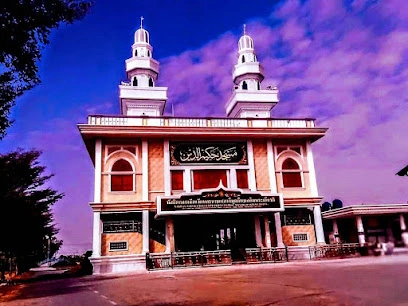
The Central Mosque of Nakhon Nayok Province is located in Chumphon Subdistrict, Ongkharak District, Nakhon Nayok Province, and has long served as an important center of the Muslim community at the provincial level. This mosque was originally registered as an Islamic mosque under the law on 2 March 1949, before later developing from a traditional wooden building into a more permanent concrete structure. Its importance therefore lies not only as a place of worship, but also as a center for gathering, religious administration, and the relationships of Muslims throughout Nakhon Nayok Province.
The Central Mosque of Nakhon Nayok Province stands out from ordinary mosques because of its status as a “central mosque,” meaning that it serves as a central place for the Muslim community at the provincial level. Its role is not limited only to nearby local communities, but also extends to serving as a connecting point among various mosques and as a central venue for important activities of the Provincial Islamic Committee of Nakhon Nayok.
The mosque is situated in Village No. 1, Chumphon Subdistrict, Ongkharak District, an area with a long-established Muslim community. Ongkharak is an important district in terms of agricultural communities, canal networks, and transportation links between Bangkok and Nakhon Nayok Province. The presence of the central mosque in this area reflects the fact that Islam has long been part of the social and cultural landscape of Nakhon Nayok, rather than being only a small element separated from the surrounding community.
From a historical perspective, the origin of the Central Mosque of Nakhon Nayok Province is highly significant. Its registration on 2 March 1949 is clear evidence that the Muslim community in the area was already strong and had formally established a religious institution at that time. Legal recognition did not only provide administrative clarity for the mosque, but also marked the starting point of its later development into a provincial-level institution.
In its earliest period, the mosque building was made of wood, a form commonly found in many older mosques in Thailand, especially in rural areas or communities that still relied on local building materials. Such wooden structures reflected simplicity and the close relationship between religious places and the everyday life of people in earlier times. However, as time passed, the original wooden building gradually deteriorated and was no longer suitable for continued use.
As the wooden structure began to deteriorate, the mosque committee together with the congregation initiated the idea of constructing a new building to replace it. This decision reflected not only the physical necessity of a better building, but also the determination of the community to preserve its center of faith in a stable and suitable form for long-term use. The cooperation between the mosque committee and the congregation thus became the key force driving the transition from the old wooden mosque to a stronger concrete structure.
The foundation stone for the concrete mosque building was laid on 6 January 1960, which is regarded as another important date in the history of the Central Mosque of Nakhon Nayok Province. This event was not only the starting point of the new building project, but also a symbol of the beginning of a new era for the Muslim community in the area, because the new mosque carried the meaning of stability, readiness, and a broader role than ever before.
The newly constructed concrete building was completed and became usable as a place for religious activities. The transition from a wooden building to a concrete one was therefore not merely a change of construction material, but a transformation of the mosque from a temporary or semi-permanent structure into a durable religious site that could accommodate more users and was better suited to serving as a provincial center.
The importance of the Central Mosque of Nakhon Nayok Province became even more pronounced when the mosque committee resolved to hand the mosque over to the Provincial Islamic Committee of Nakhon Nayok for use as the central place of all Muslims in the province. This decision clearly expanded the mosque’s role from being a mosque for the local community into an institutional center for Muslims across the entire province of Nakhon Nayok.
Serving as the central place for Muslims of the entire province carries great significance, because the mosque does not accommodate only daily religious activities, but also functions as a venue for coordination, meetings, and decision-making on important issues concerning the Muslim community at the provincial level. It may therefore be said that the Central Mosque of Nakhon Nayok Province fulfills religious, social, and administrative roles all in one place.
In the religious dimension, the mosque continues to function as an active place of worship, including prayers, gatherings on important religious occasions, and activities connected with the life of Muslims in the area. This continuity of real use keeps the mosque alive. It is not merely a historical building or a place whose role exists only in the past, but remains part of the daily life of the community today.
In the community dimension, the central mosque of Nakhon Nayok is also a place of human relationships, where people meet, consult one another, and work together to drive public activities of the Muslim community. In this sense, the meaning of the mosque is much deeper than simply being a “place for prayer,” because it also serves as a center of social life, a center of communal identity, and a center of shared belonging for Muslims in Nakhon Nayok Province.
Architecturally, the Central Mosque of Nakhon Nayok Province reflects a building style that emphasizes stability and practical use more than elaborate decoration. The key feature of this type of structure is its ability to accommodate large numbers of people and its suitability for continuous religious use. The simplicity of the building is therefore not a weakness, but rather a characteristic fully consistent with its role as both a religious center and a community center.
When visitors arrive at the Central Mosque of Nakhon Nayok Province, what they usually feel is not the bustle of a commercial tourist attraction, but an atmosphere of peace, simplicity, and genuine religious use. This kind of atmosphere makes the place suitable for those interested in cultural and religious tourism, because a visit here is not only about looking at a building, but about seeing a way of life and the living relationships of a community that still continues today.
For those interested in religious diversity in Thailand, the Central Mosque of Nakhon Nayok Province is a clear example that, in a province many people know for its natural attractions, waterfalls, and green landscapes, there is another equally fascinating dimension: the Muslim community and Islamic religious institutions that have real roots, real history, and a real role in the lives of people in the area.
Visiting a mosque requires understanding proper etiquette and respect for the place. Visitors should dress modestly, behave with restraint, and avoid disturbing religious activities. If they wish to take photographs or enter the interior, they should choose an appropriate time and follow the guidelines of the place, because a mosque is a living religious site, not a place arranged solely for tourism.
Another aspect that makes the Central Mosque of Nakhon Nayok Province especially interesting is that it stands as evidence of social change within the local Muslim community. From a wooden mosque in its early years, it developed into a stronger concrete building, and from being a community-level mosque, it advanced into becoming the central place of Muslims across the province. Stories like this give the mosque meaning as a window into community history, rather than merely as a single structure.
Those interested in studying Islamic institutions at the provincial level will find the central mosque of Nakhon Nayok especially significant, because it reflects the formal organization of the Muslim community in a tangible way. It has a physical place, a committee, an administrative role, and a function in connecting Muslim networks across the area. This is why the mosque carries greater significance than an ordinary community mosque.
In experiential terms, the Central Mosque of Nakhon Nayok Province is well suited to those who appreciate places with meaning beyond surface beauty. Its charm does not lie in flashy decoration, but in its historical value, the stability of faith, and the role it has continuously accumulated up to the present day. Those who enjoy understanding places through the stories of people and communities will feel that this mosque carries genuine historical and social weight.
If asked who the Central Mosque of Nakhon Nayok Province is suitable for, the answer would be those interested in Islam, those interested in community history, those who want to learn about the cultural diversity of Nakhon Nayok, and travelers who want to add another dimension to an Ongkharak trip beyond the usual nature-based route. A visit here helps reveal Nakhon Nayok in a broader and deeper perspective.
Getting There The most convenient way to reach the Central Mosque of Nakhon Nayok Province is by private car, using the Rangsit–Nakhon Nayok route into Ongkharak District and then heading to Chumphon Subdistrict in Village No. 1. Travelers coming from Bangkok can easily plan this as a day trip. Those without a private car may first take public transportation to the Ongkharak area and then continue by local transport to the destination. This is possible, but less convenient than driving, especially if planning to visit several places in the same area.
Overall, the Central Mosque of Nakhon Nayok Province is a religious site of great value on many levels at once, as a center of worship, a center of community life, and a center of Islamic administration at the provincial level. From its registration in 1949, to the laying of the foundation stone for the concrete building on 6 January 1960, and its development into the central place of Muslims throughout the province, this mosque clearly shows that a truly meaningful religious site is not important because of the building alone, but because of the faith, history, and shared meaning that people have built together over a long period of time.
| Place Summary | The central mosque of Nakhon Nayok Province, serving as a center of religious activities and as the central place for Muslims throughout the province. |
| Highlights | It holds the status of a provincial central mosque, has a history dating back to 1949, and serves as the center of the Provincial Islamic Committee of Nakhon Nayok. |
| History / Period | Registered as a mosque under the law on 2 March 1949. The original building was made of wood, but after it deteriorated, a concrete building was constructed to replace it, with the foundation stone laid on 6 January 1960. It later became a place for religious activities and the central place for Muslims throughout the province. |
| Address | Village No. 1, Chumphon Subdistrict, Ongkharak District, Nakhon Nayok Province 26120 |
| Getting There | Convenient by private car via the Rangsit–Nakhon Nayok route into Ongkharak District, then onward to Chumphon Subdistrict, Village No. 1. If using public transport, it is best to get off in the Ongkharak area first and then continue by local transport. |
| Open Days / Opening Hours | Every day / 08.00 - 17.00 |
| Facilities | Prayer area, religious activity area, and space for central activities of the Muslim community |
| Nearby Attractions | 1. St. Theresa International University, about 4 km. 2. Farm de Lek, Khlong 15, about 8 km. 3. Uthayan Mai Yai, Khlong 14, about 10 km. 4. Khlong 15 Plant Market, about 11 km. 5. Suan Sawan Ban Thung, Khlong 15, about 12 km. |
| Popular Restaurants Nearby | 1. Montreux Cafe and Farm, about 9 km. Tel. 087-979-7341 2. Phuan Farm Cafe and Restaurant, about 9 km. Tel. 094-964-1461, 064-569-4636 3. Sebiang Ban Mae Cafe & Restaurant, about 10 km. Tel. 063-969-7993 4. Krua Rim Khlong 15, about 12 km. Tel. 093-949-2602 5. RATI CHA, about 12 km. Tel. 091-860-2009 |
| Popular Accommodations Nearby | 1. Area 15 Apartment, about 5 km. Tel. 062-872-0373 2. Hong Phak Lang Mor, about 5 km. Tel. 090-549-3665, 098-302-9934 3. Ton Rak Resort, Khlong 15, about 10 km. Tel. 088-570-7938, 037-333-042-3 4. Piyaphan near SWU Ongkharak, about 6 km. 5. Poonphon Apartment, Khlong Yai, about 7 km. |
Frequently Asked Questions (FAQ)
Q: Where is the Central Mosque of Nakhon Nayok Province located?
A: The Central Mosque of Nakhon Nayok Province is located at Village No. 1, Chumphon Subdistrict, Ongkharak District, Nakhon Nayok Province.
Q: When was the Central Mosque of Nakhon Nayok Province officially registered?
A: The mosque was officially registered as an Islamic mosque under the law on 2 March 1949.
Q: When did the concrete building of the central mosque begin?
A: The foundation stone for the concrete building was laid on 6 January 1960, before construction was completed and the mosque became usable for religious activities.
Q: Why is this mosque important at the provincial level?
A: Because the mosque committee resolved to hand this place over to the Provincial Islamic Committee of Nakhon Nayok, so that it could be used as the central place for Muslims throughout the province.
Q: Is the Central Mosque of Nakhon Nayok Province still active today?
A: Yes, it is still active today and continues to serve as a center of religious activities and Muslim community affairs in Nakhon Nayok Province.
Q: How should visitors behave when entering a mosque?
A: Visitors should dress modestly, behave respectfully, honor the space, and avoid disturbing prayer times or religious activities. If taking photographs, they should choose an appropriate time.
 Nakhon Nayok Mosque Map
 Category:
  Group:
  Last Update: 19 HourAgo
Comment
 Nearby Attractions
| Keyword (Advance) |
 Facebook Fanpage
 Region
 Art, Culture and Heritage
 Historical Sites and Monuments(
 Landmarks and Memorials(
 Art, Craft Centres, Tradition(
 Museums(
 Educational Places
 Educational Gardens, Farm(
 University
 Temple(
 Church(
 Other religious and spiritural sites(
 Suburban Living
 Village, Community(
 Local Market(
 Nature and Wildlife
 Dam, Reservoir, Lake(
 Waterfalls(
 Other natural attractions(
 Entertainment and Agricultural
 Farm, Parks, Gardens and Ecotourism(
 Outdoor and Adventure Activities(