
 Home
Home North(
 Chiang Mai(


Rating: 3.8/5 (6 votes)
 |
|  Map
Map 
 Have Map
  No Map
Nakhon Nayok attractions
Attractions in Thailand
Open Days: Tuesday - Sunday
Opening Hours: 08.00 - 17.30
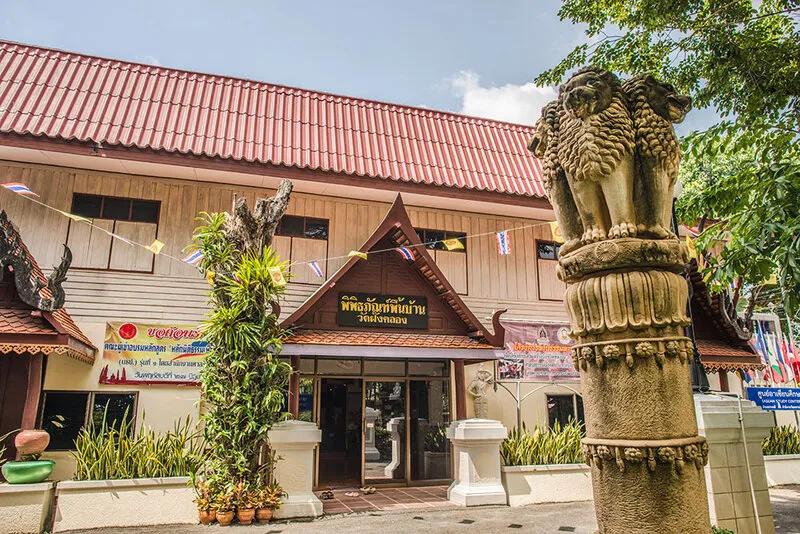
Thai Phuan Folk Museum at Wat Fang Khlong is an important cultural learning center in Pak Phli District, Nakhon Nayok Province. It serves as more than just a place to store old objects, because it is a space that preserves the memories, way of life, and identity of the Thai Phuan community in a form that can still be experienced today. Visitors do not simply see household items from the past, but also gain an understanding of the roots of local people through objects, stories, and the atmosphere of the temple, which still remains the center of the community up to the present.
This museum is located inside Wat Fang Khlong, along Highway 33 in Ko Wai Subdistrict, Pak Phli District, making it easier to access than many community museums in rural areas. One of its main strengths is that it remains closely connected to the original community context. In other words, visitors still see the temple, the people, the handicrafts, and the ongoing use of cultural space, which creates a feeling very different from that of a large institutional museum separated from real local life.
What makes the Thai Phuan Folk Museum at Wat Fang Khlong especially interesting is that it helps explain what “Thai Phuan” means through everyday objects. The Thai Phuan are an ethnic group with distinctive language, dress, food, traditions, and craft knowledge. When household items used by Thai Phuan people around 200 years ago are gathered in this museum, visitors can read the history of the community through objects in a concrete way, whether through domestic utensils, farming tools, or clothing that reflects the tastes and worldview of people in the past.
One of the most outstanding objects is the Thai Phuan sinh, which is an important symbol of Thai Phuan women’s identity. A sinh is not merely a garment, but a representation of knowledge about weaving, color selection, pattern arrangement, and the passing of skills from one generation to the next. Seeing an authentic Thai Phuan sinh in the context of a community museum helps visitors understand clearly that traditional clothing is valuable not only for its beauty, but also as a cultural language that deeply reflects the identity of a people.
In addition to the sinh, the museum also displays a stone mill, a traditional household object that vividly tells the rhythm of life in the past. The stone mill was used in food preparation, processing raw ingredients, and household labor. Seeing it in the museum is therefore not just about seeing a single object, but about understanding the way earlier generations lived, relying far more on physical labor, time, and skill in household work than people do in modern society.
The antique coffee boiler is another object that may seem like a small detail, yet it expands the picture of daily life in the past more than one might expect. Coffee-drinking culture and hospitality within the community were closely tied to public and domestic spaces. Displaying an antique coffee boiler therefore gives the museum a stronger sense of “lived life,” helping visitors feel that these objects were not merely old items, but once formed part of conversation, hospitality, and the atmosphere of homes in the Thai Phuan community.
The section on farming tools is especially important, because it confirms that the foundation of the Thai Phuan community here was deeply tied to agriculture. Farming tools are valuable not only as implements for making a living, but also as evidence of the local economic system, the relationship with the seasons, and the body of knowledge adapted to the landscape. Seeing the real tools in the museum makes it clear that farming in the past was not simply food production, but the central structure of life for both the household and the wider community.
Weaving tools are another highly distinctive category, because weaving in the Thai Phuan community was not simply a handicraft for making clothing, but a heritage of knowledge passed down through women in families and kinship networks. When the museum displays weaving tools alongside Thai Phuan sinh, visitors can see both the process and the finished result at the same time. In other words, they do not only see the woven cloth itself, but also understand how much process, skill, and patience were required to produce a single piece of fabric.
Another point that sets the Thai Phuan Folk Museum at Wat Fang Khlong apart from ordinary museums is that it does not display only the past, but is clearly connected with the present. Within the temple grounds there is also a local weaving group, which proves that Thai Phuan knowledge is still being preserved and actively practiced, rather than stopping at the preservation of old objects alone. This continuity makes a visit here more meaningful, because visitors can sense that Thai Phuan culture in Pak Phli is still alive and not merely a thing of the past.
Beyond weaving, the temple also has the making of pandan salted eggs, which is another excellent example of how local wisdom is adapted into contemporary community products. This means that a visit to Wat Fang Khlong is not only about seeing the museum, but also about experiencing both handicrafts and local food in the same setting. For cultural travelers, this is a highly valuable experience because it helps connect an understanding of the community’s past with its present in a very tangible way.
In terms of atmosphere, the Thai Phuan Folk Museum at Wat Fang Khlong feels calm, warm, and welcoming, more so than many museums in the city. Visitors can sense the atmosphere of a community temple that still functions as the real center of local life. The quietness of the site makes it ideal for a slow visit, taking time to read, observe, and understand, rather than rushing through. This quality is especially appealing to travelers who like places with strong stories and a clear sense of place.
In cultural terms, this museum plays a very important role in preserving the Thai Phuan identity of Pak Phli District, because it functions as a place that gathers objects, language, stories, and local wisdom in a form that younger generations can easily access. For students and teachers, it becomes a living classroom of history and culture, while for general visitors it offers an understanding of Nakhon Nayok in another dimension, deeper than the province’s better-known image of natural attractions and waterfalls.
The Thai Phuan Folk Museum at Wat Fang Khlong is suitable for many kinds of visitors. The first group is those directly interested in Thai Phuan culture. The second is travelers who enjoy community-based tourism and want to see real local ways of life. The third is families who want to bring children to learn about old household objects. The fourth is people traveling along Highway 33 who want to stop at a place that offers both knowledge and tranquility at the same time. This makes the site not merely a stopover, but a destination with substance and a very distinct character.
The visitor information confirmed at this stage is that the museum is open मंगलवार - Sunday from 08.00 - 17.30, and the main phone number for inquiries is 0 3739 9833. In addition, there are also community coordinators whose details have been verified, including Mr. Ratchakit Unruean at 08 6380 6461 and Phra Khru Wiriyanuyok at 08 1458 8200. This makes the site especially suitable for visitors who want to call ahead before traveling, particularly in the case of group visits or study-oriented trips.
As for Wat Fang Khlong itself, Phra Khru Wiriyanuyok serves as the ecclesiastical head of Pak Phli District and the abbot of Wat Fang Khlong. This is an important entity connected with the site, because it reflects that the temple continues to function in religious, community, and cultural roles. It is not merely the backdrop of the museum, but part of the structure that cares for and passes on the heritage of the Thai Phuan community.
Getting There Reaching the Thai Phuan Folk Museum at Wat Fang Khlong is convenient by private car, as the temple is located along Highway 33 in Pak Phli District. If starting from downtown Nakhon Nayok, you can follow the main road directly toward Pak Phli, then look for the entrance to Wat Fang Khlong beside the main road. Once you arrive, it is best to park within the temple grounds and ask the temple staff or caretakers for the museum entrance point, especially if this is your first visit.
Once there, visitors should dress politely, because the museum is located inside a temple and remains part of an active religious site. Speech and conduct should be appropriate. Do not touch the displayed objects without permission, and if you wish to visit as a large group or study the collection in greater depth, prior coordination is recommended. Showing respect for the place helps make the visit smoother and preserves the atmosphere of this community learning space appropriately.
Visitors who wish to continue their trip can connect this route to nearby temples and attractions in Pak Phli District and around Nakhon Nayok town, such as Wat Nong Pho, Wat Si Nawa, Wat Ban Bung, Wat Dong, and Wat Udom Thani Royal Monastery. This makes a visit to the Thai Phuan Folk Museum at Wat Fang Khlong easy to expand into a full-day cultural trip, especially for those who want to see another side of Nakhon Nayok filled with community stories and local heritage.
Looking at the overall picture, the Thai Phuan Folk Museum at Wat Fang Khlong is far more than a place storing old household items. It is truly a center of memory, identity, and wisdom for the Thai Phuan community in Pak Phli. Here, displayed objects, textiles, local food, the temple, and the community all come together in one place, allowing visitors to experience both the past and the present at the same time. For anyone seeking deep and meaningful cultural travel in Nakhon Nayok, this is one destination that deserves a stop.
| Summary | A Thai Phuan folk museum inside Wat Fang Khlong in Pak Phli District, Nakhon Nayok Province, displaying household items around 200 years old and connecting them with the cultural activities of the Thai Phuan community. |
| Highlights | Displays Thai Phuan sinh, stone mills, antique coffee boilers, farming tools, and weaving tools. The temple grounds also include a local weaving group and pandan salted egg production. |
| History / Period | Most displayed objects are around 200 years old and reflect past Thai Phuan ways of life. The site was later developed into the Chalermraj Cultural Center of Wat Fang Khlong. |
| Latest Caretaker / Abbot | Phra Khru Wiriyanuyok, Ecclesiastical Head of Pak Phli District and Abbot of Wat Fang Khlong |
| Address | Wat Fang Khlong, Moo 4, Ko Wai Subdistrict, Pak Phli District, Nakhon Nayok Province 26130 |
| Getting There | Located along Highway 33, it is easy to reach by private car from downtown Nakhon Nayok or via routes passing through Pak Phli District. |
| Open Days / Opening Hours | Open every day 08.00 - 17.30 / some sources recommend contacting in advance before visiting |
| Fees | No admission fee |
| Facilities | Temple grounds support visits, with a community context connected to weaving, local food, and cultural learning activities. |
| Zones | Thai Phuan Folk Museum zone, community learning area, local weaving group, pandan salted egg production activity |
| Nearby Tourist Attractions | 1. Wat Nong Pho — 5.33 km. 2. Wat Si Nawa — 5.93 km. 3. Wat Ban Bung — 6.23 km. 4. Wat Dong — 6.29 km. 5. Wat Udom Thani Royal Monastery — 6.59 km. |
| Main Contact Numbers | 0 3739 9833 / 08 6380 6461 / 08 1458 8200 |
Frequently Asked Questions (FAQ)
Q: What is interesting about the Thai Phuan Folk Museum at Wat Fang Khlong?
A: Its highlights are the display of Thai Phuan household items around 200 years old, such as Thai Phuan sinh, stone mills, antique coffee boilers, farming tools, and weaving tools, as well as a local weaving group and pandan salted egg production inside the temple grounds.
Q: Where is the museum located?
A: It is located inside Wat Fang Khlong, Moo 4, Ko Wai Subdistrict, Pak Phli District, Nakhon Nayok Province, along Highway 33.
Q: Is the museum still open?
A: Yes, it is still open to visitors. Verified information states its opening days as Tuesday - Sunday, and there are contact numbers available for advance inquiries.
Q: What is the best time to visit?
A: Verified information states that it is open from 08.00 - 17.30, and if you plan to visit as a group, you should call ahead for convenience.
Q: Who is this place suitable for?
A: It is suitable for cultural travelers, students, teachers, people interested in the Thai Phuan community, and those who want to explore a deeper side of Nakhon Nayok beyond natural attractions alone.
Q: Where should I continue after visiting here?
A: You can continue your trip to Wat Nong Pho, Wat Si Nawa, Wat Ban Bung, Wat Dong, and Wat Udom Thani Royal Monastery, all within about 5 - 7 km. from Wat Fang Khlong.
 Tel: 037399833
 Thai Phuan Folk Museum at Wat Fang Khlong Map
 Category:
  Group:
  Last Update: 2 DayAgo
Comment
 Nearby Attractions
| Keyword (Advance) |
 Facebook Fanpage
 Region
 Historical Sites and Monuments(
 Landmarks and Memorials(
 Art, Craft Centres, Tradition(
 Educational Places
 Educational Gardens, Farm(
 University
 Places of Worship
 Temple(
 Church(
 Mosque(
 Other religious and spiritural sites(
 Suburban Living
 Village, Community(
 Local Market(
 Nature and Wildlife
 Dam, Reservoir, Lake(
 Waterfalls(
 Other natural attractions(
 Entertainment and Agricultural
 Farm, Parks, Gardens and Ecotourism(
 Outdoor and Adventure Activities(