
 Home
Home North(
 Chiang Mai(


Rating: 5/5 (1 votes)
 |
|  Map
Map 
 Have Map
  No Map
Nakhon Nayok attractions
Attractions in Thailand
Open Days: The ritual is usually held after the harvest season until before Buddhist Lent and is generally not performed on Buddhist holy days.
Opening Hours: They depend on the ritual schedule of each family line and community.
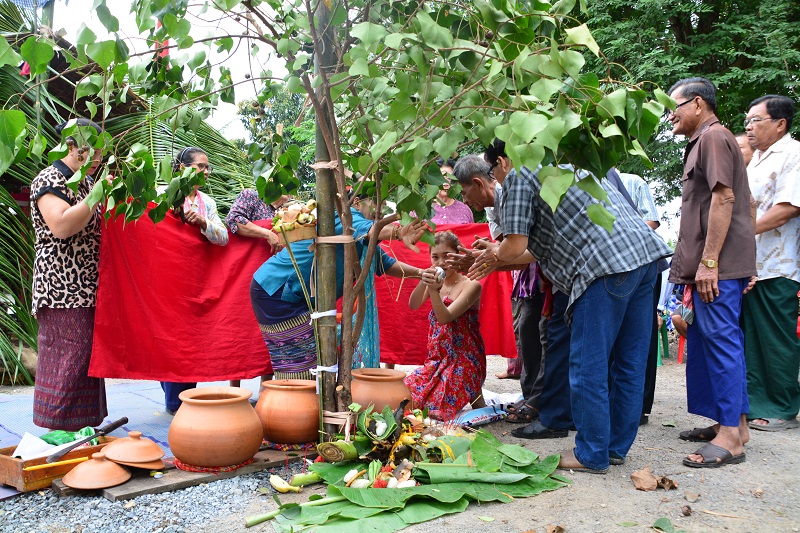
Ram Phi Rong Tradition, Nakhon Nayok Province is an important ritual tradition of the Mon community in Ban Na District. It reflects ancestral spirit beliefs alongside Buddhism, featuring spirit possession, ritual dance accompanied by music, and a variety of performance sets. It remains a cultural heritage practice that continues to strengthen bonds within the community today.
Ram Phi Rong Tradition, Nakhon Nayok Province is one of the most distinctive folk rituals of the Mon people in Ban Na District, Nakhon Nayok Province, especially among old Mon communities that have preserved ancestral spirit beliefs as an important part of their cultural life. Although time has led people to adapt more closely to the wider Central Thai social world, the Ram Phi Rong ritual still survives as a clear symbol of shared memory, faith, and the roots of the Mon community in Nakhon Nayok.
When people speak of Mon communities in Thailand, many usually think of the “new Mon” groups who migrated during the early Rattanakosin period and who were still able to preserve the Mon language, food, and dress to some degree. The Mon people of Nakhon Nayok, however, followed a different social and cultural path. Over a long period, they blended closely with Thai communities in the Central region, to the point that many details of everyday life are now difficult to separate as either distinctly Mon or local Thai. Even so, one element remains clearly visible and stands at the heart of their identity: belief in Mon ancestral spirits, known as “phi Mon.”
This belief does not exist only at the level of private faith. It is woven into kinship structures, life within neighborhood clusters, and the organization of important communal rituals. One of the clearest expressions of this is the “Ram Phi Rong” ritual, which combines spirit offerings, dance, possession, expressions of gratitude toward ancestors, and the gathering of relatives who return to meet one another once again.
The phrase “Ram Phi Rong” directly reflects the essential elements of the ritual. “Ram” means dancing, while “rong” refers to the ritual pavilion or ceremonial space prepared to receive ancestral spirits or lineage spirits who come to possess spirit mediums. For this reason, the ritual is not a performance staged for entertainment. It is a sacred ceremony in the eyes of the community and follows its own inherited structure and order.
In historical terms, the Mon people of Nakhon Nayok are connected to Mon ethnic groups that have long been distributed across Central Thailand. They lived alongside Thai communities in agricultural areas and gradually blended many customs together. While many outward aspects of daily life changed over time, the inner belief in ancestral spirits was preserved as something sacred within each lineage. This belief functions as a core marker confirming that the community still retains its own cultural roots, even though many outward forms have changed significantly.
One of the most compelling aspects of the Ram Phi Rong tradition is the close blending of spirit belief and Buddhism. Villagers do not see the two as contradictory. Instead, they coexist naturally in daily life. The ritual thus takes place in a society where people make merit, visit temples, and follow Buddhism, while at the same time believing that ancestral spirits protect descendants, watch over the peace of the neighborhood, and receive prayers or vows made by members of the community.
The purposes of the Ram Phi Rong ritual are several. First, it is performed to make offerings to the spirits believed to protect the neighborhood or the surrounding area. Second, it serves as an offering to ancestral spirits or lineage spirits, reflecting kinship ties and the importance of family continuity. Third, it may be held as a vow-fulfillment ceremony to repay the spirits after a wish has been granted, whether related to health, work, harvests, or general well-being in life.
For this reason, the Ram Phi Rong ritual is not limited to the dimension of religion or belief alone. It is also tied to social organization, the strengthening of unity within extended families, and the affirmation of each member’s place within the kinship network. When the ritual is held, family members who have moved elsewhere often return home, turning the ceremonial space into a meeting place that reconnects the past and the present.
The overall structure of the ritual usually begins with choosing the day of performance, which typically falls after the harvest season and before Buddhist Lent. This period is meaningful in agricultural and social terms because people have more time to organize the event and gather relatives. The avoidance of Buddhist holy days also shows that the community recognizes an appropriate boundary between folk ritual life and the rhythm of formal Buddhist observance.
Before the ritual day arrives, the venue, offerings, and ceremonial items are prepared in detail. A ritual pavilion or ceremonial shelter is arranged to receive the spirits and accommodate the dances. Inside, there is space for placing offerings, dance equipment, and the area for the spirit mediums. At the same time, relatives and community members help prepare savory dishes, sweets, liquor, fruit, and other ritual items. The atmosphere during preparation clearly reflects the collective cooperation of the community.
The heart of the ritual lies in the possession of spirit mediums by the spirits. At that moment, the medium uses a cloth, often a checkered scarf or another prepared cloth, as a medium through which the spirit enters the body. Once the spirit has arrived, the medium begins to move, changes posture and mannerisms, and dances to the continuously played music. The movements, expressions, and speech of the medium during this stage are regarded as important signs that the spirit has truly descended.
During the dance, the spirit medium mainly drinks liquor and may consume a small amount of the offerings in accordance with ritual belief, while also speaking with descendants and others in the community. At times there may be questioning, comforting words, warnings, or advice directed to family members through the medium. This makes the ritual more than an act of worship; it also becomes a symbolic channel of communication between descendants and their ancestors.
Possession may occur one spirit at a time or with several spirits at once, depending on the context of the ritual and the beliefs of each family. Once possessed, the medium continues dancing to the rhythm of the music until eventually collapsing to the ground, which the community understands as the sign that the spirit has departed. This moment often creates an especially intense and sacred feeling among those attending the ritual.
Another element that gives Ram Phi Rong its unique identity is the range of dance sets, which number as many as 15, including sword dances, dagger dances, elephant-spirit dances, horse-spirit dances, buffalo-spirit dances, and other sets with their own distinctive details. These dances do not merely add color to the ritual; they also reflect the worldview of the community, connecting people, animals, weapons, protection, and supernatural power in meaningful ways.
The clothing of performers or spirit mediums generally retains a clear Mon character, such as wearing the chong kraben, using a cloth draped around the neck, and dressing appropriately for the role of each spirit. If the spirit is considered fierce or linked with weapons, the costume may include different accessories. Some spirits may instead reflect animals or other specific symbolic states. These details make the Ram Phi Rong ritual both a sacred ceremony and a highly distinctive form of folk performance.
The music in the ritual does more than provide rhythm. It is the force that carries participants into a sacred atmosphere. The musical rhythm supports the dance, controls the continuity of the ritual, and intensifies the possession state of the medium. When the music accelerates or shifts, people in the community immediately sense that the ceremony is entering an important stage. This is what makes Ram Phi Rong a cultural experience shaped at once by sound, movement, and shared emotion.
The offerings used in the ritual express reverence and reciprocity toward ancestral spirits. The items presented are usually foods and objects the community believes the spirits can receive, or things that symbolize the sincerity of descendants. The presence of liquor is especially striking because it is used by the medium during possession and forms a direct part of the ritual itself.
The atmosphere of the Ram Phi Rong ritual is clearly different from that of an ordinary performance. Within the ceremony, one finds solemnity, liveliness, and a strong sense of shared feeling among community members. At one moment, people may sit quietly and attentively observe the possession with seriousness; at another, the atmosphere may be filled with conversation, cooperation, and the warmth of kinship. It can therefore be said that this ritual is both a spiritual space and a social space at the same time.
In cultural terms, Ram Phi Rong has immense value in preserving the identity of the Mon people of Nakhon Nayok. Although language, everyday dress, and some foods have been absorbed into Central Thai culture, this ritual continues to function as a “space of memory” that reminds people of their ancestors and their roots. It is a living heritage experienced through practice, not simply something described in documents.
In social terms, the ritual also functions as a mechanism for building unity within the community. Organizing the event requires cooperation from many sides, including elders, relatives, spirit mediums, dancers, and local residents. Because everyone plays a role, the ritual helps strengthen relationships within the community and allows younger generations to learn about duties, proper conduct, and the meaning of living together in a society that values kinship and gratitude.
In today’s world, where many folk traditions are fading, the Ram Phi Rong tradition remains important as a representative of cultural continuity. Although some outward forms may adapt to changing social conditions, the core of the ritual remains the same: respect for ancestors, affirmation of community identity, and preservation of a ceremony passed down across generations.
For those interested in Thai culture or heritage travel, Ram Phi Rong is a tradition well worth studying. It opens another layer of understanding of Central Thai society beyond familiar images of temples, markets, or natural attractions. Visitors can see that local belief systems are still alive and still play a real role in community life, rather than existing only as cultural displays arranged for tourism.
Anyone wishing to observe or learn from the ritual should approach it with respect, show consideration toward the community, and avoid viewing it merely as entertainment. For local people, this is a sacred ceremony tied to faith and ancestral relations. Dressing modestly, not disturbing important stages of the ritual, and asking for information politely from local residents are therefore essential forms of conduct.
Getting There If you start from Bangkok, you can take the Rangsit–Nakhon Nayok Road or Highway 305 toward Nakhon Nayok, then continue into Ban Na District, which is the main area where the Mon community still preserves this ritual. Traveling by private car is the most convenient option because it offers greater flexibility in reaching the community and nearby learning sites. If traveling by public transport, it is best to get off in Ban Na District or Nakhon Nayok town first, then continue by local transport or hired vehicle into the community area where the ritual is being held.
The surrounding atmosphere of Ban Na District and nearby areas still carries the charm of a quiet agricultural town, surrounded by rice fields, orchards, and several natural and cultural attractions. This makes a visit to learn about the Ram Phi Rong tradition suitable for extending into a broader cultural trip around Nakhon Nayok, including visits to temples, the red lotus field, wooden bridges across the fields, or an overnight stay in locally styled accommodation.
Seen as a whole, the Ram Phi Rong tradition is not merely a spirit-possession ritual or a dance performed to music. It is a reflection of ethnic history, ancestral spirit belief, kinship relations, and the adaptation of the Mon community of Nakhon Nayok in the modern world. For this reason, the ritual holds great value in cultural studies, anthropology, and the understanding of local Thai society.
Ultimately, what gives the Ram Phi Rong tradition its enduring power is not only the ceremonial form or its striking appearance, but the meaning the community continues to invest in it. As long as descendants still return to join the ritual, still value their ancestors, and still believe that shared memory matters in present life, the Ram Phi Rong tradition will continue to stand at the heart of Mon identity in Nakhon Nayok.
| Summary | The Ram Phi Rong tradition is a ritual practice of the Mon community in Ban Na District, Nakhon Nayok Province. It reflects belief in ancestral spirits alongside Buddhism and continues to be preserved within the community today. |
| Highlights | Its highlights include spirit possession, ritual dance accompanied by music, multiple dance sets such as sword dances, dagger dances, elephant spirits, horse spirits, and buffalo spirits, as well as the continuing belief in Mon ancestral spirits within the Ban Na community. |
| History / Period | This is a folk ritual inherited from old Mon communities in Nakhon Nayok. Although the Mon people in the area gradually blended with Central Thai culture, they continued to preserve ancestral spirit beliefs through the Ram Phi Rong ritual. |
| Location | Mon community in Ban Na District, Nakhon Nayok Province |
| Getting There | From Bangkok, take the Rangsit–Nakhon Nayok Road or Highway 305 toward Ban Na District. A private car is the most convenient option. If traveling by public transport, get off in Ban Na District or Nakhon Nayok town first, then continue by local transport into the community area where the ritual is being held. |
| Open Days / Opening Hours | There are no regular daily opening days. The ritual is usually held after the harvest season until before Buddhist Lent and is generally not performed on Buddhist holy days / There are no fixed opening hours, as they depend on the ritual schedule of each family line and community. |
| Facilities | Facilities depend on the specific venue used for each ritual. In general, visitors should plan their transport and rest arrangements in advance because this is a community ritual rather than a commercial attraction open every day. |
| Current Status | The tradition is still preserved in the Mon community of Ban Na and remains one of the important rituals reflecting the community’s identity. |
| Nearby Tourist Attractions | 1. Red Lotus Field, Ban Na — Approx. 8 km. 2. Wat Chulabhorn Wanaram — Approx. 12 km. 3. Thung Na Mui Bridge — Approx. 14 km. 4. Ban Thung Kraprong — Approx. 9 km. 5. Phu Kariang Learning Center — Approx. 28 km. |
| Nearby Restaurants | 1. Khrua Hydro — Approx. 20 km. — Tel. 037-615-469, 081-864-2995 2. Lung Phao Coconut Shell Boat Noodles — Approx. 20 km. — Tel. 081-874-8296 3. Mai Na Aroi Restaurant — Approx. 3 km. — Tel. 081-613-0689 4. Yok Le Crab Basil Restaurant — Approx. 4 km. — Tel. 097-993-9221 5. Khrua Tia Phuai — Approx. 5 km. — Tel. 081-402-0902 |
| Nearby Accommodations | 1. Banna Resort — Approx. 4 km. — Tel. 095-929-2594, 094-356-5563 2. Baanna Place — Approx. 3 km. — Tel. 082-962-6692, 065-963-9394 3. Walee Home&Food — Approx. 5 km. — Tel. 088-929-1437 4. Sawan Banna Cafe ณ Ban Na — Approx. 6 km. — Tel. 065-195-9353 5. SP2 Hotel — Approx. 7 km. — Tel. 095-554-4888 |
Frequently Asked Questions (FAQ)
Q: What is the Ram Phi Rong tradition?
A: It is a ritual practice of the Mon community in Ban Na District, Nakhon Nayok Province, involving ancestral spirit worship, spirit possession, and ritual dance within the ceremonial pavilion.
Q: When is the Ram Phi Rong ritual usually held?
A: It is generally held after the harvest season until before Buddhist Lent and is usually not performed on Buddhist holy days.
Q: What are the main highlights of the Ram Phi Rong ritual?
A: Its main highlights are spirit possession through mediums, dancing to ritual music, and a range of performance sets such as sword dances, dagger dances, elephant spirits, horse spirits, and buffalo spirits.
Q: How is the Ram Phi Rong tradition connected to religion?
A: The ritual reflects a close blending of ancestral spirit belief and Buddhism, with the community viewing both as naturally coexisting within everyday life.
Q: Can travelers visit and learn about this tradition?
A: Yes, they can, but they should dress modestly, respect community rules, and avoid disturbing important parts of the ritual because it is a sacred ceremony rather than a general entertainment event.
Q: What nearby places are worth visiting when traveling to Ban Na District?
A: Nearby places of interest include the Red Lotus Field in Ban Na, Wat Chulabhorn Wanaram, Thung Na Mui Bridge, Ban Thung Kraprong, and the Phu Kariang Learning Center, all of which can make the cultural trip more complete.
 Category:
  Group:
  Last Update: 2 DayAgo
Comment
 Nearby Attractions
| Keyword (Advance) |
 Facebook Fanpage
 Region
 Historical Sites and Monuments(
 Landmarks and Memorials(
 Museums(
 Educational Places
 Educational Gardens, Farm(
 University
 Places of Worship
 Temple(
 Church(
 Mosque(
 Other religious and spiritural sites(
 Suburban Living
 Village, Community(
 Local Market(
 Nature and Wildlife
 Dam, Reservoir, Lake(
 Waterfalls(
 Other natural attractions(
 Entertainment and Agricultural
 Farm, Parks, Gardens and Ecotourism(
 Outdoor and Adventure Activities(