
 Home
Home North(
 Chiang Mai(


Rating: 4/5 (4 votes)
 |
|  Map
Map 
 Have Map
  No Map
Ang Thong attractions
Attractions in Thailand
Open Days: Open Daily
Opening Hours: 08:00 – 17:00
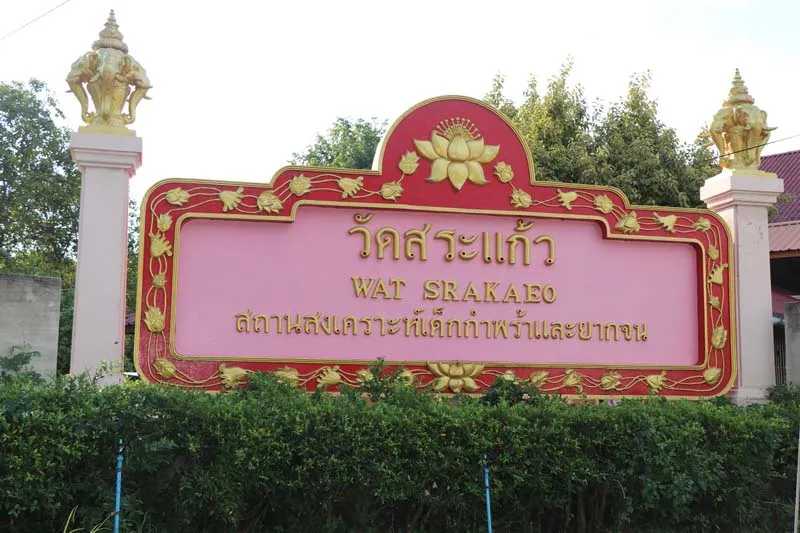
Wat Sa Kaeo, Ang Thong is located in Bang Sadet Subdistrict, Pa Mok District, Ang Thong Province. This historic temple was established in 2242 BE (1699 CE) during the Ayutthaya period. It was originally known as “Wat Sa Kae” before later becoming “Wat Sa Kaeo.” The temple is not only a place for merit-making and Buddhist ceremonies on important holy days, but also a clear example of a “Thai temple as a community hub.” Over time, it has carried overlapping roles in religion, education, social welfare, and the preservation of local craftsmanship that has long connected people to this area. Visitors often experience more than peaceful shade and an old-temple atmosphere; they also see the community’s intention to use the temple as a place to unite, support one another, and continue living cultural livelihoods that still exist today.
The location of Wat Sa Kaeo is convenient for travel and well-suited for planning a cultural temple route in Ang Thong. The temple is close to the main Ayutthaya–Ang Thong road (Highway 309). A clear landmark is around kilometer markers 39–40, where the entrance to the temple is on the left. From there, turn onto the irrigation canal-side road for about 200 meters to reach the temple. It is also approximately 0.2 kilometers (by actual route) from Wat Tha Sutthawat. This makes it easy for travelers with limited time to include as a smooth stop without needing to allocate long travel time. It is also suitable for those who prefer a “short visit with meaningful content,” because the temple grounds offer local history, craftsmanship, and learning spaces to explore.
In terms of place-name meaning, “Sa Kae” reflects the area’s original landscape, believed to have had an important pond near the temple with “kae” trees growing around it. Later, the addition of the word “Kaeo” intensified the symbolic sense of purity, beauty, and spiritual value. The temple name therefore serves not only as a location label, but also as a memory of place passed down through words. It helps explain why the temple has remained alongside the community for so long: the temple was founded on the real foundations of geography, belief, and everyday life, rather than being separated from the community.
Over many centuries, Wat Sa Kaeo has stood through major changes in Thai history from the late Ayutthaya era, through Thonburi, and into the Rattanakosin period. Although parts of the buildings have been restored over time, the overall impression remains that of an old temple layered with local history. Those who enjoy visiting temples by “reading the place” often notice this through the simplicity of building proportions, the lines of traditional craftsmanship, and an atmosphere that still feels like a true community temple, rather than a heavily commercialized attraction that has lost its essence.
What makes Wat Sa Kaeo especially memorable in local history is its social welfare role. In the past, the temple served as an orphanage, caring for many children. It functioned as both a home and a school at the same time. In this community dimension, the meaning of a “temple” becomes tangible: it did not only conduct rituals, but also extended support as a structure that truly sustained the lives of disadvantaged people. Caring for orphans was never easy. It required food, education, healthcare, and many daily expenses, so the temple needed a way to generate income that fit the society of that time.
One important mechanism that enabled the temple to sustain its welfare mission was the establishment of the “orphan Likay troupe of Wat Sa Kaeo” to raise funds for the children’s care. Likay, as a Thai folk performing art, carries strong social power: it brings people together, creates enjoyment and lasting impressions, and at the same time provides a way for audiences to participate in merit-making without feeling distant. The orphan Likay troupe was therefore not just performance; it was a creative and widely accessible form of community fundraising.
More importantly, the orphan Likay troupe also functioned as a “school of life” for the children. Those who grew up in the welfare setting trained in speaking, singing, dancing, teamwork, responsibility, and the discipline required for rehearsals and performances. The value was not only in income used for care, but in building confidence and transferable skills for the children’s futures. Many view this role as reflecting the traditional Thai values of compassion and mutual support, where the temple, the community, and nearby people formed a “life-support network” for those with fewer opportunities.
Beyond supporting disadvantaged groups, Wat Sa Kaeo also illustrates community development through “craft and livelihood” in a concrete way, especially through the “Samakkhi Samakhom Building,” the center of a royal-initiative weaving project established in 2524 BE (1981 CE). The center is under the responsibility of the Family Industry Division, Ministry of Industry. Inside, visitors can find high-quality woven textiles such as pha sin (traditional tube skirts), pha khao ma (Thai checkered multipurpose cloth), and other local textile products. Having such a facility within the temple grounds helps visitors understand that the temple does not stand alone; it is deeply connected to the community’s way of making a living.
Weaving is not merely handicraft for commerce; it is the accumulation of knowledge, the transmission of techniques, and the preservation of local identity. Patterns on textiles often reflect the weaver’s aesthetics, color sense, and creativity, while aligning with the central Thai context that favors simplicity with refinement. The pha khao ma is a clear example, because it has long been part of Thai daily life—used over the shoulder, as a wrap, as a cover, to bundle items, and also as a recognizable symbol of “Thainess” to visitors. When Wat Sa Kaeo provides a place where people can see and purchase woven cloth, it effectively opens a door for visitors to “read culture through real everyday objects,” not only through museum-style displays or information signs.
Another area where visitors often spend time is the “Pa Mok District Cultural Center,” located at the front of the temple. It demonstrates local wisdom such as traditional “ki kratuk” loom weaving, silver jewelry making, palace-style doll crafting, and agricultural products from local women’s groups, including banana chips (kluae brek taek). This cultural center functions like a community window, allowing outsiders to see the local people’s skills and pride. Each craft did not appear out of nowhere; it comes from practice, group collaboration, and accumulated experience. Demonstrations help visitors observe the real process and understand the value of products in terms of labor, detail, and wisdom.
When religion, social welfare, and craftsmanship come together, Wat Sa Kaeo becomes a clearly suitable destination for cultural travelers—especially for those who want a day trip that offers both merit-making and learning. The temple’s greenery and the quiet community surroundings also make the journey relaxing rather than rushed. It is suitable for bringing elderly family members to make merit, or bringing children to learn about community life and local handicrafts in a friendly setting.
On important Buddhist holy days such as Makha Bucha Day, Visakha Bucha Day, and the beginning of Buddhist Lent (Khao Phansa), Wat Sa Kaeo commonly hosts religious activities that local residents join continuously, such as alms-giving, listening to sermons, and candlelit circumambulation. This reflects the temple’s role as an ongoing “center of faith” for local people, not merely a place for short-term visitors. Observing these rhythms helps visitors understand that a temple is not only a place; it is a relationship among people, beliefs, and community cooperation.
For those who want to contact the temple to ask about merit-making, joining activities, or group visits, the temple’s contact number published through official tourism sources can be used as shown in the summary table below. The current abbot of Wat Sa Kaeo is “Phra Wachirasikkhakan,” who plays a role in both temple administration and community-related initiatives, as the name appears in local Ang Thong organizational sources and community media.
Getting There From Ayutthaya, take Highway 309 (Ayutthaya–Ang Thong). Around kilometer markers 39–40, look for the entrance on the left. Then turn onto the irrigation canal-side road for about 200 meters to reach Wat Sa Kaeo. The route is suitable for private cars. If you want to continue your trip, you can drive to Wat Pa Mok Worawihan, Pa Mok Market, or Wat Khun Inthapramun within the same day. It is recommended to travel in the morning to allow enough time to visit the cultural center and shop for local community products.
| Topic | Details |
| Name | Wat Sa Kaeo |
| Address | Bang Sadet Subdistrict, Pa Mok District, Ang Thong 14130, Thailand |
| Place Summary | A historic Ayutthaya-period temple (established in 2242 BE) formerly known as Wat Sa Kae. Known for its past social welfare role with an orphanage and an orphan Likay troupe, and for supporting local livelihoods through a royal-initiative weaving project and the Pa Mok District Cultural Center. |
| Highlights | Orphanage history and orphan Likay troupe, Samakkhi Samakhom Building (royal-initiative weaving center), Pa Mok District Cultural Center (handicraft demonstrations and community products) |
| Period | Ayutthaya Period |
| Current Abbot | Phra Wachirasikkhakan |
| Temple Contact Number | 035-661-950-1 |
| Current Status | Open for merit-making and visits as usual |
| Nearby Attractions (Approx. Driving Distance) | 1) Wat Tha Sutthawat – 0.2 km 2) Wat Pa Mok Worawihan – 3 km 3) Pa Mok Market – 3 km 4) Wat Khun Inthapramun – 15 km 5) Wat Muang (Ang Thong) – 20 km |
| Nearby Restaurants (Approx. Driving Distance + Phone) | 1) Pinto Restaurant (Pa Mok) – 3 km – 085-182-5479 2) Khong Aroi by Loong Loong – 3 km – 080-932-2331 3) Baanmaeoon Cafe (Branch 1) – 4 km – 086-129-9994 4) Ban Rak Nam (Banraknam Cafe’) – 6 km – 095-263-9493 5) Lek Ban Ro (Ang Thong) – 16 km – 035-612-070 |
| Nearby Accommodations (Approx. Driving Distance + Phone) | 1) Baan Suan Jit Somboon (Pa Mok) – 9 km – 081-776-1718 2) Pae Rim Nam Resort (Ang Thong) – 17 km – 081-947-7491 3) Suphorn Grand Hotel (Ang Thong) – 19 km – 081-551-2828 4) IKKYU2 Ang Thong (Ang Thong) – 18 km – 086-506-9503 5) Luancharoen Condo (Ang Thong) – 18 km – 035-612-636 |
Frequently Asked Questions (FAQ)
Q: When was Wat Sa Kaeo established?
A: Wat Sa Kaeo was established in 2242 BE (1699 CE) during the Ayutthaya period. It was originally known as Wat Sa Kae before later becoming Wat Sa Kaeo.
Q: Why is Wat Sa Kaeo important to the Bang Sadet community?
A: The temple has long served as both a religious and community center. Historically, it played a major social welfare role through an orphanage and an orphan Likay troupe, and it also supports local livelihoods through weaving and cultural demonstration programs.
Q: Which route should I take from Ayutthaya to Wat Sa Kaeo?
A: Take Highway 309 (Ayutthaya–Ang Thong). Around kilometer markers 39–40, turn left and continue along the irrigation canal-side road for about 200 meters to reach the temple.
Q: What can I see or learn at Wat Sa Kaeo besides making merit?
A: You can visit the Samakkhi Samakhom Building, a royal-initiative weaving center, and explore the Pa Mok District Cultural Center, where local crafts and community products are demonstrated.
Q: How can I contact Wat Sa Kaeo?
A: You can contact Wat Sa Kaeo at 035-661-950-1.
Q: If I have only one day, where should I go next nearby?
A: You can continue to Wat Tha Sutthawat, Wat Pa Mok Worawihan, Pa Mok Market, and then to Wat Khun Inthapramun or Wat Muang depending on your schedule.
 Tel: 035661169, 035661273
 Wat Sa Kaeo Map
 Category:
  Group:
  Last Update: 3 WeekAgo
Comment
 Nearby Attractions
| Keyword (Advance) |
 Region
|
 Muang Ang Thong(