

 Home
Home Chiang Mai(












Rating: 3.8/5 (4 votes)
 |
|  Map
Map 
 Have Map
  No Map
Trat attractions
Attractions in Thailand
Open Days: Monday–Friday
Opening Hours: 09:00–16:30 (official working hours)
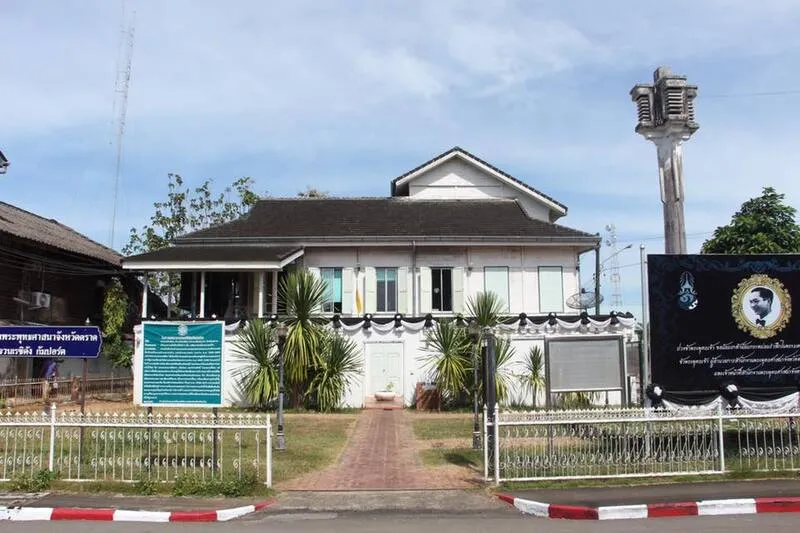
Residanggamport Resident is one of the quiet yet powerful historic buildings in Trat. It stands on Lak Mueang Road in Bang Phra Subdistrict, Mueang Trat District, right in the heart of the town’s old community. This three-storey half-masonry, half-wooden building with a tiered hipped roof has played important roles in many eras: as the bridal house of a local noble family, the residence of a French colonial resident, and later the governor’s residence of Trat. Today it serves as the Provincial Probation Office, while still preserving its original architectural form as a “living witness” to the history of Trat.
Although visitors today may see only a calm and modest half-masonry, half-wooden building that does not stand out like modern constructions, a closer look at its story reveals that Residanggamport Resident is like a great history book standing in the middle of town. It tells of international politics, colonial expansion, Siam’s adaptation, the growth of the urban community of Trat, and the coexistence of Thai, Chinese, and Western cultures within a single shared space.
The origins of this building go back to the reign of King Rama V, when Trat began to flourish through trade and maritime transport. A Chinese-descended official who played an important role in local administration, Phraphrani Chin Pracha, the Chinese section deputy of Trat, built this elegant wooden house as a bridal home for his daughter “Sud” and Luang Worabat Phakdi, the district officer of Mueang Trat at the time. The house thus served not only as a residence but also as a symbol of social status and of the close relationship between Thai and Chinese elites in this small seaside town.
Later, when Phraya Norachet Wutthiwai (Changwang Iam), the governor of Trat, retired from government service, he moved into the same house. This effectively turned the building into the “governor’s residence” in practice. The role of the house as a centre for elite life and local administration in Trat thus became even more important during a political turning point at the end of the 19th century.
Not long afterwards, the winds of European colonialism reached the eastern coast of Siam. France, which had created the Indochinese Union from Vietnam, Laos and Cambodia, recognised the strategic and economic importance of Trat and the Gulf of Thailand coast. Trat became a closely watched area and eventually came under French influence in the early 20th century.
When France occupied Trat and nearby coastal towns, it needed a “Resident” – a French colonial official representing the government – to govern, control, and report the situation back to the centre. Residanggamport Resident was chosen as the residence of the French resident and was used as a de facto administrative headquarters. This marked an important milestone in which the former bridal home of a local noble family was reinterpreted as a centre of foreign power on Siamese soil.
From around 1910–1921 (B.E. 2453–2464), Residanggamport Resident thus functioned much like a “governor’s residence” within the French administrative structure. The French resident stationed here had authority over civil administration, military affairs and tax collection, including overseeing transport routes between Trat, Kampot and Koh Kong. The building therefore became a crucial junction on trade and communication routes between Siam and the colonial territories.
Even though the building served as a colonial power centre, its architecture clearly reflects a compromise between European ideas and local Asian wisdom. The “three-storey half-masonry, half-wooden” form of Residanggamport Resident is like an architectural language that shows the designer understood structure, stability and climate all at once.
The ground floor is entirely built of brick and mortar, providing a solid base and cutting off moisture rising from the ground, which is a major problem in coastal towns like Trat. At the front, a low brick wall surrounds a veranda, with railings and a backrest that clearly define this as a “space of authority”. Stepping over the threshold is thus not just entering an ordinary house, but crossing into the realm of state power.
The second and third floors are built primarily of wood. The walls are made of horizontal timber planks, neatly aligned. Large double-leaf wooden windows run around the building, catching sea breezes and allowing good ventilation. This suits the hot and humid climate of eastern Thailand far better than thick European-style masonry walls. The architecture therefore retains the character of an “Eastern Thai house” subtly woven into a colonial home.
The tiered hipped roof, clad with wooden or clay tiles, is another detail that responds well to Trat’s climate and geography. The hipped form provides good drainage and reduces wind impact, especially during monsoon season when winds from the Gulf of Thailand can be strong. The stepped roof helps the building look lighter and less bulky, even though it rises three storeys high.
The exterior staircase leading up to the second-floor veranda is another feature that reflects both practicality and the social hierarchy of the building’s users. The ground floor may have been used by officials, staff or visitors on official business, while the upper floors served as living and working spaces for high-ranking officers. This separation of levels is common in Thai noble houses and affluent homes in various regions, with the distinctive addition here of colonial house features.
As political relations between Siam and France began to shift, the Siamese government used diplomacy and territorial negotiations to preserve independence and reclaim certain key areas. Trat was one such area that returned to Siamese control. When this happened, the role of Residanggamport Resident changed again: from “French resident’s house” back to the “Trat governor’s residence” in the era of the modern nation-state.
Interestingly, instead of demolishing a building that had once symbolised foreign power, the Siamese state chose to continue using it as the governor’s residence. This reflects an approach that did not deny the past, but rather integrated it into the Thai state structure. The political status of the building changed, but its physical form largely did not, leaving traces of French influence embedded in every corner of the structure.
Later, as the state administration expanded and new governor’s residences and government buildings were constructed, Residanggamport Resident was reassigned as a government office under the Ministry of Justice. Today it houses the Trat Provincial Probation Office, under the Department of Corrections. Although some interior spaces have been adapted to suit modern office work, the main structure and key architectural elements have been carefully preserved.
Another factor that adds to the value of Residanggamport Resident is its registration as a historical monument by the Fine Arts Department, as announced in the Royal Gazette in 1988 (B.E. 2531), covering an area of about 1 ngan 78 square wah. This registration does not only confirm its architectural value, but also recognises it as an important contemporary historical site at national level, and a place to learn about colonial expansion and the adaptation of Siam in the wider context of mainland Southeast Asia.
If you walk closer to the building and look from the front yard, you will see that the proportions of the structure relate harmoniously. The brick-and-mortar ground floor conveys a sense of solidity and weight, while the wooden upper floors feel lighter and more suited to the tropical climate. The large windows, almost reaching the floor, reveal how much the builders valued natural ventilation over mechanical cooling, unlike today. Ventilation panels above doors and windows help air circulate throughout the day, keeping the interior cool even in the hot season of eastern Thailand.
Visitors who have the chance to see the interior during certain periods when it is open will find simple yet orderly halls and rooms. Some rooms host displays of documents, old photographs and artefacts related to the period when French officials lived here, as well as small exhibitions about the French occupation of Trat and the negotiations that eventually brought the town back under Siamese sovereignty.
In cultural terms, Residanggamport Resident serves as a kind of “collective memory” for people in Trat. Many locals grew up with the sight of this building standing quietly on Lak Mueang Road. It is used as a reference point when giving directions or arranging to meet. Some people have come here on official business. Others have heard stories about the French era from elders in the community. The building is therefore not only a listed historical monument found in books, but a living part of everyday life in Trat.
Its value thus goes beyond being just a historical attraction. It also serves as a “reminder” that a small border town like Trat once stood in the middle of global political pressure, during an era when powerful nations were drawing lines and dividing territories. Many people in Trat take pride in the fact that their town passed through that period and still retains tangible evidence that later generations can see for themselves.
From an architectural point of view, Residanggamport Resident demonstrates a natural blend between Western and local forms. The overall massing and ideas about verandas, staircases and room layouts may have been influenced by colonial houses, but the choice of timber materials, the raised floors, the emphasis on ventilation and the use of air vents reflect the essence of Thai houses and traditional eastern Thai dwellings. This “in-between” quality of the building is precisely what makes it so charming and allows it to tell a rich cultural story.
At the same time, Residanggamport Resident is an example of a “living heritage” site. It has not been transformed into a museum alone, but remains an active government office. Staff meetings, paperwork and interactions with the public all take place inside this century-old building. This keeps the monument from being frozen as a mere relic and instead makes it part of contemporary social life.
For travellers interested in historical walking routes in downtown Trat, Residanggamport Resident is often recommended alongside the Trat City Museum, the city pillar shrine and surrounding old neighbourhoods. Such routes help visitors better understand the overall picture of Trat in terms of administration, economy and local ways of life, without having to travel far outside the town centre.
Getting There to Residanggamport Resident is convenient both from Bangkok and from within Trat town itself. From Bangkok, you can take Highway No. 3 (Sukhumvit Road), passing through Samut Prakan, Chonburi, Rayong and Chanthaburi before entering Trat Province, a total distance of about 380–390 kilometres. Once in Trat town, head towards the market area and provincial hall. From the municipal fresh market, drive straight to Lak Mueang Intersection, then turn left onto Lak Mueang Road and continue for about 400–500 metres. Residanggamport Resident is on the left-hand side, a distinctive three-storey half-masonry, half-wooden building with a tiered hipped roof that clearly stands out from its surroundings.
Those using intercity buses can travel from Bangkok to the Trat Bus Terminal, then continue by local songthaew or hired vehicles into town. Tell the driver you wish to get off near the Trat city pillar shrine or the Trat City Museum, then walk a short distance to Lak Mueang Road, where you will find the building. Distances within downtown Trat are relatively short, making it ideal for walking while observing local life, old houses and traditional shopfronts.
When you reach the building, it is important to respect its dual status as both a government office and a historical site. Visitors should dress modestly, avoid making loud noise that might disturb staff, and observe all on-site regulations. Those wishing to see the interior should contact the responsible agency in advance, as access to certain areas may depend on the office schedule and operational needs even on normal working days.
A visit to Residanggamport Resident is therefore not just about taking photos of an attractive old building. It is also an opportunity to explore traces of real political and cultural change that took place in Trat. The bridal house of a local noble family that became the home of French colonial officials, later transformed into the governor’s residence and today the probation office, illustrates how “power” may shift hands over time, while the original building continues to stand in the same place, patiently telling its story to those willing to listen.
In the future, if new interpretive and exhibition formats are developed – such as permanent displays on the history of French occupation in Trat, collections of old photographs and maps, or curated walking routes linking Residanggamport Resident with the Trat City Museum and other landmarks – this place could be further elevated as a dynamic historical and cultural learning hub, both for local residents and for visitors who wish to see Trat as more than just a transit point to the islands of the Gulf of Thailand.
| Name | Residanggamport Resident (โบราณสถานจวนเรสิดังกัมปอร์ต) |
| Location | Lak Mueang Road, Bang Phra Subdistrict, Mueang Trat District, Trat 23000. Near Anuban Trat School and the old downtown area. |
| Key Features | Three-storey half-masonry, half-wooden building with a tiered hipped roof. The ground floor is brick-and-mortar, the upper floors are timber, with verandas on all sides and exterior staircases in a colonial house style. It blends Western colonial architecture with local eastern Thai wisdom, and has served as a bridal home, governor’s residence, French resident’s house and government office. |
| Period | Built during the reign of King Rama V (late 19th century), used in the period of French occupation in the early 20th century, and continued into the era of the modern Siamese nation-state. |
| Key Evidence | Registration as a historical monument by the Fine Arts Department (Royal Gazette, Vol. 105, Part 188, 16 November 1988), information from the 5th Regional Office of Fine Arts, local documents and maps, old photographs from the French period, and oral histories from the community. |
| Name Origin | The word “Resident” derives from the French colonial administrative title, referring to the colonial official governing a town. The name “Residanggamport Resident” reflects both the building’s role as the resident’s house and its historical connection with Kampot in former French Indochina. |
| Travel | From Bangkok, take Highway No. 3 (Sukhumvit Road) through Chonburi, Rayong and Chanthaburi into Trat, a distance of about 380–390 km. In Trat town, head to Lak Mueang Intersection, turn left onto Lak Mueang Road and continue for about 400–500 m. Residanggamport Resident is on the left, near Anuban Trat School. It can be reached by private car, intercity bus plus local songthaew or taxi, getting off near the city pillar shrine or Trat City Museum and walking a short distance. |
| Current Status | Currently used as the Trat Provincial Probation Office under the Ministry of Justice (Department of Corrections) and registered as an official historical monument. Open to visitors on official working days and hours, subject to office conditions. Visitors should respect staff at work and follow all regulations. |
| Entrance Fee | No entrance fee. As it is a government office, visits are possible during official working hours, subject to the office’s discretion. |
| Nearby Attractions (approximate distance) | Trat City Museum (about 200 m), Trat City Pillar Shrine (about 300 m), municipal fresh market and old town area (within 500 m), Ban Huai Raeng community (about 3.5–4 km), Trat Buddhist Park and surrounding recreation areas (around 7–9 km). |
| Popular Nearby Restaurants | Local eateries and cafés in downtown Trat around Lak Mueang Road, Santisuk Road and Tessaban Road, including simple Thai restaurants, noodle shops and small cafés within roughly 500 m–2 km. They are convenient stops before or after visiting Residanggamport Resident (check latest opening times before visiting). |
| Popular Nearby Accommodations | Small hotels and guesthouses in downtown Trat, as well as accommodations along Sukhumvit Road and near the bus terminal, located about 1–3 km from Residanggamport Resident. These provide convenient bases for exploring town and travelling on to ferry piers for Koh Chang and Koh Kood. |
| Facilities | Street-side parking and limited nearby parking (depending on day and office hours), restrooms inside the building for people on official business (use at the office’s discretion), and easy access to basic shops and services in downtown Trat. |
| Contact Number | Last verified on 2025-12-08: 0 3959 7259 |
Frequently Asked Questions (FAQ)
Q: What is Residanggamport Resident?
A: Residanggamport Resident is a three-storey half-masonry, half-wooden building with a tiered hipped roof, located on Lak Mueang Road in Bang Phra Subdistrict, Mueang Trat District. It was originally built as the bridal house of a local noble family, later used as the residence of a French colonial resident during the period when Trat was under French control, and afterwards served as the governor’s residence. Today it houses the Provincial Probation Office and is a registered historical monument.
Q: When is Residanggamport Resident open to visitors?
A: In general, Residanggamport Resident can be visited during official working days and hours, Monday–Friday, around 09:00–16:30. As it is a functioning government office, visitors should allow time for procedures and follow all regulations. Those wishing to see the interior should call in advance for confirmation.
Q: Is there an entrance fee to visit Residanggamport Resident?
A: Currently there is no entrance fee, as the building is a government office open to the public and visitors during official working hours. Visitors are expected to dress modestly and respect the rules of the premises.
Q: What is interesting inside Residanggamport Resident?
A: The highlight of a visit is the chance to see the three-storey half-masonry, half-wooden architecture that blends colonial-house design with eastern Thai building wisdom. At certain times, there may be exhibits of documents, old photographs and stories related to the French occupation of Trat, along with small displays about the town’s development from the perspective of administrative history.
Q: How does Residanggamport Resident reflect the colonial era?
A: Residanggamport Resident once served as the residence of the French colonial resident responsible for governing Trat during the period when the town was under French influence as part of Indochina. The building functioned as both a home and a centre of colonial authority on the eastern coast. When Trat returned to Siam and the building was reused as the governor’s residence, it became a key piece of evidence of the shift from foreign colonial power to the modern Siamese state.
Q: How can I get to Residanggamport Resident from downtown Trat?
A: From central downtown Trat, such as the municipal fresh market or Trat City Museum, you can walk or take a local songthaew along Lak Mueang Road. Head towards Lak Mueang Intersection, then continue along the road for a short distance. Residanggamport Resident stands on the left-hand side, not far from Anuban Trat School.
Q: How much time should I plan for a visit to Residanggamport Resident and nearby areas?
A: If you focus only on the building and its immediate surroundings, about 30 minutes to 1 hour is sufficient. However, if you plan a full historical walking route in downtown Trat – including stops at the Trat City Museum, the city pillar shrine and the old town area – you may want to set aside half a day to a full day to fully absorb the atmosphere and stories of Trat.
Q: What type of travellers is Residanggamport Resident suitable for?
A: Residanggamport Resident is ideal for visitors interested in history, architecture and deep cultural narratives of border towns, as well as travellers who want to know Trat as more than just a transit point to the islands. It is also suitable for students and researchers studying the history of colonial expansion in mainland Southeast Asia from the perspective of a small town like Trat.
 Residanggamport Residence Map
 Category:
  Group:
  Last Update: 3 MonthAgo
Comment
 Nearby Attractions
| Keyword (Advance) |
 Region
|
 Muang Trat(