

 Home
Home Chiang Mai(




Rating: 3.8/5 (4 votes)
 |
|  Map
Map 
 Have Map
  No Map
Ang Thong attractions
Attractions in Thailand
Open Days: Open Daily
Opening Hours: 06.00 – 18.00
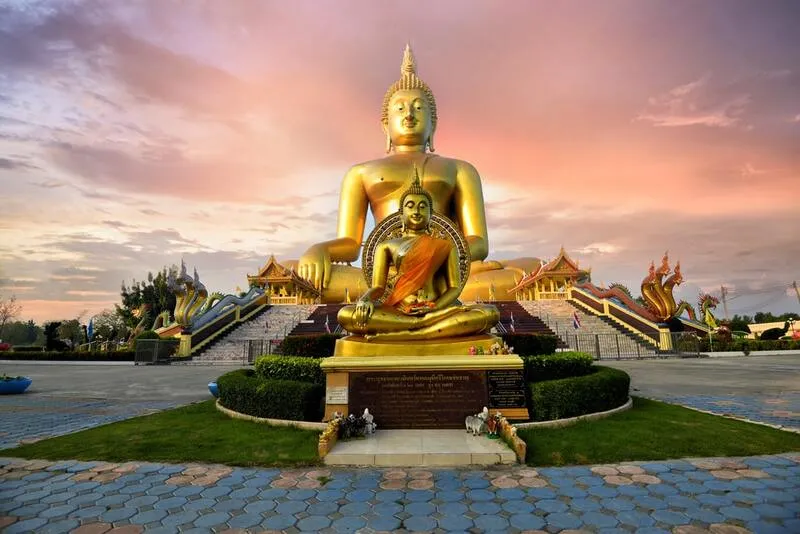
Wat Muang in Wiset Chai Chan District, Ang Thong is one of Thailand’s most iconic temple destinations—the kind of place you can tell is extraordinary the moment you see it. The temple’s headline landmark is the colossal golden Buddha in the subduing Mara posture, widely known as Luang Pho Yai (also called “Phra Phuttha Mahanawamin Sakyamuni Si Wiset Chai Chan”). Beyond the main statue, the temple offers areas to explore Buddhist art, moral-themed displays, and a lively atmosphere of faith throughout the year. It suits family outings, a one-day pilgrimage-style trip, and travelers who want to experience a national-level landmark in Ang Thong in person. Most visitors spend about 1–2 hours here (or longer if exploring in detail).
Wat Muang, Ang Thong is located in Wiset Chai Chan District and is regarded as a major religious tourism landmark in Central Thailand. Its most recognizable feature is the immense golden Buddha statue standing tall and visible from far away. As soon as you approach the temple grounds, you can feel the “scale” of this sacred space and how it differs from typical local temples. The statue is not only a revered object of worship, but also a shared symbol for visitors from many provinces who come to pay respects, make merit, and recharge their spirits in the uniquely uplifting way Thai religious sites often provide.
What makes Wat Muang nationally distinctive is its colossal Buddha image in the subduing Mara posture, commonly called “Luang Pho Yai,” with the formal name “Phra Phuttha Mahanawamin Sakyamuni Si Wiset Chai Chan.” Knowing the statue’s dimensions helps you picture the real experience before you arrive. The Buddha is approximately 95 meters tall from the base to the topknot, with a lap width of about 63 meters. This sheer scale is why many people choose Wat Muang as a primary destination when visiting Ang Thong, even if temple-hopping is not their usual travel style. Standing near the base and looking up often brings a calm, awed feeling—the statue’s vast presence makes the surroundings feel quietly “still” and “grounded” in a way that is hard to describe until you are there.
Looking back at the history of Wat Muang, it becomes clear that this site was not created overnight as a brand-new project. Instead, it represents a “revival” of a religious place with deep roots. Accounts consistently connect the temple area to the late Ayutthaya period, and the temple is said to have become abandoned after major upheavals in Thai history. Following the fall of Ayutthaya, many temples across Central Thailand were damaged and left deserted as conditions changed; Wat Muang was part of that broader landscape. It later returned to life in the modern era through the faith and commitment of monks and local residents—an essential context that helps visitors understand that the “grandeur seen today” has a story behind it, built through collective effort over time.
The modern restoration of Wat Muang is widely described as beginning in 2526 BE (1983 CE) through the role of “Luang Pho Kasem Achan Supho” (Phra Khru Wibun Achanakhun). He initiated the restoration and development of the temple, leading to several important structures across the grounds. Most memorably, he launched the creation of the enormous Buddha statue that later became the temple’s defining symbol. This kind of revival reflects a meaningful aspect of Thai culture: many religious sites do not grow primarily through state power or large budgets, but through “collective merit-making” and the shared faith of people who believe that joining together in good deeds can create something lasting for both the community and Buddhism.
Building Luang Pho Yai was a long-term undertaking, and the details often deepen visitors’ sense of reverence. The project is described as progressing through widespread public support, with construction taking about 16 years and reaching completion in 2550 BE (2007 CE). These figures are more than statistics; they are “footprints of time” that suggest every stage required sustained contributions, careful planning, and continuity of purpose. For visitors, understanding this background can make standing before the statue feel more meaningful than simply witnessing its size, because it reveals the shared determination of countless people who wanted this place to become a true spiritual center for society.
When you enter the main area of Wat Muang, it helps to set your pace to match the nature of the place. The temple carries both a devotional dimension and a visitor-friendly dimension. Many people come primarily to pay respects to Luang Pho Yai and then continue to explore the other areas of the temple. Beginning with a calm, respectful moment of worship helps the overall experience feel unhurried and harmonious, while also honoring the fact that many people are engaged in genuine religious practice throughout the day. If you plan to pray for blessings or offer alms, preparing appropriately and acting with care is worthwhile, especially on weekends and festivals when crowds can be dense. Good etiquette makes shared spaces more comfortable for everyone.
The area around Luang Pho Yai is best enjoyed by taking time to “look fully” because the statue’s scale can make smaller details easy to miss if you focus only on taking photos. Many visitors choose a viewpoint where the entire Buddha can be captured to convey its magnitude, while others walk closer to the base to feel the atmosphere of devotion at close range. One detail worth noticing is how architecture and site planning work together. A statue of this size requires surrounding spaces that can support large numbers of visitors—walkways, resting points, donation areas, and open courtyards. These design choices help Wat Muang function both as a place for religious activities and as a destination for visitors, without the two purposes overlapping in a disruptive way.
From the Luang Pho Yai zone, walking through Wat Muang often leads to structures and themed displays that many visitors find more engaging than what they expect from a typical temple visit. People frequently mention areas such as halls and the ordination complex, along with sections featuring sculptures and moral-themed scenes connected to ideas of karma, heaven, hell, and other spiritual realms in Thai belief. These elements make the visit more than an act of worship; they allow visitors to “read moral teachings through imagery,” which can be especially accessible for children and families. This style of communicating Dharma is seen in many contemporary Thai temples, but Wat Muang stands out because of its large grounds and steady flow of visitors.
For visitors who come with a learning mindset, a slow, step-by-step walk from the major landmarks into the finer details often makes the experience richer. Many areas carry messages intended to encourage reflection—scenes of hell emphasizing consequences of actions, depictions of heaven inviting contemplation of goodness, and zones that blend Thai and Chinese spiritual motifs in ways familiar to many Thai people. Exploring mindfully can make the visit feel more substantial, turning 1–2 hours into an experience that is both uplifting and meaningful.
Another reason Wat Muang is widely loved is that it works well as a group destination—for families traveling with children, older visitors who want to make merit, or friends planning a one-day trip near Bangkok. The overall atmosphere feels “open” and “welcoming,” with spacious grounds that are easy to walk and several places to pause and rest. Visiting early in the morning or later in the afternoon tends to be more comfortable, especially on hot days. Bringing a hat or umbrella can also help you enjoy the walk without fatigue.
A visit to Wat Muang can also reveal Ang Thong from a perspective some travelers may not have considered. Ang Thong is a relatively small province, yet it carries a distinctly Central Plains charm—community life, waterways, rice fields, and temples filled with historical narratives. In that sense, Wat Muang can act like a “gateway” that sparks interest in exploring the province further. Many visitors then extend their trip to other significant temples in Ang Thong, such as Wat Chaiyo Worawihan, Wat Pa Mok Worawihan, or Wat Khun Inthapramun, which can be combined into a one-day temple route with good timing and a clear plan.
In terms of etiquette, Wat Muang is a busy tourist site, but it remains a true religious place at its core. Dressing respectfully is recommended—tops with sleeves, and pants or skirts of an appropriate length—and keeping voices low in sacred areas where people are praying or practicing. If you are visiting with children, a simple explanation that “some areas are for worship” can help keep the atmosphere calm even when crowds are present. These small considerations improve the experience for both your group and those around you.
Many visitors come to take photos with Luang Pho Yai, and there are multiple angles that work well. Still, it is important not to block walkways and to avoid poses that feel inappropriate in a religious space. If you want a photo that shows the full statue, shooting from a suitable distance often gives better proportions and reduces the need to tilt the camera dramatically upward. If you want to capture the spirit of the place, photographing the overall scene of merit-making—without focusing clearly on anyone’s face—can create a respectful image that still conveys the temple’s powerful atmosphere.
Beyond the statue itself, Wat Muang is also an example of a temple functioning as a social “center” in a distinctly Thai way. It is not merely a venue for rituals; it is a space where people come together to make merit and feel part of something larger than individual concerns. Maintaining and managing such a large site requires organization as well as community participation. In one sense, this reflects how Thai temples continue to play a meaningful social role, even as the world outside changes rapidly.
Getting There from Bangkok is straightforward by car. Take the Asia Highway (Highway 32) toward Ang Thong, then continue toward Wiset Chai Chan District (often via the Ang Thong–Wiset Chai Chan route). Watch for clear signs indicating “Wat Muang / Luang Pho Yai,” and then turn into the access road for about 1 kilometer to reach the temple grounds. From Ang Thong town, the overall distance to Wat Muang is within the tens of kilometers range, making it convenient for a quick day trip or a multi-temple route in a single day. For a more relaxed visit, leaving early is recommended to avoid intense midday heat and heavier crowds from late morning to afternoon.
Once your timing is set, most visitors can see Wat Muang thoroughly in about 1–2 hours by dividing time between worship at Luang Pho Yai, walking through the temple’s display areas, and making merit as they wish. Families and groups traveling with older visitors may want to include rest stops, as the grounds are spacious. The advantage is that the overall environment does not feel cramped, and most people are there for the same reason—to make merit—so staying longer often still feels calm and restorative.
Ultimately, Wat Muang is ideal for anyone who wants to witness “faith expressed through architecture” in a vivid and unforgettable way. Luang Pho Yai is not only visually striking in size, but also stands as a result of shared devotion that helped an abandoned temple return as a living spiritual center. When visitors come to pay respects, explore, and understand the background, the experience goes beyond photographs. It becomes a memory with depth—history, belief, and the collective effort that allows a place to “endure” in a fast-changing world.
| Place Summary | A major temple landmark in Wiset Chai Chan, Ang Thong, best known for the colossal golden Buddha “Luang Pho Yai” (Phra Phuttha Mahanawamin Sakyamuni Si Wiset Chai Chan) and multiple moral-themed display zones across the grounds. |
| Highlights | Luang Pho Yai (giant subduing Mara Buddha) / Areas for Buddhist art and moral-themed displays / Ideal for a one-day temple trip near Bangkok |
| Address | Wiset Chai Chan District, Ang Thong (Wat Muang area) |
| Open Days | Open Daily |
| Opening Hours | 06.00 – 18.00 |
| Abbot (Latest) | Phra Khru Suphat Khet Sunthon |
| Contact Number | 035-631-556 |
| Current Status | Open to visitors for sightseeing and merit-making |
| Nearby Attractions (Approx. Distance) | 1) Wat Khun Inthapramun – 15 km 2) Talat San Chao Rong Thong – 9 km 3) Ban Bang Sadej Royal Doll Center – 20 km 4) Wat Pa Mok Worawihan – 28 km 5) Wat Chaiyo Worawihan – 30 km |
| Nearby Restaurants (Approx. Distance + Phone) | 1) Nimit Restaurant (Ang Thong) – 12 km – 081-852-4777 2) The Lao Cafe & Resort (Ang Thong) – 10 km – 083-426-6362 3) Suk Arrom Cafe (Ang Thong) – 14 km – 098-323-9979 4) Notre Maison (Ang Thong) – 11 km – 064-497-1709 5) Santi Cafe (Ang Thong) – 16 km – 084-291-6991 |
| Nearby Accommodations (Approx. Distance + Phone) | 1) Jumbo Villa Resort – 12 km – 085-944-1244 2) Bualuang Ang Thong Hotel – 22 km – 035-611-116 3) Bualuang Boutique Resort Ang Thong – 24 km – 035-949-850 4) The Strong Room Resort (Ang Thong) – 23 km – 061-671-3991 5) Blue House Ang Thong – 22 km – 080-640-9465 |
Frequently Asked Questions (FAQ)
Q: Where is Wat Muang (Luang Pho Yai) located?
A: It is in Wiset Chai Chan District, Ang Thong, a major landmark temple known for the giant Buddha statue “Luang Pho Yai,” visible from a long distance.
Q: Is Wat Muang open every day, and what are the opening hours?
A: Yes. It is open daily, with visiting hours around 06.00 – 18.00.
Q: What is the main highlight of Wat Muang?
A: The main highlight is paying respects to Luang Pho Yai (Phra Phuttha Mahanawamin Sakyamuni Si Wiset Chai Chan) and exploring the temple’s moral-themed display zones.
Q: How much time should I plan for a visit?
A: Most visitors should plan for about 1–2 hours to worship, explore, and enjoy the atmosphere (longer if exploring in detail).
Q: What should I wear when visiting Wat Muang?
A: Dress respectfully—tops with sleeves and pants or skirts of an appropriate length—and keep noise low in sacred areas.
Q: What is the easiest driving route from Bangkok to Wat Muang?
A: A common route is via the Asia Highway (Highway 32) toward Ang Thong, then continue toward Wiset Chai Chan and follow the signs for “Wat Muang / Luang Pho Yai.”
 Website: www.watmuang.com
 Wat Muang Map
 Category:
  Group:
  Last Update: 1 HourAgo
Comment

Photo Gellery(18) 
 Thank you photo(3) from: Bertosky