

 Home
Home Chiang Mai(




Rating: 4/5 (5 votes)
 |
|  Map
Map 
 Have Map
  No Map
Ang Thong attractions
Attractions in Thailand
Open Days: Daily
Opening Hours: 08:00 – 17:00
Wat Pa Mok Worawihan is located in Pa Mok Municipality, Ang Thong, on the western bank of the Chao Phraya River. This venerable riverside temple is nationally renowned for enshrining the beautiful Reclining Buddha, widely regarded as one of Thailand’s finest. Yet the temple’s appeal extends beyond the sheer grandeur of the image. Wat Pa Mok is also shaped by the Chao Phraya’s river-culture narratives — stories of sacred objects drifting downstream, community rituals of hauling them ashore, and the historic relocation of the Reclining Buddha to protect it from riverbank erosion. Local memory further links the site to major chapters of Thai history, including accounts that King Naresuan the Great once came to pay homage before marching his army. Taken together, these layers make a visit to Wat Pa Mok more than a simple merit-making trip; it is a journey through time that reveals how faith, community life, and the river once formed the living framework of Thailand’s Central Plain.
Through the lens of Chao Phraya River history, Wat Pa Mok represents the classic riverside temple that flourished alongside the river’s role as the nation’s “main road” in earlier centuries. Long before concrete highways and automobiles, the Chao Phraya was the primary corridor for trade, news, and travel, and it also functioned as a strategic route during wartime movements. Many towns and communities across Ang Thong, Sing Buri, Ayutthaya, Suphan Buri, and beyond grew from fertile alluvial soils along the banks. In this landscape, temples were never merely ritual venues; they served as community knowledge centers, meeting grounds, and places where local wisdom was passed down. They also anchored a shared “community calendar” through Buddhist holy days, the Khao Phansa – Ok Phansa season, and annual merit-making traditions that brought entire villages together.
In a river-based world like this, stories of sacred images “floating in with the current” are commonly found along the Chao Phraya. The river not only sustained daily life; it also carried the possibility of extraordinary events into the collective imagination. Wat Pa Mok is associated with a well-known local tale that the Reclining Buddha drifted from elsewhere and sank near the temple, after which residents performed rites of reverence and hauled the image onto the bank for enshrinement. The meaning of such a story is less about scientific proof and more about how the community interprets the image as a blessing bestowed by the river. Once the sacred arrived, the community protected it through ongoing rituals, care, and restoration.
The Reclining Buddha at Wat Pa Mok measures 22.58 meters in length. Built of brick and stucco and covered in gold, the image is admired for its calm, dignified proportions that often bring an immediate sense of quiet to first-time visitors. The reclining posture symbolizes the Buddha’s final passing into Parinirvana, reminding worshippers of impermanence and gently inviting the mind back to order, stillness, and the present moment. Many visitors therefore begin their walk through the temple by paying respect to the Reclining Buddha with deliberate focus, believing it sets a serene tone for the rest of the day before continuing to other sacred points within the compound.
The story of Wat Pa Mok’s Reclining Buddha is often said to gain additional historical depth through accounts referencing royal chronicles, which local tradition connects to King Naresuan the Great gathering troops and paying homage before a military campaign. Narratives of this kind reflect an older Thai worldview in which Buddhism and statecraft were closely intertwined. In moments of great decision, rulers and soldiers alike sought spiritual assurance. Major temples along river routes could function as resting points, assembly locations, and ceremonial spaces for auspicious rites before departures. As a prominent riverside temple, Wat Pa Mok has therefore been remembered as a place where national history and local faith converge.
Another reason Wat Pa Mok stands out in “historical geography” is the relocation of the Reclining Buddha to protect it from severe riverbank erosion. When the Chao Phraya’s current threatened the stability of the riverside ground near the original shrine, the relocation of such a significant image became more than a local matter. In the Thai historical imagination, major temples and revered Buddha images were symbols of public stability as well as devotion, and safeguarding them required large-scale coordination, craftsmanship, and organized labor. The relocation — remembered as moving the image 168 meters away from the riverbank — is frequently cited as a striking example of how sacred heritage was preserved through practical, large-scale action.
This episode also highlights the complex relationship between people and water in the Central Plain. The river gives life, but it can also reshape shorelines and disrupt what communities have built. Chao Phraya communities historically learned to live with the river through adaptation — moving structures, reinforcing banks, and reorganizing space. For visitors today, Wat Pa Mok is not only a temple that houses a celebrated Reclining Buddha; it is also a place that embodies a lived lesson: sacred heritage must survive in the real world, and survival depends on maintenance, planning, and collective effort.
After the image was relocated into a safer shrine, the temple’s internal layout became more secure than the earlier riverside arrangement. Even so, Wat Pa Mok retains the distinctive character of a riverside temple because it still faces the Chao Phraya, and the river remains part of the visitor experience. The waterway may no longer serve as the Central Plain’s principal transport artery in the way it once did, but it continues to function as the backdrop that helps visitors intuitively understand how the temple and its community were rooted in river life.
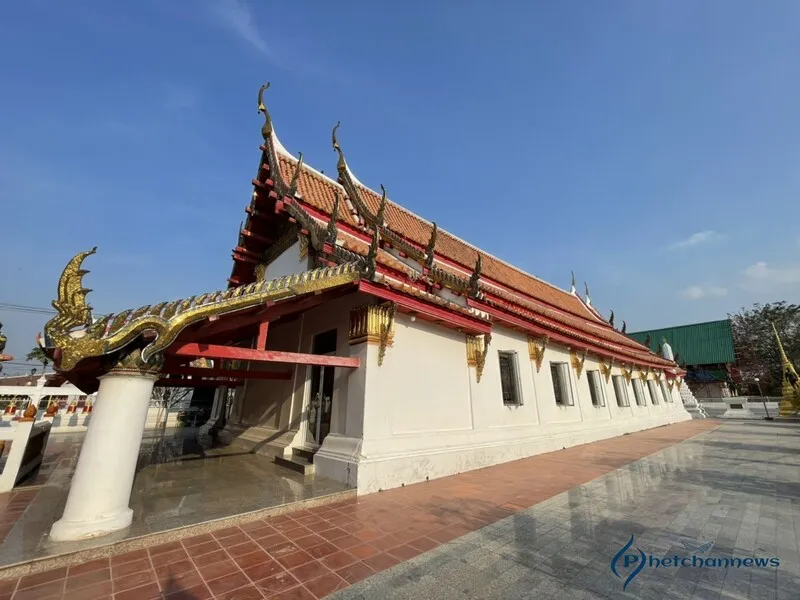
Beyond the Reclining Buddha, Wat Pa Mok Worawihan includes several notable structures that enrich a cultural visit. One such highlight is the so-called “Vihan Khian,” often described as an important artistic and historical hall oriented toward the river. For travelers interested in Thai visual culture, it serves as a reminder that temples communicate not only through sacred images but also through narrative art — murals and painted traditions used to convey Buddhist teachings and social memory. Walking through a riverside-oriented hall also reveals the builders’ intention to harmonize religious space with landscape.
Many worshippers also pay respect at the “Mondop Phra Phutthabat 4 Roi,” a sacred pavilion that enshrines four replicated Buddha footprints. In Thai Buddhist tradition, venerating Buddha footprints signifies remembrance of the Buddha’s path — the trace of Dhamma left for humanity to follow. The presence of four footprints adds further auspicious symbolism and offers a fuller devotional circuit for those who want more than a single-stop visit centered solely on the Reclining Buddha.
Wat Pa Mok is also associated with a “Ho Trai,” a scripture library traditionally used to preserve the Tripitaka and Buddhist manuscripts. In older Thai society, temples were major centers of learning long before modern schooling became widespread. They provided literacy education, moral instruction, and custodianship of essential knowledge. Passing by a Ho Trai in a historic temple like Wat Pa Mok can feel like stepping through a layer of the Central Plain’s educational memory.
To experience Wat Pa Mok thoroughly without rushing, it is best to begin with the Reclining Buddha — the heart of the temple — and take a moment to settle the mind. Then continue along the internal walking route to other devotional points such as the Buddha-footprint pavilion and the river-facing halls. Finally, slow down and stroll through the wider compound. Many visitors discover that the temple’s beauty is not only in its famous image but also in its atmosphere — a quietness that naturally encourages a gentler pace and deeper attention.
As a royal temple, Wat Pa Mok Worawihan remains an important center for Buddhist activities aligned with Thailand’s religious calendar, especially on major holy days such as Makha Bucha, Visakha Bucha, and Asalha Bucha, as well as during the Khao Phansa – Ok Phansa season. Community events after Ok Phansa, including kathin ceremonies, often bring together multiple generations — elders who have been connected to the temple since childhood and younger people returning home on holidays. Visiting on a significant merit-making day can therefore feel quite different from an ordinary day, because the “community energy” becomes visible through collective care of the temple space and shared participation in rites.
For a relaxed one-day merit-making route, Wat Pa Mok can serve as a practical “hub” for Ang Thong because it lies along a main road connection (Highway 309) and is close to other key sites such as Wat Chaiyo Worawihan, Wat Khun Inthapramun, Wat Muang, and community craft-learning areas in the Bang Sadet zone. A well-planned route can combine a nationally famous Reclining Buddha, important provincial temples, and local cultural learning without overly long driving times.
Getting There Wat Pa Mok Worawihan is approximately 18 km from Ang Thong town. By car, the common approach is via Highway 309 (Ang Thong – Ayutthaya) toward Pa Mok Municipality, where the temple sits on the western bank of the Chao Phraya River. From Bangkok, travelers often use Highway 32 (Phahonyothin/Asian Highway) toward the Ayutthaya – Ang Thong area and then connect to Highway 309 into Pa Mok. By public transport, you can take a bus or van from Mochit Bus Terminal to Ang Thong/Pa Mok, then continue by local transport (songthaew or motorcycle taxi) to the temple.
Upon arrival, dress modestly, keep voices low, and respect areas used for religious practice. If you plan to pay homage to the Reclining Buddha with intention, take a brief moment to set your focus and bow calmly. This temple is often at its most beautiful when you do not rush and allow the site’s stillness to quietly work on the mind.
| Name | Wat Pa Mok Worawihan |
| Address | Pa Mok Municipality, Pa Mok District, Ang Thong (Western Bank of the Chao Phraya River) |
| Place Summary | A royal riverside temple famous nationwide for its Reclining Buddha (22.58 m), with layered Chao Phraya River legends and the historic relocation of the image to protect it from riverbank erosion. |
| Highlights | Reclining Buddha (22.58 m), river-origin legend and community hauling rites, historical relocation of the image (168 m) to avoid erosion, Vihan Khian, Mondop Phra Phutthabat 4 Roi, Ho Trai (scripture library) |
| Open Days | Daily |
| Opening Hours | 08:00 – 17:00 |
| Current Status | Open for worship and visits |
| Contact Number | 035-661-115 |
| Getting There | Car: Highway 309 (Ang Thong – Ayutthaya) to Pa Mok Municipality | Public Transport: Bus/van from Mochit to Ang Thong/Pa Mok, then local transport to the temple |
| Facilities | Parking area, main worship halls, internal walkways, shaded resting areas |
| Nearby Tourist Attractions With Distance | 1) Ban Bang Sadet Royal Court Dolls Center – approx. 6 km (by road) – Tel. 035-661-157 2) Wat Prasat (Pa Mok) – approx. 10 km (by road) – Tel. 035-662-335 3) Wat Chaiyo Worawihan – approx. 17 km (by road) – Tel. 035-862-669 4) Wat Khun Inthapramun – approx. 23 km (by road) – Tel. 035-691-406 5) Wat Muang – approx. 30 km (by road) – Tel. 035-631-556 |
| Popular Restaurants Nearby With Distance | 1) Suan Ahan Phae Rim Nam (Pa Mok) – approx. 3 km (by road) – Tel. 062-936-2249 2) Krua Khun Kung Phae Rim Nam (Pa Mok) – approx. 4 km (by road) – Tel. 083-039-1999 3) Pinto Restaurant (Pa Mok) – approx. 4 km (by road) – Tel. 035-662-589 4) Krua Kai Chon (Pa Mok) – approx. 5 km (by road) – Tel. 035-662-576 5) Lamoonnee (Bang Sadet) – approx. 7 km (by road) – Tel. 081-241-6699 |
| Popular Accommodations Nearby With Distance | 1) Bualuang Hotel Ang Thong – approx. 18 km (by road) – Tel. 035-611-116 2) Bualuang Boutique Resort Ang Thong – approx. 18 km (by road) – Tel. 081-495-8884 3) Thanara Resort (Ang Thong) – approx. 19 km (by road) – Tel. 092-940-9104 4) Thi Ni Mi Dee Resort (Ang Thong) – approx. 20 km (by road) – Tel. 094-131-8081 5) Khlong Suan Phlu Resort (Ayutthaya) – approx. 32 km (by road) – Tel. 035-242-525 |
Frequently Asked Questions (FAQ)
Q: Where is Wat Pa Mok Worawihan located?
A: Wat Pa Mok Worawihan is in Pa Mok Municipality, Pa Mok District, Ang Thong, on the western bank of the Chao Phraya River. It is easy to reach via Highway 309.
Q: What is the must-see highlight of Wat Pa Mok?
A: The must-see highlight is the Reclining Buddha, 22.58 meters long, admired as one of Thailand’s most beautiful reclining images.
Q: What is the famous legend associated with the Reclining Buddha?
A: A well-known local legend says the image floated downstream and sank near the temple, after which the community performed rites and hauled it ashore for enshrinement. The temple is also remembered for the historic relocation of the image to protect it from riverbank erosion.
Q: What else can visitors see besides the Reclining Buddha?
A: Visitors can also pay respect at Mondop Phra Phutthabat 4 Roi, explore Vihan Khian, and see the Ho Trai (scripture library), which reflects the temple’s religious and educational heritage.
Q: When is the best time to visit for a calm atmosphere?
A: Early morning or late afternoon is comfortable for walking and offers a serene riverside mood. Visiting on major Buddhist holy days can also be meaningful if you want to experience community activities.
Q: Where can I continue a one-day trip after visiting Wat Pa Mok?
A: A convenient one-day route can include Ban Bang Sadet Royal Court Dolls Center, Wat Prasat, Wat Chaiyo Worawihan, Wat Khun Inthapramun, or Wat Muang, depending on your available time.
 Wat Pa Mok Worawihan Map
 Category:
  Group:
  Last Update: 5 HourAgo
Comment
 Nearby Attractions
| Keyword (Advance) |
 Region
|
 Muang Ang Thong(