

 Home
Home Chiang Mai(




Rating: 4.2/5 (5 votes)
 |
|  Map
Map 
 Have Map
  No Map
Prachuap Khiri Khan attractions
Attractions in Thailand
Open Days: Open daily
Opening Hours: 08:00 – 16:30
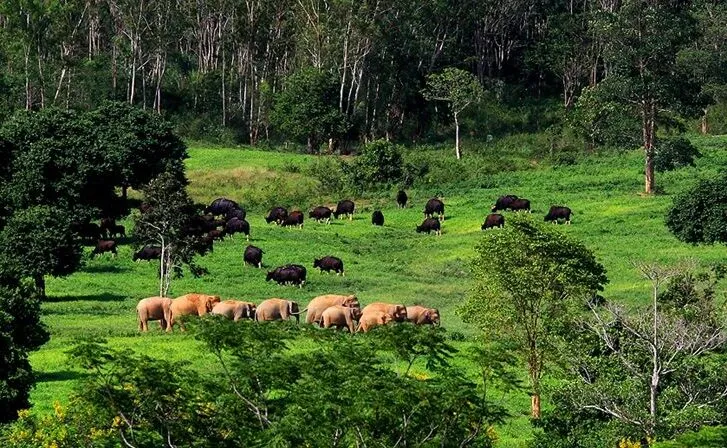
Kui Buri National Park, Prachuap Khiri Khan Province, is one of Thailand’s most famous places to see wild elephants. It stands out for its vast forest along the Tenasserim Range, its still-abundant ecosystem, and its wildlife watching activities, which are the park’s major highlight. The most popular time for visitors to watch wild elephants is from the afternoon into the early evening, as this is when elephants and many other wild animals often come out to feed in the open grasslands.
Kui Buri National Park is one of the most important natural attractions in Prachuap Khiri Khan Province and one of the most distinctive forest areas in western Thailand. Beyond being a large watershed forest, it is also home to a wide variety of wildlife. Wild elephants in particular have made this national park a major destination for both Thai and international nature travelers. The charm of Kui Buri is not limited to seeing wild elephants in their natural habitat. It also lies in the atmosphere of a vast, well-preserved forest filled with rugged mountains, open grasslands, waterfalls, and routes that allow visitors to experience nature on a deeper level than a quick sightseeing stop.
Kui Buri National Park covers several areas in Prachuap Khiri Khan Province, including Khao Chang Subdistrict in Pran Buri District; Silalai, Silaloi, Rai Kao, and Rai Mai in areas connected with Sam Roi Yot and Pran Buri; as well as Hat Kham, Sam Krathai, Kui Buri, Bo Nok, Ao Noi, Ko Lak, and Khlong Wan in Mueang Prachuap Khiri Khan District. The total area is about 969 square kilometers, or around 605,625 rai. This makes it a large forest tract of major ecological importance to the region, serving as a watershed, a plant conservation area, and a habitat that supports a wide diversity of wildlife.
The establishment of Kui Buri National Park is closely tied to concerns over forest loss in Thailand. As government agencies found that many forest areas were being encroached upon and steadily diminished, the Royal Forest Department ordered officials to survey the area around Pran Buri Forest Park and nearby sections of the Khlong Kao–Khlong Khoi National Reserved Forest beginning in 1989. The survey revealed that this area remained highly intact, forming a large forest connected to the Myanmar border along the Tenasserim Range and holding exceptional conservation value.
Later survey results showed that Kui Buri’s landscape consists of complex mountain ranges with moist evergreen forest, dry evergreen forest, and mixed deciduous forest. Valuable timber species were found growing densely throughout the area, which was also an important habitat for many species of wildlife. At the same time, however, parts of the forest had been encroached upon for agriculture, especially pineapple plantations, and some land had been used for settlement. The Royal Forest Department therefore pushed conservation measures seriously, leading to a proposal for the National Park Committee to designate the Kui Buri forest area as a national park. It was eventually declared an official national park in the Royal Gazette on March 25, 1999.
From a geographical perspective, Kui Buri National Park is highly valuable because it forms part of the Tenasserim Range, a forest corridor that plays an important role in the ecological system of Thailand and mainland Southeast Asia. Its variation in elevation, mountains, valleys, streams, and open grasslands enables the area to support a large number of living organisms. The moist evergreen forest helps preserve humidity and headwaters, the dry evergreen forest maintains ecological balance during seasonal transitions, and the mixed deciduous forest provides important ground for herbivores and predators alike.
One of the main reasons Kui Buri National Park is so well known is that it offers a relatively high chance of seeing wild elephants compared with many other places in Thailand. Visitors often come here specifically to experience watching elephants emerge to feed naturally in the grasslands. The viewing system emphasizes safety and minimizes disturbance to wildlife. Visitors do not drive into the core area on their own to look for animals. Instead, they use guided vehicles or park-operated transport along designated routes, helping ensure that tourism remains appropriate and does not overly interfere with the natural behavior of the animals.
The most popular elephant-watching period is from the afternoon into the early evening, because this is when elephants, gaur, and other herbivores commonly come out to feed in the open grassland areas. This makes the period especially suitable for wildlife observation and nature photography. Many visitors choose to arrive at the park in the late morning or around noon, then prepare for the wildlife-viewing activity in the afternoon so they have time to arrange tickets, vehicle fees, and receive safety instructions from park staff before departure.
Besides wild elephants, Kui Buri National Park is also home to many other wild animals, including gaur, banteng, barking deer, deer, monkeys, leaf monkeys, and numerous bird species. This diversity reflects the richness of the park’s ecosystem and shows that Kui Buri is not merely a place to see elephants, but also a natural study area suitable for people interested in wildlife, conservation, and ecotourism. Those who enjoy observing nature will find that the park’s quietness adds greatly to the journey, because even if not every species appears on a single visit, the experience of being inside a vast forest is already rewarding in itself.
Within the park there are also other natural attractions worth visiting, especially Dong Mafai Waterfall, which cascades down through 15 tiers from the right branch of the Kui Buri headwaters. Its rocky surface is granite, and in some sections there are natural pools where visitors can swim. The atmosphere along both sides of the stream is shaded by forest, the water is clear, and the setting is ideal for peaceful relaxation. Another interesting place is Pha Ma Hon Waterfall, a 3-tier waterfall formed from the left branch of the Kui Buri headwaters. It features a steep cliff face that is almost vertical, a large pool in the middle section, and abundant ferns and wild palms growing around it, creating a fresh atmosphere well suited to nature walks.
Traveling to Kui Buri National Park by private car is the most convenient option for most visitors. The trip usually begins from Bangkok, heading south through Phetchaburi, Cha-am, and Hua Hin, then continuing toward Prachuap Khiri Khan Province along the main highway. Once in the Kui Buri area, visitors follow connecting roads into the park according to signposts. Some sections near the end of the route may change from paved roads to dirt roads or internal forest roads, so drivers should proceed carefully, especially during the rainy season when the road surface may be slippery and have water-cut grooves in some places.
Getting There For travelers who want to plan carefully, it is best to leave early in the morning so they can reach the park before the wildlife-viewing period. Visitors should also prepare drinking water, clothing suitable for the weather, binoculars, or photography equipment. If the main goal is to see wild elephants, arriving slightly before the afternoon allows more time to prepare and reduces rushing when contacting staff or arranging wildlife-viewing activities.
From the perspective of quality travel, Kui Buri National Park is ideal for travelers who want to experience nature with respect for the place. It is not a destination for rushed tourism or a quick photo stop before leaving. Instead, it is a place to spend time with the forest, sit with the silence, and allow nature to reveal itself gradually. Watching a wild elephant slowly emerge from the tree line into the grassland, spotting gaur in the distance, or hearing the sound of the forest before sunset are all details that give Kui Buri a charm different from that of many other parks.
For those who want to extend their journey, the areas surrounding the park also connect easily to other attractions in Prachuap Khiri Khan Province, including seaside temples, marine parks, science learning centers, beaches, and coastal accommodations that make it easy to turn the trip into a 2-day, 1-night or 3-day, 2-night itinerary. Kui Buri National Park is therefore not only a destination for wildlife lovers, but also a central point that helps make a nature-and-learning trip through Prachuap Khiri Khan more complete.
Considering its conservation history, ecological importance, and tourism value, Kui Buri National Park is a place that deserves to be understood in depth. It shows that conserving a large forest does not simply mean protecting trees or wildlife. It also means preserving natural balance, safeguarding headwaters, and leaving future generations the chance to see Thai nature in a landscape that is still alive, still moving, and still calling people back to learn from it.
| Name | Kui Buri National Park |
| Location | Covers areas in Kui Buri District, Pran Buri District, Sam Roi Yot District, and Mueang Prachuap Khiri Khan District, Prachuap Khiri Khan Province |
| Place Summary | A large national park along the Tenasserim Range, famous for viewing wild elephants and other wildlife in their natural habitat |
| Highlights | Wild elephant watching, gaur and other wildlife in nature, a large watershed forest, Dong Mafai Waterfall, Pha Ma Hon Waterfall, and a peaceful atmosphere ideal for ecotourism |
| Area | About 969 square kilometers, or around 605,625 rai |
| Best Time to Watch Wild Elephants | The most popular time is from the afternoon to the early evening, around 14:00 – 18:30, when wild elephants and other animals usually come out to feed in the grasslands |
| Getting There | Best accessed by private car from Bangkok via Phetchaburi, Cha-am, and Hua Hin, then onward to Kui Buri and into the park by following road signs. Some of the final sections are forest roads. |
| Current Status | Open to visitors during official operating hours, with wildlife-viewing activities available according to park schedules |
| Contact Number | 032-611-275 |
| Nearby Attractions with Distance | 1. Khao Sam Roi Yot National Park – about 55 km – Tel. 032-821-568 2. Wat Ao Noi – about 58 km – Tel. 032-603-979 3. King Mongkut Memorial Park of Science and Technology at Waghor – about 68 km – Tel. 032-661-098 to 101, 032-661-103 ext. 0 4. Ao Manao – about 75 km – Tel. 032-661-088 5. Hat Wanakon National Park – about 90 km – Tel. 063-142-1121 |
| Nearby Restaurants with Distance | 1. Kuiburi Restaurant – about 34 km – Tel. 089-166-1668 2. Bo Din Restaurant Kuiburi – about 36 km – Tel. 097-047-3984 3. Krua Chom Whan, Bo Nok Seaside – about 41 km – Tel. 061-070-1993, 082-664-2406 4. Sai Kaew Seafood Kui Buri – about 43 km – Tel. 090-792-7725 5. Krua Laem Thong Seafood – about 52 km – Tel. 089-549-4992 |
| Nearby Accommodations with Distance | 1. Tolani Resort Kui Buri – about 46 km – Tel. 032-510-466 2. Dhevan Dara Beach Villa Kuiburi – about 42 km – Tel. 032-820-141 3. Kuiburi Hotel & Resort – about 34 km – Tel. 032-820-111 4. Vartika Resovilla Kuiburi Beach Resort and Villas – about 44 km – Tel. 032-820-167 5. Nishaville Resort – about 73 km – Tel. 032-616-333 |
Frequently Asked Questions (FAQ)
Q: Which province is Kui Buri National Park in?
A: Kui Buri National Park is in Prachuap Khiri Khan Province and covers areas in Kui Buri, Pran Buri, Sam Roi Yot, and Mueang Prachuap Khiri Khan Districts.
Q: What is Kui Buri National Park famous for?
A: Its most famous highlight is being one of Thailand’s best places to see wild elephants, along with gaur and other wildlife in a natural setting.
Q: What is the best time to watch wild elephants at Kui Buri?
A: The most popular time is around 14:00 – 18:30, when wild elephants and other animals commonly come out into the grasslands to feed.
Q: What is there to see in the park besides wild elephants?
A: The park also features rich forest ecosystems, Dong Mafai Waterfall, Pha Ma Hon Waterfall, watershed forests, and nature routes suitable for ecotourism.
Q: Is Kui Buri National Park easy to reach?
A: The most convenient way is by private car, as the final section requires travel along internal park roads. Arriving before the afternoon is recommended for visitors who want to join wildlife-viewing activities.
Q: Can I plan an overnight trip to Kui Buri National Park?
A: Yes. Many travelers stay in Kui Buri, Bo Nok, Ao Noi, or in Mueang Prachuap Khiri Khan, then enter the park at the appropriate time for wildlife viewing.
Q: What nearby places can I visit after Kui Buri National Park?
A: You can continue your trip to Khao Sam Roi Yot National Park, Wat Ao Noi, King Mongkut Memorial Park of Science and Technology at Waghor, Ao Manao, and Hat Wanakon National Park.
 Website: www.dnp.go.th
 Tel: 032611275
 Kui Buri National Park Map
 Category:
  Group:
  Last Update: 4 DayAgo
Comment

Photo Gellery(9) 
 Thank you photo(3) from: Taey