

 Home
Home Chiang Mai(










Rating: 3.3/5 (13 votes)
 |
|  Map
Map 
 Have Map
  No Map
Chiang Mai attractions
Attractions in Thailand
Open Days: Daily (recommended to check the latest announcement before traveling)
Opening Hours: Please check the latest notice from the official unit/page (visitor hours may be limited during certain seasons)
Khun Pae Royal Project Development Center is a living example of how the Royal Project works on the ground. It is not a destination designed for spectacle or photo spots, but a real working area created to build sustainable livelihoods alongside natural resource conservation on highland terrain. The core strength of Khun Pae lies in its long-term, community-based development—helping highland residents replace opium cultivation and shifting agriculture with stable occupations, while gradually improving their quality of life.
The Khun Pae Royal Project Development Center was established in February 1983 following the Royal initiative of His Majesty the King. Its primary objective was to assist Karen and Hmong highland communities by creating lawful and suitable occupations to replace opium cultivation and slash-and-burn farming. The center focuses on building secure livelihoods, reducing pressure on upstream forests, and enabling communities to stand on their own through systematic and continuous development.
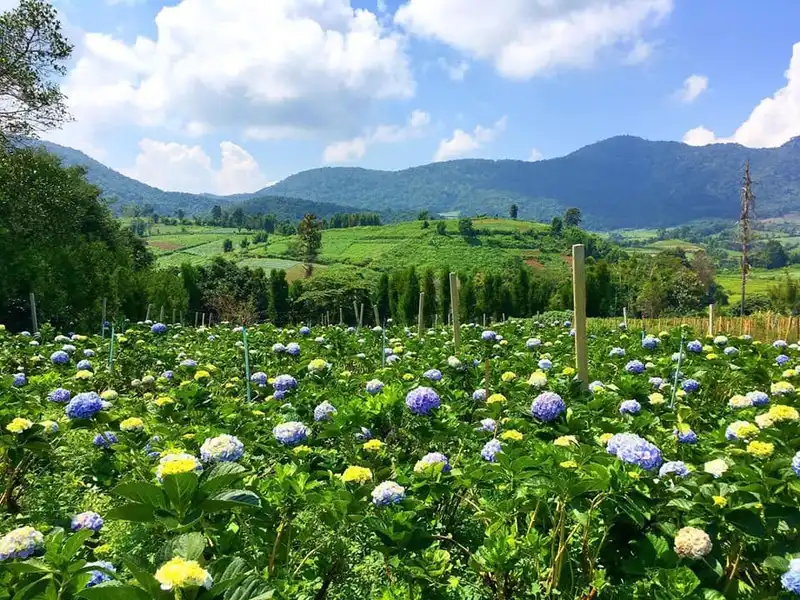
In terms of land use, the center covers agricultural areas within surrounding villages. Development initially focused on fruit trees as a medium- to long-term income base, before expanding into vegetables, ornamental plants, herbs, and field crops. This reflects a key Royal Project principle: diversity. Highland areas face limitations from slope, temperature, and seasonal variation. Relying on a single crop exposes households to high risk, whereas diversified production spreads income sources and strengthens resilience against climate variability and market fluctuations.
As livelihoods became more stable, the center expanded its role into economic, social, and cultural development. Sustainable highland development cannot rely solely on agricultural techniques; it must also strengthen household management, community organization, market access, and cultural continuity. Equally important is the parallel promotion of natural resource conservation, ensuring that farming activities remain compatible with watershed forests and that the mountains can continue to support future generations.
At present, the Khun Pae Royal Project Development Center is responsible for an area of 28,765 rai, covering four villages and supporting 466 households (466 families). These figures highlight that Khun Pae is not just a point on the map, but a large-scale, ongoing development area requiring careful management of knowledge, networks, and natural resources to deliver real benefits to people’s lives.
The terrain consists of mountains interspersed with valley plains, with Mae Pae Stream and Ton Phueng Stream flowing through the area. The elevation is approximately 1,035 meters above sea level. The soil is sandy loam with good drainage and a pH of about 6.5–7. These physical conditions are both an advantage and a challenge: while good drainage reduces waterlogging, careful soil and moisture management is essential, especially during the rainy season when erosion risks increase. Highland agriculture must therefore integrate soil and water management with income planning.
The climate features an average minimum temperature of around 14.5°C and an average maximum of about 27.2°C, with annual rainfall averaging 1,220 millimeters. These conditions support a wide range of crops and align with the Royal Project principle of “the right crop for the right season and place.” For visitors interested in development work, the knowledge here is not confined to textbooks—it is embedded in plot layout, crop selection, and land management that respects the mountain environment.
From a visitor’s perspective, Khun Pae is ideal for those who prefer to move slowly and look deeply. Its charm does not lie in decorative landscaping, but in the authenticity of a working development area—fields, people, methods, and clear objectives. For learning-oriented travelers, each demonstration plot reflects a specific community challenge and shows why conservation must go hand in hand with livelihoods. This is what gives Khun Pae meaning beyond a brief photo stop.
Getting There From Chiang Mai city, take Highway 108 (Chiang Mai–Hot) to kilometer markers 82–83 at the junction to Ban Pae and Wat Tong, then turn right. Continue through Ban Pae, Ban Thung Phatthana, Ban Bon Na, and Ban Khun Pae for approximately 22 kilometers to reach the Khun Pae Royal Project Development Center. During the rainy season, road conditions may be difficult; allow extra travel time and drive with caution.
| Name | Khun Pae Royal Project Development Center |
| Location | Chom Thong District, Chiang Mai Province (access via Ban Pae–Wat Tong junction to Ban Khun Pae) |
| Key Characteristics | Highland development center under the Royal Project, promoting alternative livelihoods to replace opium cultivation and shifting agriculture, integrating diversified crops with natural resource conservation and socio-cultural development |
| Development Focus Areas | Fruit trees: medium- to long-term income base Vegetables: seasonal income flexibility and household consumption Ornamental plants: niche-market options suited to highland climates Herbs and field crops: diversified production and local use Economic, social, and cultural development alongside livelihoods Natural resource conservation aligned with watershed protection |
| Established | February 1983 |
| Key Facts | 28,765 rai under responsibility; 4 villages; 466 households supported |
| Name Origin | Named after the local community of Khun Pae and its role as a Royal Project development center |
| Access | Chiang Mai → Highway 108 (Chiang Mai–Hot) → Km 82–83 junction to Ban Pae and Wat Tong → Ban Pae → Ban Thung Phatthana → Ban Bon Na → Ban Khun Pae (approx. 22 km) |
| Current Status | Active development area; visitors should check access conditions and visiting periods in advance |
| Contact | 098-008-8441, 095-450-6335 |
Frequently Asked Questions (FAQ)
Q: Who is Khun Pae Royal Project Development Center suitable for?
A: It is ideal for visitors interested in Royal Projects, highland agriculture, community development, and sustainable livelihoods rather than conventional sightseeing.
Q: What makes Khun Pae distinctive?
A: Its integrated approach—fruit trees, vegetables, ornamental plants, herbs, and field crops—combined with socio-cultural development and natural resource conservation.
Q: When is the best time to visit?
A: Late rainy season to early winter is generally more convenient for travel. During the rainy season, roads may be difficult and extra caution is advised.
Q: How should visitors prepare?
A: Check visiting conditions in advance, dress respectfully, follow local guidance, and remember this is a working development area serving local communities.
Q: Which route should be used to reach Khun Pae?
A: Take Highway 108 (Chiang Mai–Hot), turn right at Km 82–83 toward Ban Pae and Wat Tong, then continue through villages to Ban Khun Pae for about 22 km.
 Khun Pae Royal Project Development Center Map
 Category:
  Group:
  Last Update: 18 HourAgo
Comment
 Nearby Attractions
| Keyword (Advance) |
 Region
|
 Muang Chiang Mai(