
 Home
Home North(
 Chiang Mai(


Rating: 4.5/5 (4 votes)
 |
|  Map
Map 
 Have Map
  No Map
Nakhon Pathom attractions
Attractions in Thailand
Open Days: Daily
Opening Hours: 09.00–17.00
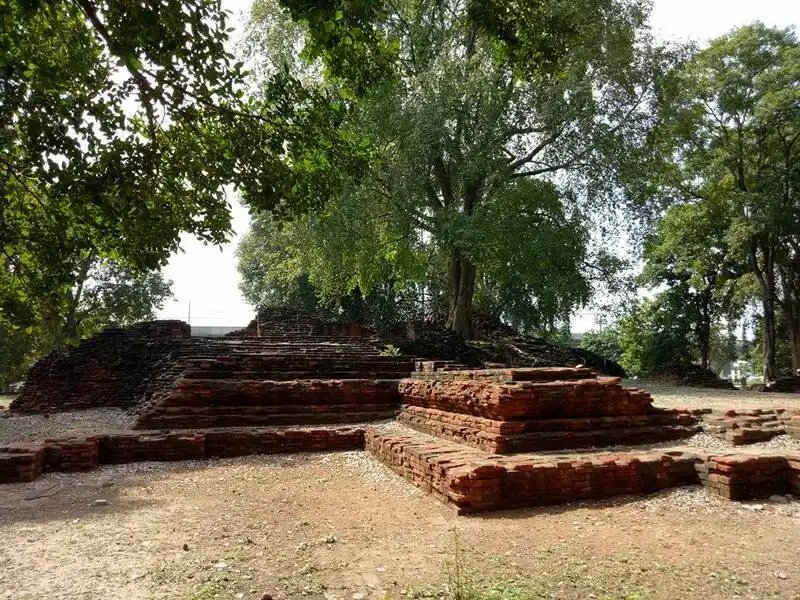
Wat Phra Meru, Nakhon Pathom Province, is an important ancient site located along Phet Kasem Road in the Ananta Uthayan area, Huai Chorakhe Subdistrict, Mueang Nakhon Pathom District. It stands not far south of Phra Pathom Chedi. Although it is now an abandoned temple and what remains visible today is mainly a large ancient mound rising prominently in the middle of the area, the quietness and simplicity of the site make it even clearer to visitors that what stands before them is not merely a pile of old bricks or an earthen mound, but the remains of a monumental religious structure that once flourished at the heart of Nakhon Pathom’s Dvaravati civilization.
The charm of Wat Phra Meru lies in the fact that it is an archaeological site that does not attract people through a fully preserved architectural form like a major active temple, but through the power of history that still lingers in the actual place. Travelers who enjoy cultural tourism can immediately feel the weight of time here, because simply walking into the area of the ancient mound feels like stepping closer to the earliest phase of Buddhism in the land of Suvarnabhumi.
Wat Phra Meru is highly significant as one of the ancient sites from the same period as the original Phra Pathom Chedi. Many scholars believe that this place was built during the Dvaravati period and is at least 1,000 years old. Its importance therefore goes beyond the local level of Nakhon Pathom Province and extends to the history of settlement, the spread of Buddhism, and the development of early art in central Thailand.
From the perspective of ancient geography, Wat Phra Meru stands in an area that was once part of the center of the ancient city of Nakhon Chai Si, or ancient Nakhon Pathom, one of the major communities of Dvaravati culture. Its close proximity to Phra Pathom Chedi creates the image of a sacred landscape in the past. In other words, this area did not contain only one religious monument, but rather a network of important ritual and sacred places connected to one another.
The present condition of Wat Phra Meru may appear quieter and simpler than many people expect, because the most clearly visible feature that remains is the large archaeological mound. Yet this mound itself is the heart of the entire story. It is the ruined base of a massive structure that once towered over this location, and the results of archaeological excavation reveal that the original construction was far larger than most visitors would imagine.
During the reign of King Rama VI, Prince Damrong Rajanubhab moved 2 pairs of large stone footprints from Wat Phra Meru to the outer gallery of Phra Pathom Chedi. This reflects the fact that Wat Phra Meru had long been regarded as an important source of antiquities and had drawn serious attention from historians and custodians of the nation’s heritage, rather than being just a small forgotten ruin by the roadside.
A major turning point in knowledge about Wat Phra Meru came in 1939, when the Fine Arts Department worked together with French archaeologists to conduct a systematic excavation. The results confirmed that this site was not merely an ordinary abandoned temple, but the remains of a major religious center built with remarkable sophistication and complete artistic components in accordance with Dvaravati tradition.
The key evidence from the excavation showed that this ancient monument once likely featured a gigantic chedi built in receding tiers that rose to a considerable height. The remaining ruined base still stood about 12 meters high at the time of excavation. That figure alone is enough to suggest the scale and grandeur of the original structure. Once one imagines the monument in its complete form, it becomes easier to understand why Wat Phra Meru is considered one of the principal ancient sites of old Nakhon Pathom.
Another especially striking feature was the discovery of niches enshrining seated stone Buddha images with pendant legs on all 4 sides. This form is of great importance in the history of art because it clearly reflects the architectural composition of religious monuments in the Dvaravati period. Later, one of these stone Buddha images was moved to Wat Phra Pathom Chedi, allowing today’s visitors to Phra Pathom Chedi to still encounter a living connection to Wat Phra Meru in another setting.
A wide range of antiquities was discovered at Wat Phra Meru, including bronze Buddha images, stone fragments such as arms, thighs, and hands of Buddha images, as well as sculptures of guardian giants, lion deities, lotus motifs, and decorative fragments from the collapsed chedi itself. These objects are highly valuable because they reveal both the technical skill of ancient craftsmen, symbolic concepts, and the flourishing Buddhist art of the old society.
Some of the antiquities from Wat Phra Meru were transferred to the Phra Pathom Chedi National Museum, while others were distributed to the Chao Sam Phraya National Museum and the Bangkok National Museum. This dispersal of finds reflects the national importance of the objects discovered here, because each piece is not simply an old artifact, but primary evidence that directly helps explain early Thai history.
From an art historical perspective, Wat Phra Meru clearly reflects the world of Dvaravati culture through the form of its large stupa, the placement of Buddha niches facing the cardinal directions, and the decorative motifs that were found. The discovery of sculptural elements such as giants and lion figures also shows that the art of this period was not limited to Buddha images alone, but included a rich variety of architectural ornament with symbolic and religious meaning.
The atmosphere of Wat Phra Meru today is very different from that of temples crowded with worshippers. This place feels like a historical landscape that still quietly preserves its stories beneath the ground and within old brick ruins. Visitors do not encounter merit-making ceremonies or the everyday religious life of a living temple. Instead, they experience something else: the feeling of standing in a place that was once monumental, and slowly imagining the past from the remains that survive.
For this reason, Wat Phra Meru is particularly well suited to travelers interested in history, students, researchers, and anyone wishing to see Nakhon Pathom beyond its most famous landmarks. Visiting here adds depth to a trip to Phra Pathom Chedi, because it reveals that Nakhon Pathom is not defined by only one great chedi, but by an ancient landscape made up of several connected sites.
For those who enjoy photography, Wat Phra Meru has a quiet and solemn appeal. The open space, the archaeological mound, and the surrounding trees create an atmosphere very different from gleaming golden temples or sites with fully preserved architecture. Photographs taken here tend to carry an archaeological and temporal feeling, making the place ideal for documentary-style photography or mood-focused images rather than images centered on grandeur alone.
The best time to visit is in the morning or late afternoon, when the sun is less intense and the site is more comfortable to walk around. At those times, the light also enhances the textures of the ancient bricks and the contours of the mound, helping visitors perceive the dimensions of the site more clearly than during the midday heat.
Getting There Reaching Wat Phra Meru is quite convenient because it is located along Phet Kasem Road within Nakhon Pathom town. If starting from Phra Pathom Chedi, visitors can continue south for only a short distance. Those traveling by private car can access the site easily, while those using public transport can take a taxi or local hired vehicle from central Nakhon Pathom without difficulty. This makes the site suitable for a one-day itinerary linking Phra Pathom Chedi, Sanam Chan Palace, and the Phra Pathom Chedi National Museum.
In terms of present-day importance, Wat Phra Meru still plays a major role as a learning site for the archaeology and history of Nakhon Pathom. Although it is now an abandoned temple, its value has not diminished at all. On the contrary, it remains one of the most direct places for understanding the origins of religious and cultural prosperity in central Thailand.
If Phra Pathom Chedi is the great symbol of Nakhon Pathom, Wat Phra Meru is another crucial piece that reveals the deep roots of this land. It may not be the place where the largest number of travelers come for photographs, but for those who truly want to understand Nakhon Pathom, Wat Phra Meru is a place that should not be overlooked.
| Place Summary | Wat Phra Meru is an abandoned Dvaravati-period temple ruin in Nakhon Pathom, marked by a large archaeological mound and recognized as an important excavation site that helps explain the development of Buddhism in ancient Nakhon Pathom. |
| Highlights | An ancient abandoned temple more than 1,000 years old, believed to have once featured a massive tiered chedi of great height, with many important Dvaravati antiquities discovered on site. |
| History / Period | Believed to have been built during the Dvaravati period, with an age close to that of the original Phra Pathom Chedi, at least 1,000 years old, and the subject of a major excavation in 1939. |
| Address | Along Phet Kasem Road, in the Ananta Uthayan area, Huai Chorakhe Subdistrict, Mueang Nakhon Pathom District, Nakhon Pathom Province |
| Getting There | Easy to reach via Phet Kasem Road from Nakhon Pathom town. The site lies a short distance south of Phra Pathom Chedi, and taxis or local hired vehicles can be taken from the Phra Pathom Chedi area. |
| Open Days | Daily |
| Opening Hours | 09.00–17.00 |
| Facilities | Outdoor walking areas around the archaeological remains and the surrounding park landscape. |
| Zones | Main archaeological mound zone and the surrounding Ananta Uthayan park area. |
| Nearby Tourist Attractions | 1. Wat Phai Lom, approximately 800 m 2. Phra Pathom Chedi Night Market, approximately 1.3 km 3. Dvaravati Si Nakhon Pathom Walking Street, approximately 1.8 km 4. Sanam Chan Palace, approximately 2.4 km 5. Phra Pathom Chedi National Museum, approximately 3.9 km |
| Nearby Restaurants | 1. Tang Ha Seng Old Shop, Talat Lang, approximately 2.5 km, Tel. 034-241-322, 081-194-9144, 086-166-9955 2. Chen Nguan Original Floating Ice Cream, Nakhon Pathom, approximately 2.6 km, Tel. 093-491-6465 3. Krua Ko Tae Nakhon Pathom, approximately 3.5 km, Tel. 095-662-2324, 095-516-1793 4. The Garden Eatery, approximately 3.0 km, Tel. 080-446-6635 5. Tang Ha Seng (Old Shop), approximately 2.5 km, Tel. 034-241-322, 081-194-9144, 086-166-9955 |
| Nearby Accommodations | 1. Xen Hotel Nakhon Pathom, approximately 3.0 km, Tel. 034-900-500, 063-270-4859 2. Mida Grande Hotel Dhavaravati Nakhon Pathom, approximately 2.8 km, Tel. 093-383-5515, 034-966-700 3. Ratchaphruek Pavilion, approximately 4.0 km, Tel. 034-280-299, 084-768-1188 4. My Room Nakhon Pathom, approximately 4.0 km, Tel. 092-567-1557, 098-843-3723 5. Xen Hotel Nakhon Pathom, approximately 3.0 km, Tel. 034-900-500, 063-270-4859 |
Frequently Asked Questions (FAQ)
Q: Where is Wat Phra Meru in Nakhon Pathom located?
A: Wat Phra Meru is located along Phet Kasem Road in the Ananta Uthayan area, Huai Chorakhe Subdistrict, Mueang Nakhon Pathom District, Nakhon Pathom Province, not far south of Phra Pathom Chedi.
Q: Is Wat Phra Meru really an abandoned temple?
A: Yes. Today Wat Phra Meru is an abandoned temple site, with its most visible remains being a large archaeological mound and the surrounding ancient landscape.
Q: Why is Wat Phra Meru historically important?
A: Wat Phra Meru is a Dvaravati-period monument at least 1,000 years old and one of the key sites that helps explain the flourishing of Buddhism in ancient Nakhon Pathom.
Q: What important discoveries were found at Wat Phra Meru?
A: Archaeologists discovered bronze Buddha images, fragments of stone Buddha images, guardian giants, lion figures, lotus motifs, decorative fragments from the chedi, and evidence of a very large ancient monument.
Q: How is Wat Phra Meru connected to Phra Pathom Chedi?
A: Scholars believe Wat Phra Meru was built during the Dvaravati period and is close in age to the original Phra Pathom Chedi. Some antiquities from Wat Phra Meru were also moved to or preserved in connection with Phra Pathom Chedi.
Q: When is the best time to visit Wat Phra Meru?
A: Morning or late afternoon is best, because the weather is cooler and it is more comfortable to walk around the archaeological site.
Q: What kind of travelers is Wat Phra Meru suitable for?
A: It is ideal for travelers interested in history, archaeology, Dvaravati culture, and for those who want to explore a deeper side of Nakhon Pathom beyond the main landmarks.
 Wat Phra Meru Map
 Category:
  Group:
  Last Update: 1 DayAgo
Comment
 Nearby Attractions
| Keyword (Advance) |
 Facebook Fanpage
 Region
 Art, Culture and Heritage
 Historical Sites and Monuments(
 Landmarks and Memorials(
 Royal Palace(
 Art, Craft Centres, Tradition(
 Museums(
 Art Gallery(
 Educational Places
 Educational Gardens, Farm(
 University
 Other religious and spiritural sites(
 Research and Development
 Royal Project(
 Suburban Living
 Village, Community(
 Local Market(
 Floating Market(
 Nature and Wildlife
 River, Canal(
 Other natural attractions(
 Entertainment and Agricultural
 Animal camps and shows(
 Stadium(
 Farm, Parks, Gardens and Ecotourism(
 Waterpark(
 Theater(
 Outdoor and Adventure Activities(
 Spas and Wellness
 Spas and Wellness(