
 Home
Home North(
 Chiang Mai(


Rating: 4/5 (6 votes)
 |
|  Map
Map 
 Have Map
  No Map
Nakhon Pathom attractions
Attractions in Thailand
Open Days: Daily
Opening Hours: 06.00–20.00
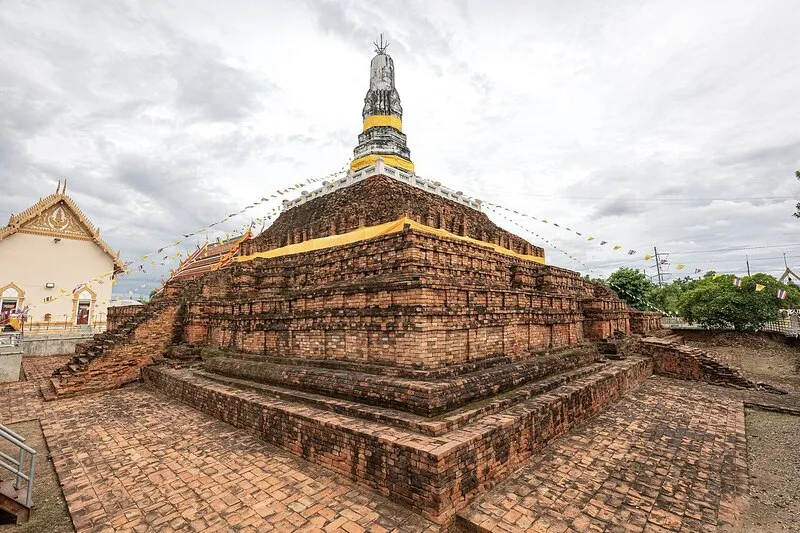
Wat Phra Prathon Chedi Worawihan is one of the most important ancient sites in Nakhon Pathom and a destination well worth visiting for travelers interested in early Thai history. Within the temple grounds stands Phra Prathon Chedi, an ancient monument from the Dvaravati period that clearly reflects the prosperity of the old city of Nakhon Chai Si in terms of religion, art, and settlement patterns in Thailand’s central river basin. For visitors who want to understand Nakhon Pathom beyond the familiar image of Phra Pathom Chedi alone, this is another key place that helps complete the historical picture of the province.
The charm of Phra Prathon Chedi lies in the fact that it is an ancient monument that still exists within the living space of an active temple. Visitors do not see only an isolated old chedi; they also experience a sacred place where local people still come to make merit, pay respect, and use the temple as a spiritual center of the community. Because of this, the atmosphere is different from that of an open-air archaeological site or museum. Here, the solemn presence of ancient brickwork coexists with the rhythm of a contemporary temple still woven into everyday life.
The location of the temple is also highly significant. Wat Phra Prathon Chedi Worawihan is located in Phra Prathon Subdistrict, Mueang Nakhon Pathom District, about 2 kilometers east of Phra Pathom Chedi along Phet Kasem Road. This short distance makes it easy for visitors to Nakhon Pathom to connect both major sites in a single trip. It also helps reveal that this ancient urban center did not revolve around only one religious landmark, but rather around a network of sacred places and important historical spaces distributed throughout the area.
In historical terms, Phra Prathon Chedi is recognized as a monument from the Dvaravati period. Its original form is believed to have been an inverted-bowl-shaped chedi, a characteristic style of early Buddhist monuments in what is now Thailand. This form is clearly different from the bell-shaped chedis more commonly associated with later periods. As a result, Phra Prathon Chedi is especially valuable for the study of the development of Buddhist architecture in central Thailand. Anyone who pauses to observe the monument closely can immediately sense that this is not merely a structure built for worship, but also a surviving trace of the ideas, beliefs, and construction knowledge of an ancient society.
The importance of Phra Prathon Chedi becomes even clearer when viewed in relation to its surroundings. The temple stands in the heart of the ancient city of Nakhon Chai Si, or in an area closely connected with ancient Nakhon Pathom, one of the major centers of Dvaravati culture. The discovery of many ancient remains and artifacts in this area suggests that it was once a large and prosperous community with a strong religious and artistic foundation, rather than a small village with a solitary monument. Visiting the site therefore means more than simply going to a temple; it is an opportunity to step into the center of a regional history that once flourished in remarkable depth.
One of the factors that makes Phra Prathon Chedi stand out so strongly in the eyes of historians and visitors alike is the large number of artifacts unearthed within the temple grounds. These include Buddha images, stucco Buddha heads, terracotta votive tablets, and other architectural elements. Such finds confirm that this area has been important since the Dvaravati period and that Buddhism played a major role in the lives of the people who lived here. Each discovery tells more than an artistic story; it also helps explain patterns of worship, local belief systems, and the cultural influences that reached this region from the outside world.
The artifact most often mentioned is a bronze figure of Garuda trampling a naga. This object is especially important because King Vajiravudh, Rama VI, later adopted this form as his royal emblem. This connection gives Phra Prathon Chedi significance not only in archaeological terms, but also in relation to the later history of royal symbolism in modern Thailand. In other words, an object discovered within this ancient monument created a symbolic link that extended into another era of Thai national history.
When looking at the chedi today, visitors can see the result of restoration and care carried out over several periods, leaving traces of different eras layered over one another. This does not diminish the value of the site. On the contrary, it makes Phra Prathon Chedi a monument that can be read on multiple historical levels: as a Dvaravati structure, as a recognized archaeological site in the modern state era, and as part of a temple that still plays an active role in present-day society.
The atmosphere at Wat Phra Prathon Chedi Worawihan differs from that of popular tourist attractions crowded throughout the day. The first impression on arrival is one of calm and historical weight. The massive brick chedi feels solemn and substantial, carrying a strong sense of the past. If you come in the early morning or late afternoon, the light brings out the texture of the old bricks and the form of the base especially well. This allows visitors to experience a beauty that is understated rather than dramatic, slowly drawing them in and encouraging them to stay longer than they might at an ordinary tourist stop.
Another appealing aspect of the temple is that it suits both those who want to make merit and those interested in history. Families can bring elderly relatives to pay respects and walk around the grounds without much difficulty, while visitors interested in ancient cities can spend time considering the form of the chedi and connecting what they see here with other important historical sites in Nakhon Pathom. It is therefore a destination that works equally well for spiritual travel and cultural exploration.
In its present-day role, Wat Phra Prathon Chedi Worawihan remains a royal temple and continues to play an active part in religious life. This means the site is not a monument frozen in the past, but a place still connected to the daily life of the surrounding community through merit-making ceremonies, annual events, and its role as a place where people come to find peace of mind. This continuity gives Phra Prathon Chedi a social meaning that stands alongside its historical importance. At present, Phra Sri Theerawong (Samai Sajjavaro) is publicly associated with Wat Phra Prathon Chedi Worawihan as a senior monk of the temple.
Another reason the temple is attractive for tourism is its location, which connects easily to the main routes through Nakhon Pathom. Visitors starting from Phra Pathom Chedi can drive here in a short time and can also continue on the same day to Sanam Chan Palace, Noen Wat Phra Ngam, or Wat Phra Men. The result is a trip that feels more like an in-depth exploration of an old city than a simple photo stop at a single landmark.
Those who enjoy photography will find that Phra Prathon Chedi has a very distinctive character. The old brick surfaces, the broad base, and the way the monument rises above the surrounding ground create a range of photographic moods, from documentary-style images to devotional scenes and architectural studies. The best time is usually early in the morning before the light becomes harsh, or late in the afternoon before sunset, when the softer light and longer shadows help create still, layered images with a strong sense of history.
Although many visitors know Nakhon Pathom mainly through Phra Pathom Chedi, Phra Prathon Chedi broadens that understanding by showing that the city contains a much deeper and wider historical landscape. This site acts almost like another chapter in the story of the ancient city, showing how Buddhism, art, and community structure developed together in central Thailand before the later historical periods emerged.
In terms of its value today, Phra Prathon Chedi remains an important learning site for students, researchers, and general visitors who want to study Dvaravati culture through a real place rather than only through books. Reading about the Dvaravati period gives one kind of understanding, but standing in front of a large ancient chedi that still survives within an active religious setting brings the weight of the phrase “cultural heritage” into much sharper focus.
Visitors should allow enough time to walk through the area without rushing, because the interest of this temple does not lie in flashy activities, but in the gradual experience of absorbing its old atmosphere and observing the details around the monument. If you move too quickly, you may see only one temple. If you spend a little more time, you begin to see the relationships between monument, religion, city, and community layered together in the same space.
Getting There Wat Phra Prathon Chedi Worawihan is easy to reach. If you are traveling by private car, you can use Phet Kasem Road into Nakhon Pathom town and then follow the route to Phra Prathon Subdistrict without much difficulty. Those starting from Phra Pathom Chedi can drive here in a short distance of around 2 kilometers. Travelers arriving in Nakhon Pathom by train or intercity bus can continue by local taxi or hired vehicle to the temple quite easily, as it is not far from the main parts of town.
Overall, Wat Phra Prathon Chedi Worawihan is ideal for travelers who want a deeper and more meaningful experience of Nakhon Pathom rather than a quick check-in. The site brings together history, archaeology, religion, and the quiet atmosphere of a living temple in one place. For anyone who wants to understand Nakhon Pathom as an ancient land shaped by Dvaravati civilization, Phra Prathon Chedi is one of the places that should not be overlooked.
| Place Summary | Wat Phra Prathon Chedi Worawihan is a royal temple containing Phra Prathon Chedi, a Dvaravati-period monument and one of the key archaeological remains connected with the ancient city of Nakhon Pathom / Nakhon Chai Si. |
| Highlights | An ancient Dvaravati chedi originally in an inverted-bowl form, one of Nakhon Pathom’s oldest monuments, with many significant artifacts discovered on site, including a bronze Garuda trampling a naga. |
| History / Period | Dvaravati period, with continued restoration and care in later eras; later registered as a national ancient monument. |
| Latest Abbot or Senior Monk | Phra Sri Theerawong (Samai Sajjavaro) |
| Address | 120 Moo 1, Phra Prathon Subdistrict, Mueang Nakhon Pathom District, Nakhon Pathom 73000, Thailand |
| Coordinates | 13.815016, 100.096988 |
| Getting There | Easy to reach by car via Phet Kasem Road. The temple is about 2 km from Phra Pathom Chedi. From Nakhon Pathom town center or Nakhon Pathom Railway Station, visitors can continue by local taxi or hired transport without difficulty. |
| Open Days | Daily |
| Opening Hours | 06.00–20.00 |
| Facilities | Religious activity areas, worship points, open temple grounds, shops during temple fairs or busy periods, and parking space depending on the temple’s available area. |
| Zones | Phra Prathon Chedi zone, ordination hall and supporting buildings, and open activity areas used for merit-making events and temple functions. |
| Nearby Tourist Attractions | 1. Wat Phra Men, approximately 3.19 km 2. Phra Pathom Chedi, approximately 3.97 km 3. Phra Ruang Rojanarit, approximately 4.00 km 4. Noen Wat Phra Ngam, approximately 4.59 km 5. Phra Tamnak Marie Ratcharat Banlang, approximately 5.48 km |
| Popular Restaurants Nearby | 1. The Garden Eatery, approximately 2.54 km, Tel. 080-446-6635 2. Sin Ha Seng Khao Moo Daeng, approximately 4.06 km, Tel. 034-242-564 3. Tang Ha Seng Old Shop, approximately 4.08 km, Tel. 034-241-703, 034-251-635 4. Chen Nguan Original Sky Ice Cream Nakhon Pathom, approximately 4.13 km, Tel. 093-491-6465 5. Krua Ko Tae Nakhon Pathom, approximately 5.00 km, Tel. 095-662-2324, 095-516-1793 |
| Popular Accommodations Nearby | 1. My Room Nakhon Pathom, approximately 3.21 km, Tel. 098-843-3723 2. Ratchaphruek Pavilion, approximately 4.19 km, Tel. 034-280-299, 084-768-1188 3. Mida Grande Dvaravati Nakhon Pathom, approximately 4.20 km, Tel. 034-966-700 4. Baan Phak Ruen Pathom, approximately 4.45 km, Tel. 091-566-9492, 089-836-3324 5. Xen Hotel Nakhon Pathom, approximately 4.57 km, Tel. 034-900-500, 034-900-505 |
| Main Contact Number | 034-212-313, 034-212-011, 034-242-440 |
Frequently Asked Questions (FAQ)
Q: Is Wat Phra Prathon Chedi Worawihan far from Phra Pathom Chedi?
A: No. It is about 2 kilometers from Phra Pathom Chedi, so both sites can easily be visited on the same trip.
Q: Why is Phra Prathon Chedi historically important?
A: Phra Prathon Chedi is an important Dvaravati-period monument in Nakhon Pathom. It helps explain the development of religion, art, and urban communities in central Thailand.
Q: What is the main highlight of Phra Prathon Chedi?
A: Its main highlight is the original inverted-bowl form associated with the Dvaravati period, along with the many important artifacts discovered within the temple grounds.
Q: What can visitors see at Wat Phra Prathon Chedi?
A: Visitors can see Phra Prathon Chedi itself, the temple atmosphere, the ordination hall, and the surrounding grounds that reflect the character of an old temple still active in religious life today.
Q: What type of traveler is this place suitable for?
A: It is suitable for both spiritual travelers and those interested in history, archaeology, and cultural tourism in Nakhon Pathom.
Q: What is the most convenient way to get to Wat Phra Prathon Chedi?
A: Traveling by private car is the easiest option because the temple is connected to the main routes of Nakhon Pathom. However, if you arrive in town first, you can also continue by local taxi or hired transport without difficulty.
Q: Is Wat Phra Prathon Chedi suitable for children or elderly visitors?
A: Yes. The temple is relatively easy to access, has a peaceful atmosphere, and allows visitors to spend as much or as little time there as they wish.
Q: Where should I go after visiting Wat Phra Prathon Chedi?
A: You can continue to Phra Pathom Chedi, Wat Phra Men, Noen Wat Phra Ngam, or Sanam Chan Palace for a broader understanding of Nakhon Pathom’s historical landscape.
 Tel: 034212011, 034212313, 034242440
 Wat Phra Prathon Chedi Worawihan Map
 Category:
  Group:
  Last Update: 15 HourAgo
Comment
 Nearby Attractions
| Keyword (Advance) |
 Region
|
 Muang Nakhon Pathom(