
 Home
Home North(
 Chiang Mai(


Rating: 3.8/5 (4 votes)
 |
|  Map
Map 
 Have Map
  No Map
Kanchanaburi attractions
Attractions in Thailand
Open Days: Open Daily
Opening Hours: 08:00 – 16:30
Srinagarindra Dam National Park is a vast national park of major ecological importance within Thailand’s Western Forest Complex. The park spans parts of Sai Yok District, Si Sawat District, and Thong Pha Phum District in Kanchanaburi Province, covering approximately 957,500 rai, or about 1,532 square kilometers. Much of the landscape consists of rugged, layered mountain ranges, dense forest, and the broad reservoir above Srinagarindra Dam with sweeping scenic views. This setting gives the park a distinctive natural identity, with a wide range of attractions such as waterfalls, caves, hot springs, and islands or rocky outcrops scattered across the lake.
Another defining strength of Srinagarindra Dam National Park is its position as part of a large, continuous conservation corridor. The park connects with other nationally significant protected areas, including Sai Yok National Park, Erawan National Park, Thung Yai Naresuan Wildlife Sanctuary, and Salak Phra Wildlife Sanctuary. As a result, this region forms a massive forest continuum that plays a critical role in wildlife conservation, watershed protection, and ecosystem stability at a broader regional scale.
Background and Establishment History Srinagarindra Dam National Park emerged from increasing recognition of the value of the headwater forests of the Khwae Yai River above Srinagarindra Dam. The area was known for its high forest integrity, complex mountain terrain, abundant wildlife, and a variety of standout natural features such as Huai Mae Khamin Waterfall, hot springs, caves, and the reservoir landscape above the dam.
In response, the Cabinet passed a resolution on 9 January 1979 to preserve the forest by declaring it a national park. In 1980, the National Parks Division of the Royal Forest Department assigned Mr. Nisai Fungkajorn, a Forestry Academic Officer (Level 5) who was serving as the head of Erawan National Park at the time, to conduct a field survey of the area together with a provincial survey team from Kanchanaburi. The survey concluded that the landscape, scenic values, and diversity of natural resources were highly suitable for national park designation.
The National Parks Division submitted the survey results to the National Park Committee, which, at its meeting No. 2/1980 on 8 August 1980, agreed to proceed with defining the area as a national park. A Royal Decree was then issued to designate forest land in the Khao Phra Ruesi and Khao Bo Rae forest zones across multiple subdistricts in Thong Pha Phum, Si Sawat, and Sai Yok Districts, Kanchanaburi Province, as a national park. The announcement was published in the Royal Gazette, Volume 98, Part 210, dated 23 December 1981. This made Srinagarindra Dam National Park the 38th national park of Thailand.
Topography Part of the park’s modern landscape is linked to the construction of Srinagarindra Dam, which blocks the Mae Klong River system (Khwae Yai). This created a large reservoir above the dam. Many important streams and tributaries flow into the reservoir, including Huai Mae Khamin, Huai Kha Khaeng, Huai Mae Wong, Huai Kriang Krai, and Huai Mae Phlu. In addition, several streams flow into the Khwae Noi River within Sai Yok District.
The terrain is dominated by limestone and sedimentary rock formations. Elevations range from about 400 meters above mean sea level on average up to roughly 1,100 meters at the highest points. The reservoir surface above Srinagarindra Dam reaches a maximum level of about 180 meters above mean sea level. This elevation gradient creates diverse scenery, from forested mountain ridges to expansive open-water vistas across the reservoir.
Climate Srinagarindra Dam National Park lies in a rain shadow zone, which means it receives less rainfall than surrounding areas. The hot season can be extremely warm, with maximum temperatures reaching approximately 44–45°C in April. In the cool season, minimum temperatures in December can drop to about 8–9°C. Average temperatures are around 27°C. The rainy season typically begins in mid-April and ends around mid-October, with average annual rainfall of about 1,600 millimeters.
Vegetation and Wildlife Forest ecosystems within Srinagarindra Dam National Park can be broadly categorized into 3 major types: mixed deciduous forest, deciduous dipterocarp forest, and dry evergreen forest. Mixed deciduous forest covers a large portion of relatively flatter areas and rolling hills, particularly in central zones and along the reservoir shoreline. Key tree species include Daeng (Xylia xylocarpa), Makha Mong (Afzelia xylocarpa), Pradu (Pterocarpus spp.), and other hardwoods, with bamboo occurring densely in some areas. Wildlife recorded in these forests includes stump-tailed macaques, porcupines, gaur, wild elephants, and many species of birds, reptiles, and amphibians.
Deciduous dipterocarp forest is found in drier upland zones and typically features tree species such as Teng (Shorea obtusa), Rang (Shorea siamensis), Daeng, and other drought-tolerant species. The understory often includes cycads and grasses, as well as bamboo such as Pai Phek. Wildlife in these areas may include lesser mouse-deer, deer, multiple woodpecker species, venomous snakes such as pit vipers, and various reptiles adapted to drier habitats. Dry evergreen forest occurs in scattered pockets, usually on windward slopes where moist air brings rain, or along stream corridors. Important trees include Yaum Hin, Takhians, and other evergreen hardwoods. This habitat can support rarer wildlife such as Indochinese tigers, white-handed gibbons, and northern spectacled langurs.
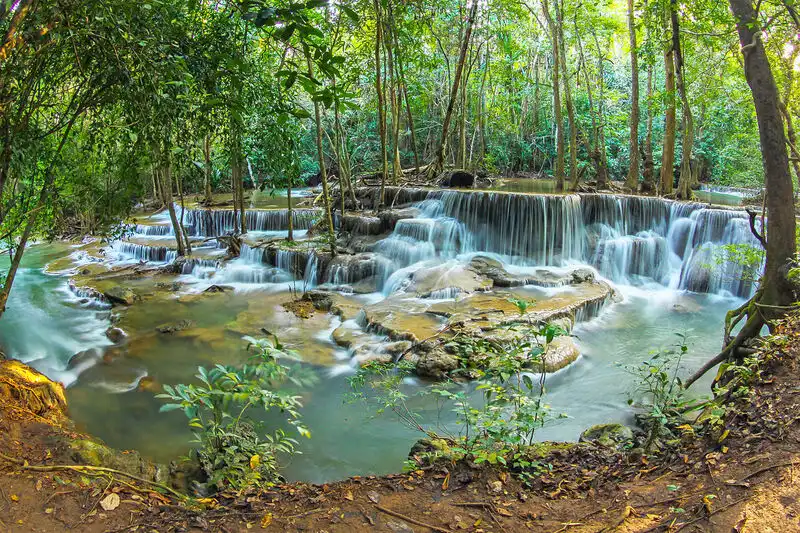
Key Attractions One of the park’s most famous highlights is Huai Mae Khamin Waterfall, located near the park headquarters on the shore of the Srinagarindra Dam reservoir. The waterfall cascades through multiple tiers and is widely regarded as one of Kanchanaburi’s most beautiful nature landmarks. In addition, the park features hot springs, caves, and reservoir viewpoints that are well-suited for boat trips and scenic exploration.
Getting There Huai Mae Khamin Waterfall and the park headquarters area are approximately 108 kilometers from Kanchanaburi town. Visitors commonly travel by private car via the Kanchanaburi–Si Sawat route. The journey typically takes about 2–3 hours, depending on traffic and road conditions.
| Place Summary | A large national park in Kanchanaburi featuring a major reservoir, waterfalls, forested mountains, and high biodiversity within the Western Forest Complex. |
| Highlights | Huai Mae Khamin Waterfall, scenic reservoir views, continuous forest conservation corridor, and diverse wildlife habitats. |
| Nearby Tourist Attractions (Route Distance) | 1) Erawan Waterfall (65 km) 2) Sai Yok National Park (45 km) 3) Huai Mae Khamin Waterfall (Inside the park) 4) Srinagarindra Dam (15 km) 5) Si Sawat Market (40 km) |
| Nearby Restaurants (Route Distance + Phone) | 1) Floating Restaurants near Srinagarindra Dam (15 km) Tel. 081-861-3434 2) Floating Restaurant, Si Sawat Area (20 km) Tel. 086-172-6632 3) Si Sawat Market Food Area (40 km) Tel. 034-574-001 4) Riverside Restaurants, Sai Yok Area (45 km) Tel. 034-686-123 5) Riverside Restaurant, Erawan Area (65 km) Tel. 081-944-5566 |
| Nearby Accommodations (Route Distance + Phone) | 1) Srinagarindra Dam National Park Lodging (Inside the park) Tel. 02-561-0777 2) Srinagarindra Dam Resort (15 km) Tel. 034-696-165 3) Accommodation in Si Sawat (40 km) Tel. 034-574-222 4) Accommodation in Sai Yok (45 km) Tel. 034-686-321 5) Accommodation near Erawan Waterfall (65 km) Tel. 081-944-8899 |
Frequently Asked Questions (FAQ)
Q: What type of travelers is Srinagarindra Dam National Park suitable for?
A: It is ideal for nature lovers, trekkers, and visitors who want reservoir views, waterfalls, and forest scenery.
Q: When is the best time to visit?
A: The rainy season and cool season are excellent, with lush scenery, stronger waterfall flow, and milder temperatures.
Q: Are there dangerous wild animals inside the park?
A: This is a natural forest area with wildlife. Visitors should follow ranger guidance strictly and avoid leaving designated routes.
Q: Can I stay overnight inside the park?
A: Yes. The park provides lodging and camping areas for overnight stays.
Q: Is the route difficult to reach?
A: The park is accessible by private car, with main routes paved throughout.
 Website: www.dnp.go.th
 Tel: 034532027, 034547018
 Fax: 034516667
 Sri Nakarin National Park Map
 Category:
  Group:
  Last Update: 2 MonthAgo
Comment
 Nearby Attractions
| Keyword (Advance) |
 Facebook Fanpage
 Region
 Art, Culture and Heritage
 Historical Sites and Monuments(
 Landmarks and Memorials(
 Art, Craft Centres, Tradition(
 Museums(
 Art Gallery(
 University
 Places of Worship
 Temple(
 Church(
 Other religious and spiritural sites(
 Research and Development
 Royal Project(
 Suburban Living
 Village, Community(
 Local Market(
 Mountain (Doi)(
 Dam, Reservoir, Lake(
 Waterfalls(
 Hot Springs(
 Caves(
 River, Canal(
 Other natural attractions(
 Entertainment and Agricultural
 Zoos and Aquariums(
 Animal camps and shows(
 Farm, Parks, Gardens and Ecotourism(
 Cinema(
 Outdoor and Adventure Activities(
 Travel Articles, Recipes
 Travel Review, Food Review(