
 Home
Home North(
 Chiang Mai(


Rating: 4.3/5 (4 votes)
 |
|  Map
Map 
 Have Map
  No Map
Kanchanaburi attractions
Attractions in Thailand
Open Days: Every day
Opening Hours: 06.00 – 18.00
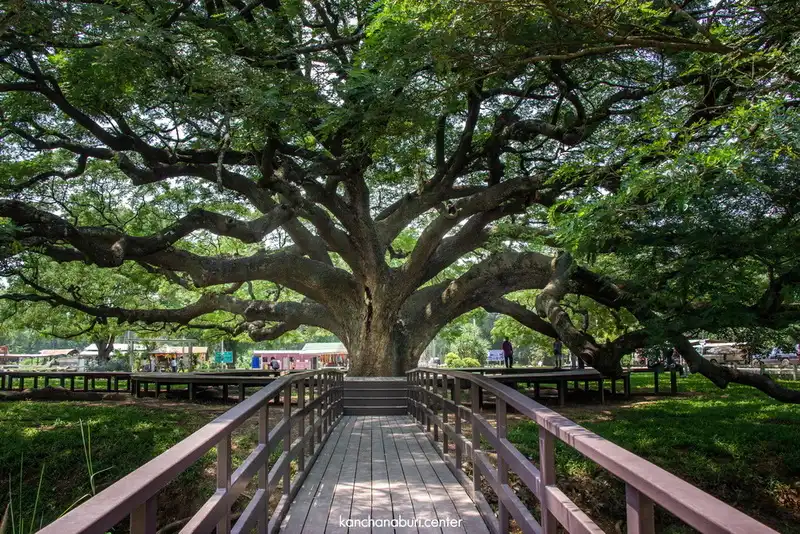
Giant Rain Tree in Kanchanaburi is a checkpoint that wins purely through the “scale of nature,” with no special effects needed. The moment you stand beneath its vast canopy—spreading like an enormous green roof—you immediately understand why people are willing to drive out of town just to see a single tree. Its sheer size makes you feel unexpectedly small, and that feeling becomes a simple but powerful kind of mental rest. Under the wide shade, the air feels noticeably cooler, especially in the morning and late afternoon when the light is soft, the wind moves through, and the green leaves reduce the harshness of the sun to the eye. This is why it suits anyone who wants to switch from chasing the clock to spending time in a place that never rushes you.
The Giant Rain Tree is located along the route to Dan Makham Tia District, in Ban Kasetthakam, Moo 5, Ko Samrong Subdistrict, Kanchanaburi. Visitors can view it within the area of the 1st Animal and Agriculture Division (Animal Breeding Unit), Royal Thai Army Department of Veterinary Services. A key feature of this location is that it is within a government facility that allows the public to come and appreciate a remarkable natural landmark. As a result, the place combines orderly surroundings with the quiet atmosphere of the countryside. When you arrive, the first reaction is usually not “wow because of decoration,” but “wow because it’s real,” because the trunk’s scale and the way the branches spread wide make photos on a phone feel completely different from what you see in front of you.
This tree is the reason many people want to come and confirm the experience with their own eyes. It is said to be over 100 years old and often described as so large that it takes around 10 people to wrap their arms around it. From a canopy-measurement perspective, the average canopy radius is about 25.87 meters, creating a shade diameter of roughly 51.75 meters. In simple terms, its shadow can cover a broad area where many people can stand together without feeling cramped. The canopy height is about 20 meters, and the canopy area covers roughly 1 rai 2 ngan 4 wah. These numbers are not just for impressing people—they help explain why “being under this tree feels like stepping into another small world.” A canopy this wide creates its own microclimate: the temperature beneath tends to feel more comfortable, and humidity and airflow differ from open ground. That is why it’s ideal for walking around, admiring the large branches, taking photos, and sitting to rest without forcing yourself.
Part of the unique appeal of a rain tree (also commonly called monkeypod in Thailand) is a canopy shape that looks almost “designed,” even though it is completely natural. The canopy often forms a low dome. Thick primary branches extend far from the trunk and then split into a network of smaller branches that support countless fine leaves. When sunlight filters through, it creates soft patterns of shadow on the ground. If you enjoy photography, this spot offers both the depth of natural light and the dramatic structure of branches in a single frame. And even if photography is not your thing, it still works as a “place to pause,” because watching massive branches slowly curve outward like a living arch naturally slows your thoughts.
In terms of history and background, the Giant Rain Tree has long been mentioned as an old, established tree that has grown in the area for generations—before its name became widely known among travelers. What makes it special is not only that it is “old,” but that it is “old and thriving.” Many large trees are affected by expanding communities, roads, or land development, yet this one has maintained a broad canopy, dense shade, and beautifully structured branches. Over time, the surrounding landscape has been adjusted to make visits more convenient while reducing impact on the roots—for example, providing walking access that does not require people to step repeatedly on sensitive ground. The fact that a single tree can become a landmark within an official facility reflects an important idea: outstanding nature can become a tourism asset when it is managed with respect for the tree first, rather than allowing tourism to press down on the environment.
Visiting here is therefore not just about “checking in.” It is a chance to look at a giant tree with more awareness. If you observe the ground around the base, you can see that a large tree does not stand only because of its trunk—it depends on a root system that spreads widely beneath the soil surface. The wider the canopy, the farther the roots must extend to support weight and resist wind forces. This is why the most important etiquette when visiting a giant tree is “do not step on or compact the root zone unnecessarily.” The shallow roots of many large trees are sensitive to soil compaction. Repeated walking on the same area, parking too close, or placing heavy objects over the roots can compress the soil, reduce oxygen, and harm the tree’s long-term health. From a nature-lover’s perspective, good travel is not only about getting a beautiful photo—it is about leaving the tree healthy enough for future visitors to experience it in the same way.
The atmosphere here is best for gentle relaxation rather than heavy activity, because the heart of the place is simply being under the shade and spending time slowly in green space. Many people come early to capture soft light, take wide-angle photos that show the full canopy, and enjoy the quiet before it gets busier, producing images that feel open and truly natural. Late afternoon is equally attractive, because angled sunlight adds depth to the branches, the leaf shadows become more dramatic, and the air turns more comfortable. It’s worth allowing 30 minutes to 1 hour to walk around and see the tree from different sides. The experience changes with your position: standing close to the trunk emphasizes thickness and power, while stepping farther back reveals a canopy that seems to cover the area like a living dome. Walking around also shows how each main branch has its own character depending on direction and growth.
Another reason people love this spot is that the shade is “useful in real life,” not just visually beautiful. Under a rain tree canopy, you can sit and rest without feeling stifled. If you come with family, it’s a good place for children to experience a truly large tree and learn about nature without formal lessons—simply observing leaves and pods, looking at branches, or listening to the wind is enough. For safety, however, children should be supervised closely: don’t allow climbing, avoid running into others, and be careful with slippery ground during or after rain, as fallen leaves and pods can become unexpectedly slick. The cool shade is a gift from nature, but careful shared use is what keeps that gift available for everyone.
When it comes to “photo angles,” the strength of this tree is that you can capture both people and scenery without extra props. If you want the size to look clearly massive, stand a reasonable distance from the trunk and use a wide lens or wide setting, framing the canopy to fill most of the image and placing your subject low in the frame to show scale. If you want a calmer mood, shoot into soft backlight in the morning or late afternoon to create layered leaves and gentle shadow patterns on the ground. If you prefer structural detail, focus on one of the main branches as it stretches far outward—you’ll see the strength and architectural beauty of nature. No matter your style, the key is not to step where roots may be vulnerable, and not to drag heavy equipment across the soil near the base. A good photo should never come with a cost the tree has to pay.
Another advantage is that the Giant Rain Tree can serve as a genuine “rest stop on the way.” Because it sits along the route to Dan Makham Tia, many travelers plan a drive out from town, stop here for a nature break, and then continue to nearby temples or cafes. If you prefer a low-key day, you can also treat this as a half-day destination, especially if you want a countryside feeling without the crowds found at bigger city landmarks. The simplicity means you don’t have to overthink it—just bring drinking water, sun protection, and comfortable shoes. The essence here is “being with the tree,” not “racing to collect check-ins.”
Getting There If you follow the local landmark directions, use the route toward Dan Makham Tia District. From Wat Tham Mangkon Thong, continue for about 3 kilometers. You will pass Wat Tham Muni Nat, then turn right into the 1st Animal and Agriculture Division (Animal Breeding Unit), Royal Thai Army Department of Veterinary Services. After entering, follow the internal signs to the viewing area of the Giant Rain Tree. Traveling by private car is the most convenient because it gives flexible timing and suits families, seniors, or anyone who wants an easy visit. If you use navigation apps, search for “Giant Rain Tree Kanchanaburi” or “1st Animal and Agriculture Division Royal Thai Army” and then confirm the final approach with on-site signs, since the last part of the route enters an official facility.
Because the tree is located within a government facility, the overall atmosphere is polite and orderly. Visitors should behave appropriately: dress respectfully, keep noise down, avoid disturbing staff work, and never do risky activities or damage natural resources. Cleanliness matters as well—take your trash with you or use designated bins. Green spaces look best when there are no traces of careless behavior left behind. The shade of this tree belongs to everyone, but responsibility is shared too. When visitors help maintain these standards, this giant tree can remain a landmark that makes people feel good the moment they arrive for a very long time.
In the end, the Giant Rain Tree is not a place that demands a full day, but it is a place that can make a short visit feel surprisingly high quality. You might stop for just an hour and leave feeling lighter, because standing beneath an ancient tree reminds you that nature’s timescale is longer than human worry. And when a travel spot can send people home with calm—without any amusement rides or major events—that is success in its purest form.
| Place Name | Giant Rain Tree (Giant Monkeypod Tree), Kanchanaburi |
| Place Summary | A natural landmark featuring a rain tree believed to be over 100 years old with an expansive canopy that provides massive shade—ideal for photography, slow nature walks, and relaxed visits within a Royal Thai Army veterinary/agriculture facility. |
| Highlights | Over 100 years old; said to be around 10 people wide to hug; average canopy radius about 25.87 m; shade diameter about 51.75 m; canopy height around 20 m; canopy area about 1 rai 2 ngan 4 wah; cool, photogenic, and increasingly rare to find a tree of this size. |
| Location | Ban Kasetthakam, Moo 5, Ko Samrong Subdistrict (Route to Dan Makham Tia), Kanchanaburi, Thailand |
| Address (For Clarity) | 1st Animal and Agriculture Division (Animal Breeding Unit), Royal Thai Army Department of Veterinary Services, Ko Samrong Subdistrict, Kanchanaburi |
| Current Status | Open to visitors and remains a popular nature landmark (please respect the official facility rules and protect the root zone). |
| Contact (Facility) | Tel. 034-671-840 |
| Nearby Attractions (With Distance + Phone) | 1) Wat Tham Muni Nat – approx. 1 km – Tel. 034-651-038 2) Wat Tham Mangkon Thong – approx. 3 km – Tel. 034-511-200 3) Wat Tham Khao Pun – approx. 15 km – Tel. 082-052-4197 4) Wat Metta Tham Phothiyan – approx. 18 km – Tel. 034-531-626 5) Wat Tham Suea – approx. 25 km – Tel. 034-655-383 |
| Nearby Restaurants (With Distance + Phone) | 1) The.vanaheim (Rain Tree Garden Cafe) – approx. 1 km – Tel. 063-882-9555 2) The Weekender Cafe’ – approx. 5 km – Tel. 082-250-5922 3) Mulberry Mellow – approx. 7 km – Tel. 081-933-1871 4) At Kan Cafe&Eatery – approx. 8 km – Tel. 064-141-6914 5) BARME Tea&Taste – approx. 15 km – Tel. 092-493-5091 |
| Nearby Accommodations (With Distance + Phone) | 1) Dheva Mantra Resort – approx. 25 km – Tel. 034-615-999 2) Felix River Kwai Resort – approx. 27 km – Tel. 034-551-000 3) U Inchantree Kanchanaburi – approx. 28 km – Tel. 034-521-584 4) Good Times Resort – approx. 28 km – Tel. 087-162-4949 5) Mida Resort Kanchanaburi – approx. 45 km – Tel. 034-919-606 |
Frequently Asked Questions (FAQ)
Q: What time is the Giant Rain Tree open for visitors?
A: It is generally open every day from 06.00 to 18.00.
Q: Where exactly is the Giant Rain Tree located in Kanchanaburi?
A: It is in Ban Kasetthakam, Moo 5, Ko Samrong Subdistrict, along the route to Dan Makham Tia, and can be visited within the 1st Animal and Agriculture Division (Animal Breeding Unit), Royal Thai Army Department of Veterinary Services.
Q: Why is this tree so famous?
A: It is believed to be over 100 years old, extremely large (often described as about 10 people wide to hug), and has a vast canopy that creates massive shade and striking photo scale.
Q: When is the best time to visit for good weather and photos?
A: Morning and late afternoon are recommended because the light is softer, temperatures are cooler, and leaf-shadow patterns look especially beautiful.
Q: What should visitors be careful about when visiting a giant tree like this?
A: Avoid stepping on or compacting the root zone, do not climb branches, keep the area clean, and watch for slippery ground during or after rain for safety and tree protection.
 Giant Rain Tree Map
 Category:
  Group:
  Last Update: 2 MonthAgo
Comment
 Nearby Attractions
| Keyword (Advance) |
 Facebook Fanpage
 Region
 Art, Culture and Heritage
 Historical Sites and Monuments(
 Landmarks and Memorials(
 Art, Craft Centres, Tradition(
 Museums(
 Art Gallery(
 University
 Places of Worship
 Temple(
 Church(
 Other religious and spiritural sites(
 Research and Development
 Royal Project(
 Suburban Living
 Village, Community(
 Local Market(
 National Parks and Marine Reserves(
 Mountain (Doi)(
 Dam, Reservoir, Lake(
 Waterfalls(
 Hot Springs(
 Caves(
 River, Canal(
 Entertainment and Agricultural
 Zoos and Aquariums(
 Animal camps and shows(
 Farm, Parks, Gardens and Ecotourism(
 Cinema(
 Outdoor and Adventure Activities(
 Travel Articles, Recipes
 Travel Review, Food Review(