
 Home
Home North(
 Chiang Mai(


Rating: 3.2/5 (5 votes)
 |
|  Map
Map 
 Have Map
  No Map
Kanchanaburi attractions
Attractions in Thailand
Open Days: Recommended to coordinate in advance (ideal for outdoor learning activities / group visits)
Opening Hours: Recommended 08:30 – 16:30 (avoid strong midday heat)
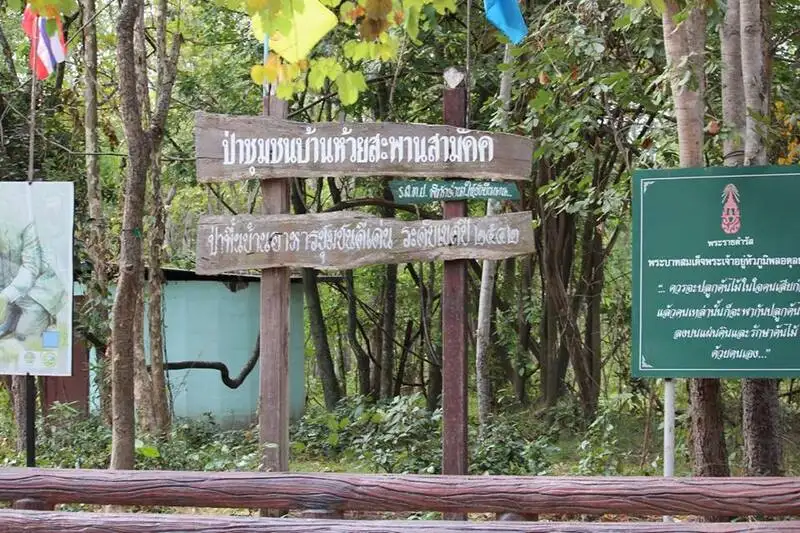
Huai Saphan Samakkhi Community Forest is a nature learning site within the Wat Huai Saphan School area in Nong Rong Subdistrict, Phanom Thuan District, Kanchanaburi Province. The forest is valuable for ecology, environmental science, and field-based learning for students and nature enthusiasts. This community forest is a mixed dry dipterocarp forest and mixed deciduous forest and is often described as a local “learning center” with a nature study trail. Knowledge gained from real places like this helps learners understand ecosystems as an integrated whole—from forest structure, plant diversity, wildlife, soil and water conditions, to the ongoing role of the community in conserving and restoring natural resources.
The key strength of Huai Saphan Samakkhi Community Forest is that it functions as an “outdoor classroom” reflecting the human–forest relationship in multiple dimensions: subsistence use, local wisdom, and community-based resource management. When learners walk the forest, observe differences between upper and lower canopy layers, examine leaves and bark, and read interpretive signs or listen to local knowledge holders, the concept of an “ecosystem” stops being only a definition in textbooks and becomes direct experience with clear cause-and-effect links—for example, why seasons and fire influence dry dipterocarp forests, why certain plant species indicate drought conditions, or why the forest can recover when pressure from encroachment is reduced and the community works together to maintain firebreaks.
From an academic perspective, dry dipterocarp forest is typically found on uplands or areas with low moisture, a long dry season, and fire as a natural or human-driven disturbance factor. As a result, many dominant tree species show adaptations such as thick bark, fire tolerance, strong resprouting ability, or deciduousness during the dry season to reduce water loss. In contrast, “mixed deciduous forest” generally has higher tree-species diversity and is often associated with relatively moister conditions or more heterogeneous microhabitats. The fact that this community forest is a mix of dry dipterocarp and mixed deciduous forest creates rich learning opportunities—from comparing tree species in drier and moister micro-sites to understanding forest recovery dynamics after disturbance.
Resource-related information often cited about this forest includes the presence of many timber tree species (for example, 30 families, 55 genera, and 69 species, as commonly used in local descriptions of plant diversity). From an educational standpoint, this can be extended into activities such as basic plant identification, using a dichotomous key, learning leaf/flower/fruit morphology, and keeping a nature journal to train observation and scientific communication skills. At upper-secondary or university levels, it can be developed into project-based work such as measuring species richness, estimating tree density using sample plots, or analyzing simple relationships between species composition and environmental factors.
The history of Huai Saphan Samakkhi Community Forest reflects clear social and environmental lessons. Historical accounts describe the area as once highly abundant, with large trees, diverse wildlife, and year-round flowing water in the local stream. During World War II, trees were cut for multiple uses such as railway sleepers, fuelwood, bridges, and military-related structures, and pressure on natural resources continued afterward. Later, agricultural expansion and mechanized clearing further degraded the forest and contributed to drought conditions, leading to water shortages for local households. These experiences helped the community recognize the forest’s importance and collectively take action, eventually advancing into forest restoration and community forest management. Information from the Royal Forest Department has also mentioned multi-village cooperation, the upgrading of the site into a learning center and study-visit area, and recognition through awards related to conservation and community forest management.
The forest’s former local name, “Pa Rang Na” (literally associated with “rang” forest), preserves a shared memory of the landscape and vegetation types linked to dry dipterocarp communities. Over time, the name “Huai Saphan Samakkhi Community Forest” came to communicate a clearer social meaning: collective effort in protecting a forest that provides food, medicinal plants, materials for daily use, and ecosystem services—especially water-related functions and landscape moisture. The new name is not merely a label, but a symbol of “shared resource management” built through long-term cooperation and learning.
Viewed through the framework of ecosystem services, a community forest does more than provide habitat for plants and animals. It stores carbon, slows storm runoff, reduces soil erosion, and supports biodiversity that underpins local food security. Community use of forest products—such as collecting mushrooms, edible shoots, neem, or other wild foods—illustrates “sustainable dependence” when community rules and stewardship ensure that the forest can continue producing resources over time. This is highly valuable for learners because it connects biology with community economics and environmental citizenship.
For primary-level students, learning in the community forest can focus on observation and inquiry—noticing differences in leaf shapes, identifying animal traces, observing fungi or insects, and practicing recording through drawings or short descriptions—while building forest etiquette such as keeping quiet, not taking living organisms home, not littering, and staying on designated paths. For secondary-level students, activities can become more scientific: studying food chains and food webs, reading basic environmental variables (temperature, humidity, light), simple experiments on leaf transpiration, or mapping trails using directions and distance estimation. At university level, learning can expand to functional diversity, forest succession, and appropriate fire management in dry dipterocarp forests—all aligned with local conditions where the dry season is pronounced.
Another important naturalist learning dimension is “traces and evidence” in real environments. Forests rarely provide answers through words, but through signals: bite marks on leaves indicating primary consumers, footprints showing how mammals use space, seed remains suggesting dispersal agents, and fungi indicating decomposer roles. Learners trained to read these signals develop “nature interpretation” skills central to natural history and can later extend this into evidence-based conservation thinking.
In terms of area management, Huai Saphan Samakkhi Community Forest is often described as a study-visit area with a learning center and a nature study trail, implying that supporting infrastructure for learning exists to some extent. Effective learning should connect “scientific knowledge” with “place-based knowledge”—for example, why the community creates firebreaks in certain seasons, why some rules apply during the dry season, or why harvesting forest products should avoid damaging regeneration sources. This helps learners understand that conservation is not only about intentions, but also about rules, monitoring, and coordination with relevant agencies.
The forest is located in Nong Rong Subdistrict, Phanom Thuan District, Kanchanaburi Province. Local descriptions note boundaries as follows: to the north it connects with the Nong Rong National Reserved Forest; to the south it borders Wat Huai Saphan; and to the east and west it borders villagers’ agricultural land. This setting makes the community forest a “buffer space” between a larger forest block and farmland, which is important for wildlife and landscape connectivity. Learners can use this context to explore edge effects, such as changes in light and wind near forest edges that favor certain plants or cause some animals to avoid particular zones.
Travel planning to Nong Rong Subdistrict and the Wat Huai Saphan area can be done by private car or public transport. In general, routes from Bangkok to Kanchanaburi commonly use Borommaratchachonnani Road or Phetkasem Road via Nakhon Pathom, then continue into Kanchanaburi Province, and onward toward Phanom Thuan District and Nong Rong Subdistrict. Morning visits are best for field learning because temperatures are lower and small wildlife is often more active than during intense midday heat. For educational trips, it is recommended to prepare a hat, drinking water, closed-toe shoes, insect repellent, and a nature journal, and to set basic safety rules such as staying together, not separating, and not handling unknown animals or plants.
Getting There If traveling by private car, set the destination to the Nong Rong Subdistrict area, Phanom Thuan District, and coordinate with Wat Huai Saphan School or local community networks to join learning activities as appropriate. For public transport, travel from Bangkok (Southern Bus Terminal) to Kanchanaburi, then connect onward to Phanom Thuan / Nong Rong by convenient local options. For groups, hiring a van or bus is recommended for smoother field activity logistics.
| Place Name | Huai Saphan Samakkhi Community Forest |
| Location | Nong Rong Subdistrict, Phanom Thuan District, Kanchanaburi Province |
| Address (Nearby Coordination Point) | Wat Huai Saphan School, 200/1 Moo 2, Nong Rong Subdistrict, Phanom Thuan District, Kanchanaburi 71140 |
| Coordinates (Approx.) | 14.105234, 99.654166 |
| Place Summary | A community forest and nature learning center (mixed dry dipterocarp and mixed deciduous forest) used for study visits and ecology field learning in Nong Rong Subdistrict |
| Key Highlights | 1) A community forest learning center with a nature study trail 2) Mixed dry dipterocarp and mixed deciduous forest suitable for learning about fire, seasons, and plant adaptations 3) A source of wild foods and medicinal plants for the community (the idea of a forest as the community’s “supermarket / refrigerator / pharmacy”) |
| Period / Key History | Accounts mention timber use and forest loss during World War II (1945) and expansion of agriculture / factories around 1972–1973, leading to later restoration and community forest management |
| Forest Type / Ecosystem | Mixed dry dipterocarp and mixed deciduous forest (a community forest embedded in an agricultural landscape, with partial linkage to reserved forest) |
| Boundaries (Overview) | North: Nong Rong National Reserved Forest South: Wat Huai Saphan East and West: Villagers’ farmland |
| Area (Agency Reference) | 2,094 rai 2 ngan 29 square wah (as stated in Royal Forest Department community forest records) and the figure 1,008 rai is also mentioned in some historical boundary contexts |
| Name Origin | Previously known locally as “Pa Rang Na”; later referred to as “Huai Saphan Samakkhi Community Forest” to reflect collective stewardship |
| Nearby Attractions (Approx. Distance) | 1) Wat Huai Saphan – 1 km 2) Chedi Yutthahatthi (Phanom Thuan) – 10 km 3) Phanom Thuan Town Area / Market – 12 km 4) Bo Phloi District (Bo Phloi Market Area) – 25 km 5) Kanchanaburi City (Bridge over the River Kwai area) – 45 km |
| Nearby Restaurants (Approx. Distance + Verified Tel.) | 1) BaanThuan Restaurant – 12 km, Tel. 034-579-460 2) Krua Tukkata – 14 km, Tel. 087-984-5560 3) Thung Na Pla Phao – 16 km, Tel. 089-902-1983 4) Nakhonluang Cafe – 8 km, Tel. 083-991-6642 5) U&ME Cafe’ Kanchanaburi – 18 km, Tel. 082-388-7711 |
| Nearby Accommodations (Approx. Distance + Verified Tel.) | 1) Mum Sabai Resort – 12 km, Tel. 095-669-0820 2) Lucky Duck Resort – 14 km, Tel. 085-442-4959 3) Naiya Place – 40 km, Tel. 062-545-9113 4) Felix River Kwai Resort – 45 km, Tel. 034-551-000 5) U Inchantree Kanchanaburi – 45 km, Tel. 034-521-584 |
| Facilities | Depends on activity format and access points (advance coordination via the school / community is recommended) |
| Fees | No standard fee information found (for group study visits, there may be community-based support arrangements depending on the activity) |
| Contact | Wat Huai Saphan School Tel. 034-540-923 Nong Rong Subdistrict Administrative Organization Tel. 034-510-855 |
Frequently Asked Questions (FAQ)
Q: What scientific learning is Huai Saphan Samakkhi Community Forest suitable for?
A: It is suitable for learning about mixed dry dipterocarp and mixed deciduous forest ecosystems, plant adaptations to drought and fire, biodiversity, and the community’s role in shared resource management.
Q: Why are dry dipterocarp forests often associated with fire and seasons?
A: Because these forests occur in areas with a pronounced dry season and low moisture, fire can be a common disturbance factor, and many plants have traits that help them tolerate fire or recover after fire.
Q: What does the site’s history tell us about conservation today?
A: The history shows that timber extraction and agricultural expansion degraded the forest and contributed to drought and water shortages. When the community recognized these impacts and worked together on restoration, the forest could return as a source of food, medicinal plants, and a learning site.
Q: How should students prepare for a field learning activity here?
A: Prepare drinking water, a hat, closed-toe shoes, insect repellent, and a notebook/pencil, and follow basic safety rules such as staying on the trail, not separating from the group, and not handling unknown animals or plants.
Q: Who should we contact to arrange a group study visit?
A: It is recommended to coordinate through Wat Huai Saphan School or local agencies in Nong Rong Subdistrict to tailor the activity to group size and learning objectives.
Q: What key learning points should visitors observe in the community forest?
A: Observe canopy layers and forest structure, traces of animals and insects, the role of fungi as decomposers, differences between edge and interior vegetation, and evidence of management such as firebreaks or restoration plots.
 Tel: 024355012
 Huai Saphan Samakkhi Community Forest Map
 Category:
  Group:
  Last Update: 2 MonthAgo
Comment
 Nearby Attractions
| Keyword (Advance) |
 Region
|
 Muang Kanchanaburi(