
 Home
Home North(
 Chiang Mai(


Rating: 3.2/5 (5 votes)
 |
|  Map
Map 
 Have Map
  No Map
Kanchanaburi attractions
Attractions in Thailand
Open Days: Daily
Opening Hours: 08:00 – 18:00
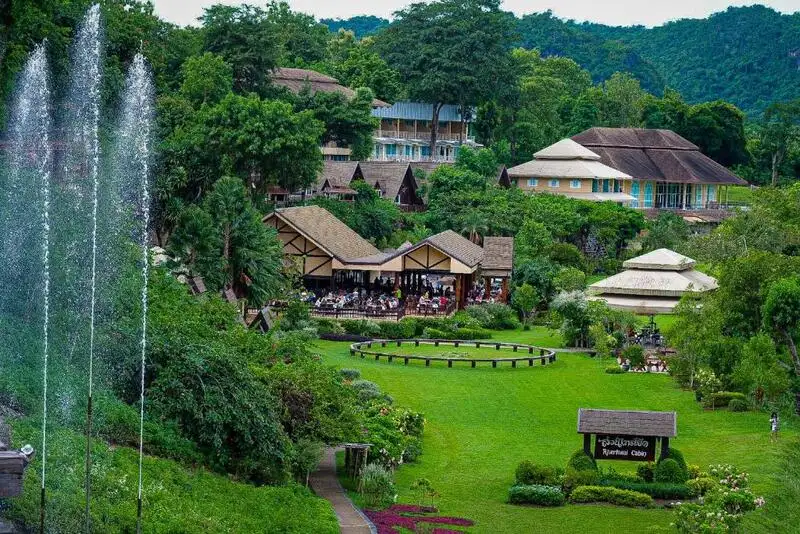
Suan Sai Yok in Sai Yok District, Kanchanaburi, is a place where you can enjoy nature and a powerful sense of history in the same setting. The resort sits close to the Khwae Noi River and looks out toward the historic railway line widely known as the “Death Railway,” with its iconic section of track hugging a rocky cliff and the timber-log bridge area around Tham Krasae—one of Kanchanaburi’s most recognizable images. What makes a visit special is not only watching the river flow or breathing in the mountain air, but also standing within the very landscape where history truly unfolded. When a train, weighing hundreds of tons, slowly advances along the steel rails above the log structure and cliffside framework, many visitors instinctively pause to watch until it disappears from view—both in awe and with a quiet, reflective feeling about the stories hidden behind the beauty of the place.
If you want the simplest way to decide whether it’s worth going, this is ideal for travelers who want an up-close “train view–river view,” love the cool, refreshing riverside atmosphere, and want time to sit still and watch layered mountain ridges in the distance without having to pack the day with nonstop activities. You can enjoy the river’s bends from several angles within the same area because Suan Sai Yok is arranged so you can stroll along the bank, with resting spots designed for catching the breeze, listening to the water, and taking in passing trains at intervals—especially when the train runs through the Tham Krasae section, a highlight of this historic route.
The charm people talk about most is its “closeness.” Whether you’re a photographer, a family traveler, or someone who simply likes to slow down, being at eye level with both the water and the railway creates a different kind of experience from typical viewpoints. It isn’t just a still landscape; the passing train adds movement and rhythm to the scenery. If you’ve seen photos of a train running along a cliff in Kanchanaburi on travel posts, there’s a strong chance the image came from this same area. And once you see it in person, it becomes clear why people are willing to drive far just for a few minutes of watching the train inch along above the log structure and the river curve below.
In terms of the landscape, Suan Sai Yok stretches along the winding Khwae Noi River. Parts of the riverside are set up as a broad grassy lawn suitable for light activities with friends or family—sitting, chatting, and simple leisure time that doesn’t require much equipment. There is also a section of shallow “pebble beach” that can be suitable for careful wading and play for adults and children. The advantage of a pebble beach is that, in many areas, the water does not drop off sharply, making it easier for parents to supervise children than in places with steep banks. Even so, safety should always come first: choose times when the current is gentle and avoid playing in the river after heavy rain, because water levels and flow speed can change quickly in mountainous river basins.
When people mention the “history” of this area, what gives it particular significance is its connection to the historic railway built during World War II. The former Thailand–Burma Railway was constructed as a wartime supply route through extremely challenging terrain and left behind stories, enduring images, and tangible traces along many points of the line. The Tham Krasae section, where the track runs along a cliff above the river, stands out both for its engineering and for the sense of height and drama it creates for modern visitors. Even decades later, watching the train move through this stretch still conveys the difficulty of the landscape and invites reflection on the lives of many people whose stories were intertwined with the construction of this route in that era.
From a practical travel perspective, a visit to “Suan Sai Yok” can be designed in several ways. If you only have half a day, you might focus on sitting by the river, taking photos, and waiting for the train to pass for the trip’s signature moment, then continuing to nearby spots such as Tham Krasae or the Death Railway viewpoint area. If you have a full day or plan to stay overnight, you can soak up the riverside atmosphere without rushing and choose activities that match your pace—for example, enjoying a riverside café where you can hear the water close by, or planning time to watch trains in both directions from different angles to capture different light, especially in the morning or late afternoon when the light is softer and the green of the mountains looks more dimensional.
Photography lovers often prefer the moment the train first appears from the curve, because that is when the “train–log bridge–cliff–river” elements align neatly in a single frame. The challenge is waiting for all the timing to come together—and always prioritizing safety. Do not stand too close to the track, avoid climbing or stepping into restricted areas, and be mindful of rules and signage. If you are traveling as a family, it helps to set clear boundaries for where children can move around, because children are naturally drawn both to the water and to watching the train, and adults should supervise closely so the trip stays fun and low-risk.
Another highlight is the character of the Khwae Noi River itself. This river acts like a lifeline for the Sai Yok landscape, keeping the surrounding area relatively lush for much of the year, especially after rainfall or in the early cool season when temperatures drop slightly. Sitting by the bank without doing very much can feel genuinely relaxing. This is why many people choose Sai Yok as a place to “reset”—because it offers a real break from city noise and constant speed. Simply listening to the flowing water and looking toward distant hills can ease fatigue in a very direct way.
For travelers who want more variety, Suan Sai Yok sits in an area that connects conveniently to several key attractions around Sai Yok. You can plan a “railway route” day by starting with sites tied to the Death Railway and Tham Krasae, then moving on to natural attractions such as waterfalls or other viewpoints in the Sai Yok area. If you are traveling with children and want animal-focused or learning-style activities, you can also add nearby activity-based stops depending on time and weather. A major advantage of this location is that you can combine nature and historical learning within distances that are not overly long to drive.
For preparation, it helps to think of a Sai Yok trip as something that changes by season. In the rainy season, the landscape turns intensely green and the air feels fresh, but humidity is higher and showers can come and go. If you plan to enjoy the riverside views or photograph the train, bring a rain jacket or an easy-to-use umbrella and choose footwear with good grip. From the cool season into the early hot season, the atmosphere is clearer with bluer skies—great for photography and long, unhurried riverside time—but bring drinking water and sun protection because midday sun can still be strong even in forested mountain areas.
One thing people often overlook is “travel time.” Sai Yok roads include curves and pass through smaller communities, so it is best to allow extra time and avoid rushing—especially if you want to arrive in time for a train passage when many visitors may be waiting for photos. Leaving a buffer helps you avoid speeding and keeps the trip calm from the start. On long holidays, it is also wise to expect possible congestion when entering Kanchanaburi town or at major junctions, then enjoy a slower pace once you reach the Sai Yok area.
Getting There If you want an experience that matches the atmosphere of the area most closely, traveling by train is a compelling option because the railway route itself is part of the appeal. Riding the train through mountain-and-river scenery, then getting off at a nearby station and continuing on foot or by local transport, helps you “enter the story” of Sai Yok from the journey itself. If you need maximum flexibility, especially when traveling with children or older adults, a private car is more convenient because you can stop at multiple sites in one day and carry more belongings. Driving is often best for overnight trips or for itineraries that aim to cover several Sai Yok attractions without being tied to the train timetable.
Once you arrive, try to give the place time without turning it into a checklist, because Suan Sai Yok’s strength is its slower rhythm. You can begin by walking along the riverbank to find a “personal viewpoint” you like most. Some people prefer a corner where the bridge and track are most visible, others prefer a wide river-and-mountain panorama, and some simply want the spot where the sound of flowing water is clearest. Finding your own spot matters because when the train passes, you can stay in a good position for composition without crowding. On busy days, choosing a spot early helps you get both your photos and your peace.
If you want a complete experience, a simple three-part rhythm works well: first, explore and find your spot; second, truly rest without spending too much time on your phone; and third, wait for the train passage with intention. Doing this helps you avoid the feeling that you must “arrive and immediately shoot.” Instead, you let the beauty of the setting work on your mood gradually—which is exactly what makes nature travel satisfying, and it fits Sai Yok especially well.
In the end, if you are looking for a Kanchanaburi destination where you can get nature, river scenery, and a train view in a single frame, Suan Sai Yok is one of the strongest choices in the Sai Yok area. You do not need to chase many separate viewpoints to assemble the full experience. The key elements are right here at close range, and it is easy to extend your trip to nearby attractions, making it suitable both for travelers with limited time and for those who want to spend a full day moving slowly with the river.
| Place Name | Suan Sai Yok (Suansaiyok Resort) |
| Address | 79 Moo 2, Lum Sum, Sai Yok District, Kanchanaburi 71150 |
| Setting / Area | Along the Khwae Noi River, near Tham Krasae and the Death Railway alignment |
| Place Summary | A riverside resort and relaxation spot known for close-up views of the historic railway and the Khwae Noi River—ideal for resting, photography, and continuing a Sai Yok itinerary |
| Key Highlights | Cliffside/log-structure railway views near Tham Krasae + Khwae Noi riverside atmosphere + multiple photo and relaxation corners |
| Historical Context | Located within the Thailand–Burma Railway (the “Death Railway”) context, constructed during World War II and now a major historical landscape of Kanchanaburi |
| On-Site Evidence | The Death Railway alignment and the Tham Krasae area, including the cliff-hugging track above the Khwae Noi River |
| Open Days | Daily |
| Opening Hours | 08:00 – 18:00 |
| Current Status | Open |
| Contact | 02-967-8181, 02-967-8182, 02-967-8183, 02-967-8184 |
| Travel | Train: Ride the Kanchanaburi route toward Sai Yok and continue by local transport/walking as suitable | Private Car: Drive into Sai Yok District via main routes, then park and walk within the area |
| Facilities | Parking, riverside seating/viewpoints, on-site restaurant/café areas (service hours may vary by outlet) |
| Fees | Please verify pricing based on service type/package at the point of service |
| Nearby Attractions (Approx. Distance) | 1) Tham Krasae – 1.2 km 2) Death Railway Section – 1.5 km 3) Sai Yok Elephant Camp – 3.0 km 4) Santitham Vanaram Hermitage – 5.6 km 5) Elephant Haven Thailand – 20.0 km |
| Popular Restaurants Nearby (Approx. Distance + Phone) | 1) Chom Saphan Restaurant (On-site/near the bridge viewpoint) – 0 km – 02-967-8181 2) The Bridge Bistro Cafe – 0 km – 094-128-7426 3) Baan Rim Khwae Floating Restaurant – 1.2 km – 034-561-052 4) Je Tia Somtam & Grilled Chicken (Tham Krasae Area) – 1.0 km – 082-334-4104 5) Wang Pho Restaurant Garden – 3.8 km – 087-152-4654 |
| Popular Accommodations Nearby (Approx. Distance + Phone) | 1) Khwae Noi River Park Resort – 1.9 km – 034-595-258 2) Pingplalee Resort – 2.0 km – 034-595-214, 098-262-2252 3) Yoko River Kwai Resort – 2.2 km – 034-513-021 4) Sai Yok Riverhouse Resort – 2.6 km – 034-591-050 5) Tree Tara Resort – 2.8 km – 034-591-038, 098-826-5353 |
Frequently Asked Questions (FAQ)
Q: How close is Suan Sai Yok to the Death Railway train-view area?
A: It sits in the same general zone as the Tham Krasae area and the Death Railway alignment, making it convenient to enjoy close-up train-and-river scenery and continue on to key nearby spots.
Q: What is the best time to photograph the train and the river views?
A: Morning and late afternoon usually provide softer light and better depth in the mountains and water. When waiting for the train, allow time and stay in safe, non-obstructive positions.
Q: Is it suitable to bring children to play by the shallow pebble riverbank?
A: Yes, during calm-flow periods and with close adult supervision. Avoid river play after heavy rain and choose shallow areas with clear visibility of the riverbed.
Q: Is traveling by train a convenient option for visiting this area?
A: It can be convenient and memorable because the railway route itself is a major highlight of Kanchanaburi. For flexible multi-stop itineraries and heavier luggage, a private car is usually easier.
Q: If I only have half a day, how should I plan the visit?
A: Focus on relaxing by the river and timing your wait for the train passage as the main highlight, then add a short stop at Tham Krasae or nearby Death Railway viewpoints before heading back or continuing to another site.
 Suan Sai Yok Map
 Category:
  Group:
  Last Update: 2 MonthAgo
Comment
 Nearby Attractions
| Keyword (Advance) |
 Facebook Fanpage
 Region
 Art, Culture and Heritage
 Historical Sites and Monuments(
 Landmarks and Memorials(
 Art, Craft Centres, Tradition(
 Museums(
 Art Gallery(
 University
 Places of Worship
 Temple(
 Church(
 Other religious and spiritural sites(
 Research and Development
 Royal Project(
 Suburban Living
 Village, Community(
 Local Market(
 Nature and Wildlife
 National Parks and Marine Reserves(
 Mountain (Doi)(
 Dam, Reservoir, Lake(
 Waterfalls(
 Hot Springs(
 Caves(
 River, Canal(
 Other natural attractions(
 Zoos and Aquariums(
 Animal camps and shows(
 Cinema(
 Outdoor and Adventure Activities(
 Travel Articles, Recipes
 Travel Review, Food Review(