
 Home
Home North(
 Chiang Mai(


Rating: 4/5 (5 votes)
 |
|  Map
Map 
 Have Map
  No Map
Kanchanaburi attractions
Attractions in Thailand
Open Days: Daily
Opening Hours: 08:00 – 16:00
Erawan Waterfall is widely considered one of the most worthwhile waterfalls in Kanchanaburi for both Thai and international travelers, because you are not coming for just one photo spot. Instead, you get a full 7-tier experience along a single route, from easy-to-reach lower pools with clear water to higher tiers where the atmosphere becomes quieter and more forest-like. It is ideal if you want a trip that combines safe swimming areas, relaxed nature time, and a manageable hike in one place. If you are looking for emerald- and turquoise-toned pools at certain levels, an easy journey from Kanchanaburi town, and the flexibility to do a day trip or stay overnight around Srinakarin Dam, this is a destination that rarely disappoints—especially on days when you want to step away from the city and immerse yourself in the sound of water and the calm of the forest.
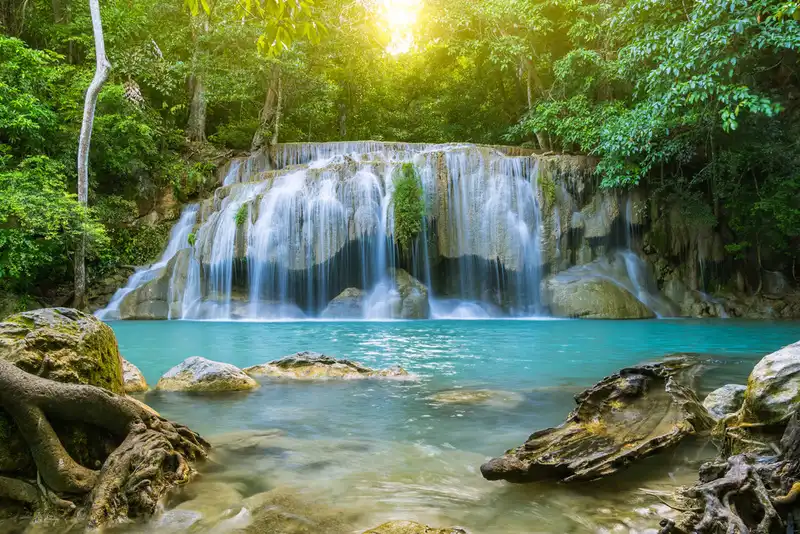
The signature charm of Erawan Waterfall comes from its limestone setting. In many pools, the water appears blue or emerald-green when sunlight hits at the right angle, creating a natural “swimming-pool” look that feels almost unreal. Walking beside the stream and seeing the clear water reflect those tones makes it immediately understandable why this place is one of Kanchanaburi’s most famous natural landmarks. Combined with the fact that it is a 7-tier waterfall, you can choose a light itinerary focused on the lower levels or plan to hike all the way to the uppermost tier within the same visit. The experience is not simply arriving, taking photos, and leaving; it is about shaping the pace of the trip to match your energy and the kind of day you want.
Erawan Waterfall is located inside Erawan National Park in Tha Kradan Subdistrict, Si Sawat District, Kanchanaburi. The waterfall area is close to the park headquarters, and the main trail distance from the lowest tier to the highest tier is approximately 1,500 meters. If you plan to visit all 7 tiers and return, it typically takes around 3 hours or more depending on how often you stop to rest, swim, take photos, and the crowd level on the day. This distance is a sweet spot: not so short that it ends too quickly, and not so demanding that it feels like a full trekking expedition. That balance makes it easy to enjoy the route at a natural pace—walking slowly, pausing often, and taking in the surroundings as you go.
Before you begin the walk, it helps to know a little background about the name and origins of the area, because it adds context to the visit. In the past, locals referred to this place as “Sadoong Mong Lai Waterfall,” linked to the Mong Lai stream that serves as a key water source in the area. Over time, the name “Erawan” became widely used and created a clear identity for the park as a destination defined by a 7-tier waterfall. Understanding this history encourages you to see the site not only as a tourist stop, but also as a natural landscape that local communities recognized and named long before it became a nationally famous attraction.
From a practical traveler’s perspective, “getting the most value” starts with deciding your goal for the day. Erawan Waterfall can be enjoyed in two clearly different styles. The first is a relaxed visit focusing on the lower to mid tiers, with time for swimming, photos, and unhurried breaks. This is well suited for families, visitors with young children, and anyone who wants a restful nature day rather than a workout. The second style is hiking to cover all 7 tiers, which requires more time and energy management—especially if you want to rest and swim along the way and still reach the top. Choosing your style early helps you avoid the feeling of “why is it still not there yet?” or “this is more exhausting than expected,” because your pace and rest breaks will match the plan you set from the start.
If you want great photos without taking unnecessary risks or pushing beyond your limits, one effective approach is to set a “satisfaction point” in advance. For example, you might decide that reaching a popular mid-level area for swimming and photos is enough, and only continue higher if you still feel strong. This keeps the trip enjoyable and reduces pressure. Even if you do not reach the very top on every visit, you can still finish the day without feeling rushed, without having to sprint back, and without ending the trip exhausted. This matters a lot on up-and-down waterfall trails, because the fun disappears quickly if you are racing the clock to exit before closing time.
Erawan’s character also changes noticeably by season. In the dry season, the water level is often lower (commonly mentioned around December to April), which can create a calmer atmosphere with clearer pools and easier walking conditions. When water levels are higher, the scenery feels more powerful: the sound of water is stronger, spray and mist are more present, and the trail can be damp. The key point is that “the most beautiful time” does not have a single universal answer. Some visitors prefer the clarity and calm of drier periods, while others love the lush, green forest look and energetic flow when water is abundant. In every season, however, safety remains the constant priority, because damp rock and shaded paths can be far more slippery than they appear.
One topic that many articles mention only briefly—yet matters greatly in real life—is how small preparations can completely change the comfort of your trip. The best footwear is non-slip shoes or secure strap sandals with solid grip, because the trail and rocks near the water stay humid. Thin flip-flops or smooth soles increase the risk of slipping significantly. Another practical item is a waterproof pouch for your phone or camera, since spray can quickly leave water spots on lenses. If you like photography, a small microfiber cloth for lens cleaning is surprisingly helpful, especially at tiers with heavier mist.
Erawan National Park also offers two designated nature study trails that add depth for travelers who want more than the waterfall itself. One is the Mong Lai dry evergreen forest trail, approximately 1,010 meters long, which follows the Mong Lai stream and starts at the campsite bridge before reconnecting with the main route near Tier 3. The other is the “Million-Year Stone Mountain” trail, approximately 1,940 meters long, starting from the parking area and reconnecting near the route to Tier 4. These trails suit visitors who enjoy forest walking, quiet natural soundscapes, and a “forest + stream” viewpoint that feels different from the classic waterfall photo spots. Along certain sections, you can observe plant life and the park’s landscape more closely than you would while focusing only on the main waterfall route.
In terms of visitor experience, many people feel impressed early on because the lower tiers are easy to access and have inviting pools for resting. However, one of Erawan’s best features is that the higher you walk, the more the atmosphere shifts from lively to calm. You begin to hear fewer voices and more of the stream and forest. This is why arriving early is often recommended: the air is cooler and more comfortable, and you have a better chance of enjoying the mid and upper tiers before they become crowded. If you plan to go higher, it is often best to start walking soon after entry and save relaxed swimming time for the lower tiers on the way back down.
For those who plan to swim, the most important points are choosing appropriate areas and being cautious on slippery rock surfaces, especially where water constantly runs and algae can form. Leaning against wet rock or climbing high boulders for a dramatic photo may look impressive, but it carries real risk. Always prioritize warning signs and staff guidance, since water conditions and slippery surfaces can change quickly with rain and visitor volume. Some sources also note that life jackets may be required in certain swimming areas, so if you intend to swim seriously, be prepared for potential rules and equipment rental requirements to avoid disruption once you arrive.
If you enjoy photography, Erawan Waterfall offers a variety of compositions in one trip: wide shots that frame limestone tiers and forest, close-ups of clear pools with turquoise reflections, portraits using water surfaces as foreground texture, and lifestyle moments that tell the story of the hike itself. A simple technique is to shoot in softer light, such as morning or late afternoon. If the popular spots are crowded, consider shifting from “must-get iconic angles” to “storytelling angles,” such as wet shoes on the path, hands on railings, mist on leaves, or reflections on still pools. These details often look more distinctive than standard tourist photos and can make your content feel more original.
Driving is the most flexible way to reach Erawan Waterfall. From Kanchanaburi town, you can head toward Si Sawat District, following the Kanchanaburi – Si Sawat route, passing the Srinakarin Dam gate area and Erawan Subdistrict Municipality, then continuing into the park along clearly marked signs. The advantage of driving is that you can shape a fuller day trip by adding nearby stops along the way, such as dam viewpoints, local restaurants, or cafes around Tha Kradan. This is especially valuable for groups or families because it makes the travel time feel more rewarding rather than simply a transfer from point A to point B.
If you do not have a private vehicle, traveling by public transport is possible in principle, but you should plan carefully. Connections and schedules can vary by season and real demand. The safest approach is to arrive at the park in the morning so you have enough time to hike, rest, and still leave with a comfortable buffer for the return trip. It also helps to have a backup plan—such as contacting accommodation in the area or getting local advice on transport options—to avoid the situation of “arriving successfully but struggling to get back” in the late afternoon or evening, especially if you need to return to Kanchanaburi town on the same day.
For the most relaxed and rewarding experience, a 2-day, 1-night plan can work exceptionally well. Stay around Tha Kradan or the Srinakarin Dam area, then begin the waterfall walk early the next morning. The benefits are clear: cooler air, lighter crowds, and a smoother pace. You can choose to hike higher first and swim in the lower tiers on the way down, or keep it simple by spending more time at the lower tiers and walking upward without pressure. Overnight stays also let you experience the lakeside and raft-style accommodation atmosphere around Si Sawat, which many visitors find just as memorable as the waterfall itself.
Finally, if you want your Erawan trip to end smoothly and safely, three habits matter most: start early so you always have time buffers, carry light essentials such as water so you do not need to walk back to the car repeatedly, and respect nature by not leaving trash, not making excessive noise, and avoiding risky behavior near the water. Beautiful natural places last longest when visitors help protect them. When you do these things, the trip delivers not only great photos, but also genuine refreshment—the kind that feels like a mental reset. That is why Erawan Waterfall continues to be searched and recommended repeatedly as one of Thailand’s must-visit waterfalls.
| Place Summary | A 7-tier waterfall inside Erawan National Park, known for clear turquoise/emerald pools at certain levels. Suitable for both relaxed visits and full hikes to all tiers. A complete up-and-down walk typically takes around 3 hours. |
| Location | Erawan National Park, Moo 4, Tha Kradan Subdistrict, Si Sawat District, Kanchanaburi 71250 |
| Key Highlights | 7-tier waterfall, turquoise/emerald pools from limestone geology, swimming in suitable areas, 2 nature study trails, ideal for day trips or overnight stays around Tha Kradan – Srinakarin Dam |
| Best Time To Visit | Weekday mornings (lighter crowds) / cooler months with comfortable hiking weather and clear pools (generally late year to early year) / high-flow periods for stronger waterfall views (check safety conditions first) |
| History / Name Origin | Locals originally called it “Sadoong Mong Lai Waterfall,” linked to the Mong Lai stream. The name “Erawan” later became widely used, establishing the park’s identity around its iconic 7-tier waterfall. |
| Getting There | Private car: Drive from Kanchanaburi town toward Si Sawat and follow park signage / Public transport: Possible, but plan return schedules and transfers carefully / Start early for enough hiking time and a stress-free exit |
| Entrance Fees | Thai: Adult 100 THB / Child 50 THB; Foreigners: Adult 300 THB / Child 200 THB (fees may change by official announcement) |
| Facilities | Parking area, restrooms, visitor service point, waterfall trail, park lodging/camping area (subject to availability), welfare shop/restaurant (by service schedule) |
| Current Status | Generally open to visitors (check official announcements before travel, especially during heavy rain or special situations) |
| Contact Number | 034-574222 |
| Nearby Attractions (With Distance) | 1) Phra That Cave (Inside Erawan National Park) – 12 km 2) Srinakarin Dam Viewpoint – 50 km 3) Tha Kradan Pier Area (Lake Trips) – 45 km 4) Huai Mae Khamin Waterfall – 65 km 5) Bridge Over the River Kwai (Kanchanaburi Town) – 70 km |
| Nearby Restaurants (With Distance + Phone) | 1) Erawan Coffee – 2 km – 084-6313102 2) Krua Khao Din (Si Sawat) – 40 km – 065-8939599 3) Khwae Yai Restaurant – 45 km – 089-5504422 4) Rayaburi Resort Restaurant – 45 km – 034-696165 5) Z9 Resort Restaurant – 55 km – 061-3604959 |
| Nearby Accommodations (With Distance + Phone) | 1) The Hub Erawan Resort – 3 km – 084-5994591 2) RaftDara Erawan – 8 km – 097-1343224 3) Rayaburi Resort – 45 km – 034-696165 4) Z9 Resort Kanchanaburi – 55 km – 061-3604959 5) Lake Heaven Resort – 55 km – 061-4182270 |
Frequently Asked Questions (FAQ)
Q: Can you swim at Erawan Waterfall?
A: Yes, swimming is allowed at multiple tiers with suitable pools, but you should choose safe areas, watch for slippery rocks, and follow staff guidance and park rules—especially during high water flow or after rain.
Q: How long does it take to visit all 7 tiers?
A: A full up-and-down visit to all 7 tiers typically takes around 3 hours or more, depending on how often you rest, swim, take photos, and the number of visitors. Starting early makes the walk more comfortable.
Q: Which tier of Erawan Waterfall is the most beautiful?
A: It depends on your travel style. Lower tiers are easier and family-friendly, while mid to upper tiers feel quieter and offer different photo perspectives. If your time is limited, aim for a comfortable mid-tier goal first, then decide whether to continue higher.
Q: Which months are best for visiting Erawan Waterfall?
A: Generally, late-year to early-year periods offer cooler weather and comfortable hiking. High-flow periods can look especially dramatic with greener forest scenery, but you should check weather conditions and safety announcements before traveling.
Q: Can you visit without a private car?
A: Yes, but you should plan transport schedules and transfers carefully because timing can vary by season. The safest approach is to arrive early, keep a time buffer for the return trip, and have a backup plan.
Q: What should you prepare before going?
A: Non-slip shoes or secure strap sandals, a waterproof pouch for valuables, a towel, and drinking water. If you plan to swim, follow park rules and staff guidance for safety.
 Erawan Waterfall Map
 Category:
  Group:
  Last Update: 2 MonthAgo
Comment

Photo Gellery(15) 
 Thank you photo(3) from: Ohm